
Last updated: September 22, 2026
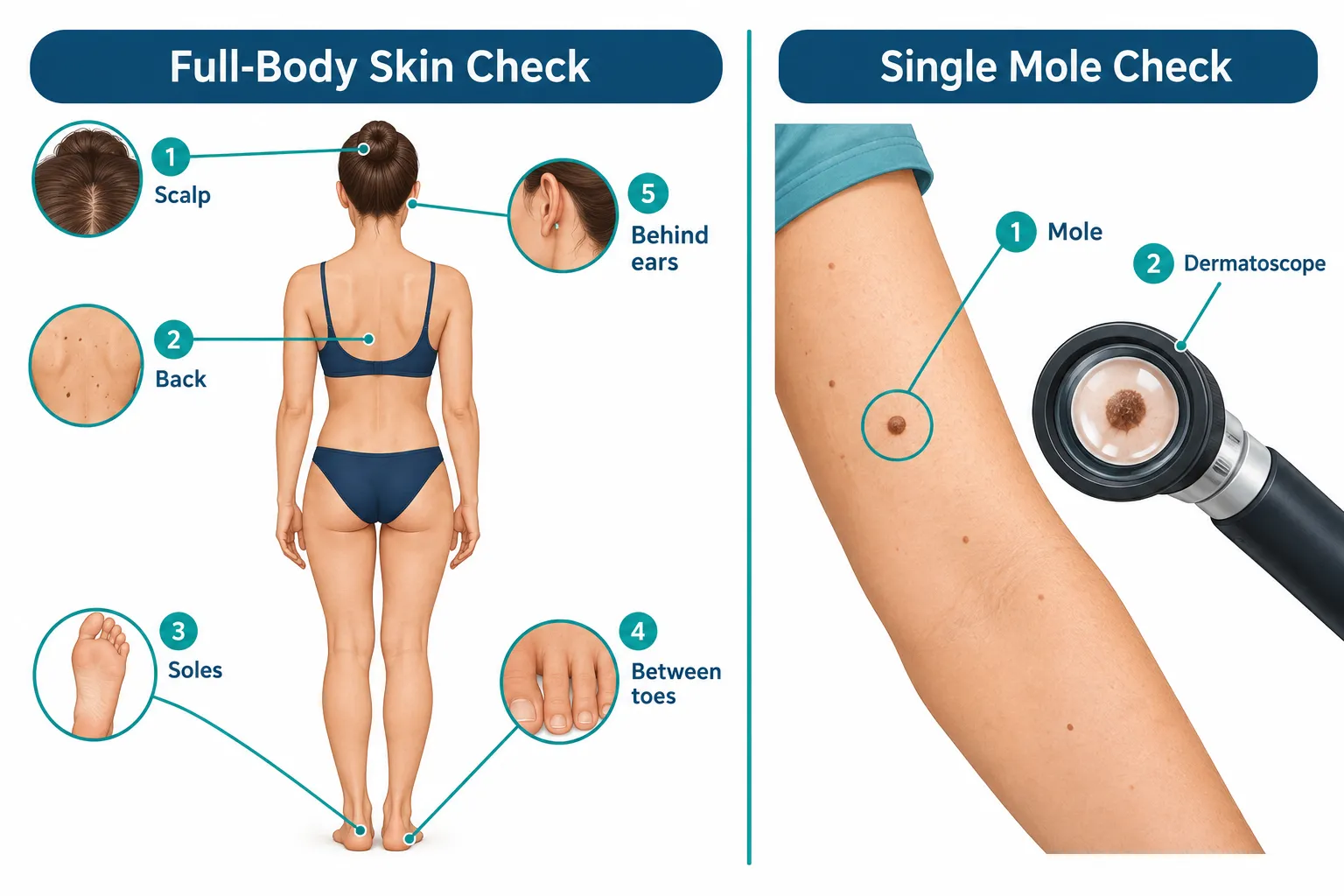
A full-body skin check is a head-to-toe visual exam of every skin surface, including the scalp, ears, between the toes, and other spots people rarely inspect themselves. Checking one mole is a faster, problem-focused visit that examines only the specific spot that worries someone. Full-body exams find more total skin cancers because they catch lesions in places patients never think to look, while single-mole checks are quicker and appropriate when only one specific area has changed.[6][4]
A full-body skin check is a systematic, head-to-toe visual exam of the entire skin surface performed by a trained clinician, while checking one mole is a narrower, problem-focused look at a single spot the patient has already noticed. The difference is not just time spent, it is coverage: one method scans everywhere, the other scans one location.
Dermatology literature describes full-body skin examination (FSE) as the mainstay of clinical detection for melanoma and non-melanoma skin cancers, even though large randomized trials proving a mortality benefit are still lacking.[4][14] A thorough FSE routinely covers the scalp, and can extend to breast, anogenital, and oral mucosal sites when clinical judgment or patient concern warrants it.[4] Checking one mole, by contrast, involves inspecting and often using a dermatoscope on just the lesion a patient is worried about, without necessarily reviewing the rest of the body.
Choose a full-body skin check if there is no single obvious spot of concern, if a patient has many moles, or if it has been years since the last comprehensive exam. Choose a single-mole visit if one specific lesion has changed recently and time or cost is a genuine constraint. A common mistake is assuming that clearing one mole means the rest of the skin is fine; a lesion-directed visit says nothing about a spot on the back that nobody has looked at in years.
For readers weighing which approach fits their situation, a full body skin check in Toronto covers the entire skin surface in one visit, while a mole check in Toronto can be scheduled specifically for a single lesion of concern.
How often someone needs screening depends heavily on personal risk factors, not on a fixed calendar rule for everyone. Higher-risk adults generally need annual full-body exams, while lower-risk individuals with one stable spot may only need to monitor that spot at home and mention it at a routine visit.
A data-driven risk framework recommends that adults aged 35 to 75 with at least one risk factor receive at least an annual total-body skin examination rather than relying only on checking individual moles.[2] Risk factors named in that framework include:
Separately, private dermatology guidance in the United Kingdom recommends a baseline full-body exam for all adults over 40, then repeat exams every two to three years, with more frequent visits for those at higher risk.[5]
Decision rule: if a patient falls into any risk category above, schedule an annual full-body exam rather than monitoring a single mole alone. If risk is low and only one spot looks slightly unusual, home monitoring plus a scheduled check-in with a clinician is often reasonable, but any new change, bleeding, or rapid growth should prompt an immediate visit regardless of the general schedule.
A dermatologist can often assess whether one specific mole shows signs of skin cancer using visual inspection and dermoscopy, but checking only that mole cannot rule out cancer elsewhere on the body. The exam is accurate for the lesion in front of the clinician, not for skin that was never examined.
During a single-mole assessment, a clinician typically applies the ABCDE criteria (asymmetry, border irregularity, color variation, diameter, and evolving change) along with dermoscopic pattern analysis to that one lesion, then decides whether to watch it, biopsy it, or refer it urgently.[10] This process is genuinely useful and can catch dangerous lesions. Data from a study comparing screening approaches found that lesion-directed screening (checking one specific spot) identified skin cancers at a rate of 3.2 percent, based on 8 cancers found among 248 patients, a rate similar to total-body screening for the same targeted lesion.[6]
The limitation is scope, not accuracy. A dermatologist examining one mole is not simultaneously checking the scalp, back, or soles, so an unrelated cancer in another location would go undetected during that visit. A useful example: a patient books an appointment for a changing mole on the forearm. The dermatologist correctly clears that mole, but a melanoma developing on the scalp, never mentioned or shown, is missed simply because it was outside the scope of that visit.
Dermatologists recommend full-body skin checks because most skin cancers are found on areas patients did not think to check, and a spot check by definition only covers the area a patient already flagged. Comprehensive exams catch more total cancers because they look everywhere, not just where the patient is worried.
In a study comparing screening methods, dermatologist-performed total-body examination detected a higher absolute number of skin cancers than lesion-directed screening.[6] The authors noted that lesion-directed screening was about 5.6 times less time-consuming, but concluded that total-body exams maximize the number of cancers found overall, while lesion-directed screening remains an acceptable option in health systems with limited budgets or long waiting lists.[6]
Global incidence of skin cancer is reported as increasing, which reinforces the case for comprehensive clinical detection rather than relying only on patient-selected spots.[14] Skin cancers frequently appear on the scalp, back, backs of legs, and other areas patients rarely inspect in a mirror, which is exactly why a systematic exam finds lesions a self-directed spot check would miss.
Common mistake: assuming that because no mole "feels wrong," nothing needs checking. Many early melanomas are not painful or itchy, so physical sensation is an unreliable guide. This is one reason clinics offering dermoscopy skin checks in Toronto pair magnified lesion analysis with a broader visual review rather than dermoscopy alone.
A full-body skin check generally costs more than checking a single mole because it takes longer and covers far more surface area, though exact pricing varies by clinic, region, and whether imaging or mapping is included. Single-lesion assessments are priced lower because they are faster and narrower in scope.
Private-sector pricing from a London-based service in 2026 illustrates the general pattern: a single suspicious lesion assessed with dermatoscopy starts around £395, a comprehensive head-to-toe skin examination starts around £595, and full-body mole mapping with photographic baselines starts around £695.[5] These figures are specific to one provider and one market, but the relative pattern, single-lesion checks costing less than comprehensive exams, and comprehensive exams costing less than exams paired with baseline photographic mapping, tends to hold across many dermatology practices.
Decision rule: if only one lesion is a concern and budget is tight, a single-mole assessment is a reasonable and lower-cost starting point. If there is no referral needed and cost of delay is the bigger risk (many moles, strong risk factors, or years since the last check), a full-body exam is usually worth the extra cost because it can catch problems a single-lesion visit would never find. Patients exploring options without a physician referral first can review a mole check without a referral in Toronto to understand what direct-access screening typically involves.
During a full-body skin check, expect a health history review, a gowned head-to-toe visual inspection, dermoscopy of any suspicious spots, and a discussion of findings and next steps. The process is systematic rather than a quick glance.
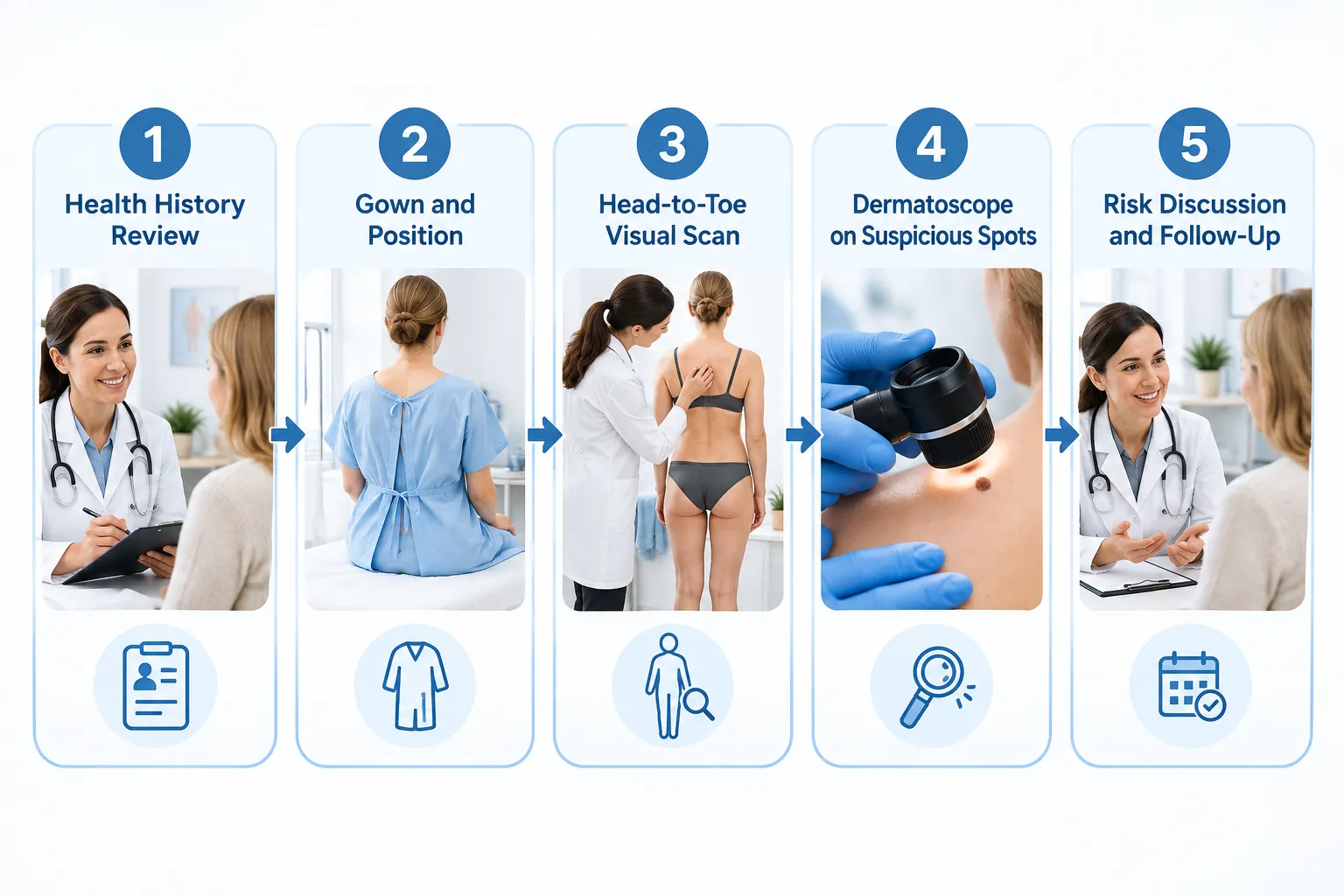
A typical clinician-led exam generally follows this sequence:
Common mistake to avoid: wearing makeup, nail polish, or self-tanner to the appointment, since these can obscure subtle color changes a clinician needs to see clearly. Patients wanting a preview of what a visit involves can review what a mole check in York Mills involves for a step-by-step walkthrough.
See a dermatologist about one specific mole when it has changed shape, color, size, or texture, or has started bleeding, itching, or crusting. Book a full-body check instead when there is no single alarming spot but general risk factors, such as many moles or a family history of melanoma, make broader screening worthwhile.
The ABCDE warning signs remain the standard reference point for a single-mole concern: asymmetry, irregular border, color variation, diameter greater than roughly 6 millimeters, and evolving change over time.[13] If a mole meets one or more of these criteria, that alone justifies a prompt, focused visit rather than waiting for a scheduled full-body exam.
Full-body checks make more sense as a proactive step rather than a reaction to one lesion. Risk-based guidance suggests adults 35 to 75 with at least one risk factor (fair skin, many moles, atypical moles, personal or family cancer history, or significant sun exposure) should have at least annual total-body exams as routine preventive care, not only in response to a specific worry.[2]
Example: someone with fewer than 10 moles and no personal or family history notices one new dark spot on the forearm. A focused single-mole visit is appropriate. Someone with more than 50 moles, a parent who had melanoma, and no exam in three years should book a full-body check even without one obvious problem spot, because the risk profile alone justifies comprehensive screening. Concerns about a specific changing lesion can be addressed through a suspicious mole assessment in Toronto.
Both approaches are normal and medically accepted, and the right choice depends on circumstances rather than one being universally correct. Checking moles one at a time is common for a specific new concern, while checking all moles at once (a full-body exam) is the standard approach for periodic preventive screening.
Health systems and private clinics offer both formats deliberately. Lesion-directed screening (one mole at a time) was found to have a detection rate similar to comprehensive screening for the specific lesion evaluated, while being roughly 5.6 times faster, which makes it a practical option where time or resources are limited.[6] Total-body screening, checking everything at once, remains the format that finds the highest absolute number of skin cancers because it is not limited to a pre-selected spot.[6]
Edge case: a patient with dozens of moles who tries to have each one checked individually across multiple separate visits ends up spending more time and money than a single comprehensive exam would have taken, and risks gaps between visits where a new spot could develop unnoticed. In that situation, consolidating into one full-body appointment, sometimes with mole mapping to track changes over time, is generally more efficient and thorough than a series of one-off checks.
During a full-body skin check, dermatologists look for new or changing lesions across areas patients rarely see themselves, including the scalp, back, backs of the legs, between the toes, and behind the ears. A single-mole visit cannot detect problems in these regions because they are never examined during that appointment.
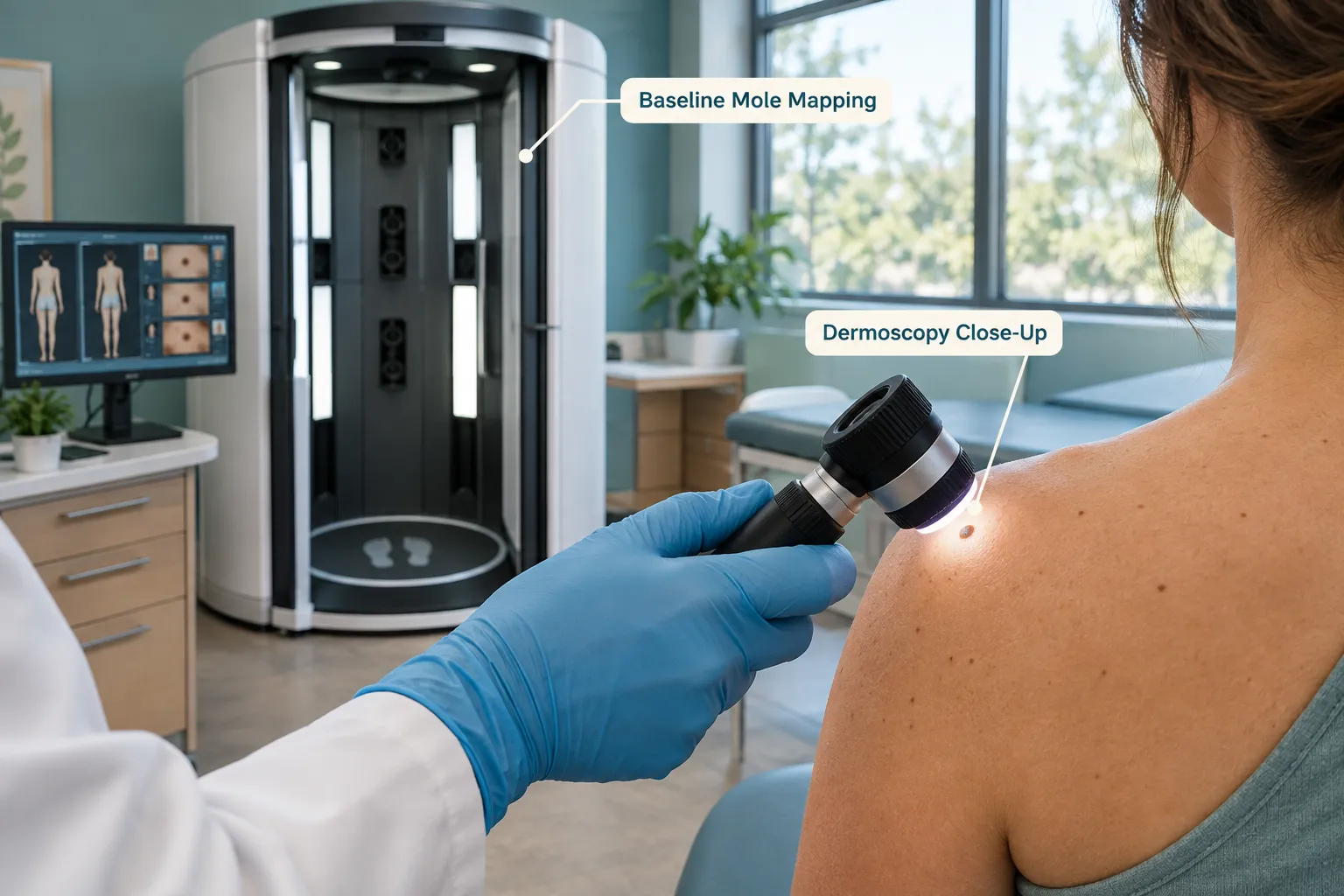
Recent clinical reviews describe how a thorough full-body exam routinely covers the scalp, with breast, anogenital, and oral mucosal sites examined when guided by patient concern, individual risk, and clinical discretion.[4] These are areas a patient focused on one forearm mole would never think to mention. Newer technology reinforces this comprehensive approach: since January 2026, VECTRA 3D full-body photography has been used at University Hospital Zurich as part of extended skin-cancer screening for patients at increased melanoma risk, creating baseline full-body photographs and detailed mole mapping so dermatologists can track changes across the entire skin surface over time.[1]
A relevant edge case: a patient's spouse notices an unusual mole on the patient's upper back, an area the patient cannot see without help. Without a full-body exam or a second set of eyes, that lesion could go unnoticed for years. This is precisely the blind spot a full-body check is designed to close. Readers wanting a broader look at what these exams screen for can review skin cancer screening options in Toronto.
Self-checks at home are a valuable habit for noticing changes early, but they do not replace a professional full-body skin check, since people cannot fully examine their own scalp, back, or other hard-to-see areas without help. Both should be part of a complete skin-health routine.
The American Academy of Dermatology recommends a structured self-exam: check the body front and back in a full-length mirror, then each side with arms raised, and examine the scalp, hands, nails, soles, and between the toes using hand mirrors as needed.[13] This routine, paired with the ABCDE warning signs, helps people notice new or changing lesions between professional visits.[13]
Community screening data show the value of professional exams layered on top of self-checks: the American Academy of Dermatology reports that since its free skin-cancer screening program began in 1985, dermatologists have performed more than 2.9 million free checks and detected over 293,000 suspicious lesions, including more than 33,700 suspected melanomas, as of a 2026 update.[11] These are opportunistic community checks rather than randomized screening, but the volume of findings shows that professional eyes catch things self-checks alone often miss.[11]
Decision rule: do monthly self-checks as a baseline habit, and book a professional full-body exam at the frequency appropriate to personal risk (annually for higher-risk individuals, every two to three years for average-risk adults over 40).[2][5] For those who want a technology-assisted middle ground, reviewing the best mole check apps in 2026 can help track changes between clinic visits, though apps are a supplement to, not a replacement for, a clinician's exam.
A screening is a proactive, preventive full-body exam performed even when no specific problem has been identified, while checking one suspicious mole is a reactive, problem-focused visit prompted by a specific concern. The distinction is about intent and timing, not just physical coverage.
The U.S. Preventive Services Task Force's 2023 final recommendation, still current in 2026, concludes that evidence is insufficient to assess the balance of benefits and harms of visual whole-body skin examination for screening adolescents and adults who have no signs or symptoms of skin cancer, resulting in an "I" (insufficient evidence) grade.[3][15] This grade does not mean screening is discouraged; a 2026 synthesis of U.S. guidance clarifies that the "I" grade signals that a net mortality benefit from universal routine screening has not yet been proven, not that screening is prohibited.[10] The Task Force instead emphasizes individualized decisions based on risk factors, clinical judgment, and patient preference.[3][15]
Checking one suspicious mole sits outside this population-screening debate entirely, since it is triggered by a specific finding rather than performed as preventive policy. A patient with a changing mole does not need to weigh screening guidelines; the visible change itself is the reason for the visit. Evidence reviews note that early detection, particularly for melanoma, remains key to improving prognosis, even while population-wide screening evidence is still developing.[14]
A full-body skin check typically takes longer than a single-mole visit because it involves a systematic inspection of the entire skin surface rather than one spot. Exact appointment length varies by clinic and by how many lesions require closer dermoscopic evaluation.
Comparative data give a useful reference point: a study found that lesion-directed screening (checking one mole) was about 5.6 times less time-consuming than total-body examination, which quantifies just how much more time a comprehensive exam requires relative to a focused check.[6] While that study did not report exact minute counts for either format, the ratio makes clear that patients should plan for a noticeably longer appointment when booking a full-body exam versus a quick single-lesion review.
Practical example: a patient booking a single-mole check might expect a short, focused appointment centered on one area. A patient booking a full-body exam, particularly one that includes dermoscopy on multiple lesions or baseline photographic mapping, should plan for a considerably longer visit, since the clinician is methodically working through the scalp, torso, limbs, hands, feet, and other regions in sequence.[10][8] Anyone deciding between formats and comparing time commitment against thoroughness can look at what a skin lesion assessment in Toronto typically involves for a focused visit, versus the fuller scope of a comprehensive exam.
Yes, even with only one worrying mole, a full-body skin check is often still worthwhile, because the visit accomplishes two goals at once: it evaluates the specific lesion of concern and it checks the rest of the body for anything the patient has not noticed. A single-mole visit only accomplishes the first goal.
There is no clinical downside to having the full body reviewed while a specific mole is being assessed, and doing so can catch a second, unrelated lesion in the same appointment rather than requiring a separate visit later. This is particularly relevant given that many skin cancers develop in areas patients cannot easily see themselves, such as the back, scalp, or backs of the legs.[4][13]
Decision rule: if attending an appointment specifically about one mole, ask whether a full-body exam can be added during the same visit, especially if it has been more than a year or two since the last comprehensive check, or if any risk factors apply (fair skin, many moles, family history of melanoma, or significant past sun exposure).[2] The added time and cost are usually modest compared to the value of catching an unrelated lesion early. Patients located across the Greater Toronto Area can find full-body screening paired with focused mole evaluation through clinics such as those serving Mississauga, Oakville, and Brampton.
The table below summarizes the practical trade-offs between a full-body skin check and checking one mole, based on the criteria most patients weigh when deciding which approach fits their situation.
FactorFull-Body Skin CheckChecking One MoleCoverageEntire skin surface, scalp to soles[10]Only the specific lesion of concern[10]Cancers detectedHigher absolute number found[6]Similar detection rate for the targeted lesion[6]Time requiredLonger, systematic exam[6]About 5.6 times faster[6]Best forPreventive screening, higher-risk patients, periodic review[2][5]A specific new or changing spot[13]Typical frequencyAnnually for higher-risk adults; every 2-3 years for average-risk adults over 40[2][5]As needed, whenever a lesion changesIncludesHistory, gowned exam, dermoscopy, risk stratification, follow-up plan[10]Dermoscopy and ABCDE assessment of one lesion[10]
"Total-body examination detected a higher absolute number of skin cancers than lesion-directed screening, while lesion-directed screening was about 5.6 times less time-consuming."[6]
A few recurring mistakes affect how patients approach skin checks, and recognizing them helps avoid unnecessary delays in diagnosis.
Anyone unsure which lesion type they are dealing with can also review differences between benign growths and cancer indicators, such as in a guide on dermatofibroma vs skin cancer.
Is a full-body skin check painful?
No. A full-body skin check is a visual and dermoscopic exam with no cutting or needles unless a suspicious lesion requires a biopsy, which is a separate step discussed with the patient beforehand.[10]
Do I need a referral for a full-body skin check?
Requirements vary by clinic and region. Some practices, including direct-access options, allow booking without a physician referral.[10]
Will insurance or provincial health coverage pay for a full-body skin check?
Coverage depends on the healthcare system, provider, and whether the visit is preventive or triggered by a specific medical concern; patients should confirm coverage details directly with their provider or insurer before booking.
Can a mobile app replace a professional mole check?
No. Apps can help track changes between visits, but they are a supplement to, not a substitute for, a clinician's exam and dermoscopy.[13]
How many moles is considered high risk?
Having more than 40 moles, or more than two atypical moles, is listed as a risk factor supporting more frequent professional screening.[2]
What happens if a dermatologist finds a suspicious lesion during a full-body check?
The clinician typically decides whether to monitor it, biopsy it, or refer it urgently, based on dermoscopic findings and risk stratification.[10]
Is checking one mole ever enough, or should everyone get a full-body exam?
Checking one mole is enough when that is the only concern and general risk factors are low; a full-body exam is preferable for anyone with elevated risk factors or without a recent comprehensive check.[2][6]
How often should someone with no risk factors get screened?
Adults over 40 with average risk are commonly advised to get a baseline full-body exam, then repeat every two to three years, with self-checks in between.[5][13]
Full-body skin checks and single-mole checks serve different, complementary purposes. A single-mole visit answers one question quickly: is this specific spot a problem? A full-body skin check answers a broader question: is anything on this entire body a problem, including areas the patient never thought to inspect? Evidence consistently shows that comprehensive exams find more total skin cancers, while lesion-directed checks remain fast and useful when only one lesion is in question and resources are limited.[6][4]
The practical next step depends on individual risk. Anyone with more than 40 moles, a personal or family history of skin cancer, very fair skin, or significant past sun or tanning bed exposure should schedule an annual full-body exam rather than relying on spot checks alone.[2] Adults over 40 with average risk should aim for a baseline full-body exam and a repeat every two to three years.[5] Anyone noticing a new or changing mole, regardless of risk category, should book a focused assessment promptly rather than waiting for a scheduled full-body visit.[13]
For those ready to act, the most efficient path is often a single comprehensive appointment: bring up the specific mole of concern, and ask the clinician to complete a full-body exam during the same visit. This combines the speed of a focused check with the thoroughness of a comprehensive screening, closing the gap that a single-mole visit alone would leave open.
[1] Vectra 3d Full Body Photography For Skin Cancer Screening - https://www.usz.ch/en/department/dermatology/service/vectra-3d-full-body-photography-for-skin-cancer-screening/
[2] Pmc5480135 - https://pmc.ncbi.nlm.nih.gov/articles/PMC5480135/
[3] Skin Cancer Screening - https://www.uspreventiveservicestaskforce.org/uspstf/recommendation/skin-cancer-screening
[4] Pmc12507240 - https://pmc.ncbi.nlm.nih.gov/articles/PMC12507240/
[5] Mole Check And Full Skin Cancer Screening London 2026 Doctor Led Dermatoscopic Examination At The Online Gp By The Wellness - https://www.theonlinegp.com/blog/mole-check-and-full-skin-cancer-screening-london-2026-doctor-led-dermatoscopic-examination-at-the-online-gp-by-the-wellness
[6] pubmed.ncbi.nlm.nih.gov - https://pubmed.ncbi.nlm.nih.gov/26466155/
[8] Full Body Skin Exam What To Expect - https://www.apexskin.com/2026/01/22/full-body-skin-exam-what-to-expect/
[10] Skin Cancer Screening Guidelines - https://nationaldermatologyauthority.com/skin-cancer-screening-guidelines/
[11] American Academy of Dermatology free screening program data (2026 update), cited via national screening guidelines synthesis - https://nationaldermatologyauthority.com/skin-cancer-screening-guidelines/
[13] American Academy of Dermatology self-exam guidance, cited via national screening guidelines synthesis - https://nationaldermatologyauthority.com/skin-cancer-screening-guidelines/
[14] Pmc12507240 - https://pmc.ncbi.nlm.nih.gov/articles/PMC12507240/
[15] Skin Cancer Screening - https://www.uspreventiveservicestaskforce.org/uspstf/recommendation/skin-cancer-screening