A full body skin check in Toronto is a head-to-toe visual exam of your skin, performed by a physician (typically a GP dermatologist) using a dermatoscope to look closely at moles and other spots. Most appointments run 20 to 45 minutes, cost between roughly $280 and $600 at private clinics, and many locations, including The Minor Surgery Center, do not require a referral[1]. If a suspicious lesion is found, the same visit often leads to a biopsy or a fast-tracked referral for removal.
Key Takeaways
A full body skin check is a systematic, head-to-toe visual and dermatoscope-assisted review of your skin done by a physician, not a plastic surgeon[1].
In Toronto, prices at private clinics range from about $280 for a basic scan to $600 for a comprehensive mapping session with same-visit treatment[5][8].
No referral is required at several Toronto clinics, including The Minor Surgery Center, though some dermatology practices still require one[1][14].
OHIP can cover a physician's visual skin exam when medically indicated, but add-on services like digital mole mapping or total body photography are usually extra, out-of-pocket fees[2][7].
A typical appointment lasts 20 to 45 minutes and includes a short health history, a gown-on visual exam, and dermoscopy of any spot that looks unusual[1].
Full body skin checks focus on cancer screening; mole removal is a separate, follow-up procedure done only if a lesion needs to come off[1].
Adults with average risk should aim for a skin check roughly once a year; those with more moles, fair skin, or a personal or family history of skin cancer may need checks every three to six months.
The exam itself is not painful. Dermoscopy involves light pressure from a handheld magnifier, and no cutting or injections happen during a standard screening.
What Is a Full Body Skin Check and Why Do You Need One
A full body skin check is a systematic examination of every visible surface of your skin, from your scalp to the soles of your feet, performed by a physician trained to spot early signs of skin cancer. The goal is simple: catch changes in moles, freckles, and other spots before they become dangerous.
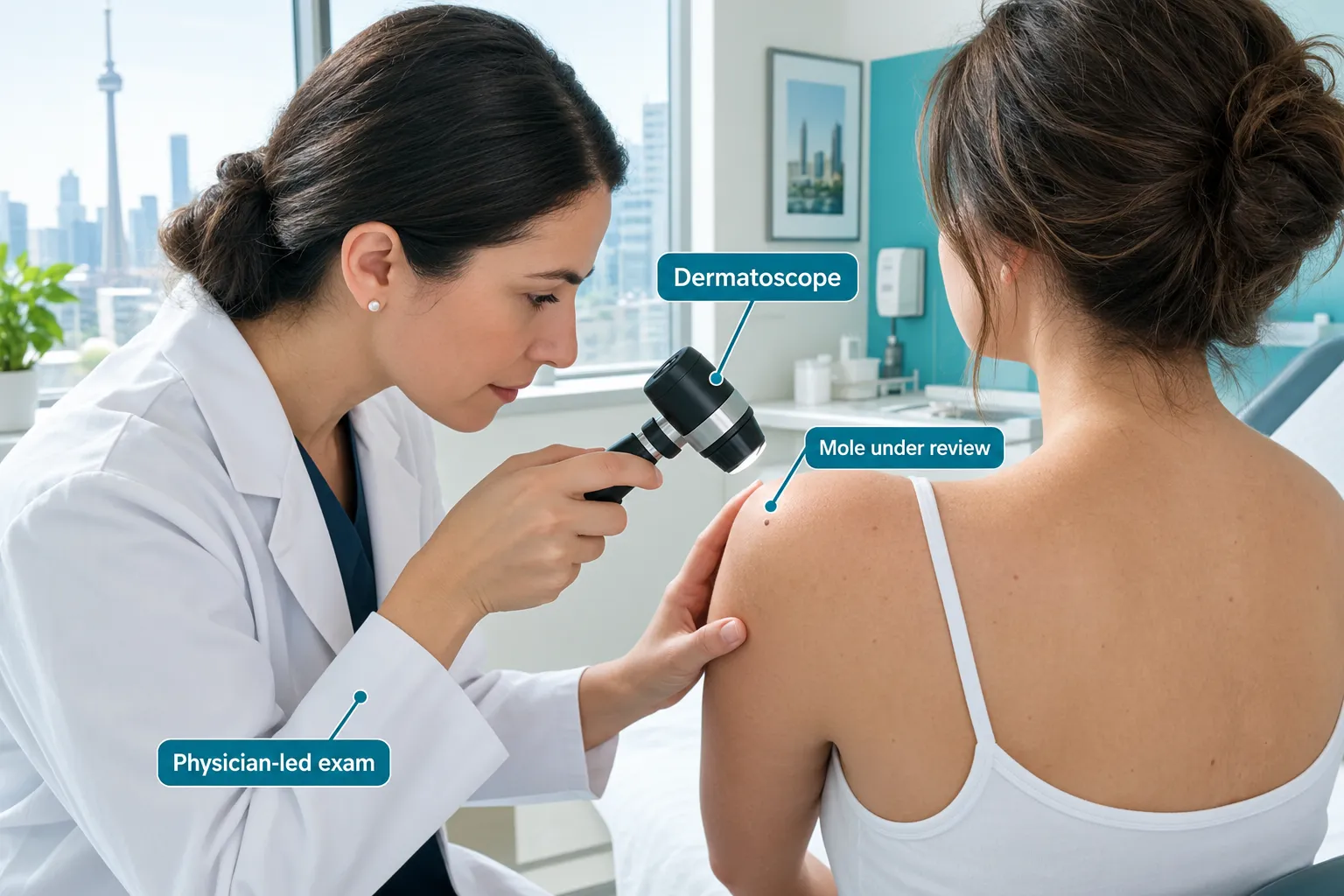
During the exam, the physician looks at the size, shape, color, and border of every mole and lesion, then uses a dermatoscope, a handheld magnifying tool with polarized light, to examine anything that looks irregular. This tool lets a trained eye see structures under the surface of the skin that are invisible to the naked eye, which is why a proper full body skin check in Toronto is done by a physician and not just a visual glance in a mirror.
You need one if:
You have never had a professional skin exam and are over age 30.
You have more than 50 moles, or moles that look different from one another.
You have a personal or family history of melanoma or other skin cancers.
You spent significant time outdoors, used tanning beds, or had sunburns as a child or teen.
You noticed a mole that is changing in size, color, shape, or is bleeding, itching, or crusting.
A full body skin check is a screening tool, not a diagnosis. If something looks concerning, the physician will recommend a biopsy or a specialist referral rather than making a final call on the spot.
Where Can You Get a Full Body Skin Check in Toronto
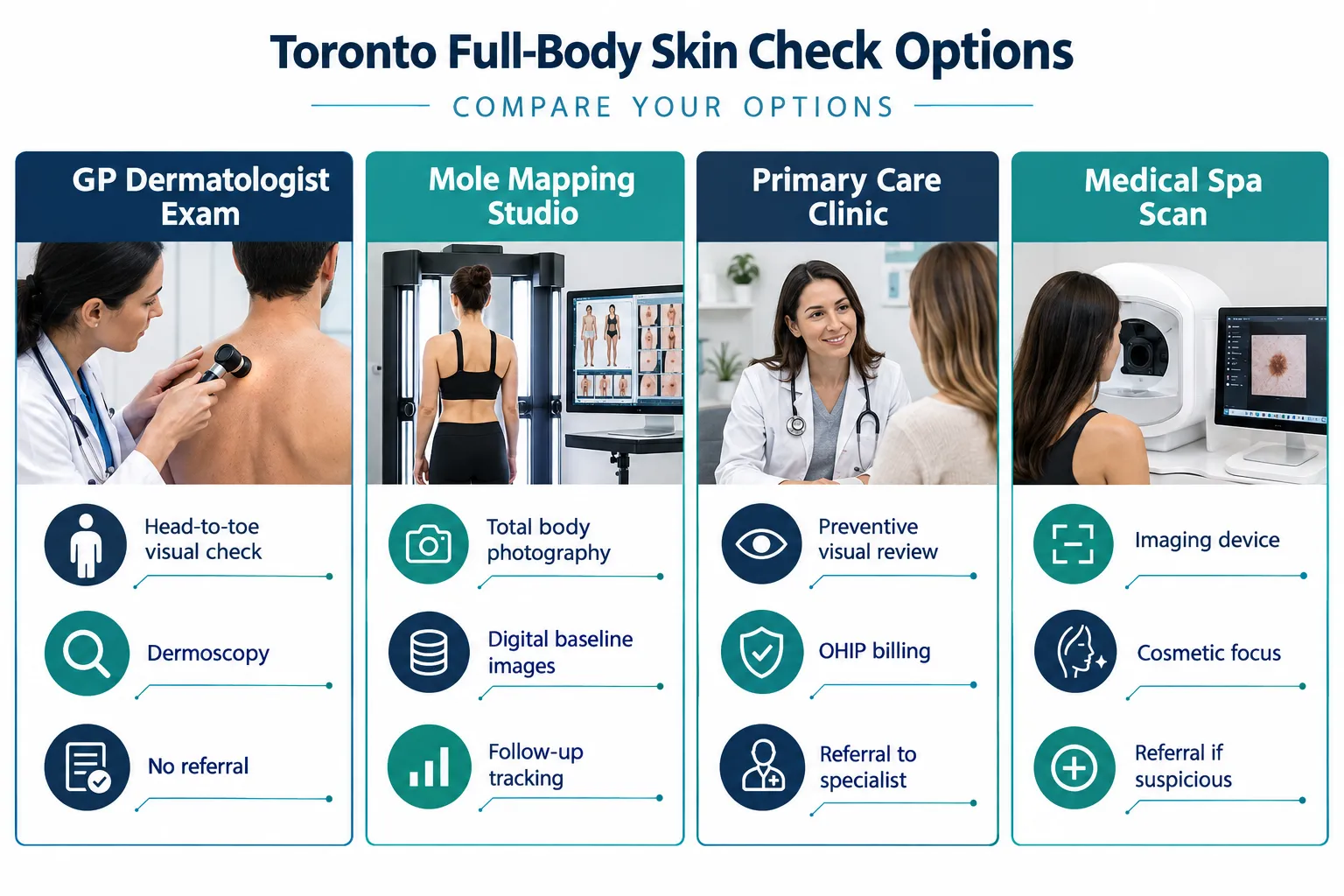
You can get a full body skin check in Toronto through minor surgery and skin clinics, dedicated mole-mapping studios, some primary care practices, and referral-based dermatology offices. The right choice depends on whether you want a quick screening, a detailed imaging record, or coverage through OHIP.
Here is a snapshot of what is currently available across the city:
Provider typeExampleWhat's includedReferral neededMinor surgery / skin clinicThe Minor Surgery CenterHead-to-toe exam, dermoscopy, same-visit biopsy option[1]NoMole mapping studioPalmerston Mole Scan ClinicAutomated total body photography (ATBM)[2]VariesPrivate dermatology (imaging-focused)Bay Charles Medical, YorkvillePhysician-led mapping and dermoscopy[7]NoRegional dermatology (full-service)Thornhill DermatologyFull-body FotoFinder imaging plus same-visit removal[8]NoLower-cost scan serviceDermscanSingle full body scan[5]NoPrimary care clinicCompass MedicalPreventive visual review by a physician[9]Usually not, if already a patientReferral-based specialistFacet DermatologyFull-body skin exam under OHIP-style referral pathway[14]Yes
Choose a no-referral minor surgery or skin clinic if you want to be seen quickly without waiting for a family doctor appointment. Choose a referral-based dermatology office if your GP has already flagged a specific concern and wants a specialist's formal opinion.
The Minor Surgery Center runs its full body skin exam through GP dermatologists, with locations across Toronto, Vaughan, Mississauga, and Oakville, and no referral required[1]. For a broader look at how Toronto clinics compare on scope and price, this roundup of the best skin cancer screening options in Toronto breaks down what "proper" modern screening should include[4].
How Much Does a Full Body Skin Check Cost in Toronto
Full body skin check costs in Toronto typically range from about $280 to $600 at private clinics, depending on whether the visit is a basic visual scan or a comprehensive imaging session with same-visit treatment. A standard physician visual exam without imaging tends to sit at the lower end of that range, while automated total-body photography and mole-mapping sessions cost more.
Current publicly listed pricing across Toronto and the surrounding region includes:
Dermscan: around $280 CAD for one full body scan, with optional skin tag or wart removal starting near $30[5].
Bay Charles Medical (Yorkville): $350 plus HST for physician-led mole mapping and dermoscopy[7].
Palmerston Mole Scan Clinic: $599 plus HST for a full body mole mapping session using automated total body imaging[2].
Thornhill Dermatology (Vaughan): a flat $600, all-inclusive, covering head-to-toe imaging, dermatologist review, dermoscopy, and same-visit removal if needed[8].
Prices vary because of what is bundled in. A basic visual check with a dermatoscope costs less than a session that also captures and stores high-resolution baseline images for future comparison. If you are being tracked for changing moles over time, the higher-cost mapping option may be worth it because it gives your physician a photographic record to compare year over year.
Common mistake: assuming the cheapest listed price includes everything. Some clinics quote a base scan fee and charge separately for biopsy, removal, or pathology if something suspicious is found. Ask what is included before booking. Aggregator sites like WhatClinic list several Toronto providers side by side, which can help with comparison shopping before you commit[6].
What Should You Expect During a Full Body Skin Check Appointment (And How Long Does It Take)
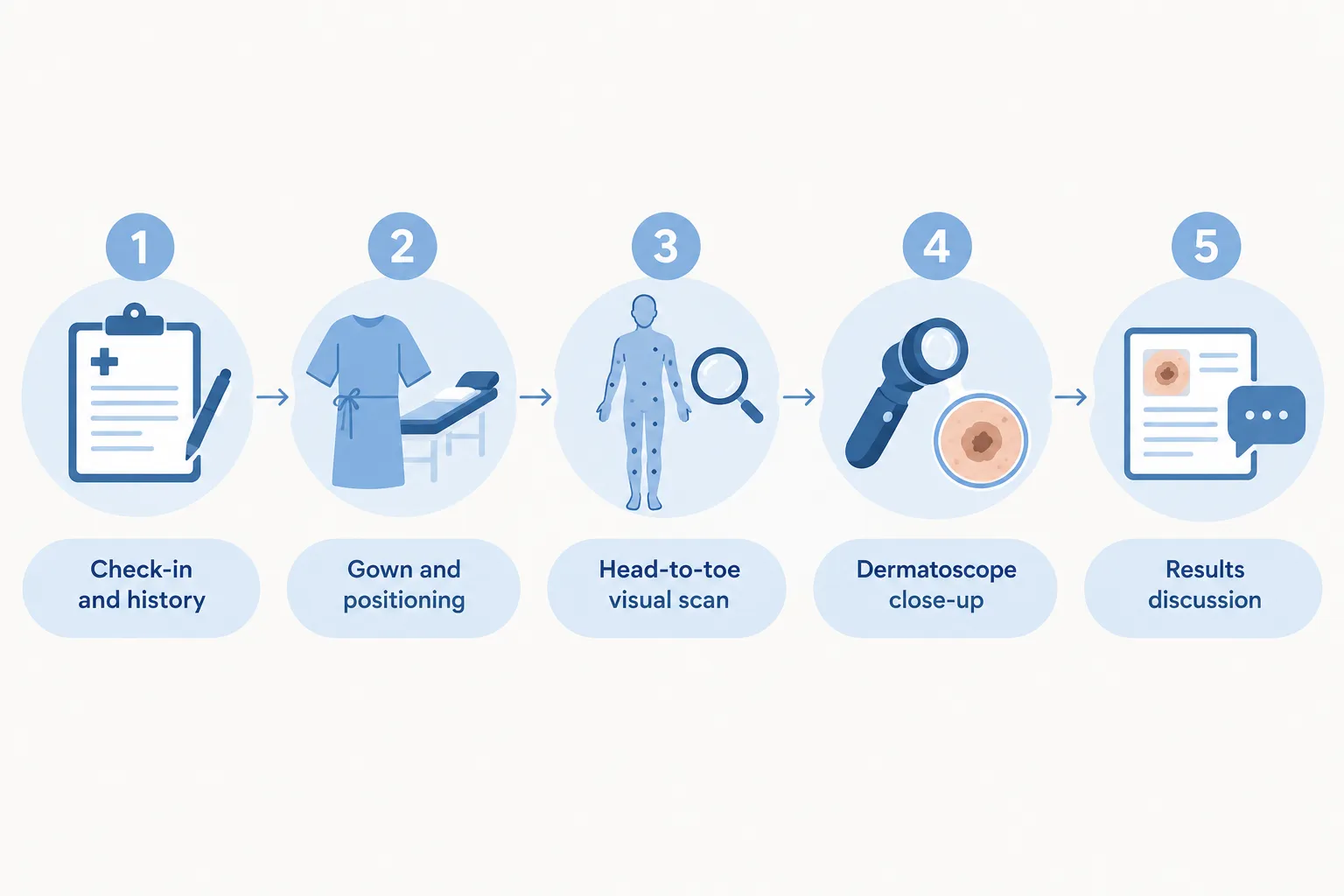
A full body skin check appointment usually takes 20 to 45 minutes and follows a predictable pattern: intake and history, a private exam in a gown, a systematic visual scan, dermoscopy of any flagged spots, and a short conversation about findings and next steps[1].
Here is what typically happens, step by step:
Check-in and history. You will fill out a short form covering sun exposure history, prior skin cancers, family history, and any specific spots you are worried about.
Gown and positioning. You change into a gown so the physician can examine skin that is normally covered, including your back, scalp, and areas rarely checked at home.
Head-to-toe visual scan. The physician moves systematically from scalp to soles, checking every mole, freckle, scar, and lesion for asymmetry, irregular borders, uneven color, and size changes.
Dermatoscope close-up. Any spot that looks even slightly unusual gets a closer look with a dermatoscope, which reveals pigment patterns beneath the surface.
Results discussion. The physician tells you what was found, whether anything needs a biopsy, and when your next check should be scheduled.
Edge case: if you have a large number of moles (over 100) or a complex history, the visit can run closer to 45 minutes because each atypical-looking mole needs individual dermoscopic review. Clinics offering automated total body photography, such as Palmerston Mole Scan Clinic, may add extra time for the imaging step itself[2].
Full Body Skin Check vs Dermatologist Visit: What's the Difference
A full body skin check is a broad screening exam covering your entire skin surface, while a dermatologist visit is often narrower and focused on a specific concern, a known condition, or ongoing treatment. Both can be done by the same type of physician, but the scope and purpose differ.
FeatureFull body skin checkFocused dermatologist visitScopeEntire skin surface, head to toeUsually one area or one complaintPurposePreventive screening for skin cancerDiagnosis or treatment of a specific issueTypical length20 to 45 minutes10 to 20 minutesWho performs itGP dermatologist or trained physicianDermatologist (may be a specialist)ReferralOften not required at minor surgery clinicsSometimes required, depending on the clinic
Choose a full body skin check if you have no specific complaint but want a baseline screening, or it has been over a year since your last full exam. Choose a focused dermatologist visit if you already have a diagnosed skin condition, a rash that needs treatment, or a mole your GP has already flagged for a specialist opinion.
A common mistake is booking a narrow dermatologist appointment expecting a full-body review, only to find the visit focuses solely on the one spot mentioned in the referral. If you want a comprehensive check, say so explicitly when booking, or choose a clinic that markets full body screening specifically, such as the skin cancer screening service in Toronto that combines a full exam with targeted mole assessment.
Do You Need a Referral for a Full Body Skin Check in Toronto
No, you do not always need a referral for a full body skin check in Toronto. Several minor surgery and skin clinics, including The Minor Surgery Center, accept self-referred patients directly, while some traditional dermatology practices still require a referral from a family doctor[1][14].
This split exists because of how clinics are structured:
No-referral clinics operate on a walk-in or direct-booking model and typically bill privately, on a fee-for-service basis, for the screening itself.
Referral-required clinics often work within a more traditional specialist pathway, where a family doctor's referral triggers an OHIP-billed assessment.
Thornhill Dermatology, for example, explicitly states no physician referral is required for its full body mole mapping service[8]. Facet Dermatology, by contrast, notes a referral is needed for its skin cancer screening and treatment services, reflecting an OHIP-funded specialist pathway[14].
Decision rule: choose a no-referral clinic if you want speed and are comfortable paying privately. Choose a referral-based OHIP pathway if you have a family doctor who can refer you and you are not in a hurry, since specialist wait times can run longer. If you are unsure who to see, this guide on finding a dermatologist in Toronto walks through both routes.
How Often Should You Get a Full Body Skin Check
Most adults with average risk should get a full body skin check about once a year. People with higher risk factors, such as many moles, fair skin that burns easily, a personal history of skin cancer, or a first-degree relative with melanoma, often need checks every three to six months.
Use this as a general guide:
Low risk (few moles, no personal or family history): every 12 to 24 months.
Moderate risk (fair skin, history of sunburns, moderate mole count): annually.
Higher risk (personal or family history of melanoma, more than 50 moles, atypical mole syndrome): every three to six months, often with photographic mole mapping to track subtle changes over time.
Common mistake: waiting until a mole visibly changes before booking a check. Skin cancer, especially melanoma, is far more treatable when caught early and small, before symptoms like bleeding or pain appear. If you notice a new or changing spot before your scheduled check, do not wait, book sooner. A suspicious mole assessment is designed exactly for that situation.
What Happens If They Find Something During a Skin Check
If a physician finds a suspicious lesion during a full body skin check, the next step is usually a biopsy, a short procedure where a small tissue sample is taken and sent for pathology testing. Depending on the clinic, this can happen the same day or at a quick follow-up visit.
The typical pathway after a concerning finding looks like this:
Dermoscopic review. The physician examines the spot more closely with the dermatoscope to assess how suspicious it looks.
Decision point. If the pattern looks clearly benign, the physician may simply note it for monitoring. If it looks atypical, a biopsy is recommended.
Biopsy. A small sample is removed under local anesthetic and sent to a lab for analysis. This is quick and typically done in the same clinic.
Pathology result. Results usually come back within one to two weeks.
Next steps. If benign, no further action is needed beyond routine monitoring. If cancerous or precancerous, a removal procedure or a specialist referral follows.
Some clinics, including Thornhill Dermatology, offer same-visit removal for lesions that clearly need to come off, which can shorten the overall timeline[8]. For a deeper look at how biopsy and testing work, see this guide to mole biopsy in Toronto.
Edge case: not every biopsy result is black and white. Some moles come back as "atypical" but not cancerous, in which case your physician may recommend closer monitoring or a wider excision to be safe, rather than immediate reassurance or immediate cancer treatment.
Best Dermatologists in Toronto for Skin Checks
The best providers for a full body skin check in Toronto are GP dermatologists and physicians trained specifically in dermoscopy and skin cancer screening, not plastic surgeons. Surgical specialists become relevant later, only if a lesion needs to be surgically removed.
This distinction matters more than most patients realize. A plastic or general surgeon is trained to excise a lesion cleanly and manage scarring, but a GP dermatologist is trained to interpret the visual and dermoscopic patterns that indicate whether a lesion is worth worrying about in the first place. The screening step and the surgical step are two different skill sets.
When evaluating a provider for a skin check, look for:
Dermoscopy training and equipment, not just a visual exam with the naked eye.
A clear, systematic head-to-toe process, rather than a quick look at just one or two spots.
A defined pathway for biopsy or referral if something suspicious turns up, so you are not left wondering what happens next.
Transparent pricing before you book, since screening fees vary widely across the city.
The Minor Surgery Center structures its model around this exact division: GP dermatologists handle the full-body screening and dermoscopy, while surgical concerns, such as removing a confirmed lesion, are handled separately by the surgical team. For a broader comparison of dermatologists across the city, this directory of the best dermatologists in Toronto is a useful starting point, and the best mole check clinics in Toronto list highlights rapid-access, no-referral options specifically.
Can a Full Body Skin Check Be Covered by OHIP in Toronto
Yes, a full body skin check can be covered by OHIP in Toronto when it is performed by an OHIP-billing physician for a medically indicated reason, but many private-clinic add-ons, such as digital mole mapping or total body photography, are not covered and are billed as separate fees.
Here is how coverage generally breaks down:
OHIP-covered: A visual skin exam by a family doctor or OHIP-billing dermatologist when there is a medical reason, such as a specific complaint about a changing mole.
Not typically covered: Digital total body photography, automated mole mapping systems, and cosmetic-adjacent scans offered at private clinics, even when a physician performs them.
Gray area: Some clinics blend a covered visual exam with an uncovered imaging add-on in the same visit, so it is worth asking upfront which parts of the fee are billed to OHIP and which are private.
Compass Medical, for instance, frames its screening as a preventive visual review by a physician within a primary care setting, a model more likely to align with standard OHIP billing for a covered visit[9]. By contrast, dedicated mole-mapping studios that charge a flat private fee, like Palmerston Mole Scan Clinic at $599 plus HST, are generally private, out-of-pocket services regardless of who performs the exam[2].
Decision rule: if cost is your primary concern, ask your family doctor for a referral to an OHIP-billed dermatology assessment first. If speed and comprehensive imaging matter more, a private clinic visit, though it comes with a fee, often gets you seen faster with a documented image record.
What's the Difference Between a Skin Check and a Mole Removal
A skin check is a screening exam to assess whether a mole or lesion looks concerning, while a mole removal is a separate procedure to physically take the mole off, done only after the screening step identifies a reason to remove it.
These are two distinct visits with different goals:
Skin checkMole removalGoalAssess and screenPhysically excise the lesionToolsDermatoscope, visual reviewScalpel, punch tool, or shave excision, local anestheticDuration20 to 45 minutesVaries by method, often 15 to 30 minutes per lesionWho performs itGP dermatologistSurgeon or trained physician performing excisionsWhen it happensRoutine or as-needed screeningOnly after a lesion is flagged for removal
Common mistake: booking a "mole check" appointment expecting the mole to be removed that same day. Removal is typically a follow-up step, scheduled once a biopsy or dermoscopic assessment confirms it is warranted, whether for medical or cosmetic reasons. Some comprehensive clinics, like Thornhill Dermatology, do offer same-visit removal when the finding is clear-cut, but this is not universal[8].
If you already know you want a specific mole removed for cosmetic reasons rather than medical concern, it is worth reading about cosmetic mole removal separately, since the process and pricing differ from a cancer-focused screening visit.
Is a Full Body Skin Check Painful or Uncomfortable
A full body skin check is not painful. The exam involves a physician looking at your skin and using a handheld dermatoscope, which applies light, brief pressure to the skin surface, similar to using a magnifying glass. There is no cutting, no needles, and no injections during a standard screening visit.
Some patients feel mild self-consciousness rather than physical discomfort, since the exam covers areas of skin not normally shown to anyone else, including the scalp, back, buttocks, and soles of the feet. A few things help:
You stay in a gown throughout, and the physician typically exposes one area at a time rather than having you fully undress all at once.
The dermatoscope itself is a handheld device pressed gently against the skin; some clinics use a thin layer of gel or alcohol to improve the view, which may feel cool but not painful.
If a biopsy is needed after the screening, that is a separate step involving local anesthetic, so any discomfort from a biopsy is minor and brief, not part of the screening exam itself.
Edge case: patients with sensitive skin conditions, such as active eczema flares, sunburn, or recent procedures, should mention this before the exam so the physician can adjust technique around irritated areas.
How Do You Prepare for a Full Body Skin Check Appointment
Preparing for a full body skin check is simple: avoid nail polish and heavy makeup, know your family history, and be ready to point out any specific spots you are worried about.
A short checklist before your appointment:
Remove nail polish, since nail beds are checked for pigment changes that can signal melanoma in unusual locations.
Skip heavy makeup or self-tanner on the day of the exam so the physician sees your natural skin tone and texture.
Take a mental note of any changing spots, including when you first noticed the change and whether it itches, bleeds, or has grown.
Know your family history of melanoma or other skin cancers, since this affects how the physician interprets certain moles.
Wear easy-to-remove clothing so you are not fumbling with layers once you are in the exam room.
Bring a list of medications, particularly any that increase sun sensitivity or affect wound healing, in case a biopsy is needed on the spot.
Quick example: if you have a mole on your back you have never been able to see clearly yourself, take a photo with a second person's help beforehand, or simply mention it at check-in. Physicians rely on patient-reported changes for spots that are hard to self-monitor, since roughly a third of melanomas are found on the back, an area people rarely check without help.
For patients who want to track moles over time in addition to the one-time visual check, some Toronto clinics now pair the standard exam with digital imaging systems like FotoFinder, which creates a baseline record for future comparison[8][10][13]. This is optional and typically an added cost, not a requirement for a standard screening visit.
Full Body Skin Check Toronto: Choosing the Right Clinic
Choosing the right clinic for a full body skin check in Toronto comes down to three factors: whether you need a referral, what you are willing to pay, and whether you want digital imaging in addition to a standard visual exam.
A short decision framework:
Choose a no-referral minor surgery clinic if you want a fast appointment and a physician who can screen, biopsy, and coordinate removal in one connected pathway. The Minor Surgery Center's full body skin exam service is built around this model, using GP dermatologists for screening and surgical staff for any lesion that needs removal[1].
Choose a mole-mapping studio if you have a high mole count and want a photographic baseline to track subtle year-over-year changes, even if it costs more upfront[2].
Choose a referral-based dermatology practice if your family doctor has already flagged a concern and you are comfortable with a longer wait for an OHIP-billed specialist assessment.
Choose a lower-cost scan service if budget is the deciding factor and you mainly want a baseline screening without add-ons[5].
If you are also dealing with a specific lesion that concerns you, rather than a general screening need, a skin lesion assessment or a targeted mole check without referral may get you seen faster than booking a full-body appointment.
Frequently Asked Questions
Does a full body skin check include the scalp and feet? Yes. A proper full body skin check covers the entire skin surface, including the scalp, between the toes, and the soles of the feet, since melanoma can develop in areas that are rarely self-checked.
Can a general practitioner do a full body skin check, or do I need a dermatologist? A trained GP dermatologist can perform a full body skin check using dermoscopy. You do not need a plastic surgeon for screening; surgeons are involved only if a lesion needs surgical removal[1].
Is a full body skin check the same as mole mapping? No. A full body skin check is a physician's visual and dermoscopic exam. Mole mapping adds digital photography to create a baseline image record for tracking changes over time, and it usually costs more[2][8].
How soon will I get results if a biopsy is taken? Pathology results from a biopsy typically take one to two weeks, though timing varies by clinic and lab.
Do I need to undress completely for the exam? You will wear a gown and the physician exposes one area at a time. Full exposure is generally required at some point to check the back, scalp, and other hard-to-see areas.
Will a full body skin check hurt if I have a lot of moles? No. The number of moles affects how long the exam takes, not whether it is painful. More moles simply mean more time spent under dermoscopic review.
Can I get a same-day mole removal after a skin check? Some clinics, such as Thornhill Dermatology, offer same-visit removal when the finding is clear[8]. Others schedule removal as a separate follow-up appointment after biopsy results confirm the need.
Is a full body skin check worth it if I have no symptoms? Yes, especially if you have risk factors like fair skin, many moles, or a family history of skin cancer. Screening is designed to catch problems before symptoms appear, which is when treatment is most effective.
Conclusion
A full body skin check in Toronto is a straightforward, non-invasive screening exam performed by a GP dermatologist, not a surgical procedure. It typically takes under an hour, costs between roughly $280 and $600 depending on whether imaging is included, and often requires no referral at minor surgery and skin clinics across the city[1][5][8].
The most useful next step is to match the type of provider to your actual need. If you want a fast, no-referral screening with a clear path to biopsy or removal if something is found, book directly with a clinic built around that model, such as The Minor Surgery Center's skin cancer screening service. If you already have a specific mole or lesion causing concern rather than a need for a general check, a focused mole check in Toronto may get you answers faster than waiting for a full-body appointment slot.
Whichever route you choose, do not delay a check because a mole "probably looks fine." Early detection remains the single biggest factor in successful skin cancer treatment, and a routine screening visit is a small time investment against that outcome.
You can book your free consultation with The Minor Surgery Center in three easy ways: online through Cortico, by phone, or by requesting a callback from our team.
The initial consultation is free. During this consultation, one of our board certified surgeons will examine your condition and recommend a suitable solution.
Directly Online
Request a Callback
By Phone
By Text
Hours
Sunday
Closed
Monday
9 am — 4 pm
Tuesday
9 am — 4 pm
Wednesday
9 am — 4 pm
Thursday
9 am — 4 pm
Friday
9 am — 4 pm
Saturday
Toronto & Oakville Open Vaughan & Mississauga Closed