A dermoscopy skin check in Toronto uses a handheld magnifying device called a dermatoscope to examine moles and skin lesions beneath the surface, spotting pigment and vascular patterns invisible to the naked eye. It is not covered by OHIP unless performed as part of a referred, medically necessary dermatologist visit, and private sessions in the city typically range from $149 to $800 depending on whether you need a single-lesion check or full-body mole mapping. Toronto residents can access dermoscopy through GP dermatologists, dedicated mole-scan clinics, and seasonal free screening programs.
Key Takeaways
Dermoscopy uses magnification (often 10x to 140x) and polarized light to look inside a mole rather than just at its surface.
A dermoscopy skin check in Toronto is different from a routine visual skin exam because it reveals pigment networks and blood vessel patterns tied to melanoma risk.
Private dermoscopy sessions in Toronto run roughly $149 for a single lesion up to $800 for full-body mole mapping, since OHIP generally does not cover cosmetic or surveillance mole mapping.[1][3][4][5]
OHIP-covered dermatology visits that include dermoscopy usually require a referral from a family doctor or walk-in clinic.[2]
Dermoscopy-based skin checks are available through GP Dermatologists where available. TMSC surgeons do not perform dermoscopy-based skin checks.
Free walk-in dermoscopy screening is available seasonally through Melanoma Canada's Mole Mobile Tour, which runs May through October across Ontario with no appointment needed.[8][9]
Dermoscopy improves diagnostic accuracy compared with visual inspection alone but does not replace biopsy, which remains the only way to confirm a cancer diagnosis.
Most healthy adults with average risk benefit from an annual check, while those with many moles, fair skin, or a personal or family history of melanoma may need checks every 3 to 6 months.
What Is Dermoscopy and How Does It Work
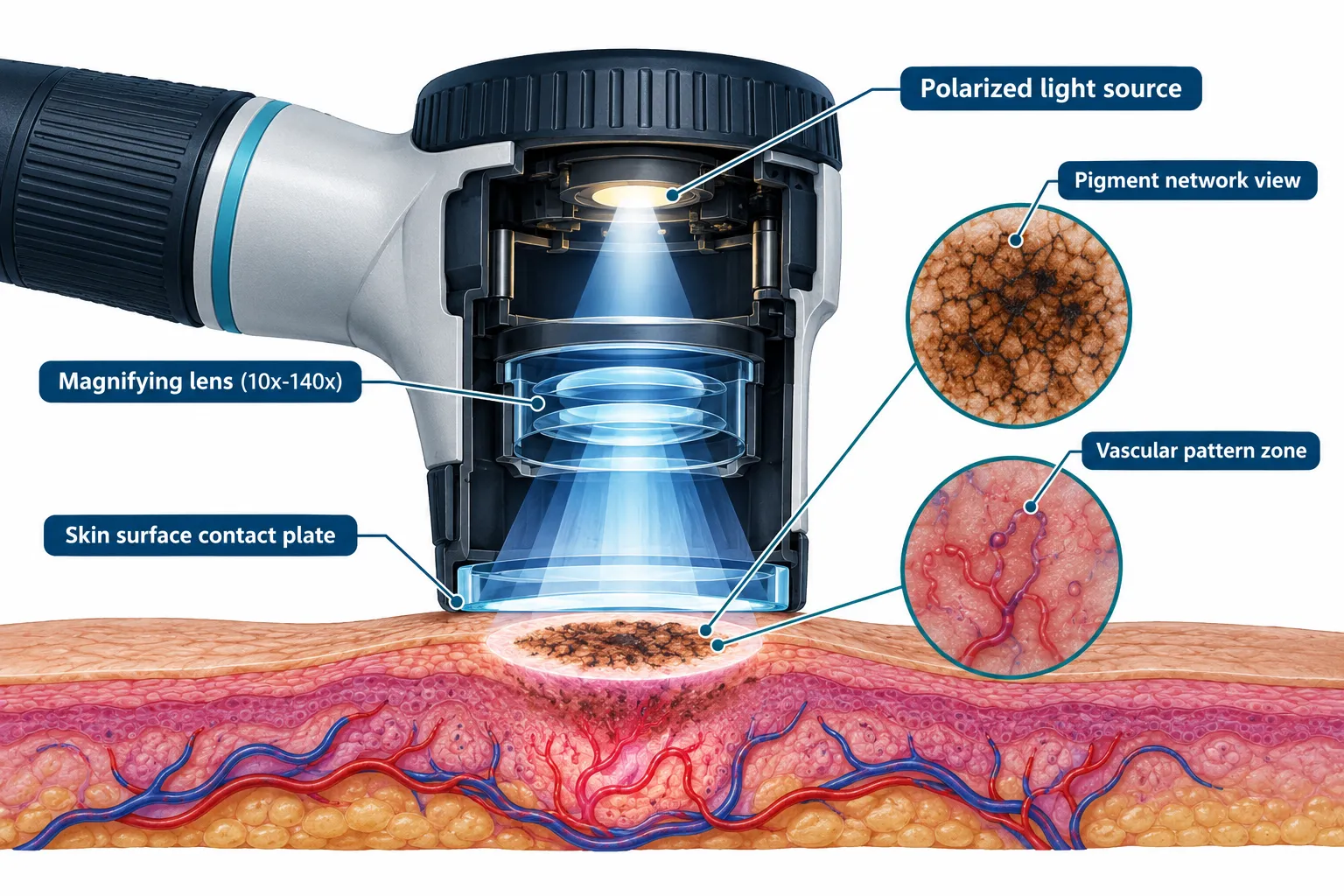
Dermoscopy is a non-invasive imaging technique that uses a handheld magnifying device, called a dermatoscope, combined with polarized light to examine the structures inside a mole or skin lesion. It lets a trained clinician see pigment networks, blood vessel patterns, and other microscopic features that are invisible to the naked eye.
The device works by eliminating surface glare from skin. Regular light bounces off skin's outer layer and hides what's underneath. A dermatoscope uses polarized or liquid-immersion contact to cut through that glare, so the clinician can see:
The pigment network pattern (how melanin is distributed within the mole)
Vascular structures (tiny blood vessels that can signal abnormal growth)
Border and color irregularities not visible with a standard visual exam
Structural symmetry or asymmetry at a magnified level
Toronto clinics that specialize in this method, such as Dermatelier on Avenue, describe their process as combining polarized light microscopy with visual assessment of ultrastructures and vascular patterns to evaluate moles more precisely than the eye alone.[6] Magnification typically ranges from about 10x for a quick check up to 140x for detailed mole mapping platforms.[11]
Decision rule: choose a dermoscopy-based check over a basic visual exam if you have a new or changing mole, a family history of melanoma, or more than 50 moles on your body. For lower-risk patients with only a handful of stable moles, a standard visual mole check may be sufficient as a starting point.
Dermoscopy vs Regular Skin Check: What's the Difference
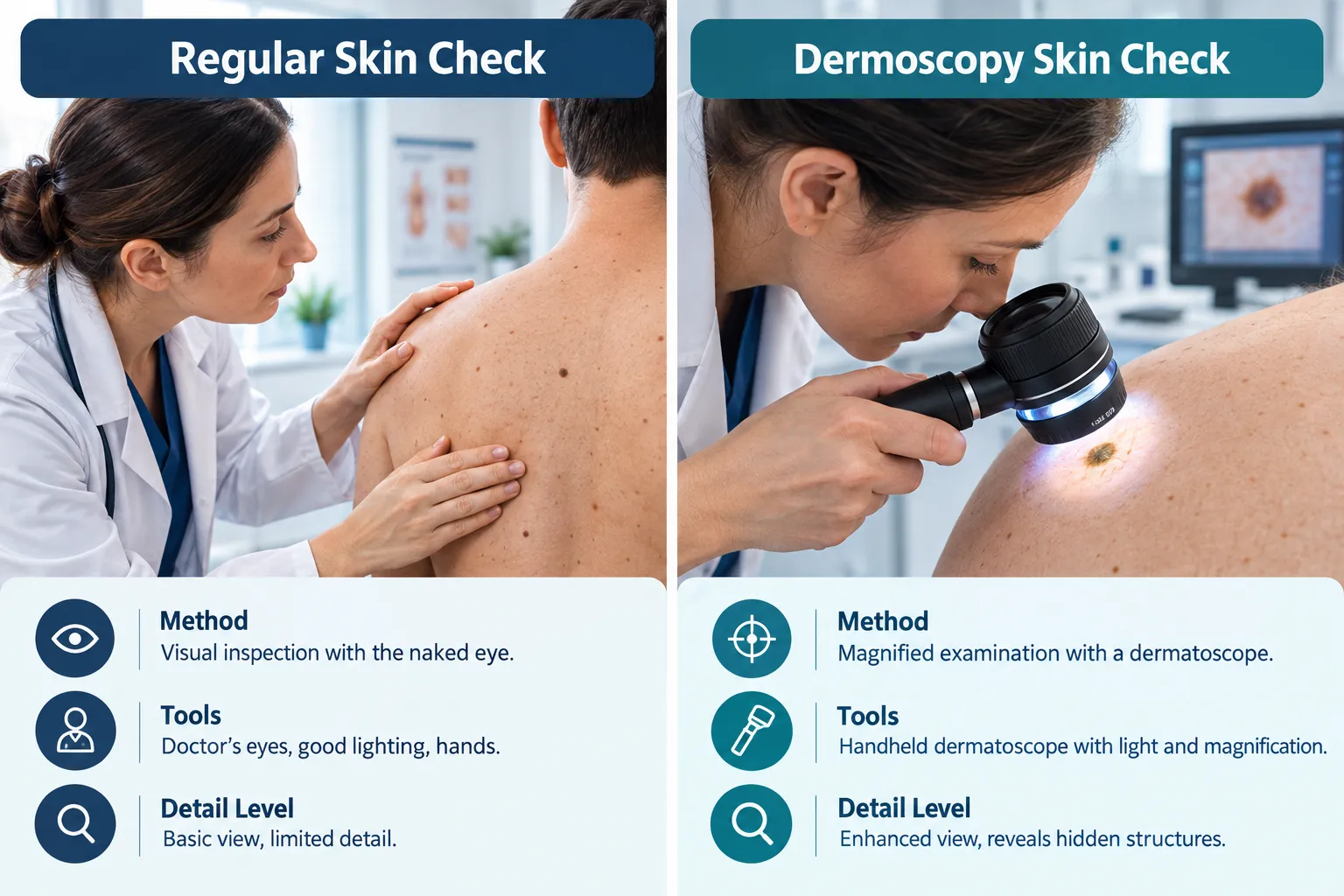
A regular skin check relies on the naked eye and a clinician's experience to spot suspicious moles, while a dermoscopy skin check uses magnification and light technology to examine what's happening below the skin's surface. The difference matters most when a mole looks borderline or ambiguous on visual inspection alone.
FeatureRegular Visual Skin CheckDermoscopy Skin CheckTool usedNaked eye, sometimes a magnifying loupeHandheld dermatoscope with polarized lightWhat it detectsSurface color, shape, size, borderPigment network, vessel patterns, subsurface structureTypical duration10-20 minutes15-45 minutes depending on scopeBest forGeneral screening, low-risk patientsAmbiguous moles, high-risk patients, surveillanceOHIP coverageOften covered if referred and medically indicatedUsually not covered unless bundled into a referred dermatology visit[2]
A quick example: a patient with a flat, brown mole that looks fine visually might still show an irregular pigment network under dermoscopy, prompting a closer look or biopsy referral. This is the core reason dermatologists layer dermoscopy onto standard exams rather than using it as a replacement. For a broader look at how visual assessment fits into cancer screening generally, see this guide to skin cancer screening in Toronto.
Common mistake: assuming a normal-looking mole on casual self-inspection means dermoscopy isn't needed. Many early melanomas look unremarkable without magnification, which is exactly why dermoscopy exists as an extra layer of scrutiny.
Where Can I Get a Dermoscopy Skin Check in Toronto
Dermoscopy skin checks in Toronto are available through GP dermatologists, dedicated mole-scan clinics, and select private skin centers, with a dense network of providers across downtown, midtown, and the wider GTA. Options range from single-lesion assessments to full-body digital mole mapping.
Notable Toronto-area access points documented in 2026 include:
Palmerston Mole Scan Clinic (474 College St), focused specifically on dermoscopy-based lesion assessment, with a published Single Lesion Assessment fee.[1][4]
SkinCan / Bay Charles Medical (100 Charles St W, Yorkville), physician-led mole mapping and targeted dermoscopy.[5][10]
Toronto Dermatology Centre (4256 Bathurst St #400), full-body mole mapping and dermoscopy, typically arranged annually.[3]
Clear Skin Dermatology (1366 Yonge St) and ICLS Dermatology in Oakville, additional GTA dermoscopy-capable clinics identified in Melanoma Canada's dermatologist locator.[10]
Thornhill Dermatology Centre in Concord/Vaughan, just north of the city, offering direct-bookable mole mapping appointments.[7]
Important note on scope of practice: dermoscopy-based skin checks are available through GP Dermatologists where available. TMSC surgeons do not perform dermoscopy-based skin checks. If a dermoscopy exam identifies a lesion needing removal or biopsy, that step is typically handled separately by a surgical provider.
Edge case: if you live outside the downtown core, checking GTA-adjacent clinics such as those in Oakville or Vaughan can shorten wait times, since demand at central Toronto mole-scan clinics tends to be higher.
How Much Does a Dermoscopy Skin Check Cost in Toronto
A dermoscopy skin check in Toronto typically costs between $149 and $800, depending on whether you book a single-lesion assessment or a full-body mole mapping session. Pricing varies by clinic, scope of the exam, and whether digital photography is included for future comparison.
Documented 2026 pricing examples:
Palmerston Mole Scan Clinic: Single Lesion Assessment at $149 + HST.[4]
SkinCan / Bay Charles Medical: Advanced mole mapping at $350.[5]
Toronto Dermatology Centre: Full-body mole mapping at $800 + HST per annual session.[3]
General market range across GTA mole mapping clinics: roughly $250 to $599+ HST per session, with some full-body packages reaching $350,$800.[11]
Choose a single-lesion assessment if you have one specific mole of concern and want a fast, lower-cost check. Choose full-body mole mapping if you have many moles, a family history of melanoma, or want a baseline photographic record for tracking changes over future years.
One important cost-saving alternative: Melanoma Canada's Mole Mobile Tour offers free walk-in screenings using visual exam and dermoscopy from May 1 through October 31, 2026, with more than 130 stops across Canada including multiple Ontario and GTA locations, and no appointment required.[8][9] This is a strong option for anyone wanting a baseline check without paying private clinic fees.
How Long Does a Dermoscopy Appointment Take
A single-lesion dermoscopy check usually takes 15 to 20 minutes, while full-body mole mapping sessions that photograph and catalog every mole can take 30 to 45 minutes. Appointment length depends on how many lesions need close examination and whether digital images are being captured for future comparison.
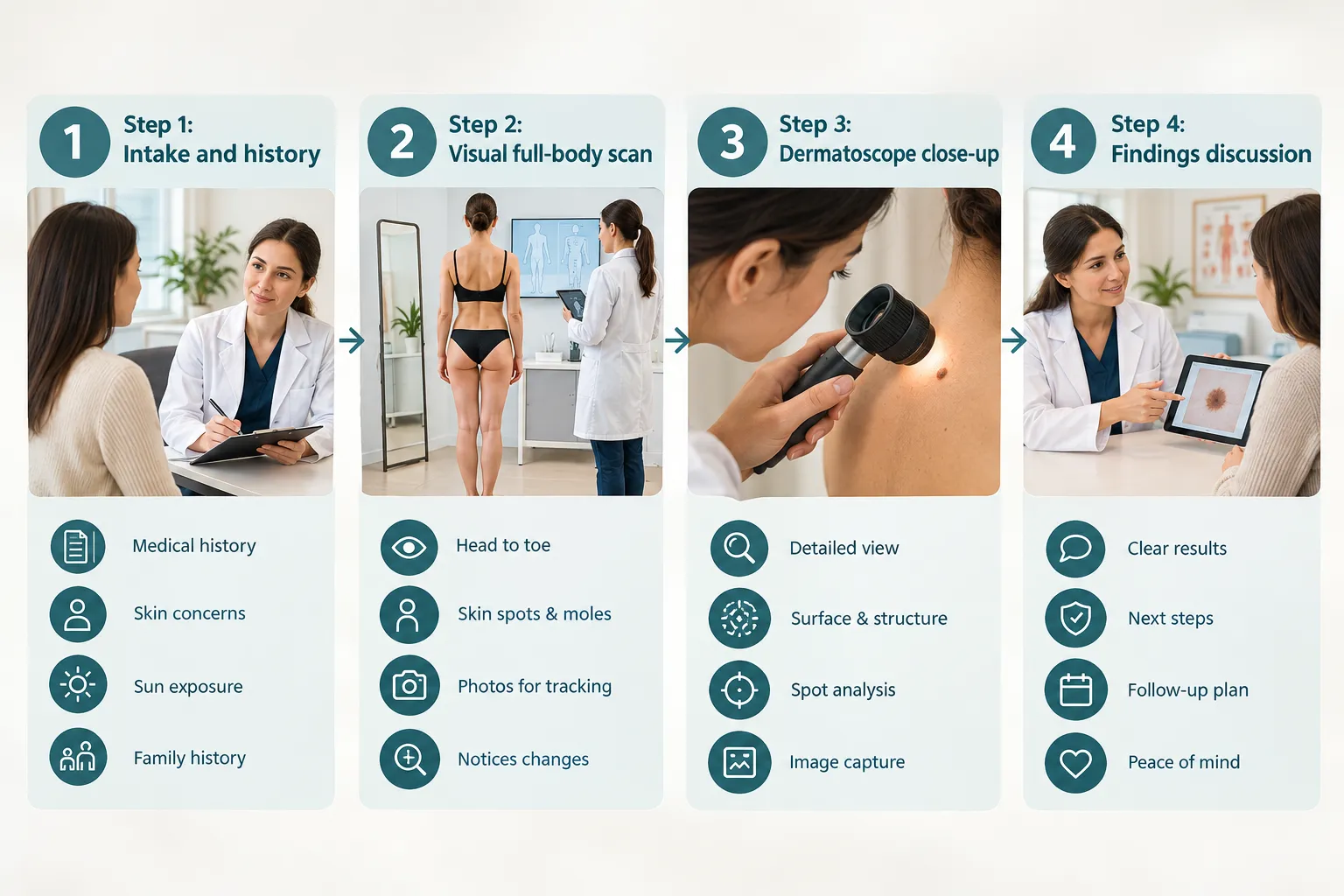
Typical time breakdown:
Intake and history review (5 minutes), questions about sun exposure, family history, and any changing moles.
Visual full-body or targeted scan (5-15 minutes), clinician looks for irregular shapes, colors, or borders.
Dermatoscope close-up examination (10-20 minutes), magnified review of flagged lesions.
Findings discussion (5-10 minutes), clinician explains results and next steps, including whether a biopsy referral is warranted.
Quick example: a patient booking only a single suspicious mole for review at a clinic like Palmerston Mole Scan Clinic can often be in and out within 20 minutes, while someone booking annual full-body mole mapping at Toronto Dermatology Centre should plan for closer to 45 minutes given the number of lesions typically photographed and logged.[1][3]
Do I Need a Referral for Dermoscopy in Toronto
A referral is generally required for OHIP-covered dermatology appointments that include dermoscopy, but many private mole-scan and mole-mapping clinics in Toronto allow direct booking without a referral. Which pathway applies depends on whether you want the visit billed to OHIP or paid privately.
Referral required: OHIP-covered dermatologist visits, including rapid access clinics such as AvantDerm's same-day weekday slots for referred patients.[10][2]
No referral needed: Private mole mapping and mole-scan services such as Palmerston Mole Scan Clinic, SkinCan, and Thornhill Dermatology Centre's mole mapping appointments, which are typically bookable directly as a private, non-OHIP service.[1][5][7]
No referral, no appointment: Melanoma Canada's seasonal Mole Mobile Tour, which is walk-in only.[8][9]
Decision rule: if cost is the priority and you're comfortable paying privately, skip the referral and book directly with a mole-scan clinic. If you want the visit covered by OHIP and have a specific medical concern (not routine surveillance), get a referral from your family doctor first.
What Should I Expect During a Dermoscopy Exam
During a dermoscopy exam, expect a clinician to first review your health history and sun exposure, then visually inspect your skin before using a dermatoscope to closely examine any moles of concern. The process is painless and involves no needles or cutting.
Step-by-step, a typical visit looks like this:
Check-in and history, you'll answer questions about family history of skin cancer, past sunburns, and any moles that have changed recently.
Undress to the level requested, full-body mole mapping requires more skin exposure than a single-lesion check; clinics provide gowns and privacy.
Visual scan, the clinician looks over your skin systematically, often starting at the scalp and working down.
Dermatoscope examination, a small handheld device, sometimes with a drop of gel or alcohol for better contact, is placed against flagged moles.
Photography (if included), some clinics capture digital images for a baseline record to compare at future visits.
Results conversation, you'll be told which moles, if any, look concerning and whether a biopsy or removal referral is recommended.
Common mistake: wearing makeup, nail polish, or self-tanner to the appointment, which can obscure subtle color changes the clinician needs to see. Arrive with clean, bare skin wherever possible.
If a lesion is flagged as suspicious during the exam, the next step is typically a suspicious mole assessment or referral for mole biopsy to confirm the diagnosis.
Is Dermoscopy Covered by OHIP in Ontario
Dermoscopy is covered by OHIP only when it is performed as part of a medically necessary, referred dermatologist visit; it is not covered when booked as elective mole mapping or cosmetic mole surveillance at a private clinic. This distinction is the single biggest factor driving out-of-pocket costs for Toronto patients.
OHIP-covered scenario: your family doctor refers you to a dermatologist because of a specific concerning mole, and the dermatologist uses a dermatoscope as part of that medically indicated exam.
Not OHIP-covered scenario: you book annual mole mapping for general surveillance or peace of mind at a private clinic like SkinCan or Toronto Dermatology Centre, which is billed privately regardless of referral status.[2][3][5]
A 2026 guide to skin cancer screening access in Toronto confirms that specialized services such as mole mapping and dermoscopy are frequently offered through dedicated private skin centers precisely because they fall outside standard OHIP billing codes for routine surveillance.[2]
Edge case: if a private mole mapping visit uncovers a lesion requiring biopsy, that follow-up biopsy and pathology may then be OHIP-covered, even though the original mapping visit was not.
How Accurate Is Dermoscopy for Melanoma Detection and Can It Detect All Skin Cancer Types
Dermoscopy improves a clinician's ability to distinguish benign moles from potentially cancerous ones compared with visual inspection alone, but it is a screening and triage tool, not a diagnostic test. It works well across melanoma, basal cell carcinoma, and squamous cell carcinoma when combined with a trained eye, though final diagnosis always requires biopsy.
Key points on accuracy and scope:
Dermoscopy adds a layer of pattern recognition (pigment networks, vascular structures) that helps flag lesions warranting closer review or biopsy.
It is used across multiple skin cancer types, not just melanoma, though its pattern-recognition strengths are most documented for pigmented lesions.
Basal cell carcinoma and squamous cell carcinoma often present with different dermoscopic patterns (such as visible blood vessels or ulceration) that experienced clinicians learn to recognize; details on these cancer types are covered in this overview of 4 types of skin cancer.
No imaging tool, including dermoscopy, can rule out cancer with certainty on its own, biopsy remains the confirmatory step.
Choose dermoscopy as your first step if you have a mole that looks ambiguous or is changing but isn't causing symptoms. Skip straight to biopsy discussion if a lesion is already bleeding, rapidly growing, or ulcerated, since those signs typically warrant more urgent evaluation regardless of dermoscopic pattern. For background on symptoms, see does skin cancer hurt.
Best Dermatologists for Dermoscopy in Toronto
The best providers for dermoscopy in Toronto are GP dermatologists and dedicated mole-scan clinics with documented, up-to-date dermoscopy services, rather than general practitioners without specialized skin imaging equipment. Several Toronto and GTA clinics stand out based on 2026 service listings.
Providers with clearly documented dermoscopy or mole mapping services include:
Decision rule: if same-day access matters most, look for referral-based rapid access clinics. If cost transparency matters most, choose clinics with clearly published per-lesion or per-session pricing, like Palmerston or SkinCan.
How Often Should I Get Dermoscopy Skin Checks
Most average-risk adults benefit from a dermoscopy skin check once a year, while higher-risk individuals may need checks every 3 to 6 months. Risk level, not age alone, should drive how often you book.
Factors that push toward more frequent checks:
A personal history of melanoma or other skin cancer
A first-degree relative with melanoma
More than 50 moles, or several atypical-looking moles
Significant childhood sunburn history or long-term tanning bed use
Fair skin, light eyes, or red/blonde hair combined with high sun exposure
Example: a patient with a prior melanoma diagnosis and full-body mole mapping on file might return every 3 to 6 months so the clinic can compare new photographs against the baseline set and catch subtle changes early. A lower-risk patient with a handful of stable moles and no family history might reasonably stick to an annual check. Toronto Dermatology Centre's full-body mole mapping, for instance, is typically arranged once per year for surveillance purposes.[3]
For general population screening guidance and self-checks between clinic visits, this resource on full body skin exams in Toronto outlines what to watch for month to month.
Dermoscopy vs Biopsy: What's the Difference
Dermoscopy is a non-invasive imaging tool used to assess a mole's surface and subsurface patterns, while biopsy involves removing a small tissue sample for laboratory analysis to confirm or rule out cancer. Dermoscopy helps decide whether a biopsy is needed; it cannot replace one.
AspectDermoscopyBiopsyInvasivenessNon-invasive, no cuttingMinor procedure, tissue removedResult typeVisual pattern assessmentDefinitive lab diagnosisPain/downtimeNoneLocal anesthetic, minor healing timePurposeScreening and triageDiagnostic confirmationTurnaroundImmediateDays to weeks for pathology results
Common mistake: assuming a "clear" dermoscopy result means a mole is permanently safe. Moles can change over time, and dermoscopy only reflects the mole's appearance at that specific visit. If a mole is flagged during dermoscopy, the logical next step is often a referral for mole biopsy to get a definitive answer.
Dermoscopy False Positives: How Common Are They
False positives happen in dermoscopy when a benign mole displays pattern features that mimic early cancer signs, prompting an unnecessary biopsy referral out of caution. This is a known and accepted trade-off, since missing an actual melanoma is a far more serious risk than an extra precautionary biopsy.
Why false positives occur:
Some benign moles (dysplastic nevi) naturally show irregular pigment networks that overlap visually with early melanoma patterns.
Inflamed or irritated moles, sometimes from shaving or friction, can temporarily display vascular changes that look concerning.
Newer or less experienced dermoscopy users may flag more borderline cases out of caution, which is generally the safer error to make in skin cancer screening.
Edge case: if you've had a mole irritated by clothing or shaving right before your appointment, mention it to the clinician, since temporary irritation can affect how the mole appears under magnification.
The practical takeaway: a flagged mole after dermoscopy is not a cancer diagnosis. It simply means the pattern warrants a closer look, most often through biopsy, and many flagged lesions turn out to be benign once tissue is examined under a microscope.
Choosing Between Dermoscopy Options: A Quick Checklist
Before booking, walk through this short checklist to match your situation to the right type of visit:
Do you have one specific mole of concern? Book a single-lesion dermoscopy assessment rather than full mapping.
Do you have many moles or a family history of melanoma? Book full-body mole mapping for a photographic baseline.
Do you want OHIP coverage? Get a referral from your family doctor first and confirm the dermatologist bills the visit as medically necessary.
Is cost the main concern? Check Melanoma Canada's seasonal Mole Mobile Tour dates for free walk-in screening.[8][9]
Do you need results fast? Ask about rapid access clinics with same-day, referral-based slots.
Has a lesion already changed shape, color, or started bleeding? Skip routine mapping and seek a suspicious mole assessment promptly.
Conclusion and Next Steps
A dermoscopy skin check in Toronto adds a layer of magnified, pattern-based assessment that a routine visual exam simply cannot match, and it is one of the most useful tools available for catching suspicious moles early. Pricing across the city currently ranges from about $149 for a single lesion to $800 for full-body mapping, with free seasonal screening also available through Melanoma Canada's Mole Mobile Tour.[1][3][4][8]
Next steps depend on your situation. If you have one mole that concerns you, book a targeted single-lesion dermoscopy assessment at a clinic like Palmerston Mole Scan Clinic. If you have many moles or a family history of melanoma, ask about full-body mole mapping at a provider such as SkinCan or Toronto Dermatology Centre. If a mole is already changing, bleeding, or growing quickly, don't wait for a scheduled mapping session, seek a suspicious mole assessment right away. And remember: dermoscopy-based skin checks are available through GP Dermatologists where available, while TMSC surgeons focus on procedural care such as biopsy and removal rather than dermoscopy screening itself. Matching the right provider to the right stage of care is the most reliable way to get accurate, timely answers about a mole that's worrying you.
Frequently Asked Questions
What is dermoscopy used for? Dermoscopy is used to examine moles and skin lesions under magnification and polarized light, helping clinicians spot pigment and vascular patterns that suggest a mole should be biopsied or monitored more closely.
Is a dermoscopy skin check painful? No. Dermoscopy is completely non-invasive. The device is simply placed gently against the skin, sometimes with a drop of gel or alcohol for better contact.
Can I get a dermoscopy skin check without a referral in Toronto? Yes, many private clinics such as Palmerston Mole Scan Clinic and SkinCan allow direct booking without a referral, though the visit will be paid privately rather than billed to OHIP.[1][5]
How much does full-body mole mapping cost in Toronto? Full-body mole mapping typically costs between $350 and $800 depending on the clinic, with Toronto Dermatology Centre charging $800 + HST per annual session and SkinCan charging $350.[3][5]
Does OHIP cover dermoscopy in Ontario? OHIP covers dermoscopy only when it's part of a referred, medically necessary dermatology visit. Elective mole mapping or surveillance dermoscopy at private clinics is not OHIP-covered.[2]
How accurate is dermoscopy compared to biopsy? Dermoscopy improves the ability to flag suspicious moles compared with visual inspection alone, but it is a screening tool. Only a biopsy can definitively confirm or rule out cancer.
Where can I get a free dermoscopy skin check in Toronto? Melanoma Canada's Mole Mobile Tour offers free, walk-in skin screenings using visual exam and dermoscopy from May through October 2026, with multiple GTA stops and no appointment needed.[8][9]
How long does a full-body mole mapping session take? Full-body mole mapping sessions typically take 30 to 45 minutes, since every mole is photographed and cataloged for future comparison.
What happens if dermoscopy flags a mole as suspicious? The clinician will typically recommend a follow-up biopsy to get a definitive diagnosis. A flagged result does not mean the mole is cancerous, only that it warrants closer examination.
Do TMSC surgeons perform dermoscopy? No. Dermoscopy-based skin checks are available through GP Dermatologists where available. TMSC surgeons do not perform dermoscopy-based skin checks; their role focuses on procedures such as biopsy and lesion removal.
You can book your free consultation with The Minor Surgery Center in three easy ways: online through Cortico, by phone, or by requesting a callback from our team.
The initial consultation is free. During this consultation, one of our board certified surgeons will examine your condition and recommend a suitable solution.
Directly Online
Request a Callback
By Phone
By Text
Hours
Sunday
Closed
Monday
9 am — 4 pm
Tuesday
9 am — 4 pm
Wednesday
9 am — 4 pm
Thursday
9 am — 4 pm
Friday
9 am — 4 pm
Saturday
Toronto & Oakville Open Vaughan & Mississauga Closed