Mole Check Toronto | Skin Cancer Screening & Mole Assessment
Looking for a mole check in Toronto? Our physicians assess suspicious moles, changing skin lesions, and other skin concerns. No referral is required, and appointments are available quickly at our Toronto, Vaughan, Oakville, and Mississauga clinics.
Mole Check Toronto: Expert Mole Assessment & Skin Cancer Screening
Last updated: June 16, 2026
Quick Answer: Looking for a mole check in Toronto? Physicians at specialized clinics assess suspicious moles, changing skin lesions, and other skin concerns using visual examination and dermoscopy. No referral is required, and appointments are typically available within days at clinics across Toronto, Vaughan, Oakville, and Mississauga. Mole mapping and preventive screenings are generally not covered by OHIP, though individual assessments may qualify depending on the clinical context.
Key Takeaways
A mole check in Toronto does not require a referral — patients can book directly at most specialized skin clinics.
The ABCDE criteria — Asymmetry, Border, Color, Diameter, and Evolving — are the standard framework for identifying suspicious moles.
Full body skin cancer screenings and mole mapping are typically not covered by OHIP; costs vary by clinic and service type.
Dermoscopy significantly improves diagnostic accuracy compared to the naked eye alone.
A mole check and mole removal are two different services — assessment comes first, removal follows only when clinically indicated.
Same-day removal may be available when a mole is assessed and found appropriate for immediate excision.
Online mole screening tools can provide preliminary guidance but are not a substitute for in-person clinical assessment.
Early detection of melanoma dramatically improves treatment outcomes — annual or biannual skin checks are recommended for higher-risk individuals.
Most mole check appointments take between 15 and 45 minutes, depending on the number of lesions examined.
Clinics across the Greater Toronto Area offer accessible mole screening services, including locations in Brampton, Newmarket, Ajax, Whitby, and Oakville.
When Should You Get a Mole Checked?
Any mole that looks different from others on your body, or that has changed recently, warrants a professional assessment. The general rule is straightforward: when in doubt, get it checked. Waiting rarely improves outcomes, and early detection is the single most effective tool against melanoma.
The ABCDE Criteria for Suspicious Moles
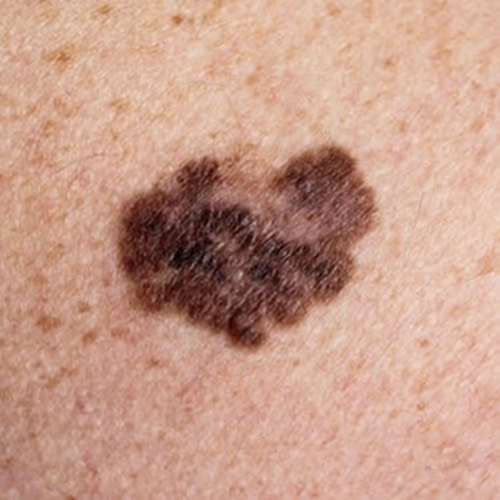
Dermatologists and skin physicians use the ABCDE framework to evaluate moles during a mole check in Toronto and elsewhere. These five criteria help distinguish benign lesions from those that may need further investigation:
A — Asymmetry: One half of the mole does not match the other half in shape.
B — Border: The edges are irregular, ragged, notched, or blurred rather than smooth and well-defined.
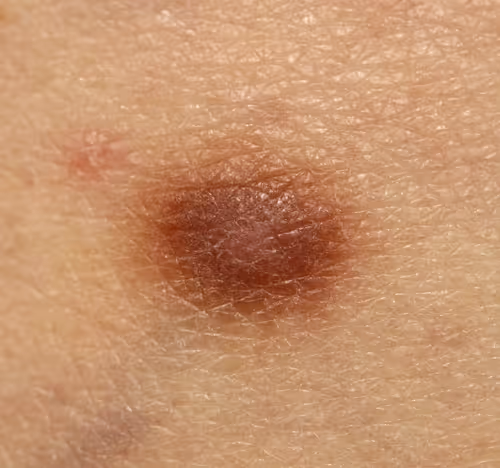
C — Color: The mole contains multiple shades — tan, brown, black, red, white, or blue — rather than a single uniform tone.
D — Diameter: The lesion is larger than 6 millimetres, roughly the size of a pencil eraser, though melanomas can be smaller.
E — Evolving: The mole is changing in size, shape, color, or texture, or is developing new symptoms such as bleeding or itching.
Beyond the ABCDE criteria, the following symptoms should prompt a prompt appointment for a mole assessment in Toronto:
A new mole appearing after age 30
A mole that bleeds without injury
Persistent itching, tenderness, or pain in a mole
A mole that looks distinctly different from all others on your body, also known as the “ugly duckling” sign
Rapid growth over weeks or months
Decision rule: If a mole meets even one ABCDE criterion, book an assessment. If it meets two or more, treat it as urgent. For a deeper look at distinguishing concerning lesions from benign ones, see this guide on melanoma moles vs benign moles.
What Exactly Happens During a Mole Check in Toronto?
A mole check appointment follows a clear, structured process that typically takes between 15 and 45 minutes, depending on how many lesions are reviewed [4]. Patients can expect the following steps:
Step 1 — Medical History
The physician asks about personal and family history of skin cancer, sun exposure habits, history of sunburns, skin type, and any recent changes to the mole in question.
Step 2 — Visual Examination
The physician examines the mole or multiple moles under good lighting, applying the ABCDE criteria and looking for any features that suggest concern.
Step 3 — Dermoscopic Assessment
If dermoscopy is available, the physician uses a handheld instrument that magnifies the skin and illuminates subsurface structures invisible to the naked eye. This significantly improves the accuracy of distinguishing benign from potentially malignant lesions [9].
Some Toronto clinics use AI-powered imaging systems such as the FotoFinder ATBM Master for full-body mole mapping and longitudinal tracking [1].
Step 4 — Risk Determination
Based on the examination, the physician classifies the lesion as low, intermediate, or high concern. This determination drives the next recommendation.
Step 5 — Recommendation
The outcome is usually one of three paths:
Monitoring: The mole is benign but worth watching. The patient is advised on what changes to look for.
Biopsy: A small tissue sample is taken for laboratory analysis to confirm or rule out malignancy.
Removal: The lesion is excised, either for diagnostic purposes or because it has been assessed as requiring removal.
This step-by-step process makes the mole check clear for patients wondering what to expect — and it is the same process used at reputable skin cancer clinics across Toronto.
How Do I Know if My Mole Looks Suspicious?
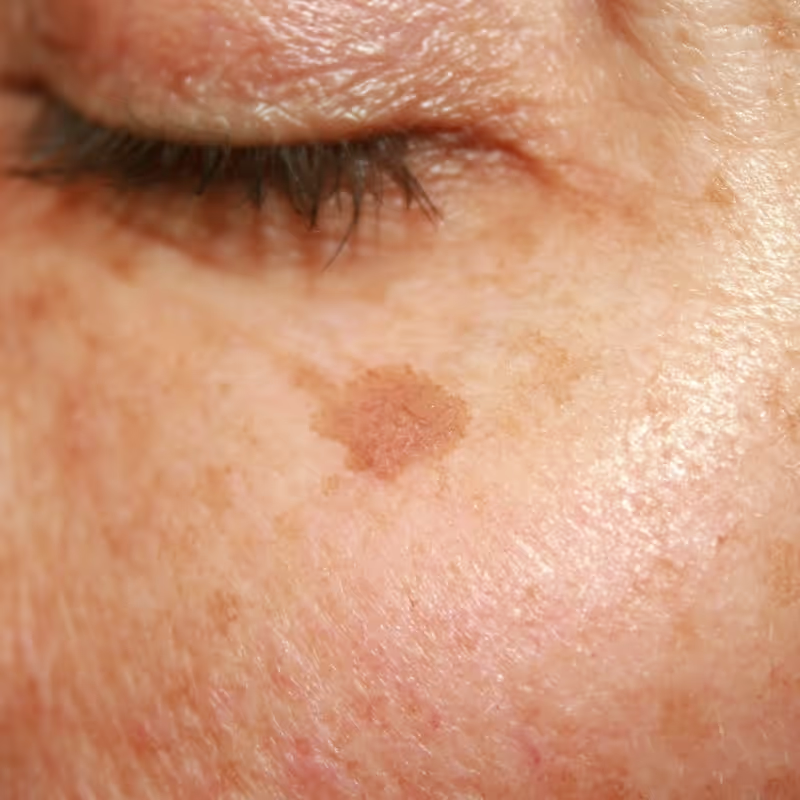
A mole is considered suspicious when it deviates from the normal characteristics of benign skin lesions. Most benign moles are round or oval, uniformly colored, usually a single shade of tan or brown, smaller than 6 mm, and stable over time.
The most reliable self-check approach combines the ABCDE criteria with the “ugly duckling” sign. Any mole that looks noticeably different from the others on your body deserves attention, even if it does not clearly meet all five ABCDE criteria.
Common Warning Signs at a Glance
Shape
A benign mole is usually round or oval.
A suspicious mole may be irregular or asymmetric.
Border
A benign mole usually has smooth, well-defined edges.
A suspicious mole may have ragged, notched, or blurred borders.
Color
A benign mole is usually one uniform shade.
A suspicious mole may have multiple colors or shades.
Size
A benign mole is usually under 6 mm.
A suspicious mole may be over 6 mm or actively growing.
Change over time
A benign mole is usually stable.
A suspicious mole may evolve in size, shape, color, texture, or symptoms.
Symptoms
A benign mole usually causes no symptoms.
A suspicious mole may itch, bleed, crust, or become painful.
If a mole is bleeding without any trauma, that is a particularly urgent sign. Do not wait for a routine appointment — contact a clinic that offers rapid access to mole screening in Toronto.
For a detailed breakdown of what atypical moles look like and how they differ from melanoma, the guide to atypical moles provides clinically grounded information.
Full Body Skin Cancer Screening in Toronto
Full body skin cancer screening means a physician examines every area of the skin — not just a single mole — to identify any lesions of concern across the entire body surface. This is particularly valuable for patients with a personal or family history of melanoma, a large number of moles, significant sun exposure history, or fair skin.
Clinics offering this service in Toronto assess individual moles as well as full skin examinations for patients concerned about skin cancer. The examination typically covers the scalp, face, neck, chest, back, arms, legs, and areas that are easy to miss during self-examination, such as the soles of the feet, between the toes, and the back of the ears.
Who Benefits Most From a Full Body Skin Exam?
A full body skin exam is especially useful for:
People with more than 50 moles on their body
Individuals with a first-degree relative diagnosed with melanoma
Patients with a history of significant or repeated sunburns
Anyone who has had a previous skin cancer diagnosis
People with very fair skin, light eyes, or red or blonde hair
Those who have used tanning beds
Some Toronto clinics now offer full-body mole mapping using advanced imaging systems. FotoFinder technology, for example, allows for complete body photography combined with AI-powered mole tracking to detect changes between visits [1][9].
Oakville Skin in Oakville, Ontario, offers mole mapping using the Fotofinder dermoscope for early detection of skin cancers [10]. These services are not covered by OHIP and are priced separately.
No. Patients can book directly with a specialized skin clinic for assessment of suspicious moles and skin lesions without a referral from a family physician.
This is one of the most common questions people ask, and the answer is consistently the same across most clinics in the Greater Toronto Area.
Clinics like Palmerston Mole Scan Clinic provide full-body mole mapping services without the need for a referral, making advanced skin assessments more accessible to the public [3]. Similarly, MolePatrol offers full-body mole mapping and skin cancer screenings with no referral required [2].
When a Referral Might Still Be Useful
A referral may still be useful in these situations:
If OHIP coverage is being sought for a medically necessary assessment
If a family physician has already identified a specific lesion and wants a specialist opinion
For access to hospital-based dermatology programs with long wait times
For most patients in Toronto who want a timely mole check, booking directly at a clinic that offers rapid access is the fastest and most practical route. Many clinics have appointments available within days rather than months.
Are All Mole Checks Covered by OHIP?
Not all mole checks are covered by OHIP, and this distinction matters before booking. Preventive skin screenings and mole mapping are typically not covered by the Ontario Health Insurance Plan [2].
However, a physician-initiated assessment of a clinically suspicious lesion may be billable to OHIP depending on the clinical context and the type of physician performing the assessment.
What Is Generally Not Covered by OHIP
These services are generally not covered:
Routine or preventive full-body mole mapping
Cosmetic mole assessment with no clinical indication
AI-assisted mole mapping services
Private clinic mole screening packages
What May Be Covered by OHIP
These services may be covered depending on the clinical context:
Assessment of a mole that a physician determines requires medical evaluation
Biopsy of a suspicious lesion
Removal of a mole confirmed or strongly suspected to be malignant
MolePatrol, for example, offers full-body mole mapping and skin cancer screenings at a cost of approximately $250 plus HST, with no referral required [2]. Pricing at other Toronto clinics varies. Patients should confirm coverage and costs directly with the clinic before their appointment.
For a full breakdown of what to expect financially, the Minor Surgery Center FAQ covers common questions about costs and coverage.
How Much Does a Professional Mole Screening Cost?
The cost of a mole check in Toronto depends on the type of service, the clinic, and whether the assessment is covered by OHIP.
For private, non-OHIP services, full-body mole mapping typically costs around $250 plus HST at clinics like MolePatrol [2]. Individual mole assessments at private clinics may be priced lower, while comprehensive mole mapping with AI-assisted imaging tends to cost more.
Typical Private-Pay Cost Ranges for Mole-Related Services in Toronto
Single mole assessment: Varies by clinic; often $50–$150.
Full-body mole mapping: Approximately $200–$350 [2].
Dermoscopic assessment with imaging: Pricing varies by technology used.
Mole removal, if indicated: Separate from assessment and usually priced per procedure.
These figures are estimates based on publicly available information from Toronto-area clinics. Costs change, so always confirm directly with the clinic. Some clinics bundle assessment and removal, while others charge separately for each service.
How Often Should Someone Get Their Moles Checked?
For most people with no significant risk factors, an annual skin check is a reasonable baseline. For higher-risk individuals, a check every six months may be more appropriate.
Recommended Frequency by Risk Level
Low risk: Every 1–2 years.
This includes people with fair skin, few moles, limited sun exposure, and no personal or family history of skin cancer.
Moderate risk: Annually.
This includes people with many moles, significant sun exposure history, or a family history of skin cancer.
High risk: Every 6 months or as directed by a physician.
This includes people with a personal history of melanoma or atypical moles, a first-degree relative with melanoma, or 100+ moles.
Between professional checks, monthly self-examination is recommended. Use a full-length mirror and a hand mirror to examine hard-to-see areas. Photograph moles to track changes over time.
What Are the Early Warning Signs of Melanoma?
Melanoma is the most serious form of skin cancer, but it is also among the most treatable when caught early. The early warning signs align closely with the ABCDE criteria, but a few additional features are worth knowing.
Early Signs of Melanoma
A mole that has changed in size, shape, or color over weeks or months
A lesion with uneven pigmentation, particularly any area that appears black, dark brown, red, white, or blue within the same mole
A flat or slightly raised lesion with an irregular, spreading border
A new dark streak under a fingernail or toenail
A sore that does not heal within four weeks
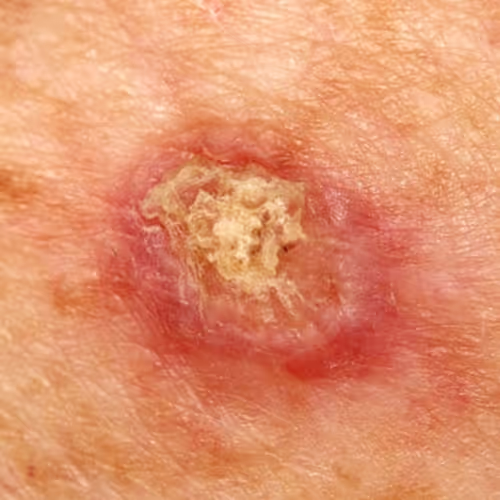
A shiny, pearly, or waxy bump, which is more characteristic of basal cell carcinoma, another common skin cancer
Melanoma does not always look like a classic dark mole. Amelanotic melanoma, for example, may appear pink, red, or flesh-colored, making it easy to dismiss. This is one reason professional assessment with dermoscopy is far more reliable than self-examination alone.
Yes. Patients can book directly with a specialized clinic for assessment of suspicious moles and skin lesions. No referral from a family physician or specialist is needed at most private skin clinics in Toronto.
This is particularly important for patients whose family doctor has a long wait time, or for anyone who has noticed a change in a mole and wants a prompt assessment. Clinics offering rapid-access mole checks in Toronto are specifically designed for this scenario.
Can a Mole Be Removed the Same Day as the Assessment?
In some cases, yes. Same-day removal is possible when the mole has been assessed and the physician determines it is appropriate for immediate excision. This is a common model at clinics that combine assessment and minor surgical services under one roof.
Typical Same-Day Removal Pathway
Assessment first: The physician examines the mole and determines its risk level.
Biopsy if needed: If the lesion is suspicious but not clearly malignant, a biopsy may be taken for pathology review before any removal decision.
Same-day removal when appropriate: If the mole is benign but bothersome, or if the physician determines removal is clinically indicated and the patient consents, excision can proceed the same day.
Not every mole is suitable for same-day removal. Lesions that require pathology confirmation before treatment, or those in locations that require more complex surgical planning, may need a follow-up appointment.
Mole Check vs Mole Removal: What Is the Difference?
These two services are frequently confused, but they serve entirely different purposes. A mole check is a diagnostic service; mole removal is a treatment procedure. One determines what a mole is; the other physically removes it.
Mole Check
Purpose: Examination and diagnosis.
What happens: Visual and dermoscopic assessment.
Outcome: Risk classification and recommendation.
Who needs it: Anyone with a mole of concern.
OHIP coverage: Varies by clinical context.
Typical duration: 15–45 minutes [4].
Mole Removal
Purpose: Procedural treatment.
What happens: Surgical excision or shave removal.
Outcome: Lesion removed from the skin.
Who needs it: Patients with confirmed or suspected lesions, or cosmetic concerns.
OHIP coverage: May be covered if medically necessary.
Typical duration: 15–60 minutes depending on size and technique.
A patient may have a mole check and leave with no procedure performed — simply a recommendation to monitor, return in six months, or apply sunscreen more consistently. Alternatively, a mole check may lead directly to removal during the same visit. The two services are related but distinct.
What Is the Difference Between a Regular Mole Check and a Dermatologist Assessment?
A regular mole check at a general or minor surgery clinic involves a physician assessing moles using visual examination and, often, dermoscopy.
A dermatologist assessment offers the same core service but is performed by a specialist with additional training in skin diseases, who may also manage complex conditions like psoriasis, eczema, or rare skin cancers.
For most patients with a straightforward concern about a suspicious mole, a physician experienced in skin lesion assessment can provide an accurate and timely evaluation. Dermatologist referrals through the public system often involve wait times of several months in Ontario.
Choose a Specialized Skin Clinic If:
You want a prompt appointment, often within days.
Your concern is a specific mole or small number of lesions.
You prefer a no-referral, direct-booking model.
Consider a Dermatologist If:
You have a complex or chronic skin condition alongside your mole concern.
A previous biopsy has returned a positive result requiring specialist management.
Your family physician has specifically recommended a dermatology referral.
For help finding a dermatologist in Toronto, the dermatologist finder tool is a useful starting point.
Are Online Mole Screening Services Reliable?
Online mole screening tools and AI-based apps can provide a useful preliminary assessment, but they are not a substitute for in-person clinical evaluation.
Platforms like CheckMole offer free AI-based tools that assess moles using the ABCDE criteria and provide instant risk levels and recommendations for further action [6]. These tools can help patients decide whether to seek an in-person appointment, but they cannot replace dermoscopy or physician judgment.
Limitations of Online Mole Screening
Image quality from smartphone cameras varies significantly.
Lighting, angle, and focus affect AI accuracy.
AI tools cannot assess texture, firmness, or the feel of a lesion.
They cannot perform a biopsy or provide a clinical diagnosis.
False reassurance from a negative AI result may delay necessary care.
Best Use Case for Online Tools
Online tools are best used as a first step to help prioritize which moles to have checked professionally, not as a final answer.
If an online tool flags a mole as potentially concerning, book an in-person assessment promptly. If it rates a mole as low risk but the mole continues to change, book an appointment regardless.
What Happens if a Mole Biopsy Comes Back Positive?
A positive biopsy result means the tissue sample contains abnormal cells. This could indicate melanoma, basal cell carcinoma, squamous cell carcinoma, or a pre-cancerous condition like dysplastic nevus.
The next steps depend on the specific diagnosis and the degree of abnormality.
Typical Next Steps After a Positive Biopsy
Review of pathology report: The physician reviews the specific findings, including the type of cells, depth of invasion for melanoma, and whether the margins are clear.
Wide local excision: If melanoma is confirmed, a wider margin of tissue around the original biopsy site is removed to ensure complete clearance.
Referral to oncology or dermatology: Depending on the stage and type of skin cancer, referral to a specialist may be required for further treatment planning.
Sentinel lymph node biopsy: For melanomas of intermediate thickness, this procedure checks whether cancer has spread to nearby lymph nodes.
Follow-up monitoring: Even after successful treatment, regular skin checks are essential to monitor for recurrence or new lesions.
A positive result is serious, but early-stage skin cancers — particularly when caught at the in-situ or thin melanoma stage — have excellent outcomes with appropriate treatment.
Yes. A mole check is a non-invasive visual and dermoscopic examination in most cases, and it does not involve any contact with chemicals, lasers, or irritants. Patients with sensitive skin, eczema, rosacea, or other skin conditions can safely undergo a mole assessment.
If a biopsy or removal is recommended, the physician will take into account any skin sensitivities, allergies to local anesthetics, or healing concerns, such as a history of keloid scarring, before proceeding.
Patients should inform the physician of any known sensitivities during the medical history portion of the appointment.
How Long Does a Typical Mole Screening Appointment Take?
A focused mole check for one or two specific lesions typically takes 15 to 30 minutes. A comprehensive full-body skin examination, including dermoscopic assessment of multiple moles, can take up to 45 minutes [4].
Mole mapping appointments that involve full-body photography and digital imaging may take longer, depending on the technology and the number of lesions documented.
Patients should arrive prepared to expose the areas of concern and, for a full-body exam, be ready to undress partially or fully with appropriate draping. Bringing a list of any moles that have changed or are causing concern can help the physician prioritize the assessment efficiently.
Frequently Asked Questions About Mole Checks in Toronto
Where can I get a mole checked in Toronto?
Mole checks are available at specialized skin clinics, minor surgery centers, and some family medicine practices across Toronto and the Greater Toronto Area. No referral is required at most private clinics.
Preventive mole mapping and routine skin screenings are generally not covered by OHIP. A physician-initiated assessment of a clinically suspicious lesion may be covered depending on the clinical context. Confirm with the clinic before booking [2].
Do I need a dermatologist to check a mole?
No. A physician experienced in skin lesion assessment can evaluate a mole accurately. Dermatologists have additional specialization, but for most mole concerns, a physician at a skin clinic is appropriate and much faster to access.
How much does a mole check cost in Toronto?
Costs vary. Full-body mole mapping typically costs around $250 plus HST at private clinics [2]. Individual mole assessments may be less. Confirm pricing directly with the clinic.
What does melanoma look like?
Melanoma often appears as an asymmetric mole with irregular borders, multiple colors, a diameter over 6 mm, or a lesion that is changing. It can also appear as a new dark spot that looks different from other moles. Some melanomas are pink or flesh-colored, known as amelanotic melanoma.
Should I worry about a changing mole?
Yes. Any mole that is changing in size, shape, color, or texture should be assessed promptly. Change is the most important warning sign — even a mole that otherwise looks normal warrants attention if it has recently evolved.
How quickly should I get a suspicious mole checked?
Within days to a few weeks for a mole showing multiple ABCDE features or that is bleeding. For a mole with a single minor concern, within a month is generally appropriate. Do not wait months for a routine appointment if the mole is actively changing.
Can a family doctor check a mole?
Yes. Family physicians can perform a visual assessment of moles and refer for biopsy or specialist care if needed. However, family doctors may not have dermoscopy equipment, and access may be limited by appointment availability.
How many moles is too many?
Having more than 50 moles increases the statistical risk of melanoma and is a reason to have regular full-body skin checks. Having more than 100 moles is considered a significant risk factor.
What is dermoscopy and why does it matter?
Dermoscopy is a technique that uses a handheld magnifying device with a polarized light source to examine subsurface skin structures. It significantly improves diagnostic accuracy for distinguishing benign moles from melanoma compared to the naked eye alone [9].
Can I get a mole check at multiple Toronto locations?
Yes. Several clinic networks offer mole assessments across multiple Greater Toronto Area locations, including downtown Toronto, Vaughan, Oakville, Mississauga, Brampton, Newmarket, Ajax, and Whitby.
What is mole mapping?
Mole mapping is a systematic process of photographing and documenting all moles on the body using standardized imaging. It allows for precise comparison between visits to detect any changes. Some clinics use AI-assisted systems for this purpose [1][5].
Is a mole check painful?
No. A mole check is a visual and dermoscopic examination and involves no pain. If a biopsy is recommended, local anesthetic is used before the tissue sample is taken, making the procedure minimally uncomfortable.
How do I prepare for a mole check appointment?
Arrive with clean, moisturizer-free skin on the areas to be examined. Remove nail polish if the physician will be checking nails. Bring a list of any moles that have changed or are causing concern, and be prepared to share your personal and family medical history.
Conclusion
Skin cancer is among the most common cancers in Canada, and melanoma is the most dangerous form. The good news is that when caught early, it is also among the most treatable.
A mole check in Toronto is the single most direct action a person can take to protect their skin health — and it requires no referral, no long wait, and no complex preparation.
Actionable Next Steps
Perform a self-examination using the ABCDE criteria and note any moles that meet one or more criteria.
Book a mole check at a Toronto clinic that offers rapid access and no-referral appointments.
If you have more than 50 moles, a family history of melanoma, or significant sun exposure history, ask about a full-body skin cancer screening.
After your appointment, follow the physician’s monitoring recommendations and schedule your next check based on your risk level.
Do not rely solely on online tools or apps for a final assessment. Use them to prioritize, then confirm with a physician.
For patients across the Greater Toronto Area, mole check services are available at The Minor Surgery Center, with locations in Toronto, Vaughan, Oakville, Mississauga, and beyond. Appointments are available quickly, and no referral is needed.
Promote healthy skin and limit the spread of disease through targeted removal procedures.
Book a Free Consultation
You can book your free consultation with The Minor Surgery Center in three easy ways: online through Cortico, by phone, or by requesting a callback from our team.
The initial consultation is free. During this consultation, one of our board certified surgeons will examine your condition and recommend a suitable solution.
Directly Online
Request a Callback
By Phone
By Text
Hours
Sunday
Closed
Monday
9 am — 4 pm
Tuesday
9 am — 4 pm
Wednesday
9 am — 4 pm
Thursday
9 am — 4 pm
Friday
9 am — 4 pm
Saturday
Toronto & Oakville Open Vaughan & Mississauga Closed




%20Treatment.avif)