Skin cancer removal in York Mills is available through community-based minor surgery clinics for confirmed basal cell carcinoma (BCC), squamous cell carcinoma (SCC), and suspicious lesions, with more complex or high-risk cases referred to hospital-based Mohs surgery programs such as those at Women's College Hospital or Sunnybrook's Odette Cancer Centre. Most straightforward BCC or SCC excisions take between 20 and 60 minutes under local anesthesia, are covered by OHIP when medically necessary, and carry a low recurrence rate when margins are fully cleared.
Key Takeaways
Skin cancer removal in York Mills now includes direct access to a dedicated minor surgery clinic, reducing wait times for straightforward excisions.
BCC removal and SCC removal are the two most common non-melanoma skin cancer procedures performed in outpatient settings near York Mills.
Simple excisions typically take 20 to 60 minutes; Mohs surgery for high-risk lesions can take several hours across multiple stages.
OHIP generally covers medically necessary skin cancer removal in Ontario, including biopsy, excision, and pathology.
Recovery from a standard excision usually takes 7 to 14 days for the surface wound to close, though full healing can take weeks longer.
Mohs micrographic surgery, offered at hospital centres serving the York Mills area, has the highest reported cure rates for high-risk facial and recurrent skin cancers.
Left untreated, BCC and SCC can grow larger, invade deeper tissue, and in the case of SCC, spread to lymph nodes or other organs.
Recurrence is possible even after complete removal, which is why follow-up skin checks matter long after the wound has healed.
What Is Skin Cancer Removal?
Skin cancer removal is a medical procedure that physically excises or destroys cancerous skin tissue, most commonly basal cell carcinoma or squamous cell carcinoma, with the goal of removing all cancer cells and preventing regrowth or spread. It is performed after a biopsy confirms the diagnosis, and the specific method chosen depends on the cancer type, size, location, and depth.
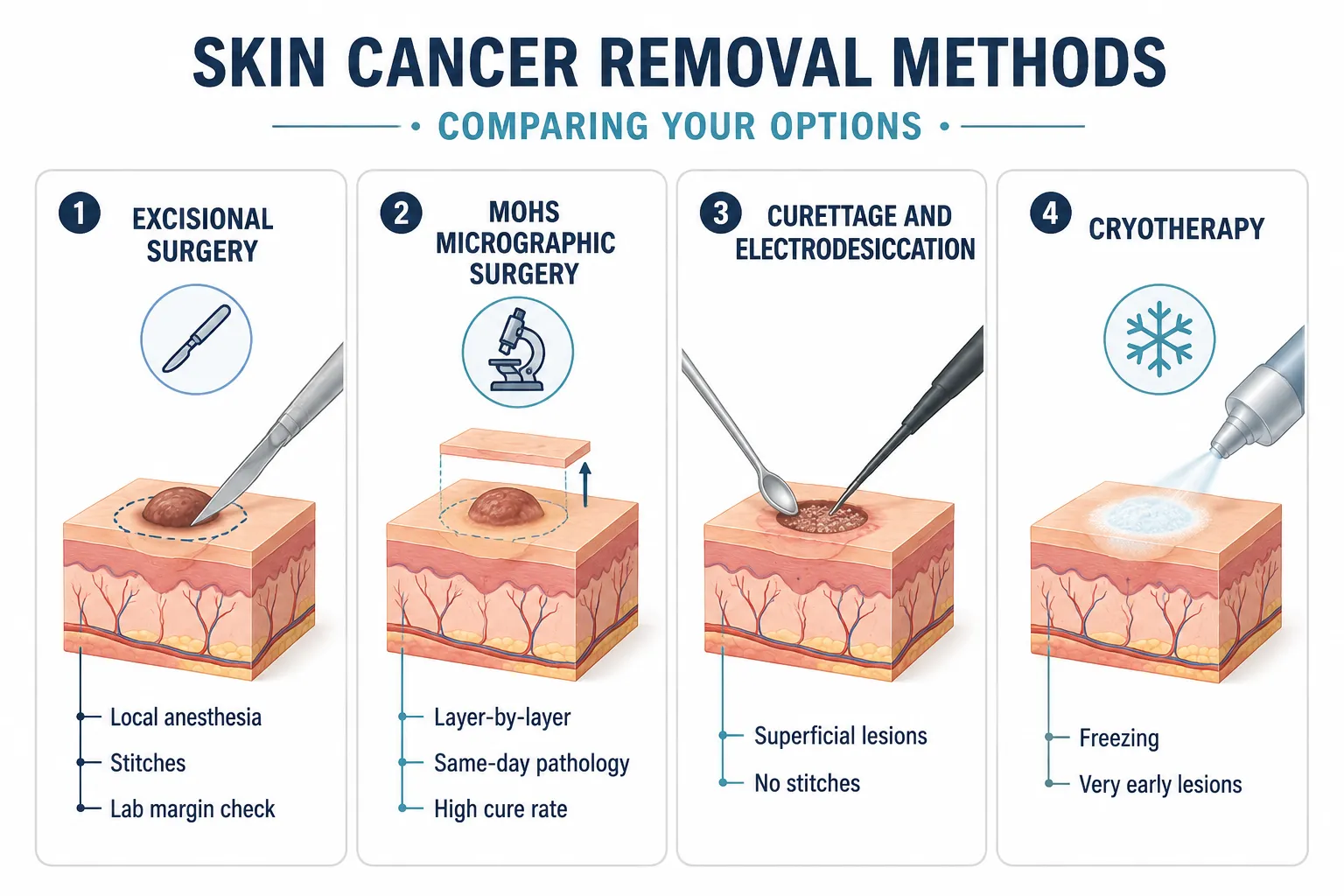
Skin cancer removal is not one single procedure. It is a category of treatments that a physician selects based on the biopsy result and the lesion's risk profile. The most common approaches used in and around York Mills include:
Excisional surgery, cutting out the lesion along with a margin of healthy-looking skin, then closing the wound with stitches.
Mohs micrographic surgery, removing the cancer in thin layers, checking each layer under a microscope on the spot, and continuing only where cancer cells remain.
Curettage and electrodesiccation, scraping away superficial cancer cells and cauterizing the base, used for select low-risk, shallow lesions.
Cryotherapy, freezing very early, superficial lesions with liquid nitrogen, generally reserved for select precancerous or in-situ cases.
Topical or light-based therapies, creams or photodynamic therapy for certain superficial basal cell carcinomas, used less often than surgical removal.
What Types of Skin Cancer Can Be Removed?
The two non-melanoma skin cancers most frequently treated through outpatient removal are basal cell carcinoma (BCC) and squamous cell carcinoma (SCC), both of which are commonly diagnosed and treated in the North York and York Mills area. Melanoma, a more aggressive form of skin cancer, is also surgically removed but typically requires wider margins and closer coordination with oncology specialists.
Basal cell carcinoma (BCC): the most common skin cancer, slow-growing, rarely spreads but can cause local tissue damage if ignored. BCC removal in York Mills usually means excision or Mohs surgery depending on location and size.
Squamous cell carcinoma (SCC): grows faster than BCC and carries a higher, though still relatively low, risk of spreading to lymph nodes if left untreated. SCC removal in York Mills follows a similar surgical pathway, with closer follow-up for high-risk features.
Melanoma: less common but more serious; removal involves wider excision margins and sometimes sentinel lymph node evaluation at a cancer centre.
Actinic keratosis and in-situ lesions: precancerous or very early changes that are sometimes treated with removal before they progress.
For readers who want background on how these cancers differ in appearance and behavior, the guide to 4 types of skin cancer breaks down the visual and clinical differences in more detail.
Choose excisional surgery if: the lesion is well-defined, low-to-moderate risk, and located somewhere a standard cosmetic closure is acceptable.
Choose Mohs surgery if: the lesion is on the face, ears, or other cosmetically or functionally sensitive area, has ill-defined borders, is recurrent, or is a high-risk subtype.
Common mistake: assuming a small, painless spot cannot be cancer. Many BCC and SCC lesions are painless for months and are only caught through a routine skin check or biopsy.
Skin Cancer Removal in York Mills: Where to Get Treated
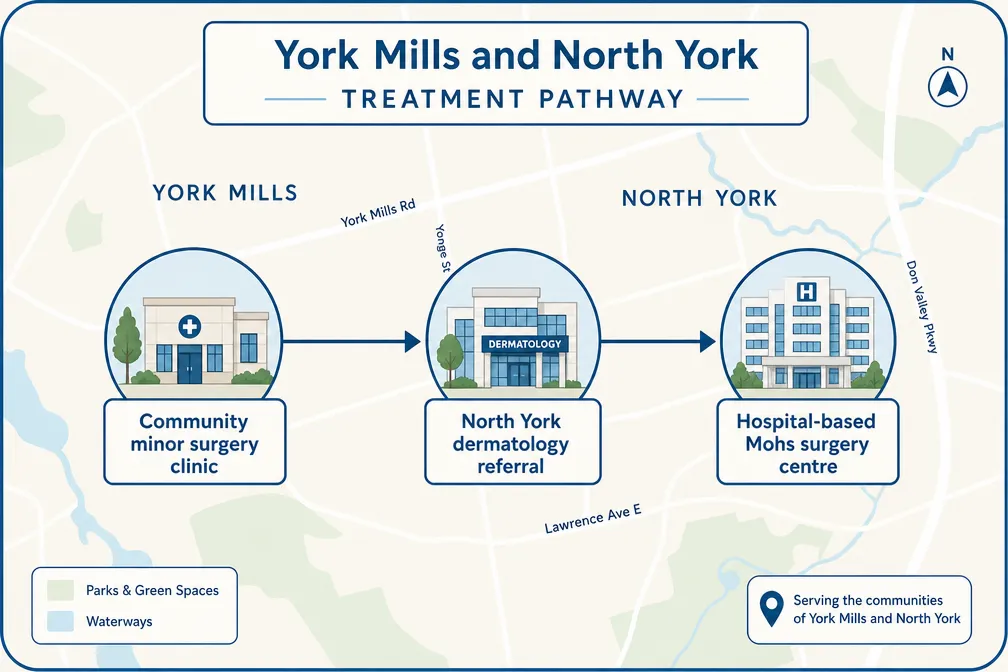
Skin cancer removal in York Mills is available at The Minor Surgery Center's clinic location at 85 Scarsdale Rd Unit 101, North York, ON M3B 2R2, which offers no-referral access for assessment and removal of confirmed or suspected BCC and SCC lesions. For higher-risk or complex cases, patients are referred into hospital-based programs serving the wider North York and Toronto region.
The clinic opened as part of a network expansion designed to bring minor surgical services, including skin cancer removal, closer to residents of York Mills and the surrounding North York communities [1]. This matters because timely removal of BCC and SCC depends heavily on how quickly a patient can get from "something looks off" to "biopsy confirmed" to "lesion removed." Extended hours and no-referral intake at the York Mills-adjacent location shorten that timeline compared to routes that require a family doctor referral and a long specialist wait.
Best Dermatologist and Clinic Options Near York Mills
There is no single "best" dermatologist for every case of skin cancer removal near York Mills; the right choice depends on the lesion's risk level. Community minor surgery clinics handle the majority of straightforward BCC and SCC removals, while hospital-based centres handle complex, recurrent, or cosmetically sensitive cases.
The Minor Surgery Center (North York / York Mills location): for biopsy-confirmed or clinically suspicious BCC and SCC lesions that are appropriate for outpatient excision, offering direct booking without a referral [1][6].
North York dermatology diagnostic clinics: useful for initial evaluation, biopsy, and ongoing monitoring, often working alongside surgical clinics for coordinated care [7].
Women's College Hospital Mohs Surgery Centre: a downtown hospital-based program serving the Greater Toronto Area, including York Mills residents, for high-risk non-melanoma skin cancers that need layer-by-layer margin control.
Sunnybrook Odette Cancer Centre: operates a dedicated melanoma and non-melanoma skin cancer clinic, relevant for York Mills-area patients with more advanced or complex disease, and coordinates with plastic surgery for reconstruction when needed.
North York General plastic surgery support: provides reconstructive options after larger excisions, particularly on the face or other visible areas.
Local service directories also list dermatology and minor surgery options serving the York and North York catchment area, which can help confirm current referral requirements and hours before booking [2][4]. For a broader regional comparison of clinics handling skin cancer assessment and treatment, see the roundup of best skin cancer clinics in Toronto and the related list of 29 best skin cancer screening and treatment clinics in Toronto.
"The lesion doesn't need to hurt to be dangerous. Painless, slow-growing spots are exactly the ones people put off checking."
Decision rule: choose a community minor surgery clinic first if the lesion is small, well-defined, and already biopsy-confirmed as a straightforward BCC or SCC. Choose a hospital-based Mohs program if the lesion sits on the nose, eyelid, ear, or lip, has recurred after previous treatment, or has poorly defined borders on exam.
Edge case: a lesion that looks simple on the surface but sits directly over a joint, near the eye, or on a scar from prior treatment often needs hospital-level planning even if the biopsy result seems routine. When in doubt, a same-day consult with the surgical team clarifies the right pathway before any cutting happens.
For general skin cancer background and how it is diagnosed, the Skin Cancer condition overview is a useful starting point before booking a removal consultation.
How Long Does Skin Cancer Removal Take, and Is It Painful?
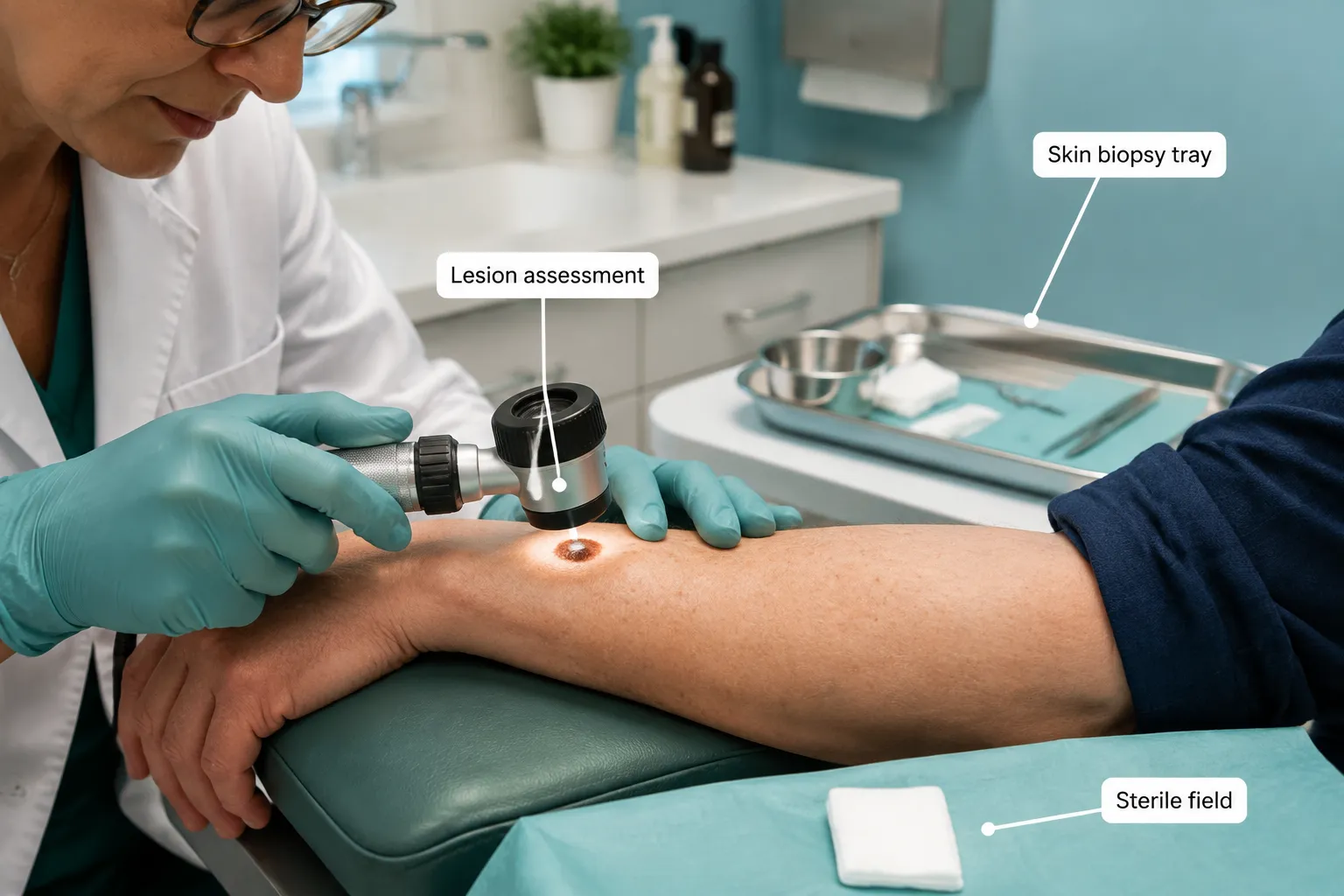
A standard excisional removal of BCC or SCC typically takes 20 to 60 minutes in-clinic under local anesthesia, while Mohs surgery can take two to five hours or longer because of the layer-by-layer pathology checks between each excision stage. Most patients describe the procedure itself as pressure and tugging rather than sharp pain, since the area is numbed before any cutting begins.
What affects procedure length:
Is it painful? The injection of local anesthetic causes a brief sting or pinch, which is usually the most uncomfortable part of the entire visit. Once numb, patients typically feel pressure, not pain, during the removal itself. Mild soreness, tenderness, or a pulling sensation for a few days afterward is normal and is usually managed with over-the-counter pain relief.
Common mistake: expecting to be fully "done" the same day when a biopsy result is still pending, or when Mohs surgery is required. Mohs appointments are often booked as a half-day or full-day commitment because the number of stages needed cannot be predicted in advance.
Quick example: a 6 mm BCC on the cheek with clear borders might be excised and closed in under 30 minutes with a single stitched line. A recurrent SCC near the eyelid with unclear margins might require a Mohs appointment scheduled to run most of a morning or afternoon.
Mohs Surgery vs Other Skin Cancer Removal Methods
Mohs micrographic surgery removes cancer in thin layers with immediate microscopic checking of each layer, which gives it the highest reported cure rates for certain high-risk basal cell and squamous cell carcinomas, especially on the face. Standard excisional surgery is faster and appropriate for most low-to-moderate risk lesions, while curettage, electrodesiccation, and cryotherapy are reserved for very select superficial or precancerous cases.
Decision rule: choose Mohs surgery if the lesion is on the nose, ears, eyelids, lips, or fingers, if it has recurred after a previous removal, or if the borders are difficult to define on exam. Choose standard excision if the lesion is well-defined, located on the trunk or limbs, and low-to-moderate risk.
Common mistake: assuming Mohs surgery is always "better." It is the preferred option for specific high-risk situations, but for a straightforward, well-defined lesion on the back or leg, standard excision achieves similarly strong outcomes with a shorter appointment and less tissue removed overall relative to the margin-checking process Mohs requires.
Skin Cancer Removal Cost in York Mills and Insurance Coverage
Skin cancer removal in York Mills is generally covered by OHIP when the procedure is medically necessary, meaning a biopsy has confirmed or strongly suggests cancer and removal is recommended by a physician. Costs that fall outside OHIP coverage typically relate to elective cosmetic refinements, certain private clinic consultation fees, or services requested outside standard medical necessity criteria.
What is usually covered:
Diagnostic biopsy of a suspicious lesion
Surgical excision of confirmed BCC or SCC
Pathology review of removed tissue
Follow-up visits related to the same diagnosis
Hospital-based Mohs surgery when referred through the appropriate specialist pathway
What may not be covered:
Purely cosmetic mole or lesion removal with no suspicious features
Certain scar revision procedures done for appearance alone, separate from the original cancer removal
Some private clinic administrative or facility fees, depending on the clinic and insurance plan
Decision rule: if a physician has flagged a lesion as suspicious or biopsy-confirmed as cancerous, removal is almost always billed as medically necessary and covered under OHIP. If a person simply wants a benign-looking mole removed for appearance, that request is typically classified as cosmetic and billed privately.
Common mistake: assuming a private minor surgery clinic charges out-of-pocket by default. Many clinics, including community-based ones serving North York, bill OHIP directly for medically necessary skin cancer removal, and only charge privately for elective or cosmetic requests. Confirming coverage status before the appointment avoids surprise billing.
Anyone unsure whether a spot is cancerous or cosmetic should start with a screening visit rather than assuming either way. The Full Body Skin Exam Toronto and Mole Check Toronto pages outline what a screening visit involves and how it connects to a removal referral if needed.
Skin Cancer Removal Recovery Time and Aftercare Instructions
Recovery from a standard skin cancer excision usually takes 7 to 14 days for the surface wound to close, with full scar maturation continuing for several months afterward. Mohs surgery recovery timelines depend on the size of the final defect and whether reconstruction, such as a flap or graft, was needed.
Typical recovery timeline:
Day 0-1: Wound is covered with a pressure dressing; some swelling, redness, and mild soreness are normal.
Day 2-5: Dressing changes as instructed; watch for excess redness, warmth, or discharge that could signal infection.
Day 7-14: Stitches removed if non-dissolving sutures were used; the surface wound is typically closed by this point.
Weeks 2-6: Scar begins to flatten and fade from red or pink toward a more natural skin tone.
Months 3-12: Continued scar maturation; final cosmetic appearance is usually clearer around the 6 to 12 month mark.
Aftercare instructions that apply to most patients:
Keep the wound covered and dry for the first 24 to 48 hours, or as specifically instructed.
Clean gently with mild soap and water during dressing changes, avoiding harsh scrubbing.
Apply antibiotic ointment or petroleum jelly only if directed by the treating clinic.
Avoid strenuous exercise or heavy lifting for one to two weeks if the excision site is under tension.
Protect the healing scar from direct sun exposure for several months, since UV exposure can darken and prolong scar redness.
Watch for signs of infection: increasing pain, spreading redness, fever, or pus, and contact the clinic promptly if these occur.
Edge case: excisions on areas with high movement or tension, such as the back, shoulder, or over a joint, tend to heal more slowly and have a higher chance of a wider scar, regardless of how well aftercare instructions are followed. Patients with these locations should expect a longer window before the scar looks fully settled.
How to Minimize Scarring After Skin Cancer Removal
Scarring after skin cancer removal can be minimized through careful surgical technique at the time of removal, disciplined aftercare during healing, and consistent sun protection for at least the first year. The final appearance of a scar depends more on wound tension, location, and skin type than on any single product applied afterward.
Steps that genuinely help reduce visible scarring:
Follow closure instructions precisely. Reopening a wound early, even slightly, from activity or friction, is one of the most common causes of a wider final scar.
Keep the area moisturized once the wound is closed. A well-hydrated healing scar tends to remain more flexible and less likely to thicken.
Use silicone sheets or scar gel if recommended. Some clinics suggest these once the wound has fully closed, generally starting a few weeks after removal.
Avoid sun exposure on the healing scar. UV light can cause a scar to darken permanently if exposed during the first several months.
Do not pick at scabs or peeling skin. This increases the risk of a raised or irregular scar.
Consider scar massage once cleared by the clinic. Gentle massage after the wound is fully closed can help soften a thickening scar.
Common mistake: applying strong retinol or exfoliating products directly on a fresh scar. These are meant for mature skin, not an open or recently closed wound, and can irritate healing tissue.
Quick example: a facial excision closed with fine, layered sutures by an experienced surgeon and protected from sun exposure for six months often fades to a thin, barely visible line. The same-sized excision left exposed to summer sun during healing is more likely to remain noticeably darker or thicker at the one-year mark.
What Happens If You Don't Remove Skin Cancer?
Untreated basal cell carcinoma continues to grow slowly but steadily, eventually invading deeper tissue, nerves, or bone in the surrounding area, particularly on the face. Untreated squamous cell carcinoma grows faster and carries a real, if still relatively low, risk of spreading to lymph nodes or beyond if left in place for an extended period.
BCC left untreated: rarely spreads internally, but can destroy significant surrounding skin, cartilage, or even bone over months to years, making eventual treatment more complex and disfiguring.
SCC left untreated: has a higher tendency to grow aggressively and, in a meaningful subset of cases, spread to regional lymph nodes, which changes the treatment plan from simple excision to a more involved cancer treatment pathway.
Melanoma left untreated: carries the highest risk of spreading (metastasizing) to other organs, which is why early detection and prompt removal matter most for this type.
Common mistake: waiting to "see if it goes away" for months because the spot does not hurt. Painless growth is typical for early BCC and SCC, and delay generally makes the eventual removal larger and more complex rather than avoiding it altogether.
Edge case: immune-suppressed patients, including organ transplant recipients or those on long-term immunosuppressive medication, tend to see faster growth and higher recurrence risk with untreated or incompletely treated skin cancers, making prompt removal and closer follow-up especially important for this group.
For a closer look at how early skin cancer typically presents before it reaches this stage, the guide on early stage skin cancer explains the visual clues worth acting on sooner rather than later.
Can Skin Cancer Come Back After Removal?
Skin cancer can come back after removal, either at the original site (local recurrence) or as a new lesion elsewhere on the skin, which is why ongoing follow-up matters even after a successful procedure. Recurrence risk depends heavily on the cancer type, how completely the margins were cleared, and the patient's overall skin cancer risk factors.
Local recurrence: happens when microscopic cancer cells remain at the excision site despite a clear margin on initial pathology review; this is part of why Mohs surgery, with its more thorough margin checking, tends to show lower recurrence rates for high-risk lesions.
New lesion elsewhere: patients who develop one BCC or SCC have a meaningfully higher chance of developing another lesion somewhere else on sun-exposed skin over time, unrelated to the original removal site.
Follow-up schedule: most physicians recommend periodic skin checks after any skin cancer removal, with frequency depending on the cancer type and personal risk factors such as prior sun exposure, skin type, and immune status.
Decision rule: anyone who has had one skin cancer removed should schedule regular follow-up skin exams rather than assuming the issue is fully resolved after the wound heals. New or changing spots should be checked promptly rather than waiting for the next scheduled visit.
Quick example: a patient treated for a single BCC on the shoulder at age 45 has a notably higher lifetime chance of developing another BCC or SCC elsewhere, which is why annual or semi-annual skin checks are typically recommended going forward rather than a one-time removal and no further monitoring.
Ongoing monitoring after removal pairs naturally with periodic screening. The Skin Cancer Screening Toronto overview outlines what a structured follow-up skin exam schedule typically looks like.
Skin Cancer Removal Clinics Near York Mills: A Practical Checklist
Choosing where to go for skin cancer removal near York Mills comes down to matching the lesion's risk level to the right level of care, confirming referral requirements in advance, and understanding what happens after the procedure. Use this checklist before booking:
Confirm diagnosis status. Has a biopsy already confirmed cancer, or is this still a suspicious spot needing assessment first?
Check referral requirements. Some clinics, including the York Mills-area minor surgery clinic, accept direct booking without a physician referral for many cases [1].
Ask about the removal method planned. Standard excision, Mohs referral, or another approach should be explained clearly before the appointment.
Confirm OHIP billing status. Medically necessary removal is typically covered; cosmetic requests are usually not.
Understand the aftercare plan. Ask what dressing changes, activity restrictions, and follow-up visits will be needed.
Plan for follow-up skin checks. Book or schedule ongoing monitoring rather than treating removal as a one-time event.
Anyone based in North York more broadly, rather than specifically York Mills, may also find it useful to review the Best Mole, Cyst and Minor Surgery in North York overview, which covers the same clinic network from a slightly broader service-area angle. Those closer to the York Mills clinic address specifically can review The Minor Surgery Center York Mills Clinic page directly for hours and booking details, and readers who first want to rule out a benign mole versus something requiring removal may benefit from the Mole Removal in York Mills guide as a companion resource.
FAQ
Is skin cancer removal painful? The anesthetic injection causes a brief sting, but the removal itself is typically felt as pressure rather than sharp pain because the area is numbed beforehand. Mild soreness for a few days afterward is normal and manageable with over-the-counter pain relief.
How long does skin cancer removal take? Standard excisional removal usually takes 20 to 60 minutes, while Mohs micrographic surgery can take two to five hours or longer because of staged pathology checks between excisions.
Is skin cancer removal covered by insurance in Ontario? Yes, medically necessary skin cancer removal, including biopsy, excision, and pathology, is generally covered by OHIP. Purely cosmetic lesion removal requests are typically billed privately.
What types of skin cancer can be removed at a minor surgery clinic? Basal cell carcinoma and squamous cell carcinoma are the most common types removed at outpatient minor surgery clinics. Melanoma and high-risk or recurrent lesions are more often referred to hospital-based Mohs surgery or oncology programs.
What is the recovery time after skin cancer removal? The surface wound typically closes within 7 to 14 days, while the final scar continues to fade and flatten over several months to a year.
Can skin cancer come back after it has been removed? Yes. Recurrence can happen at the original site if microscopic cancer cells remain, and patients with one skin cancer have a higher chance of developing another lesion elsewhere, which is why ongoing skin checks are recommended.
What happens if skin cancer is not removed? BCC can grow and damage surrounding tissue over time; SCC grows faster and carries a higher, though still relatively low, risk of spreading to lymph nodes; melanoma carries the highest risk of spreading to other organs if left untreated.
Where can I get skin cancer removal near York Mills? The Minor Surgery Center's clinic at 85 Scarsdale Rd Unit 101, North York, offers direct-access assessment and removal for confirmed or suspicious BCC and SCC lesions, with referral pathways available to hospital-based Mohs surgery programs for complex cases.
Do I need a referral for skin cancer removal in York Mills? Many straightforward cases can be booked directly without a physician referral at community minor surgery clinics serving the York Mills area. High-risk or complex lesions typically still require referral into a hospital-based Mohs surgery or oncology program.
How can I minimize scarring after skin cancer removal? Careful wound closure at the time of surgery, following aftercare instructions precisely, avoiding sun exposure on the healing scar, and not picking at scabs are the most effective ways to keep the final scar as minimal as possible.
Conclusion
Skin cancer removal in York Mills follows a clear, practical pathway: assessment and biopsy first, then removal through the method that matches the lesion's risk level, whether that's a straightforward excision at a local minor surgery clinic or Mohs surgery at a hospital-based program. BCC removal and SCC removal are the most common procedures handled through community clinics, while complex, recurrent, or high-risk lesions are appropriately referred to specialized centres serving the North York area.
The most important next step for anyone with a suspicious spot is not to wait. Book a skin check, get a biopsy if a lesion looks unusual, and follow through on removal promptly if cancer is confirmed. For those near York Mills, direct-access booking at a local minor surgery clinic, paired with hospital referral pathways for more complex cases, means treatment does not have to wait on a long specialist queue. After removal, keep follow-up skin checks on the calendar, since one skin cancer diagnosis raises the odds of another lesion appearing later, and early action remains the single biggest factor in keeping treatment simple.
The Minor Surgery Center’s York Mills clinic, located at 85 Scarsdale Rd, Unit 101 in North York, offers convenient access to specialized surgical care for a range of skin and hand conditions. Our Plastic Surgeons provide treatment for skin cancer, suspicious moles, cysts, lipomas, carpal tunnel syndrome and trigger finger, with a focus on timely care and personalized treatment. In many cases, patients may be able to have their consultation and treatment completed during the same visit when medically appropriate. For expert care in a welcoming clinical setting, contact our York Mills team at (647) 614-1611.
We are the experts in the field of Minor Surgery. All our Surgeons have completed 5 years of post Medical School Surgical Residencies. They are all Board Certified by the Royal College of Physicians and Surgeons of Ontario.They have been trained at Institutions including McGill, McMaster, Queen's, University of British Columbia, University of Toronto, University of Western Ontario, The Mayo Clinic, University of Pennsylvania, University of Southern California, Yale University, and Oxford.
In many clinics, you could wait months—sometimes over a year—for a procedure like cyst or lipoma removal, mole removal, or even carpal tunnel release. But at TMSC, we prioritize fast access to care. In many cases, we can schedule and complete your minor surgery on the same day as your initial consultation—no extra runaround required.
Our clinics are designed with your comfort, safety, and efficiency in mind. We use strict sterilization protocols to minimize any infection risk, and our advanced surgical equipment meets hospital-grade standards. Yet, you’ll never feel like you’ve stepped into a stark, clinical space—our friendly staff ensures you’re welcome and supported the moment you walk through the door.
Cosmetic results matter—even for the smallest procedures. Skin lesions can be excised by non surgeons in Ontario. Furthermore, any MD with 2 years of post graduate training even outside of a surgical field can perform removal. At TMSC we only have Surgeons under our roof. They are trained well above the level of the procedures we offer to ensure the surgery goes smoothly with minimal scaring and preserving your natural contours. Our Surgeons are trained to ensure both function and aesthetics are always front and center.
At TMSC, we specialize in surgical treatment of both benign and malignant skin lesions, as well as minor hand conditions. We offer significantly reduced wait times often allowing you to schedule your surgery on the same day as your consultation.
You can book your free consultation with The Minor Surgery Center in three easy ways: online through Cortico, by phone, or by requesting a callback from our team.
The initial consultation is free. During this consultation, one of our board certified surgeons will examine your condition and recommend a suitable solution.
Directly Online
Request a Callback
By Phone
By Text
Hours
Sunday
Closed
Monday
9 am — 4 pm
Tuesday
9 am — 4 pm
Wednesday
9 am — 4 pm
Thursday
9 am — 4 pm
Friday
9 am — 4 pm
Saturday
Toronto & Oakville Open Vaughan & Mississauga Closed



.avif)
%20(600%20x%20600%20px)%20(2).avif)
.avif)
%20(8).avif)
%20(7).avif)

.png)