
Last updated: August 27, 2026
The fastest option for where to get a mole, cyst or lipoma removed near York Mills is a dedicated minor surgery clinic rather than a walk-in clinic or a long dermatology waitlist. The Minor Surgery Center's York Mills location, at 85 Scarsdale Rd Unit 101, North York, ON M3B 2R2, offers self-referral appointments for mole, cyst and lipoma removal without needing a family doctor referral in most cases [1][2]. Nearby dermatology clinics and cosmetic laser centers also offer removal services, but wait times and coverage rules vary depending on whether the lesion is medical or cosmetic.
The most direct path is a minor surgery clinic that specializes in skin lesion removal, since these clinics are built specifically around mole, cyst, and lipoma procedures. In the York Mills area of North York, that means a short list of specialized clinics, dermatology practices, and cosmetic centers, each with different intake rules and appointment speed.
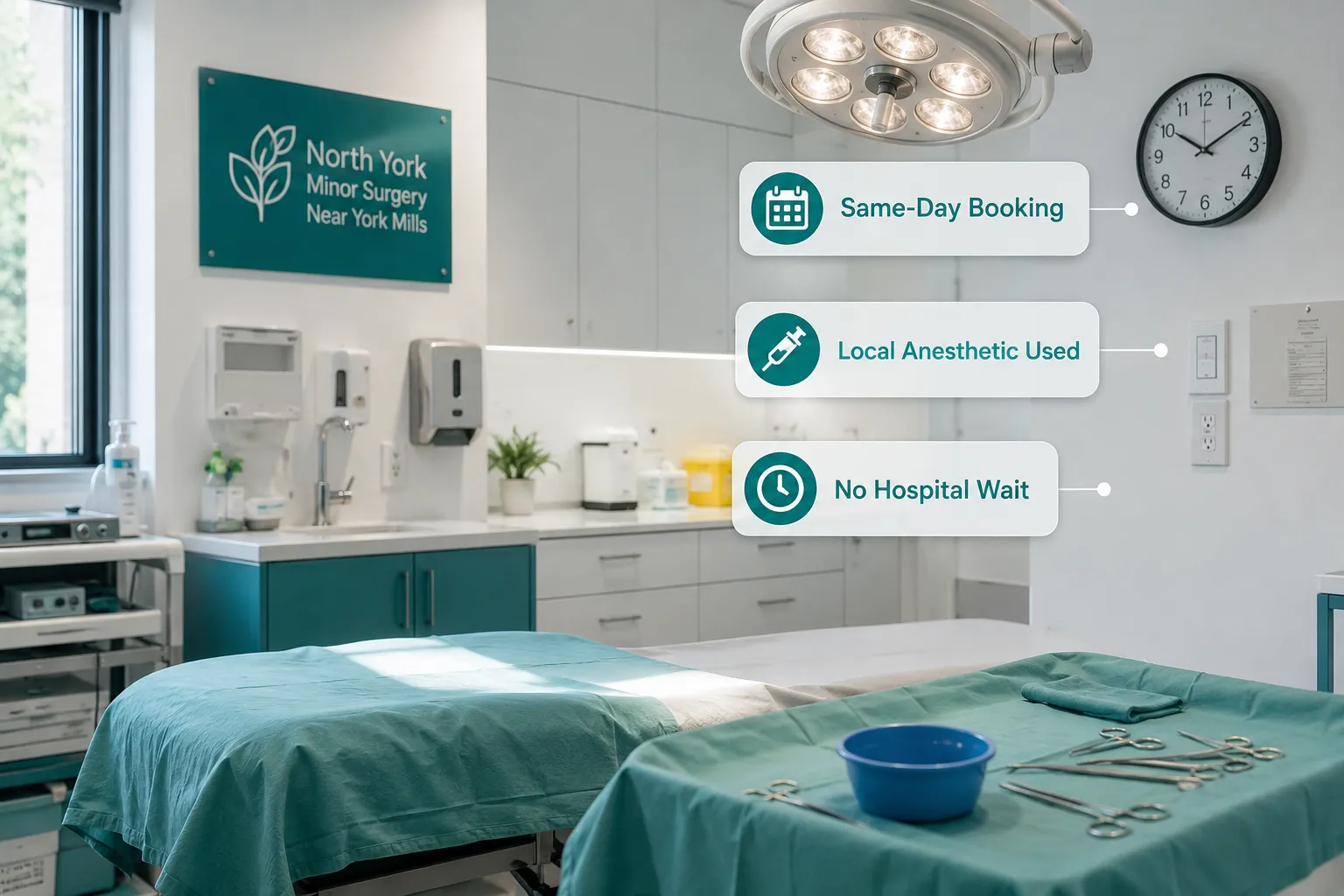
A new dedicated minor surgery clinic opened in the York Mills area in July 2026, giving residents a nearby, non-hospital option for these procedures [1]. This clinic accepts self-referrals, meaning a patient does not necessarily need a family doctor's note before booking a consultation for a suspicious mole, an inflamed cyst, or a lump suspected to be a lipoma [2].
Local options near York Mills generally fall into three categories:
Choose a dedicated minor surgery center if speed and self-referral matter most. Choose a dermatology clinic if the lesion needs ongoing skin monitoring alongside removal. Choose a cosmetic clinic only for small, already-diagnosed benign moles removed for cosmetic reasons.
For readers specifically searching for the York Mills clinic option, the Mole Removal In York Mills page outlines procedure details, and the The Minor Surgery Center York Mills Clinic page has current booking information.
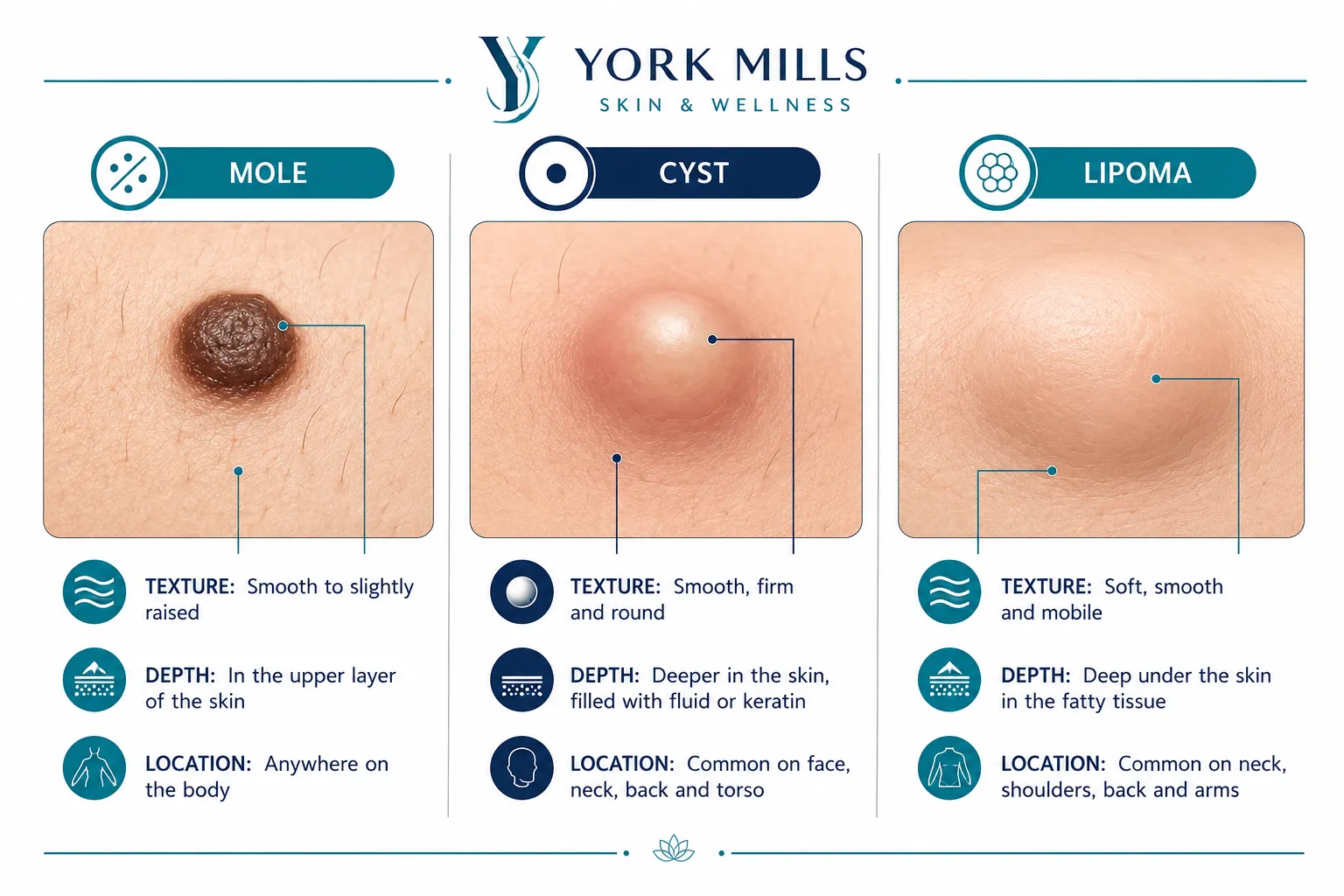
A mole is a pigmented skin growth made of melanocytes, a cyst is a fluid- or keratin-filled sac under the skin, and a lipoma is a soft lump of fatty tissue that grows slowly beneath the skin. Each one needs a different removal technique, so an accurate diagnosis before treatment matters more than most people expect.
Here is how the three compare side by side:
FeatureMoleCystLipomaWhat it isCluster of pigment-producing cellsSac filled with fluid or keratinFatty tissue lump under the skinTypical feelFlat or slightly raised, firmRound, movable, sometimes tenderSoft, doughy, moves under pressureGrowth speedUsually stable, can change over yearsCan grow steadily or flare up suddenlyVery slow, over months to yearsMain removal methodExcision or shave removalFull excision including the sac wallSurgical excisionKey concern if untreatedSome can become cancerousCan become infected or inflamedRarely dangerous but can keep growing
Common mistake: People often assume any new bump is "just a cyst" without getting it checked. A lipoma that is unusually hard, fixed in place, or growing quickly should be evaluated rather than assumed benign, since this pattern is less typical of a standard lipoma.
For a deeper explanation of what makes a mole medically benign, see this guide on benign mole characteristics. For questions about lipoma safety specifically, this article on whether a lipoma can turn into cancer covers the rare exceptions.
A mole needs medical evaluation, and possibly removal, if it changes shape, size, or color, bleeds, itches persistently, or has irregular borders. Dermatologists and minor surgery clinics use the well-known "ABCDE" pattern (Asymmetry, Border irregularity, Color variation, Diameter growth, Evolution over time) as a screening checklist, though a professional exam is still the only reliable way to confirm risk.
Signs that warrant a same-week appointment:
Decision rule: Choose an urgent assessment if a mole is changing quickly or bleeding on its own. Choose a routine consultation if the mole has looked the same for years but the patient simply wants it removed for comfort or appearance.
Suspicious lesions should go to a clinic equipped to send tissue for pathology, not a purely cosmetic provider. The Suspicious Mole Assessment Toronto page explains what that evaluation process looks like, and the Mole Biopsy Toronto page details biopsy and pathology testing for lesions that need lab confirmation.
A family doctor or walk-in clinic can examine a mole and decide whether it looks safe, but most do not perform surgical removal themselves; they typically refer patients to a dermatologist or minor surgery clinic. Some family doctors do remove small, clearly benign moles in-office, but this varies widely by practice and equipment available.
What a walk-in clinic or family doctor can typically do:
What they usually cannot do:
Edge case: If a mole or cyst is actively infected, inflamed, or bleeding heavily, a walk-in clinic or emergency department is appropriate for immediate stabilization, with definitive removal scheduled afterward at a specialized clinic.
Because many patients want to skip the referral step entirely, self-referral minor surgery centers have become a practical shortcut. The Mole Check Without Referral Toronto page explains how self-referral works for Toronto-area patients, including those near York Mills.
For most lipomas, a minor surgery clinic or a surgeon experienced in excisions is the more direct choice, while a dermatologist is better suited for lesions that also need ongoing skin monitoring or biopsy work. Both can remove a lipoma; the right choice depends on the lipoma's size, depth, and whether there's any diagnostic uncertainty.
Choose a minor surgery center if:
Choose a dermatologist if:
Common mistake: Waiting months for a dermatology referral for a lipoma that a minor surgery center could remove within a week or two. Lipomas rarely resolve on their own, so delaying does not typically reduce the eventual procedure size, but it can allow the lump to keep growing slowly over time.
The strongest local options near York Mills combine a dedicated minor surgery center for speed with nearby dermatology and cosmetic clinics as alternatives for specific needs. Because York Mills sits within a dense stretch of North York and Don Mills medical services, patients have several credible choices within a short drive.
Notable options in the area include:
This cluster of specialized and cosmetic providers within a small radius of York Mills means patients rarely need to travel far to compare options [1]. Industry coverage from August 2026 has also highlighted minor surgery and skin-lesion clinics in the broader Toronto market as a growing category, reflecting rising demand for accessible, non-hospital removal services [5].
Minor Surgery Center, York Mills Location
85 Scarsdale Rd Unit 101, North York, ON M3B 2R2
Self-referral accepted for mole, cyst, and lipoma consultations. Weekday appointments available.
Decision rule: Choose the dedicated minor surgery center if booking speed and self-referral matter most. Choose Dermapure Don Mills if broader dermatology care or aesthetic services are also needed. Choose a laser or cosmetic clinic only for small, already-confirmed benign moles.
For comparison shopping across the wider Toronto region, Best Skin Cancer And Screening Clinics In Toronto reviews clinics with a stronger focus on lesion screening, and Best Mole Removal Clinics Near You offers a broader city-wide comparison. Patients specifically in the North York corridor may also want to review the Best Mole, Cyst & Minor Surgery In North York page.
Cost depends on whether the removal is medically necessary or cosmetic, the size and location of the lesion, and whether pathology testing is required. Medically necessary removals are typically billed through OHIP with no out-of-pocket cost, while cosmetic removals are paid privately and priced per lesion.
Factors that change the price:
Common mistake: Assuming all mole removals cost the same. A single small cosmetic mole removal is priced very differently from a lipoma excision or a suspicious lesion that requires biopsy and follow-up.
For a full breakdown of what affects mole removal pricing, see Mole Removal Cost 2025 and the general overview at Cyst Removal Cost In Ontario. Both explain how medical necessity affects what a patient pays out of pocket.
Lipoma removal is covered by OHIP when a physician documents medical necessity, such as pain, restricted movement, rapid growth, or uncertainty about whether the lump is something more serious. Purely cosmetic removal of a lipoma that causes no symptoms is generally not covered and is billed privately.
OHIP is more likely to cover removal when:
OHIP is less likely to cover removal when:
Quick example: A lipoma on the forearm that has stayed the same size for two years and causes no discomfort is usually classified as cosmetic. A similar lipoma that suddenly doubles in size or becomes tender is more likely to meet the medical necessity threshold for coverage.
Since OHIP eligibility depends on documentation from a physician's assessment, it's worth discussing coverage directly with the clinic before booking. The Minor Skin Surgery FAQ Section covers common billing and coverage questions in more detail.
Most cyst removals take between 15 and 45 minutes under local anesthetic, depending on the cyst's size, depth, and location. Recovery is typically quick: light activity can usually resume within a day, while full healing of the incision site takes one to a few weeks.
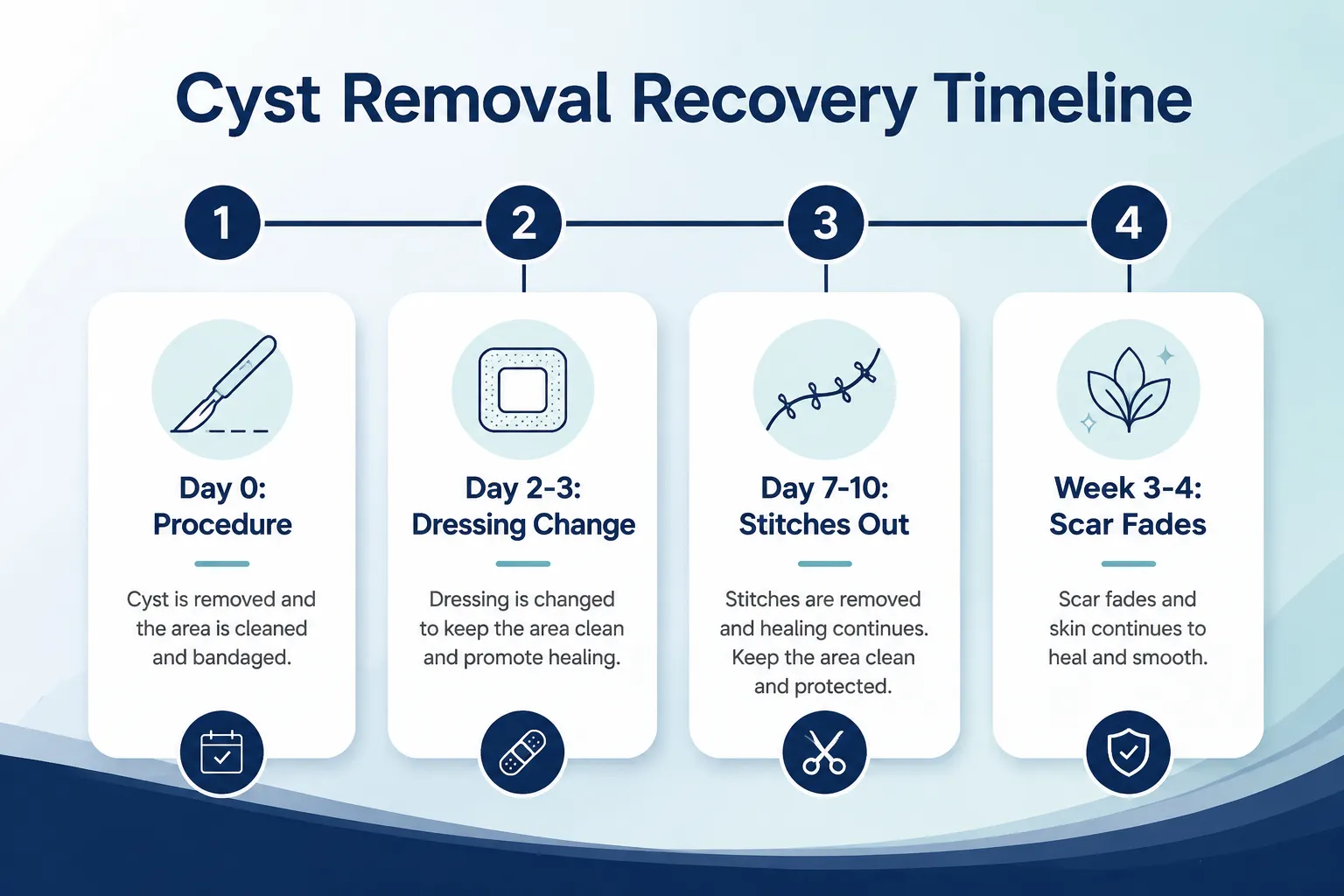
Typical cyst removal timeline:
Recovery expectations:
Edge case: Cysts on the scalp, face, or near joints can take slightly longer to heal because of movement or hair coverage. The Cyst Removal On Scalp and Facial Cyst Removal Techniques guides cover location-specific recovery differences.
Common mistake: Removing the dressing too early or picking at a healing scab, which increases infection risk and can worsen scarring. Following the clinic's specific aftercare sheet matters more than general internet advice, since techniques vary by cyst type and location.
For a step-by-step breakdown of the entire procedure, see Cyst Removal Surgery Step By Step, and for why the sac wall matters so much for preventing recurrence, review Cyst Sac Removal: Why It's Crucial To Remove The Entire Cyst.
There is no reliable non-surgical method that fully removes a lipoma; surgical excision remains the standard approach because it removes the entire fatty lump rather than shrinking it. Some clinics mention liposuction-style techniques or steroid injections for very small lipomas, but these carry a higher risk of incomplete removal and recurrence compared to excision.
Why non-surgical methods fall short:
Decision rule: Choose surgical excision if the goal is complete, lasting removal, or if there's any uncertainty about whether the lump is truly a lipoma. Consider a non-surgical option only for very small, confirmed lipomas where a patient specifically wants to avoid a scar, understanding that regrowth is more likely.
Common mistake: Choosing a non-surgical option based on marketing claims of "no downtime" without understanding the meaningfully higher recurrence rate compared to excision.
Attempting to remove a mole or cyst at home, using tools like needles, tweezers, or over-the-counter mole removal creams, carries meaningful risks including infection, scarring, incomplete removal, and missing a cancerous lesion that needed proper evaluation. These risks apply regardless of how small or "simple" the lesion looks.
Specific risks of home removal:
Edge case: Popping a cyst at home might seem to provide temporary relief, but the sac wall almost always remains under the skin, meaning the cyst is likely to refill and recur, sometimes with a higher infection risk than before.
"A cyst that has been squeezed or partially drained at home is often harder to remove cleanly later, because the surrounding tissue becomes inflamed and scarred."
Anyone tempted to try at-home removal should weigh that short-term convenience against the higher chance of infection, scarring, and needing a second, more complicated procedure later. For a closer look at whether removal itself carries cancer risk (a common home-removal myth), see Does Removing A Mole Cause Cancer.
An untreated cyst can stay stable for years, but it can also grow larger, become inflamed, rupture under the skin, or become infected, particularly if it is repeatedly irritated by clothing, shaving, or pressure. Whether removal is urgent depends on the cyst's location, size trend, and symptoms.
Possible outcomes of leaving a cyst untreated:
Decision rule: Choose prompt removal if the cyst is growing, becoming painful, or located somewhere prone to friction, like the scalp, back, or waistline. A stable, painless cyst can often be monitored, though many patients still choose removal to avoid future flare-ups.
For examples of how location affects both risk and removal technique, see the guides on Cyst Behind Ear and Belly Button Cyst, both of which cover common friction-prone cyst sites.
The right choice for where to get a mole, cyst or lipoma removed near York Mills comes down to matching the lesion type and urgency to the right kind of clinic. A dedicated minor surgery center covers most cases efficiently, while a dermatologist or biopsy-focused clinic is better for diagnostic uncertainty.
A simple checklist for choosing a provider:
Quick example: A patient with a stable, longstanding mole they simply want removed for comfort might go straight to a minor surgery center for a quick, self-referred appointment. A patient with a mole that has changed shape in the last two months should prioritize a clinic that offers on-site biopsy and pathology testing.
Given the growing number of specialized and cosmetic providers clustered near York Mills, and ongoing forward-looking expansion of minor surgery and dermatology capacity in the area, patients now have more flexibility in choosing between speed, specialization, and cost [1][5]. Related regional guides, including Cyst Removal In York Region and Best Melanoma Specialist Near Me, can help patients compare options if they are willing to travel slightly farther for a specific specialty.
Is there a minor surgery clinic directly in York Mills?
Yes. A dedicated minor surgery clinic opened in the York Mills area in July 2026, located at 85 Scarsdale Rd Unit 101, North York, ON M3B 2R2, offering mole, cyst, and lipoma removal with self-referral booking [1][3].
Do I need a referral to book a mole or cyst removal near York Mills?
Not necessarily. Many minor surgery centers near York Mills accept self-referrals for consultations, meaning patients can book directly without first visiting a family doctor [2].
How much does mole removal cost near York Mills?
Cost depends on whether the removal is medically necessary (typically OHIP-covered) or cosmetic (privately billed based on lesion size and number). A detailed cost breakdown is available in the Mole Removal Cost 2025 guide.
Can a walk-in clinic remove a mole or cyst?
A walk-in clinic can assess a mole or cyst but usually refers surgical removal to a dermatologist or minor surgery center, since most walk-in clinics are not equipped for excisional procedures.
How long does cyst removal take?
Most cyst removals take 15 to 45 minutes under local anesthetic, depending on the cyst's size and location, with light activity possible within a day or two afterward.
Is lipoma removal covered by OHIP?
Lipoma removal is covered by OHIP when it is medically necessary, such as when the lipoma is painful, restricts movement, or requires diagnostic confirmation. Purely cosmetic removal is billed privately.
Are there risks to removing a mole at home?
Yes. Home removal risks infection, incomplete removal, permanent scarring, and missing a potentially cancerous lesion, since no pathology testing can be done on tissue removed outside a clinical setting.
Should a lipoma be removed by a dermatologist or a surgeon?
Either can remove a lipoma. A minor surgery center or surgeon is typically faster for a confirmed lipoma, while a dermatologist is a better fit if there's diagnostic uncertainty or other skin concerns to address.
What happens if a cyst is never removed?
An untreated cyst may stay stable, grow slowly, become inflamed, or become infected and rupture, particularly in areas exposed to friction like the scalp, back, or waistline.
Are there non-surgical treatments for lipomas?
No fully reliable non-surgical option exists. Surgical excision remains the standard because it removes the entire fatty lump, while injections or liposuction-based methods carry a higher risk of regrowth.
Finding the right place for a mole, cyst, or lipoma removal near York Mills comes down to matching the lesion to the right type of provider. A dedicated minor surgery center, such as the York Mills location at 85 Scarsdale Rd Unit 101, North York, ON M3B 2R2, offers self-referral booking and fast turnaround for most straightforward removals [1][2][3]. A dermatologist is the better fit when there's diagnostic uncertainty or when ongoing skin monitoring is needed alongside the removal.
Next steps:
Avoiding at-home removal and choosing a properly equipped clinic remains the safest, most reliable path to a clean result and an accurate diagnosis.
[1] The Minor Surgery Center Opens New York Mills Clinic In York Mills - https://www.theminorsurgerycenter.com/blog/the-minor-surgery-center-opens-new-york-mills-clinic-in-york-mills
[2] theminorsurgerycenter - https://www.theminorsurgerycenter.com/
[3] The Minor Surgery Center York Mills Clinic - https://www.theminorsurgerycenter.com/the-minor-surgery-center-york-mills-clinic
[4] Don Mills - https://www.dermapure.com/en/locations/toronto/don-mills/
[5] Best Skin Cancer And Screening Clinics In Toronto - https://www.theminorsurgerycenter.com/best-skin-cancer-and-screening-clinics-in-toronto
[6] Private Aesthetic Dermatology Service - https://www.dermapure.com/en/locations/toronto/don-mills/private-aesthetic-dermatology-service/