
Last updated: September 15, 2026
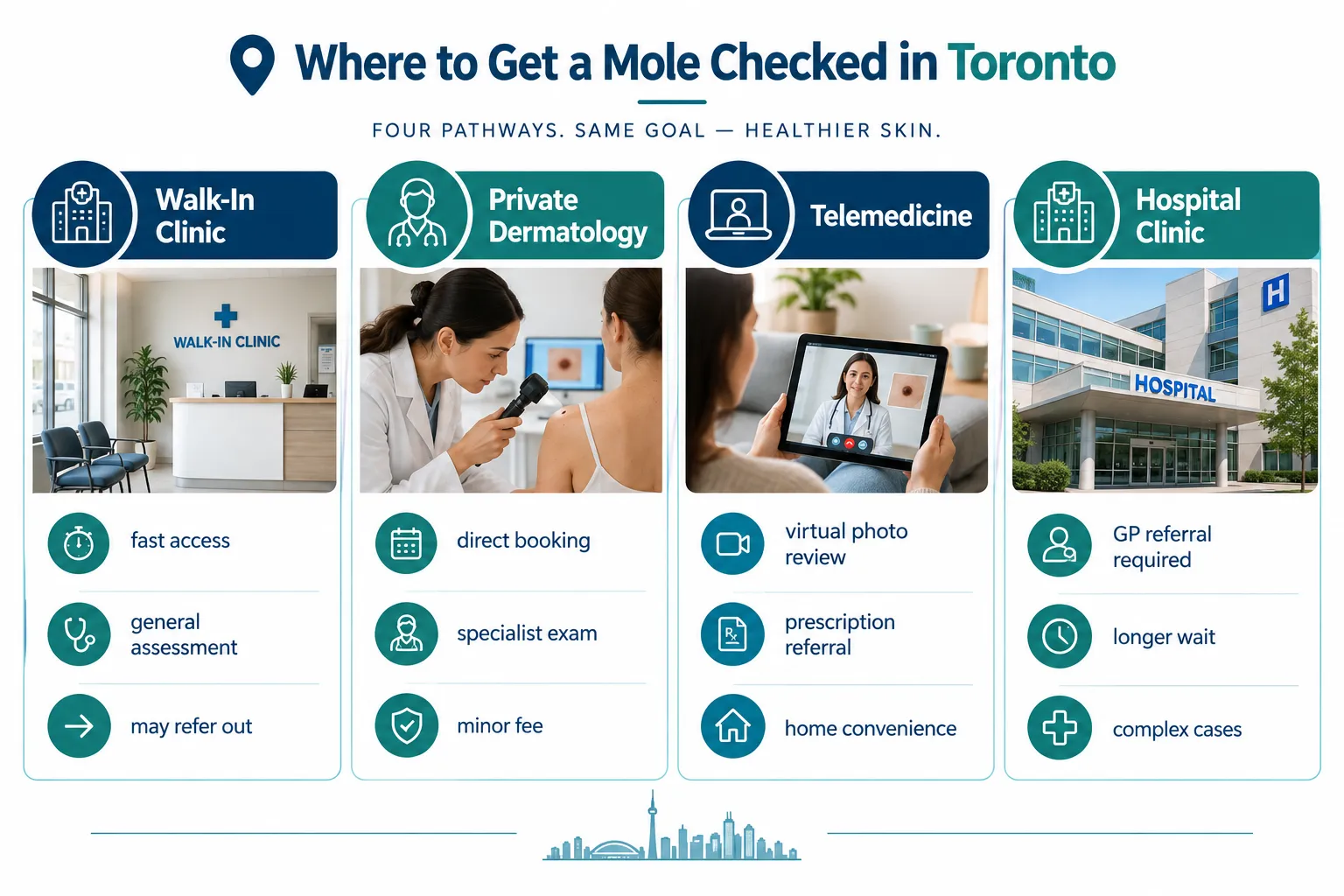
You do not need a family doctor's referral to get a mole checked in Toronto. Walk-in clinics, private dermatology clinics, minor surgery centers, and telemedicine platforms like Maple all accept self-referred patients for mole assessments. The fastest route for a genuinely concerning mole is a private skin lesion clinic or a walk-in medical clinic with same-day or next-day booking, while OHIP-covered dermatologist visits still usually require a referral unless the clinic operates as a direct-access screening service.
Walk-in dermatology clinics in Toronto let patients book or drop in for a skin assessment without a referral from a family doctor. These clinics can examine a mole, use a dermatoscope, and tell a patient whether the spot looks benign or needs further testing, but not every walk-in location has a dermatologist on-site or biopsy capability.
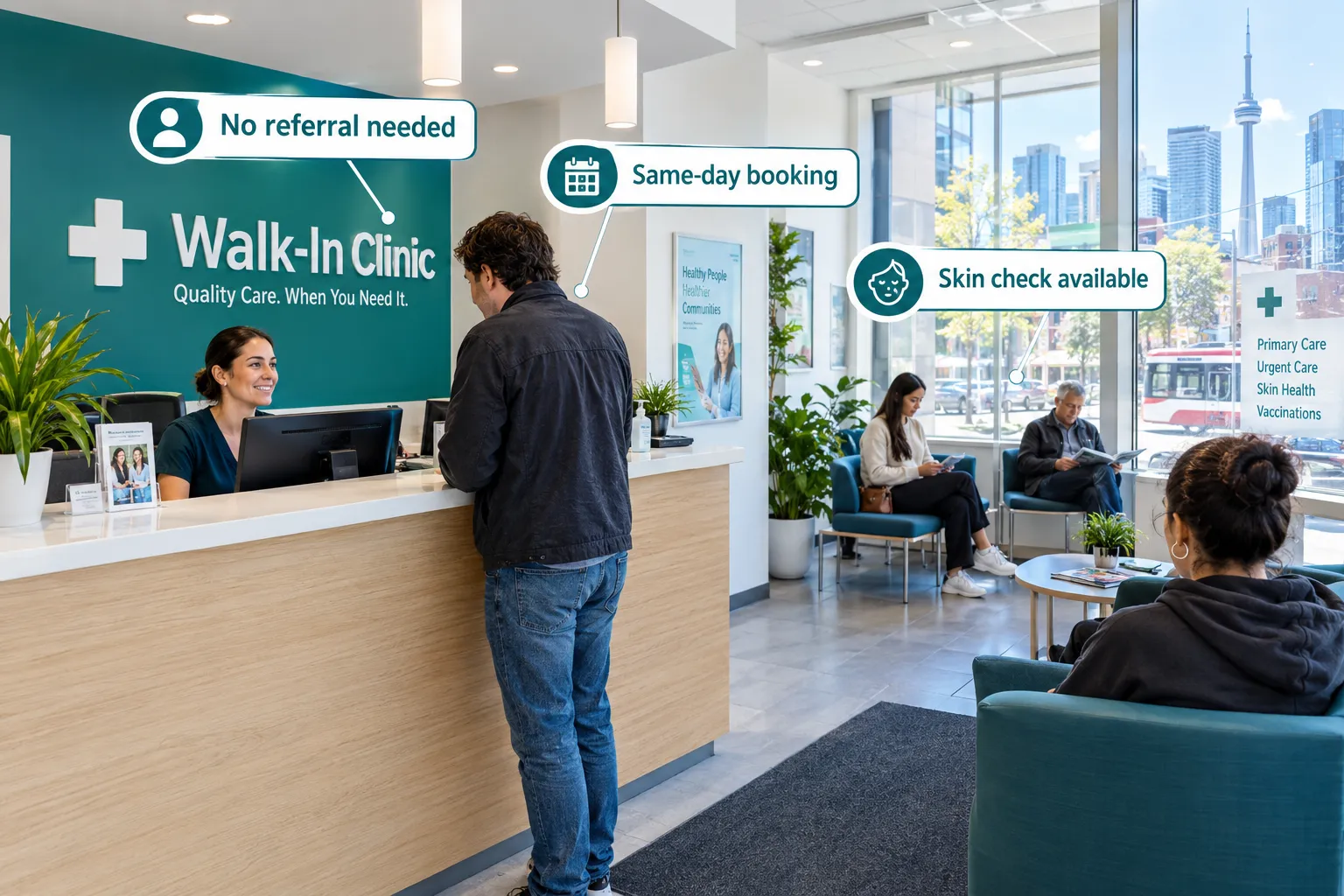
Toronto has a mix of walk-in medical clinics (staffed by general practitioners) and walk-in dermatology-specific clinics (staffed by dermatologists or specially trained physicians). The distinction matters:
A patient who has a single mole they're worried about, with no other health complications, typically does best at a dedicated skin lesion clinic rather than a general walk-in, because the second visit for a biopsy or removal is avoided. For a full breakdown of clinics built for direct access, see this guide to the best no-referral walk-in dermatology clinics in Toronto [1].
Common mistake: assuming any walk-in clinic can remove a mole the same day. Many can only assess and refer; always confirm on the phone whether the clinic performs in-house biopsy or removal before booking, especially if time matters.
Patients can see a dermatologist in Toronto without a referral by booking directly with a private dermatology practice or a self-pay skin clinic, since Ontario's referral requirement applies mainly to OHIP-billed specialist visits arranged through the public system. Private and self-referred routes bypass that requirement entirely.
Ontario's health system generally expects a referral for a subsidized visit to a specialist, including dermatologists, because OHIP funding flows through a structured referral pathway [3]. That said, several legitimate ways around this exist:
A decision rule worth following: choose a private or self-referred dermatology clinic if a mole has changed recently and waiting weeks for a public referral feels risky. Choose the traditional GP-to-dermatologist referral route only if the mole is stable, the situation is not urgent, and cost is the primary concern.
Melanoma Canada also maintains a directory of dermatologists and screening clinics across the country that accept direct bookings, which is a useful cross-check when comparing Toronto options [4].
Yes, a walk-in clinic is an appropriate and common first stop for a mole check in Toronto, and it functions similarly to urgent care for non-emergency skin concerns since Toronto does not have dedicated "urgent care" mole clinics in the way some U.S. cities do. The physician there will assess the mole and decide whether it needs a dermatologist, a biopsy, or simply monitoring.
What actually happens at a Toronto walk-in for a mole concern:
Edge case: walk-in clinics vary widely in dermoscopy training. A physician without specific skin-lesion experience may err on the side of over-referring, which adds time. Patients who want a more decisive answer, and who are willing to pay privately, often skip the walk-in step and book directly with a skin lesion assessment clinic or a dedicated mole check clinic in Toronto.
There is no formal "urgent care" designation for skin concerns in Ontario's system the way there is for injuries or infections, so a same-day walk-in visit or a private clinic with rapid booking is the practical equivalent.
A private dermatologist in Toronto can be booked without a referral because the visit is paid for directly by the patient rather than billed through OHIP's referral-based specialist system. This is the most reliable way to skip the wait entirely.
Private dermatology and skin lesion clinics operate on a different funding model than public OHIP dermatology:
Access routeReferral neededTypical waitWho paysOHIP dermatologist via GPYesWeeks to monthsOHIP (if covered)Private dermatology clinicNoDays to 2 weeksPatient (self-pay)Minor surgery / mole clinicNoDays to 1-2 weeksPatient, some OHIP portions may applyHospital melanoma clinicYesWeeks (urgent cases faster)OHIPTelemedicine (e.g., Maple)NoSame day to 48 hoursPatient or insurance
Private clinics can move faster because they are not competing for limited OHIP-funded specialist slots. This matters most for patients who notice a mole has changed and don't want to wait through a multi-step referral chain. The Toronto Dermatology Centre is one example of a practice with both OHIP and self-pay options depending on the service [6], and mole mapping programs are increasingly offered as a self-pay add-on for higher-risk patients [7].
Common mistake: assuming "private" always means expensive cosmetic-only care. In reality, many private clinics handle medically necessary assessments, biopsies, and referrals just as thoroughly as the public system, just with faster scheduling. For a curated list of clinics built around this model, see the best mole check clinics in Toronto with rapid access and no referral.
A basic mole assessment at a private Toronto clinic generally costs less than a dermatologist consultation elsewhere in the province, though exact pricing depends on whether the visit includes dermoscopy, photography, or biopsy. OHIP covers mole removal only when it is medically necessary, not when the removal is purely cosmetic.
Here's how the cost and coverage split typically works:
Decision rule: if a mole is asymptomatic and has looked the same for years, expect any removal to be classified cosmetic and billed privately. If a mole has changed, bled, or been flagged during a screening as suspicious, medically necessary criteria usually apply, which shifts the removal (though not always the initial private consultation) toward OHIP coverage. For a breakdown of what typical pricing looks like across procedures, see this mole removal cost guide for 2026, and for the assessment side specifically, the mole check page outlines what's included in a standard screening visit.
The dermatologists most likely to accept new patients quickly in Toronto are those at private or hybrid clinics, since fully OHIP-billed dermatology practices often have long waitlists and limited new-patient capacity. Melanoma Canada's clinic directory and private mole clinics are the two most practical starting points.
When comparing options, look for these signals that a clinic is genuinely accepting new patients without a long delay:
Canadian Dermatology Association resources and the Melanoma Canada directory are both useful for cross-checking which Toronto dermatologists are currently listed as accepting patients [2][4]. For a Toronto-specific shortlist that filters for direct booking, the guide to finding the best dermatologist in Toronto reviews over 50 local providers, and Find a Dermatologist in Toronto breaks down which practices take self-referred patients versus GP-referred only.
Edge case: some dermatologists accept new patients only for specific concerns, such as acne or psoriasis, and not for mole screening. Always confirm the reason for the visit matches what the clinic actually books for before assuming "accepting new patients" applies to a skin cancer check.
Getting a mole checked in Toronto without a referral typically takes anywhere from same-day to about two weeks, depending on the route chosen, compared to several weeks or months through the traditional GP-to-dermatologist referral pathway. Private and walk-in options are consistently faster.
Realistic timelines by pathway:
One factor that skews these numbers: Toronto has periodically run temporary community screening initiatives, such as mobile mole-check events, that offer free or low-cost screenings but come with long lines and limited slots, sometimes requiring hours of waiting on the day itself. These events are useful for basic peace of mind but are not a reliable option for someone with an actively changing or concerning mole who needs a decisive answer quickly.
Choose a private clinic or walk-in dermatology option if: a mole has changed in the past few weeks or months and waiting is not acceptable.
Choose the standard GP referral route if: the mole is stable, there is no urgency, and the goal is to minimize out-of-pocket cost.
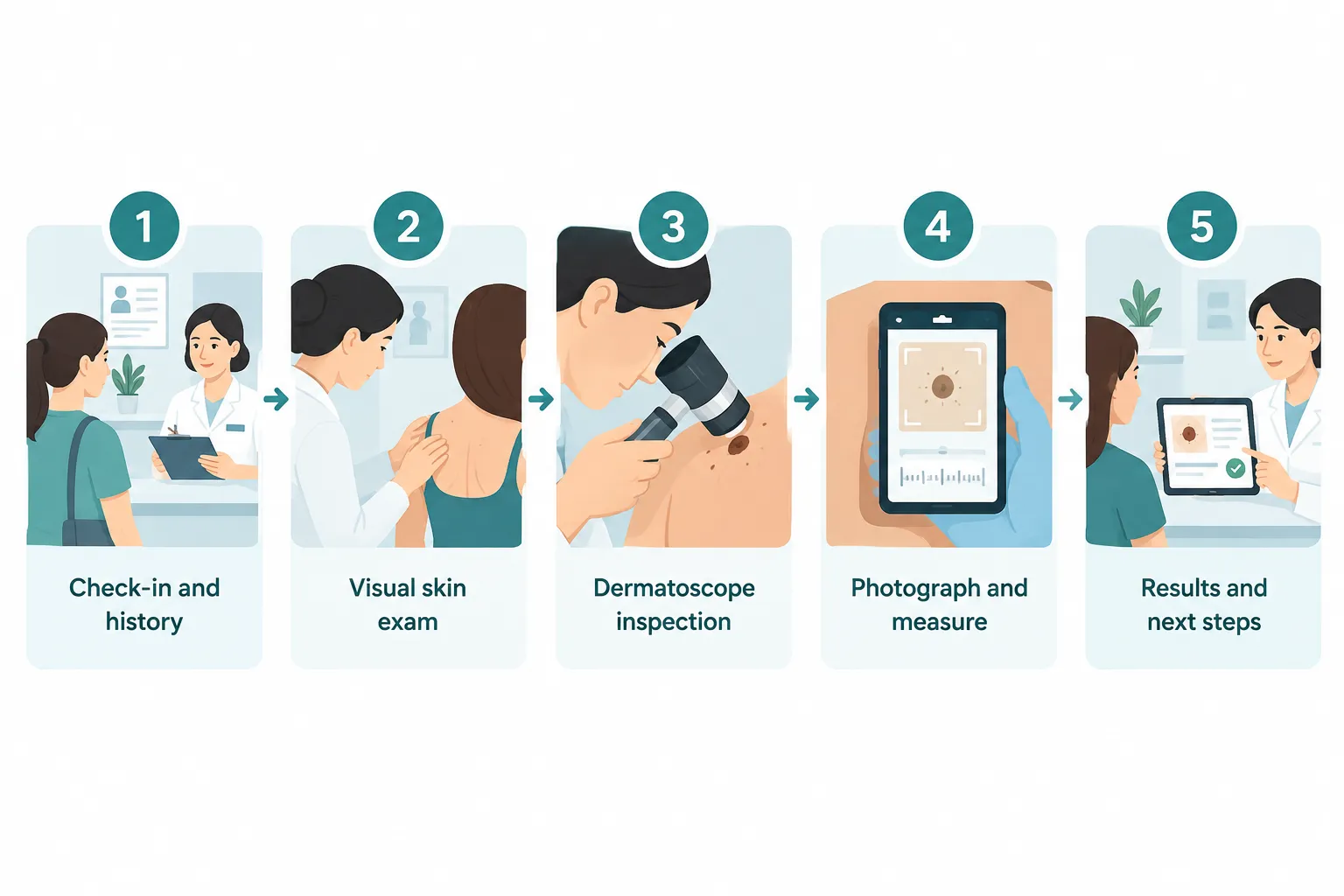
A mole screening appointment in Toronto usually takes 15 to 30 minutes and involves a visual exam, a review of personal and family skin cancer history, and often a closer look with a dermatoscope. Most visits end with either reassurance, a monitoring plan, or a referral for biopsy.
A typical appointment follows this sequence:
Common mistake: expecting every visit to end with a definitive yes-or-no answer on cancer. Even experienced clinicians often cannot confirm malignancy by sight alone; a biopsy and pathology report are the only way to be certain, and demystifying that report afterward is its own step in the process, covered in detail in this guide to pathology reports after mole removal. Patients considering a broader check rather than a single spot should look at a full body skin exam, which covers the whole skin surface rather than one lesion.
A mole should be checked by a doctor promptly if it has changed in size, shape, or color, developed irregular or blurred borders, started bleeding or itching, or looks noticeably different from the person's other moles. These signs do not confirm cancer, but they are the standard triggers for a professional assessment rather than a wait-and-see approach.
The widely used ABCDE checklist helps frame the decision:
A useful decision rule: if a mole checks even one of these boxes and the change happened within the last few months, book an assessment within one to two weeks rather than waiting for the next annual physical. If a mole has looked the same for years and shows none of these signs, routine annual self-checks are usually sufficient, though anyone with a family history of melanoma or many atypical moles should still get periodic professional screening regardless of how any single mole looks.
For context on what a low-risk mole typically looks like compared to a concerning one, see this explainer on benign moles, and for a comparison of raised versus flat lesions specifically, the guide on flat mole versus raised mole skin cancer risk is worth reviewing. Anyone noticing a mole that is actively changing, bleeding, or growing should not wait for a scheduled annual exam; that pattern is exactly what suspicious mole assessment services are built to handle quickly.
A mole that has stayed the same for a decade is a very different concern than one that changed shape in the last two months. Timing and change matter more than size alone.
A GP can assess a mole, rule out obvious low-risk cases, and refer onward if needed, but a dermatologist has specialized training in skin conditions and typically more experience distinguishing benign lesions from early skin cancer using dermoscopy. For a single worrying mole, seeing a dermatologist or skin-lesion specialist directly often saves a step.
Here is how the two compare in practice:
Decision rule: choose a GP first if the concern is minor, there's no urgency, and cost matters more than speed. Choose a dermatologist or skin lesion specialist directly if the mole shows ABCDE warning signs, if there's a family history of melanoma, or if a faster answer is worth a private consultation fee. This is also the logic behind bundled services like suspicious mole assessment and same-visit mole biopsy, which combine the assessment and the diagnostic step instead of splitting them across two separate referrals.
A telemedicine mole check can screen for obvious risk factors and give general guidance, but it cannot replace an in-person dermoscopic exam for a genuinely suspicious mole. Virtual platforms work best as a fast first opinion or for low-risk monitoring, not as the final word on anything unusual.
Platforms like Maple connect patients with licensed physicians, including dermatologists in some cases, through photo submission and video consultation, without requiring a referral [8]. This works well for:
It works less well for:
Common mistake: relying solely on a phone photo submitted through an app without professional dermoscopy, especially for a mole that has changed. A virtual visit is a reasonable first filter, but any lesion flagged as even moderately concerning should move to an in-person exam within days, not weeks. Reviews of AI-based mole mapping apps show similar limitations around image quality and the absence of dermoscopic magnification, which is worth understanding before relying on any remote screening tool as a final answer see the analysis of 3D mole mapping app reliability.
Hospital-based melanoma and skin oncology clinics in Toronto, such as the one operated through Princess Margaret Cancer Centre, require a physician referral and are not a direct-access option for a first mole check. These clinics exist for confirmed or strongly suspected skin cancer cases, not general screening.
This distinction matters for setting expectations:
Edge case: if a walk-in or private clinic physician examines a mole and believes it is highly suspicious for melanoma, they can fast-track a referral to a hospital-based service rather than sending the patient through the standard multi-week specialist queue. This is one reason starting with a private mole check clinic isn't just about speed for low-risk cases; it also creates a faster on-ramp into urgent hospital care if something serious turns up.
As of September 2026, the fastest reliable pathway for a mole concern in Toronto without a referral is: book directly with a private dermatology or minor surgery clinic that specializes in skin lesion assessment, request dermoscopy at the first visit, and ask upfront whether biopsy or removal can happen at the same location if needed. This avoids the referral bottleneck at every stage.
Step-by-step checklist:
Ontario's direct-access landscape has been gradually expanding, with more clinics and telemedicine platforms offering self-referred mole checks each year. That trend is likely to continue, meaning patients in Toronto should expect even more no-referral options in the near future, though hospital-based oncology care will likely remain referral-based for the foreseeable future given the complexity of those cases.
Do I need a referral to get a mole checked in Toronto?
No. Walk-in clinics, private dermatology practices, and minor surgery centers all accept self-referred patients for mole checks. A referral is mainly required for OHIP-billed hospital dermatology or oncology clinics.
Can a walk-in clinic remove a suspicious mole?
Some can, especially minor surgery or skin lesion clinics, but general walk-in medical clinics often only assess and refer. Confirm biopsy and removal capability before booking if same-visit treatment matters.
How much does a private mole check cost in Toronto?
Costs vary by clinic and whether dermoscopy, photography, or biopsy is included. Medically necessary follow-up care is often covered by OHIP, while purely cosmetic removal is not.
Is telemedicine a reliable way to check a mole?
It works as a fast first opinion or for low-risk monitoring, but it cannot replace an in-person dermoscopic exam for a genuinely suspicious mole, since photo quality limits what a physician can assess.
What is the fastest way to get a mole checked in Toronto?
Booking directly with a private dermatology or minor surgery clinic is usually faster than the traditional GP-to-dermatologist referral route, often within a few days to two weeks instead of several weeks or months.
Does OHIP cover mole removal?
OHIP covers mole removal when it is medically necessary, such as for a suspicious or symptomatic lesion. It does not cover removal done purely for cosmetic reasons.
When should a mole be checked by a doctor instead of monitored at home?
Any mole showing asymmetry, irregular borders, uneven color, growth beyond about 6mm, or recent change in appearance, bleeding, or itching should be checked by a professional rather than monitored alone.
Are hospital melanoma clinics an option for a first mole check?
No. Hospital-based melanoma and skin oncology clinics require a physician referral and are reserved for confirmed or strongly suspected skin cancer, not routine screening.
Getting a mole checked in Toronto without a referral is entirely possible, and for most people it's the faster, more practical route. Walk-in clinics handle basic assessments quickly, private dermatology and minor surgery clinics offer direct booking with dermoscopy and often same-visit biopsy, and telemedicine platforms provide a reasonable first opinion for low-risk situations. The traditional GP-to-specialist referral pathway still has a place, particularly for cost-sensitive, non-urgent cases, but it is rarely the fastest option.
The practical next step is straightforward: photograph the mole today, note any recent changes, and call a private skin lesion clinic to ask about dermoscopy and same-visit biopsy availability rather than waiting on a referral to move through the system. Anyone noticing rapid change, bleeding, or irregular borders should treat that as a reason to book within days, not months. For a direct, no-referral starting point in Toronto, review the options at Mole Check Toronto | Skin Cancer Screening & Assessment and book an assessment that matches the urgency of the mole in question.
[1] Best No Referral Walk In Dermatology Clinics In Toronto - https://www.theminorsurgerycenter.com/blog/best-no-referral-walk-in-dermatology-clinics-in-toronto
[2] canadiandermatology - https://canadiandermatology.com/
[3] Displayservice - https://www.centralwesthealthline.ca/displayservice.aspx?id=145713
[4] Find A Dermatologist Canada - https://melanomacanada.ca/find-a-dermatologist-canada/
[5] Do You Need A Referral To See A Dermatologist - https://facetdermatology.com/blogs/news/do-you-need-a-referral-to-see-a-dermatologist
[6] torontodermatologycentre - https://torontodermatologycentre.com/faq/
[7] Molemapping - https://torontodermatologycentre.com/molemapping/
[8] Dermatologists - https://www.getmaple.ca/providers/dermatologists/
[9] Skin Health Clinic - https://my.clevelandclinic.org/canada/services/skin-health-clinic
[10] Melanoma Skin Oncology - https://www.uhn.ca/PrincessMargaret/Clinics/Melanoma_Skin_Oncology