
Last updated: September 22, 2026
Surgical excision remains the most common way to treat skin cancer in Toronto. A physician numbs the area, cuts out the tumor along with a margin of healthy-looking skin, closes the wound with sutures, and sends the tissue to a lab to confirm the cancer is fully removed. Skin Cancer Removal in Toronto: What Surgical Excision Involves usually takes 30 to 60 minutes under local anesthesia, is covered by OHIP when medically necessary, and can often be booked directly at a dedicated minor surgery clinic without waiting months for a hospital referral.[1][2][3]
Surgical excision is a minor operation where a doctor removes a skin cancer along with a border of healthy tissue around it, then stitches the wound closed. This "safety margin" is removed on purpose, because cancer cells can extend slightly beyond what is visible to the eye.[1][3]
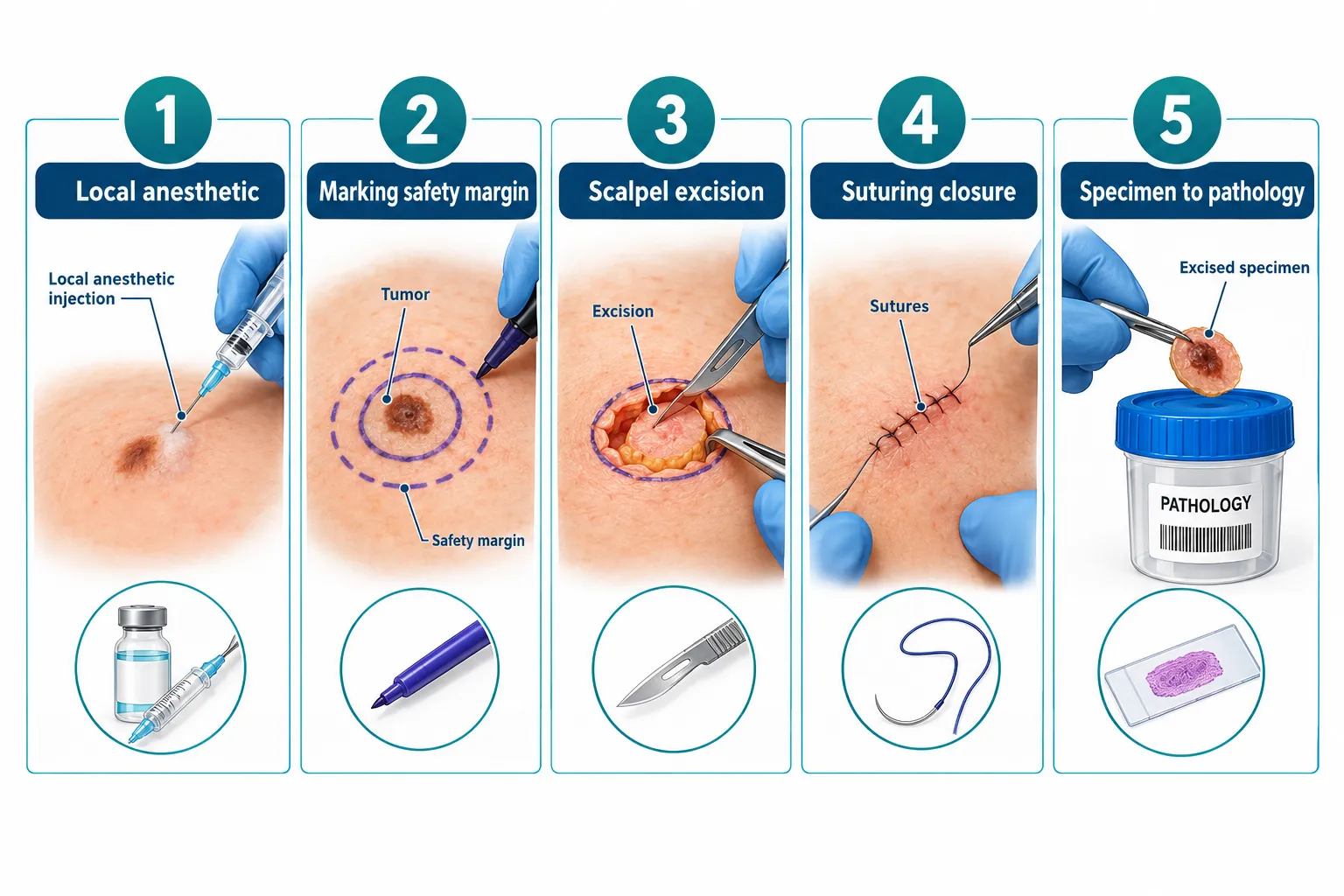
The basic sequence looks like this:
This approach applies to the three most common skin cancers: basal cell carcinoma, squamous cell carcinoma, and melanoma. For melanoma, the margin size is usually wider and may be based on how deep the tumor has grown, sometimes determined only after an initial biopsy.
Choose surgical excision if: a biopsy has already confirmed a non-melanoma skin cancer of typical size and location, or a melanoma requires wide local excision after staging. It is the default surgical treatment for the large majority of diagnosed skin cancers in Ontario, with more specialized techniques reserved for exceptions discussed later in this guide.[3][14]
A common mistake is assuming every mole removal or biopsy counts as "cancer surgery." A shave biopsy or punch biopsy is diagnostic, not curative, surgical excision is the treatment step that follows once pathology confirms cancer. Readers preparing for this step may also want to review what a mole biopsy in Toronto involves, since biopsy results usually determine the excision plan.
Most surgical excisions for skin cancer in Toronto take between 30 and 60 minutes from numbing to final suture, performed entirely under local anesthesia in an outpatient procedure room.[2] The exact time depends on tumor size, location, and whether reconstruction is needed.
Factors that affect procedure length include:
Quick example: A small basal cell carcinoma on the forearm might be excised and closed in under 30 minutes. A larger squamous cell carcinoma near the eyebrow, requiring layered closure by a plastic surgeon, could take closer to an hour.
Patients typically arrive, have the area marked and numbed, undergo the excision and closure, and leave the same day. No hospital stay is required for standard excisions.[2][12]
Before surgery, patients undergo an assessment and often a biopsy to confirm the diagnosis; during surgery, the area is numbed and the tumor is excised and closed; after surgery, patients go home the same day with wound care instructions and a follow-up appointment to review pathology results.[3][4]
Before the procedure:
During the procedure:
Immediately after:
Surgical excision itself is not painful because the area is fully numbed with local anesthetic before any cutting begins; patients may feel pressure or tugging but should not feel sharp pain during the procedure. After the anesthetic wears off, mild to moderate soreness at the incision site is common for one to a few days, usually managed with over-the-counter pain relief such as acetaminophen.[1][2]
A common concern is the injection itself, the anesthetic needle causes a brief pinch or burning sensation lasting a few seconds, which is the most uncomfortable part of the entire visit for most patients. If pain during or after the procedure feels severe, increasing, or accompanied by spreading redness, patients should contact their clinic promptly, since this can signal infection or a wound-healing issue rather than expected post-surgical soreness.
Recovery from skin cancer excision typically ranges from about 2 days to 2 weeks, depending on the size and location of the wound, with sutures usually removed between 5 and 14 days after surgery.[2][10] Facial wounds often heal faster in appearance but require more careful suture timing; wounds on the back or legs may take longer to fully close due to skin tension in those areas.
Standard aftercare checklist:
Edge case: Patients on blood thinners, those with diabetes, or older adults with thinner skin may experience slower healing or a higher chance of minor complications like bruising or delayed closure. These patients should flag their health history before the procedure so the surgical team can adjust technique and follow-up timing accordingly.
Anyone recovering from a basal cell carcinoma removal specifically may also find it useful to review basal cell carcinoma recovery expectations for a closer look at typical healing milestones.
Yes, surgical excision always leaves some form of scar, because the technique requires cutting through skin and closing it with sutures; however, the final appearance depends heavily on lesion size, location, closure technique, and aftercare.[3] A well-planned excision on the trunk or limb often fades to a thin line over several months to a year.
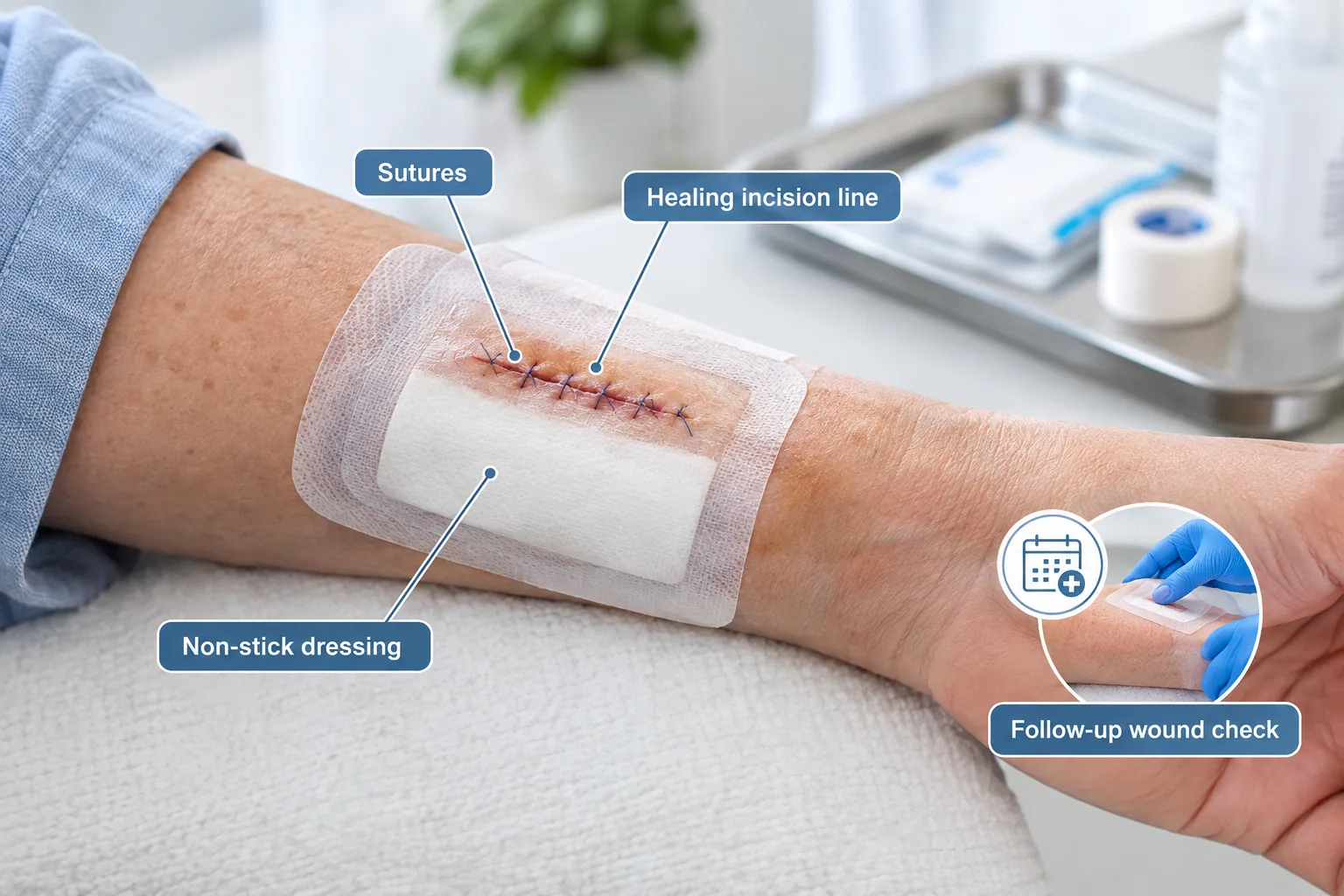
Scarring outcomes depend on:
Some Toronto minor surgery centers now build reconstruction into the same surgical visit. Board-certified plastic surgeons close the defect immediately after tumor removal, aiming to balance complete cancer clearance with a scar that heals as unobtrusively as possible, a meaningful difference for lesions on the face, ears, or other visible areas.[3][4]
Decision rule: Choose a clinic with plastic surgery, trained closure specifically if the lesion is on the face, neck, hands, or another cosmetically sensitive area. For excisions on the back, abdomen, or thighs, standard surgical closure is usually sufficient.
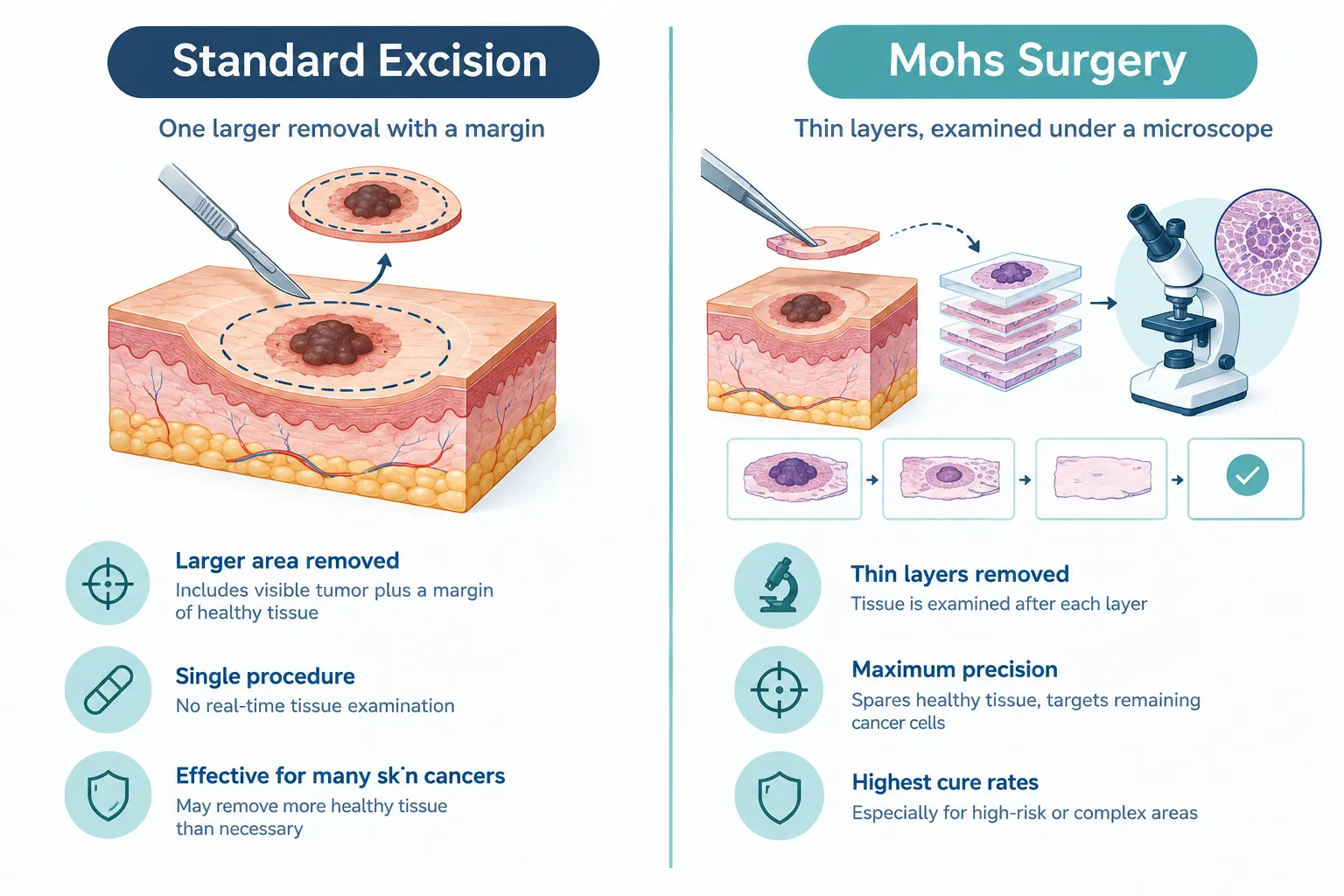
Surgical excision removes the tumor plus a fixed margin in one step and sends it to pathology afterward, while Mohs micrographic surgery removes the tumor in thin layers, examining each layer under a microscope on the spot before deciding whether more tissue needs to come out.[1][5][6] Mohs is generally reserved for higher-risk or cosmetically sensitive cases rather than being the default for every skin cancer.
FeatureStandard Surgical ExcisionMohs Micrographic SurgeryBest forMost basal cell, squamous cell, and melanoma casesLarge, recurrent, or facial/high-risk tumorsMargin checkingSent to lab after surgeryChecked layer by layer during surgeryTypical duration30 to 60 minutesSame day, but can involve several rounds and waiting periodsAccess in TorontoDirect booking at minor surgery clinicsReferral usually required, specialized centers onlyTissue sparingStandard margin, moderate sparingMaximum tissue sparing, useful near eyes/nose/ears
Cancer Care Ontario guidance cited by Toronto Mohs providers positions Mohs as the current standard for facial skin cancers where tissue preservation and precision matter most, while the Canadian Society of Surgical Oncology's Skin Cancers Pathway Map (updated September 2026) frames standard surgical excision as a primary treatment for many other lesions.[14][15] Carlton Skin Clinic and similar providers describe Mohs as suited to "unusual or more difficult" tumors, those that are large, in complex anatomical zones, or have come back after previous treatment, while routine cancers are more commonly managed with simple excision.[6][14]
Common mistake: Assuming Mohs is automatically "better" for every skin cancer. For a small, low-risk basal cell carcinoma on the shoulder, standard excision achieves the same cure goal with a faster, simpler visit and no need for a specialized referral.
Surgical excision principles are shared across melanoma and basal cell carcinoma, but margin size and staging steps differ significantly: basal cell carcinoma usually needs a narrower margin and no further staging, while melanoma often requires a wider margin sized to tumor depth and sometimes additional lymph node evaluation.[1][3]
Basal cell carcinoma (BCC):
Melanoma:
Squamous cell carcinoma, the third major type, sits between these two in typical behavior, it grows faster than BCC and carries a higher, though still generally low, risk of spread compared with BCC, which is why margins are sometimes slightly wider than for BCC.
For a broader overview of how these three cancers and other lesion types differ in appearance and behavior, see this guide on the 4 types of skin cancer, and for BCC specifically, this breakdown of BCC skin cancer characteristics.
Medically necessary skin cancer excisions in Toronto, including removal of basal cell carcinoma, squamous cell carcinoma, and melanoma, are typically fully covered by OHIP with no out-of-pocket cost for the surgery itself, provided a physician determines the removal is medically necessary rather than purely cosmetic.[2][4][9] Patients without valid OHIP coverage, such as some visitors, new residents, or those between coverage periods, may be responsible for private-pay fees, which vary by clinic and lesion complexity.
Key cost factors to understand:
Decision rule: If a lesion has already raised clinical suspicion of cancer or been biopsy-confirmed, ask the clinic directly whether the excision qualifies for OHIP coverage before assuming a private fee applies. Clinics such as North Toronto Surgical and The Minor Surgery Center explicitly state that medically necessary excisions are billed to OHIP.[2][4]
Anyone weighing removal of a lesion that turns out to be benign, such as a stubborn skin tag rather than a cancer, may want to compare options through this guide to skin tag removal in Toronto, since cosmetic removals follow a different payment path than confirmed skin cancer excisions.
Some dermatologist offices in Toronto do perform skin cancer excisions, but many refer patients to dedicated minor surgery or surgical clinics for the excision step, particularly for larger lesions, facial locations, or cases needing reconstructive closure.[3][4][5] Availability depends heavily on which dermatology practice a patient sees and whether that office has surgical capacity on-site.
Practical pathways in Toronto include:
Quick example: A patient with a biopsy-confirmed basal cell carcinoma on the cheek might be referred by their family doctor or dermatologist directly to a minor surgery center for excision and same-day reconstruction, bypassing a longer hospital surgical wait list.
Patients who have not yet had a lesion assessed may start with a full body skin exam in Toronto or a mole check in Toronto to determine whether a biopsy or direct excision is the appropriate next step.
The strongest option for most Toronto patients seeking skin cancer removal is a dedicated minor surgery center, because these clinics combine rapid assessment, biopsy, surgical excision, and reconstructive closure in one coordinated pathway, often without the wait times associated with hospital referral systems.[3][4][11] Several centers across the city now offer this model, including The Minor Surgery Center, North Toronto Surgical, Sunnybrook's Skin Clinic, and Unity Health's dermatology program.[3][4][7][11][12]
What distinguishes a strong minor surgery center for skin cancer removal:
For patients specifically dealing with basal cell carcinoma, a comparison of leading options is available in this review of best basal cell carcinoma removal clinics in Toronto, and a broader citywide comparison appears in this list of best skin cancer clinics in Toronto. Patients located near North York may also want to review the skin cancer clinic in York Mills as a closer option.
Decision rule: Choose a minor surgery center over a general hospital referral pathway when the goal is faster access to excision, integrated biopsy and pathology handling, and reconstructive closure in the same visit. Reserve hospital-based Mohs centers for cases specifically flagged as high-risk, recurrent, or in complex facial zones.
Yes, skin cancer can recur after surgical excision, most often when the pathology report shows the margins were not completely clear or when the original tumor subtype is known to be more aggressive; regular follow-up and sun protection significantly reduce this risk going forward.[1][3] Recurrence rates vary by cancer type, size, and location, but no surgical removal offers an absolute zero-risk guarantee.
Situations where recurrence risk is higher include:
If margins are not clear on the pathology report, some Toronto clinics use frozen-section guidance or additional surgery to fully clear the site, an approach highlighted by centers like Sunnybrook's Skin Clinic for appropriate cases.[1][7]
Common mistake: Assuming a clear pathology report means no further monitoring is needed. Even with clear margins, patients with a history of skin cancer should continue routine skin checks, since a new cancer can form elsewhere on the skin, separate from the original excision site. Ongoing surveillance through a skin cancer screening program in Toronto is a practical way to catch new or recurrent lesions early.
Left untreated, skin cancer typically continues to grow locally, and depending on the type, it can invade deeper tissue, damage surrounding structures, or in the case of melanoma, spread to lymph nodes and other organs. Delaying treatment generally makes later surgery larger and more complex than it would have been at an earlier stage.
Specific risks by cancer type:
Edge case: Some patients delay treatment because a lesion is not painful or bothersome. Skin cancers, particularly basal cell and early melanoma, are frequently painless in their early stages, which is precisely why visible changes such as a growing mole, an unhealing sore, or a new pigmented spot warrant assessment even without discomfort. Readers concerned about unusual marks may find it useful to review the difference between age spots vs cancer spots or learn more about the skin cancer condition overview before booking an assessment.
Surgical excision is generally avoided or modified when a tumor is very large, located in an anatomically complex or cosmetically sensitive area, has recurred after previous treatment, or when a patient's overall health makes surgery higher risk; in these cases, Mohs surgery, radiation, or other specialized treatments may be considered instead.[6][14] The decision depends on tumor characteristics as much as patient factors.
Situations that may call for an alternative to standard excision:
Decision rule: If a lesion sits in a high-risk cosmetic or functional zone, such as the tip of the nose or the eyelid margin, ask specifically whether a Mohs referral is appropriate before proceeding with standard excision. For lesions on the trunk, arms, legs, or scalp away from these zones, standard excision at a minor surgery center remains the practical, efficient first choice for most patients.[3][4][6]
How is skin cancer diagnosed before excision?
Diagnosis typically starts with a clinical exam, sometimes using dermoscopy, followed by a biopsy if a lesion looks suspicious. Pathology results from the biopsy confirm the cancer type before excision is scheduled.
Do I need a referral to get skin cancer excision in Toronto?
It depends on the clinic. Some minor surgery centers, including The Minor Surgery Center, accept direct bookings for assessment and excision, while specialized centers like Mohs surgery programs typically require a referral with biopsy-proven diagnosis.[4][5][11]
Is skin cancer excision covered by OHIP?
Yes, medically necessary excisions of basal cell carcinoma, squamous cell carcinoma, and melanoma are generally fully covered by OHIP, with no out-of-pocket cost for the surgery itself.[2][4][9]
How soon after biopsy is excision usually scheduled?
Timing varies by clinic and case urgency, but rapid-access minor surgery pathways in the GTA are specifically designed to shorten the gap between diagnosis and excision compared with traditional hospital wait times.[11]
Will I need stitches removed after excision?
Most excisions use sutures that are removed at a follow-up visit, typically between 5 and 14 days after surgery, depending on wound location and healing progress.[2][10]
Can a benign mole be mistaken for skin cancer?
Yes, some benign lesions can resemble early skin cancer, which is why biopsy confirmation matters before assuming a diagnosis. A dermoscopy skin check can help clarify uncertain lesions before deciding on biopsy or excision.
What happens if the pathology report shows the margins aren't clear?
If margins are not fully clear of cancer cells, a second, more targeted excision is typically recommended to remove the remaining tissue and reduce the chance of recurrence.[1][3]
Is Mohs surgery available without a referral in Toronto?
Generally no. Specialized Mohs centers such as Women's College Hospital typically require a medical referral along with biopsy-proven non-melanoma skin cancer and pathology results before scheduling.[5]
Skin Cancer Removal in Toronto: What Surgical Excision Involves comes down to a fairly predictable sequence: assessment, biopsy confirmation when needed, numbing, excision with a safety margin, closure, pathology review, and follow-up. For the large majority of basal cell carcinomas, squamous cell carcinomas, and many melanomas, standard surgical excision at a dedicated minor surgery center offers the fastest, most coordinated path from diagnosis to treatment, with OHIP typically covering the cost when the removal is medically necessary.
Patients facing a suspicious lesion should not wait on a diagnosis that could change the treatment timeline. The practical next step is a proper skin assessment, ideally at a center equipped to move from evaluation to biopsy to excision without unnecessary delays. For those in Toronto weighing where to start, booking a mole biopsy or a full skin assessment at a minor surgery center is a sound first move, particularly when reconstructive closure and OHIP-covered excision are available in one coordinated visit rather than spread across multiple referrals.
[1] Skin Cancer Surgery - https://www.minorsurgery.ca/conditions-we-treat/skin-cancer-surgery/
[2] Skin Cancer - https://www.northtorontosurgical.com/skin-cancer
[3] Skin Cancer - https://www.theminorsurgerycenter.com/conditions/skin-cancer
[4] Best Skin Cancer Clinic Toronto - https://www.theminorsurgerycenter.com/blog/best-skin-cancer-clinic-toronto
[5] Displayservice - https://www.torontocentralhealthline.ca/displayservice.aspx?id=157952
[6] carltonskinclinic - https://www.carltonskinclinic.com/
[7] Content - https://sunnybrook.ca/content/?page=occ-skinclinic
[9] Bening Lesion Removal - https://www.northtorontosurgical.com/bening-lesion-removal
[10] Skin Lesion Surgery - https://www.northtorontosurgical.com/skin-lesion-surgery