

Last updated: August 19, 2026
A red ring around a mole can mean either. Most of the time it comes from mechanical irritation, such as friction from clothing or shaving, and fades within a few weeks. But major cancer organizations also list redness or swelling around a mole as a possible melanoma symptom, particularly when the redness is new, spreading, or lasts longer than three to four weeks.[3][4] The safest approach is to track how the red ring behaves rather than guess: irritation calms down once the trigger stops, while a warning-sign red ring tends to persist or grow.
A red ring around a mole is a band of pink, red, or reddish-brown discoloration in the skin surrounding a pigmented spot. It signals that something has changed in the tissue next to the mole, most often inflammation, but occasionally an early immune reaction to abnormal cells underneath.
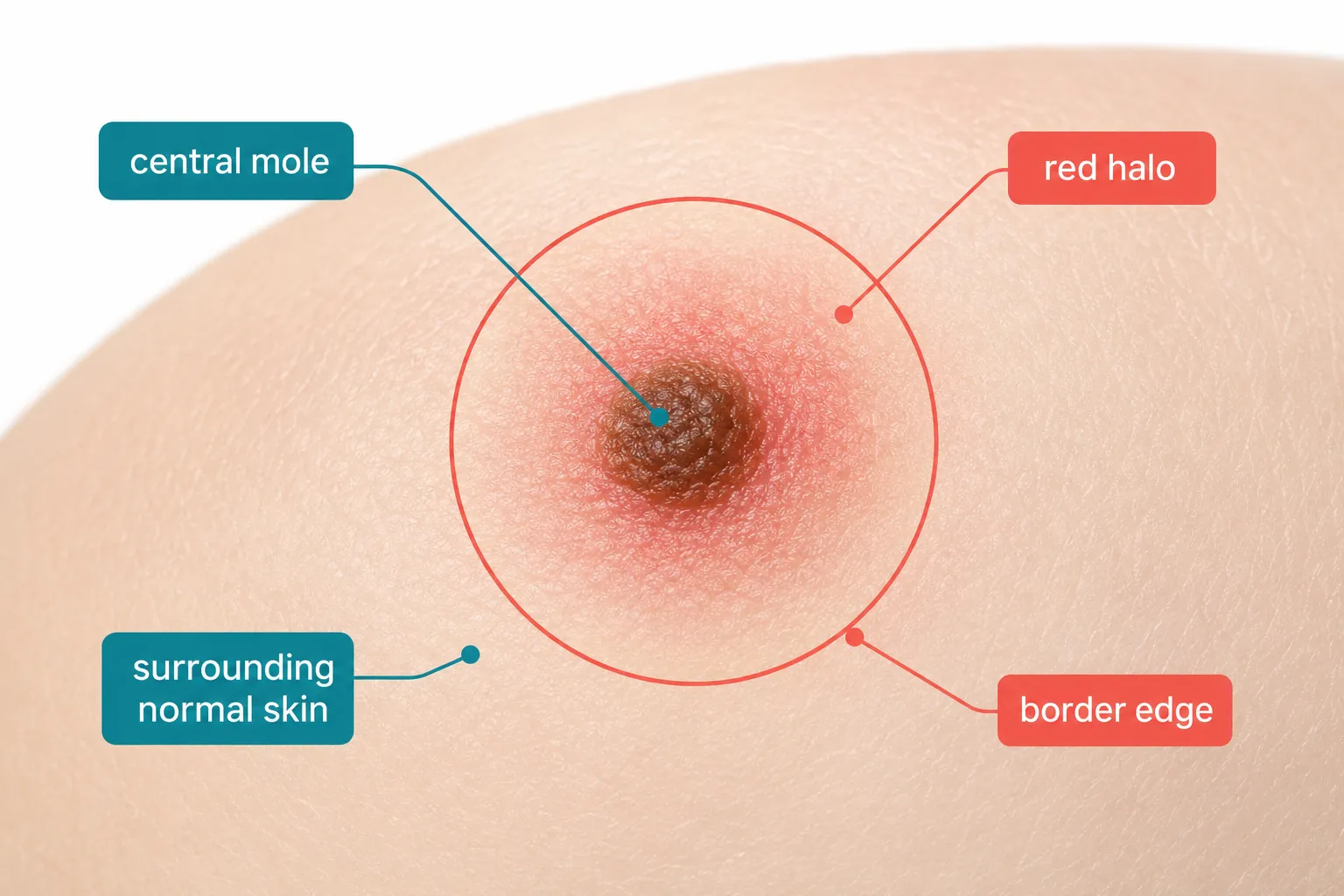
Skin doctors describe this area as the "perilesional skin," meaning the skin bordering the lesion itself. A change here matters clinically because it shows the mole is affecting the tissue around it, not staying contained. Training materials used by cancer registries specifically flag "skin around the mole may become red or swollen" as a symptom worth noting, separate from changes in the mole's own color or shape.[3] The American Cancer Society lists similar changes, redness or a new swelling beyond the mole's edge, among the signs that a mole should be checked.[4]
That said, a red ring is a description of appearance, not a diagnosis. The same visual finding can come from:
Decision rule: if the red ring appeared right after a specific physical trigger (shaving, a tight waistband, a new lotion) and starts fading within a week once that trigger is removed, irritation is the likely cause. If there is no clear trigger, or the redness is still present after three to four weeks, treat it as a finding that needs a professional look rather than something to keep watching at home.
For anyone unsure whether a spot needs a formal look, a mole check in Toronto gives a same-visit answer using dermoscopy, which is far more reliable than visual guessing.
Both are possible, and the only way to know for certain is a clinical exam, but the pattern of the redness gives useful clues. Simple irritation tends to be uniform, short-lived, and tied to a specific trigger, while a cancer-related red ring tends to be uneven, persistent, and paired with other mole changes.
Cancer Research UK notes that a change in the skin around a mole, including redness, is one of the symptoms doctors ask about when assessing melanoma risk, alongside changes to the mole's shape, color, and size.[5] MD Anderson Cancer Center similarly explains that redness or a "halo" effect around a pigmented lesion can sometimes reflect the body's immune response to abnormal melanocytes, though this same halo effect is also seen in entirely benign moles.[6]
The table below summarizes the practical differences clinicians and patients use to separate the two.
FeatureSimple irritationPossible warning signOnsetRight after friction, shaving, or a product changeNo obvious triggerTimelineFades within 1-3 weeksPersists past 3-4 weeks or keeps growingBorder of the rednessFairly even, smooth ringUneven, patchy, or spreading unevenlyMole itselfStays the same size, shape, colorChanges shape, color, size, or develops crustingSymptomsMild itching or tenderness that settlesItching, bleeding, or tenderness that worsensResponse to removing the triggerImproves noticeablyNo improvement
Common mistake: assuming that because a red ring is itchy, it must be benign eczema, or assuming that because it is not itchy, it must be safe. Itching is not a reliable sign either way, melanoma can itch, and benign irritation can be itch-free. The pattern over time matters more than any single symptom.
A structured skin cancer screening in Toronto is the fastest way to settle the question when the pattern is unclear, since it uses magnified dermoscopic imaging rather than the naked eye alone.
An itchy red ring around a mole is usually caused by localized skin inflammation, which can come from mechanical irritation, an allergic reaction, or, less commonly, an immune response to atypical cells in the mole. The itch itself is a nonspecific symptom, meaning it does not confirm or rule out anything on its own.
Common benign causes of itching with redness include:
One specific benign pattern worth knowing is called Meyerson phenomenon, sometimes described as halo dermatitis. This is an itchy, scaly, red halo of eczema that forms around a central mole. Dermatology case reports describe it as most common around ordinary benign moles, though it can occasionally appear around atypical moles or, rarely, melanoma, which is why an eczema-like halo still warrants a look rather than automatic reassurance, especially if the central mole itself looks irregular.
Yes. An allergic or irritant contact reaction to a product applied near a mole, sunscreen, a new moisturizer, adhesive from a bandage, or metal from jewelry, can produce a red, sometimes itchy ring that looks similar to other causes of perilesional redness. This type of reaction usually affects a broader patch of skin, not just the border of one mole, and it typically clears within days of stopping the product.
Edge case: if the red ring only appears in the exact shape of a bandage, necklace, or waistband, allergy or contact irritation is far more likely than a mole-related change. If the redness is confined tightly to the mole's border and nowhere else on the body, that pattern deserves more attention.
There is no single home test that confirms melanoma, but certain combinations of features raise suspicion enough to warrant prompt evaluation. A red ring that is uneven, growing, and paired with changes in the mole's own shape or color is far more concerning than a uniform red ring on its own.
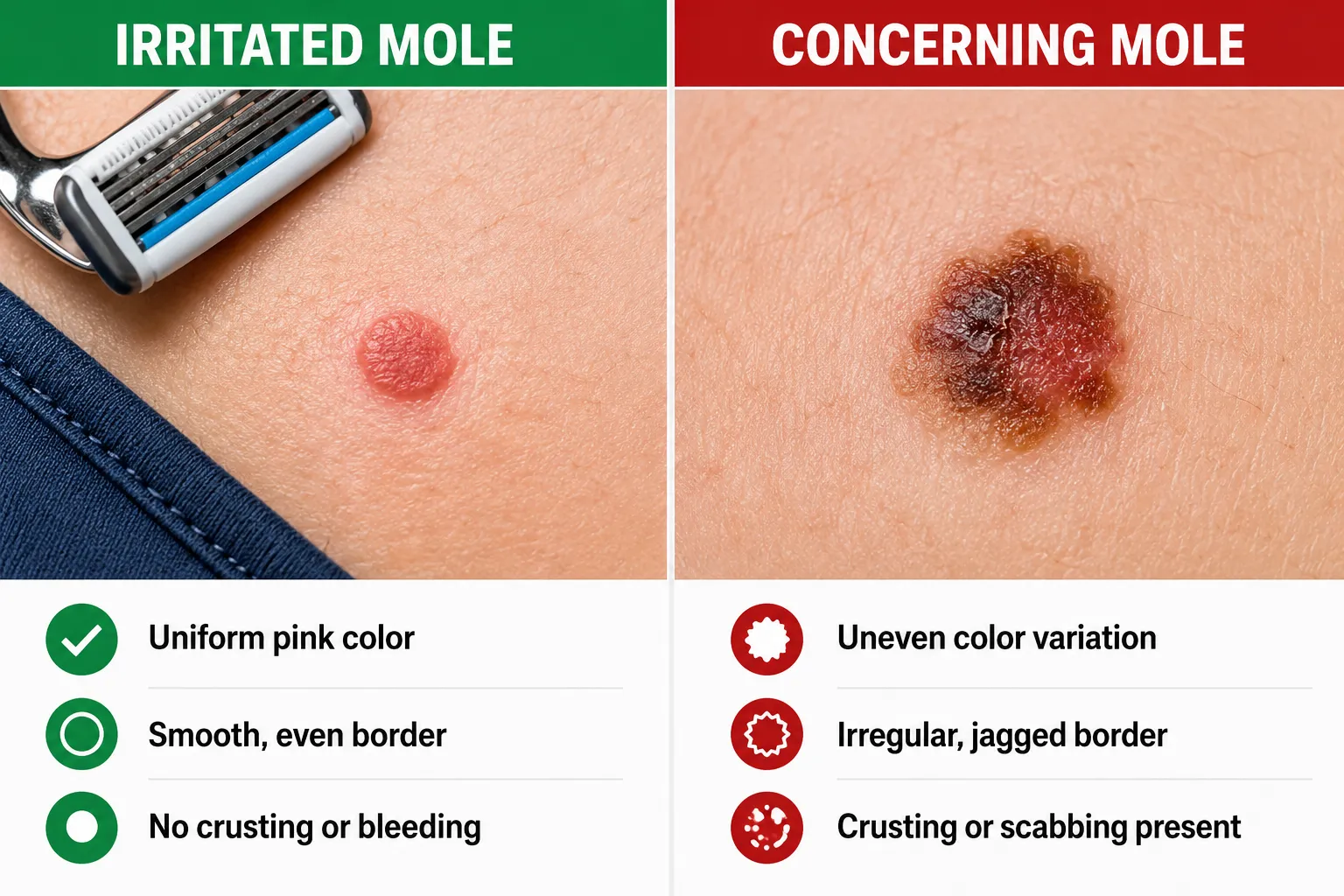
Features that raise concern when seen together with redness:
The Skin Cancer Foundation lists these evolving changes, including new redness or swelling around a mole, among its recognized melanoma warning signs.[1] The Cleveland Clinic recommends monthly self-exams specifically to catch this kind of gradual change early, since melanoma often develops slowly before becoming obvious.[2]
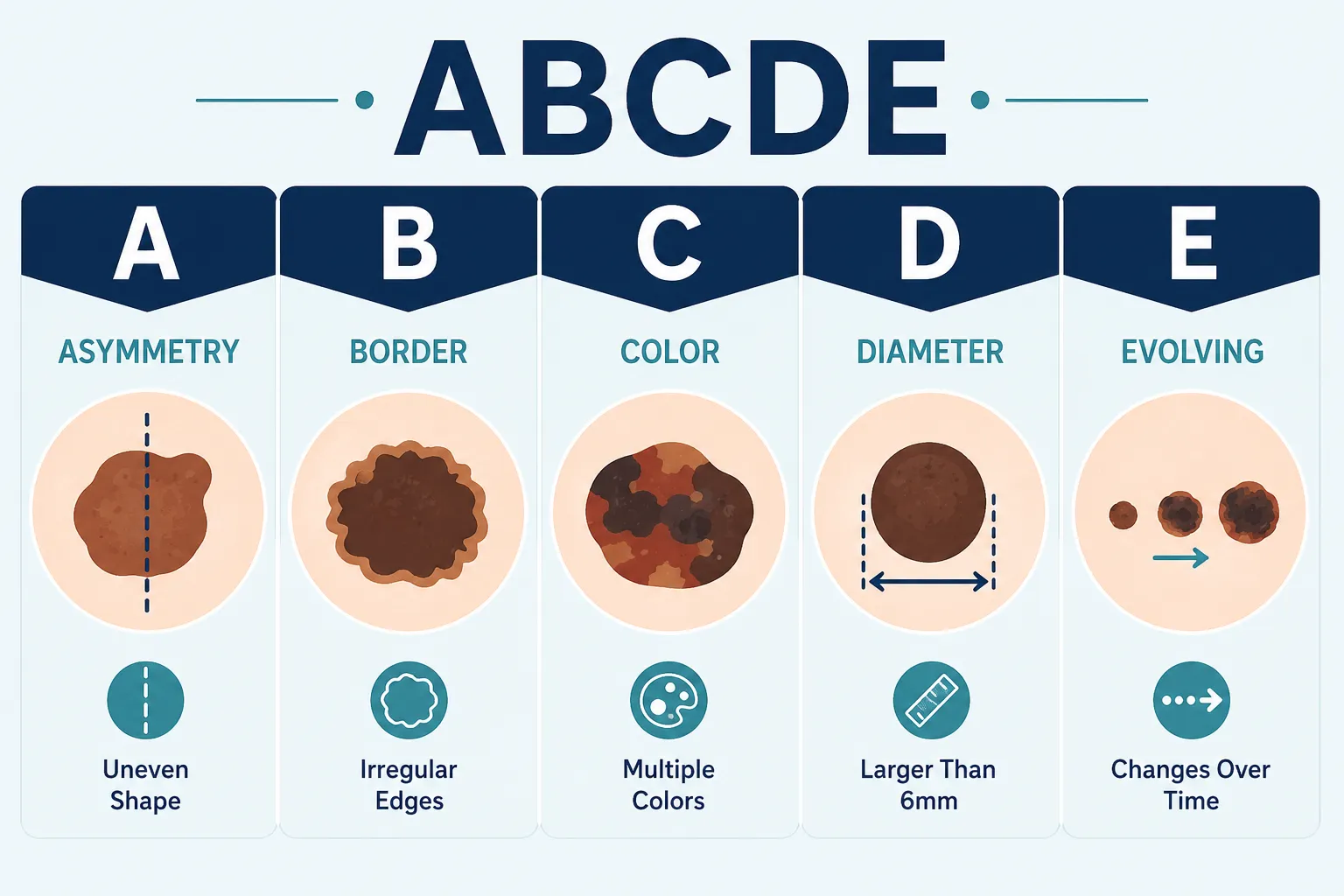
The ABCDE rule stands for Asymmetry, Border, Color, Diameter, and Evolving, and it is the standard framework dermatologists teach for spotting concerning moles.[10] Redness is not one of the five letters directly, but a red ring fits under "Evolving," since that letter covers any new change in a mole's appearance, including its surrounding skin.
Here is how the rule breaks down:
The American Academy of Dermatology stresses that "Evolving" is often the most important letter, because it captures change over time rather than a single snapshot.[10] A mole that scores normal on A, B, C, and D but has newly developed a red ring still meets the criteria for a professional check.
Quick example: a 4mm brown mole with smooth borders that has looked the same for ten years, but suddenly develops a red ring after two weeks of hiking with a backpack strap rubbing against it, is more consistent with friction irritation. A 7mm mole with a notched border, mixed brown and black color, and a red ring that appeared without any known trigger meets several ABCDE flags at once and needs prompt evaluation.
For a full-body comparison of moles against these criteria, a full body skin exam in Toronto documents baseline moles so future changes, including new redness, are easier to catch.
The core difference is behavior over time. An irritated mole reacts to a known cause and settles down once that cause is removed. A cancerous mole changes on its own, without needing an external trigger, and the change tends to continue rather than resolve.
SignIrritated molePossible cancerous moleTriggerClear (shaving, friction, product)None identifiableRedness patternEven ring, fades with timeUneven, spreading, or worseningBorderStays smoothBecomes notched or blurredColorUnchangedNew shades appear (black, blue, white, red mixed)SizeStableGrowing over weeks to monthsTextureUnchangedNew bump, crust, or open soreBleedingRare, only from scratchingCan occur without traumaResponse to timeImproves in 1-3 weeksStays the same or worsens
Cancer Council Australia advises checking any mole that is new, changing, or different from a person's other moles, using this kind of side-by-side comparison as a practical filter.[7] This "ugly duckling" approach, comparing one mole against the rest of a person's moles, is often more useful than judging a single mole in isolation.
Decision rule: choose "likely irritation" if the redness has an obvious mechanical cause and the mole itself has not changed shape, size, or color. Choose "get it checked" if the mole has changed in more than one way at the same time, since multiple simultaneous changes are statistically more concerning than one change alone.
Readers comparing a red-ringed mole against other skin growths sometimes also confuse it with unrelated conditions; a resource on dermatofibroma versus mole versus skin cancer on the leg covers how these look-alikes differ in texture and behavior.
Yes, a red ring caused by simple irritation commonly resolves on its own within one to three weeks once the trigger stops. A red ring linked to an underlying skin change is less likely to resolve without treatment and often continues or slowly worsens instead.
Typical timelines:
A 2025 clinical review aimed at the public draws this same line: temporary redness that clears quickly once the irritant is removed is different from sustained redness lasting more than a few weeks, which is described as a possible marker of a deeper change rather than ordinary irritation.[8]
Common mistake: waiting months to "see if it goes away" once redness has already lasted past the three-to-four-week mark. Cancer patient-education materials consistently advise against open-ended watching once a change is unexplained or persistent, the recommendation is to get it looked at rather than continue waiting.[1][4]
No. Most red rings around moles turn out to be caused by mechanical irritation, minor allergic reactions, or benign inflammatory skin conditions rather than skin cancer. Redness becomes a stronger concern when it is persistent, unexplained, spreading, or accompanied by other mole changes.
Think of redness as one data point, not a verdict. Context that lowers concern:
Context that raises concern:
Edge case: older adults and people with a personal or family history of melanoma should have a lower threshold for getting redness checked, even if it looks mild, since baseline skin cancer risk is already higher in these groups. A skin cancer screening visit is a low-effort way to settle uncertainty for anyone in a higher-risk category.
A red ring that is visibly spreading outward from a mole, getting wider or extending further across the skin over days to weeks, should be evaluated by a physician promptly rather than monitored at home. Spreading redness is one of the clearer signals that something beyond simple friction is happening.
Steps to take if a red ring is spreading:
A rapidly spreading, painful, warm red area can also indicate a skin infection such as cellulitis rather than melanoma, this needs urgent same-day care, since untreated skin infections can spread quickly through the bloodstream. A slower, weeks-long spread without pain, warmth, or fever points more toward either a chronic irritant or a mole-related process.
For patients who have already had a mole removed and later notice redness returning or spreading near the scar, a guide on normal healing versus warning signs after mole removal explains what is expected during recovery versus what needs follow-up.
See a doctor if the red ring lasts longer than three to four weeks, keeps spreading, has no clear trigger, or appears alongside any other change in the mole's shape, color, size, or texture. Bleeding, crusting, or an open sore near a mole also warrants prompt evaluation.
Use this checklist to decide urgency:
Major cancer organizations, including the American Cancer Society and Skin Cancer Foundation, both frame the decision the same way: any unexplained or persistent change around a mole should prompt a professional exam rather than continued self-monitoring.[1][4]
People managing multiple moles, a family history of melanoma, or a large number of atypical-looking spots benefit from a dedicated dermatology visit rather than relying on a single spot check. Clinics across the Toronto area, including options in Mississauga, Vaughan, and Oakville, offer same-visit mole assessment and biopsy when needed.
Treatment for a red ring around a mole depends entirely on the cause: irritation-based redness usually needs no medical treatment beyond removing the trigger, while a red ring linked to an atypical mole requires clinical evaluation and possibly a biopsy or excision.
Common treatment paths:
Choose home care if the redness has an obvious trigger, the mole itself is unchanged, and there are no other worrying features. Choose a clinical visit if the cause is unclear, the redness persists, or the mole shows any other change at the same time.
Patients who need a biopsy or removal often ask what happens with the tissue sample afterward, a guide on understanding a pathology report after mole removal walks through how results are typically communicated.
For patients specifically noticing a red, inflamed appearance around skin tags rather than a true mole, a separate explanation of red skin tags and what they can mean may be more relevant, since skin tags and moles are managed differently.
A red ring around a mole is a symptom, not a diagnosis, and it points in one of two directions: a temporary irritation that settles once the trigger is gone, or a change in the tissue that needs a professional look. The clearest signals are timeline and pattern, irritation fades within a couple of weeks and stays contained, while a warning-sign red ring tends to persist, spread, or show up alongside other changes to the mole's border, color, or size.
Next steps to take right away:
When in doubt, a same-visit assessment with dermoscopy settles the question definitively, which is a better outcome than living with uncertainty for weeks.
What does a red ring around a mole usually mean?
It usually means localized skin inflammation, most often from friction, shaving, or a mild allergic reaction. Less commonly, it can reflect an immune response to atypical cells, which is why persistent or unexplained redness should be checked by a doctor.
Is a red ring around a mole always a sign of cancer?
No. Most red rings are caused by irritation or contact reactions, not cancer. Cancer organizations list redness around a mole as a possible melanoma sign, but it is only one of several features doctors consider together.[3][4]
How long does a red ring around a mole typically last?
Irritation-related redness typically fades within one to three weeks once the trigger is removed. Redness lasting longer than three to four weeks without improvement should be evaluated.
Can a red ring around a mole go away without treatment?
Yes, if it is caused by friction or a mild allergic reaction, it often clears on its own once the cause is removed. Redness tied to an atypical mole is less likely to resolve without medical evaluation.
What is the difference between an irritated mole and a cancerous mole?
An irritated mole has a clear trigger, an even red border, and settles down within a couple of weeks, while the mole itself stays unchanged. A concerning mole tends to change on its own, new color, shape, size, or texture, often alongside uneven or spreading redness.
Does the ABCDE rule mention red rings directly?
Not by name. Redness fits under the "Evolving" letter, which covers any new change in a mole's appearance over time, including new redness, swelling, or itching.[10]
Can allergies cause a red ring around a mole?
Yes. Contact reactions to sunscreen, lotion, adhesive bandages, or jewelry can cause redness around a mole that mimics other causes. This type of redness usually affects a wider area of skin, not just the mole's border, and clears once the product is stopped.
What should someone do if the red ring keeps spreading?
Stop any possible irritants, photograph the area to track the rate of change, and book a medical appointment within the week. Rapid spreading with pain, warmth, or fever needs urgent same-day care, since it may indicate infection rather than a mole-related change.
[1] Melanoma Warning Signs And Images - https://www.skincancer.org/skin-cancer-information/melanoma/melanoma-warning-signs-and-images/
[2] 8648 Skin Self Exam - https://my.clevelandclinic.org/health/diagnostics/8648-skin-self-exam
[3] Symptoms - https://training.seer.cancer.gov/melanoma/intro/symptoms.html
[4] Signs And Symptoms - https://www.cancer.org/cancer/types/melanoma-skin-cancer/detection-diagnosis-staging/signs-and-symptoms.html
[5] Symptoms - https://www.cancerresearchuk.org/about-cancer/melanoma/symptoms
[6] How Can You Tell If A Mole Is Cancerous.h00 159778023 - https://www.mdanderson.org/cancerwise/how-can-you-tell-if-a-mole-is-cancerous.h00-159778023.html
[7] Check For Signs Of Skin Cancer - https://www.cancer.org.au/cancer-information/causes-and-prevention/sun-safety/check-for-signs-of-skin-cancer
[8] How To Tell A Melanoma From A Scary Mole - https://skin-analytics.com/news/skin-cancer/how-to-tell-a-melanoma-from-a-scary-mole/
[9] What Does It Mean If A Mole Is Red Around It - https://scienceinsights.org/what-does-it-mean-if-a-mole-is-red-around-it/
[10] Abcdes Melanoma - https://www.aad.org/public/diseases/skin-cancer/abcdes-melanoma