
Last updated: October 28, 2026
Most moles never need to come off. Is mole removal necessary in any given case usually comes down to one question: is the mole suspicious for skin cancer, or is it causing a physical problem such as catching on clothing, bleeding, or irritation? When a qualified clinician removes a mole and sends it for pathology, the procedure is low-risk and the main downside is a scar. Removing a mole does not cause cancer to spread, and at-home removal products carry real, avoidable dangers.
No, not usually. The National Cancer Institute notes that most adults carry roughly 10 to 40 common moles, and the vast majority never need treatment because very few ever turn into melanoma.[1]
Dermatologists generally remove a mole for one of three reasons:
The American Academy of Dermatology states plainly that most moles do not require treatment, and that removal is reserved for lesions that are bothersome, cosmetically unwanted, or suspicious.[2] A mole that is stable, symmetric, and unchanged for years is generally left alone and simply monitored.
Mole removal becomes medically necessary when a lesion shows signs consistent with melanoma or another skin cancer, or when a benign mole is repeatedly injured or infected. In these cases, delaying removal can delay a cancer diagnosis or allow ongoing tissue damage.
If a mole is left untreated and it turns out to be melanoma, the cancer can continue to grow and, over time, spread to lymph nodes or other organs. This is why clinicians urge prompt assessment rather than a wait-and-see approach for changing lesions, not routine removal of every mole on the body.[1]
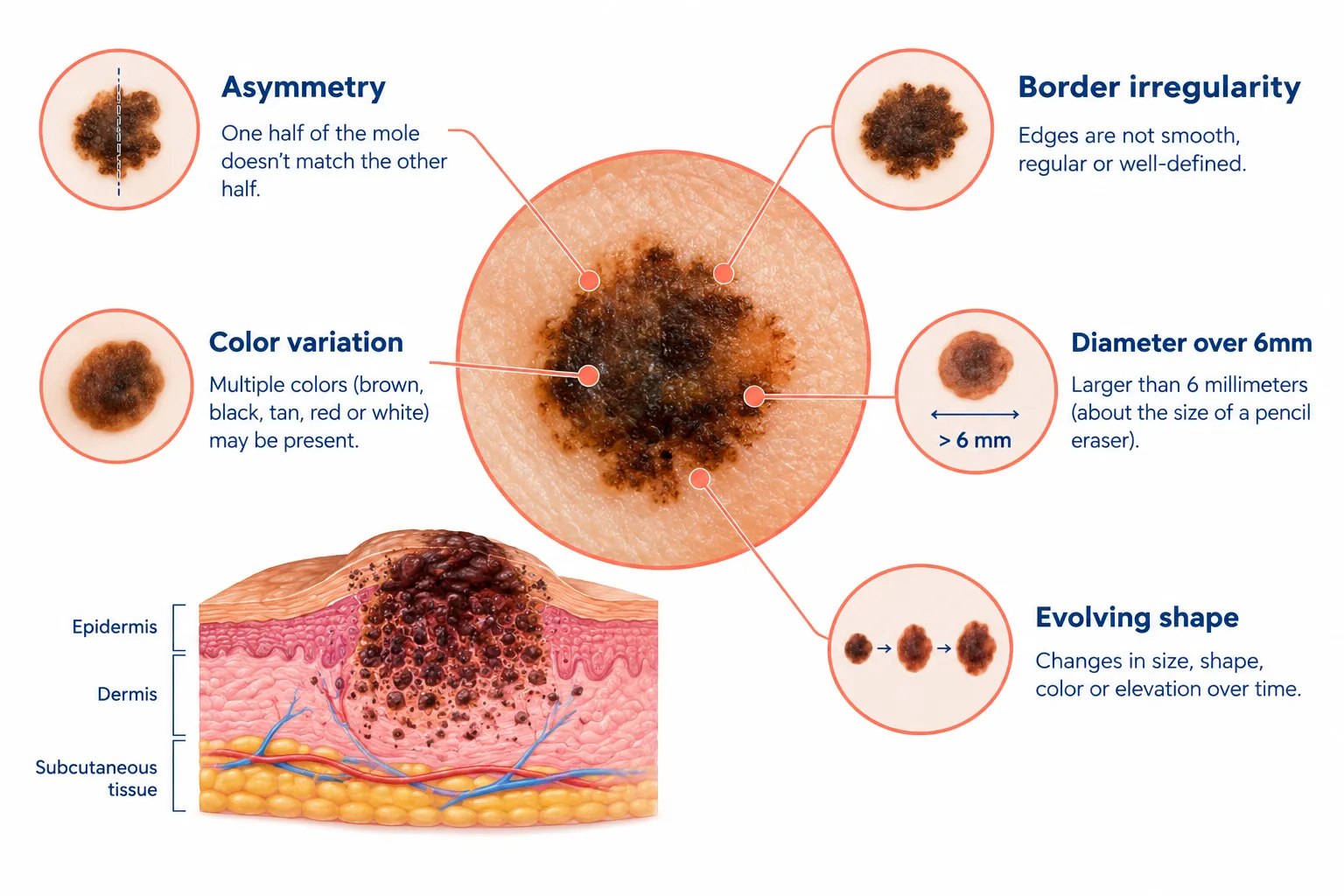
The AAD's ABCDE system helps identify which moles deserve urgent evaluation:[3]
A new mole appearing after age 30, or one that itches or bleeds without injury, deserves prompt assessment even if it is smaller than 6 millimeters.[4][5]
The "ugly duckling" sign refers to a mole that looks different from a person's other moles. Most people's moles share a similar pattern; a lesion that stands out from that pattern is worth having checked, even if it doesn't meet every ABCDE criterion.
Get a mole checked before removing it if it shows any ABCDE change, itches, bleeds, appeared new after age 30, or stands out as an "ugly duckling" compared to your other moles.[3][4]
For a full visual walkthrough, see the ABCDEs of melanoma guide.
Removing a mole through a proper in-clinic procedure is not generally dangerous. It is a minor surgical procedure with well-understood, manageable risks, mainly scarring, temporary bleeding, and a small infection risk, similar to other minor skin surgeries.
Mole removal becomes dangerous mainly in two situations: when it's done without proper technique or sterile equipment, or when a suspicious lesion is removed in a way that prevents accurate pathology (for example, with a cream or laser that destroys the tissue). A thin melanoma can sometimes be fully removed during a diagnostic biopsy, while a thicker melanoma usually needs a wider surgical margin afterward.[6] That's one reason the method of removal matters as much as the decision to remove.
The real risks of mole removal are scarring, infection, bleeding, pigment changes, and, rarely, nerve irritation near certain locations. None of these are unique to mole removal; they apply to most minor skin procedures.
Every mole removal leaves some mark on the skin, because any break in the skin heals with a scar. Most scars fade and flatten over months. People with a personal or family history of keloids are more prone to raised, thickened scars and should mention this before a procedure. Review best scar care practices after mole removal for options like silicone sheeting.
Minor bleeding during and right after the procedure is expected and controlled with pressure or a stitch. Infection is uncommon when the clinician uses sterile technique and the patient follows aftercare instructions, but redness, warmth, pus, or fever after the first few days should prompt a call to the clinic.
Can mole removal cause nerve damage? True nerve damage is uncommon, but not impossible, particularly for moles removed near the face, neck, or areas where small sensory nerves run close to the skin surface. A board-certified surgeon reduces this risk by knowing regional anatomy and choosing a technique matched to the mole's depth and location. Most patients experience only temporary numbness around the scar, which typically resolves as nerves regenerate.
Can a mole grow back after removal? Yes, this can happen, especially after a shallow shave removal that leaves some pigmented cells behind. Regrowth is usually benign but should always be re-evaluated rather than assumed harmless. Read more on moles growing back in scar tissue.
Yes. No over-the-counter product is legally approved by the FDA for mole removal, and unapproved creams, gels, sticks, and liquids can cause chemical burns, scarring, and infection.[6]
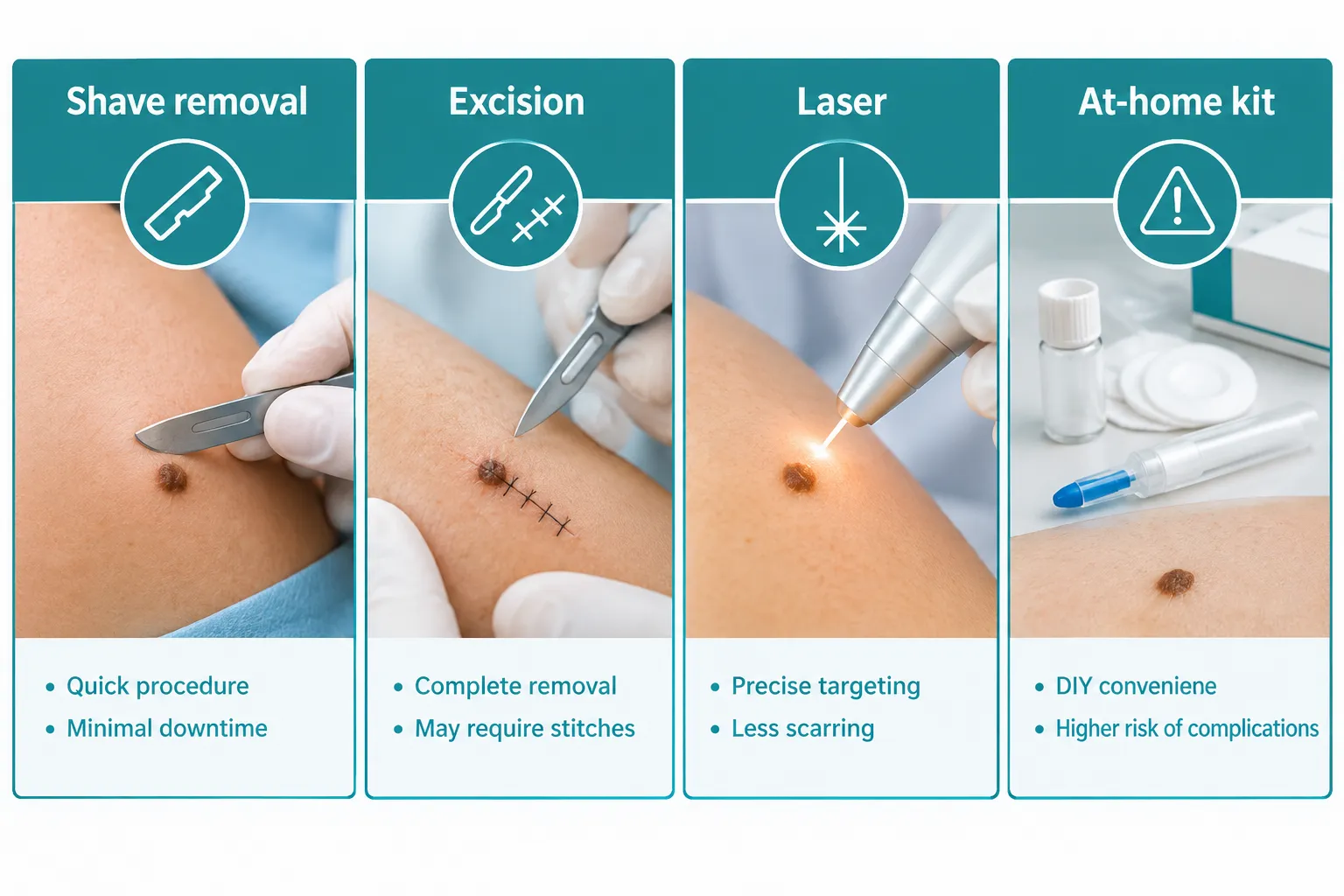
At-home removal is risky for three overlapping reasons:
See do mole removal creams actually work for a closer look at specific products.
The safest method depends on the mole's depth, shape, and whether cancer is suspected. A clinician chooses the technique; the method itself determines whether pathology is possible and what scar to expect.
MethodDepthPathology possibleScarRegrowth riskShaveSurface/raised layerYesFlat, minorModerateExcisionFull thicknessYesLinear, more visibleLowLaserSurface onlyNoMinimalHigherAt-home kitsUncontrolledNoOften poorHigh
Laser removal is not appropriate for any mole that could be cancerous because it destroys tissue without allowing pathology.[7] Compare with cryotherapy for mole removal and shave mole removal for more detail. Flat moles and raised moles also carry different considerations, see flat mole vs. raised mole skin cancer risk.
Sending a removed mole to a lab for microscopic examination is the only way to confirm whether it was benign or cancerous. Mayo Clinic describes removal as both diagnostic and potentially therapeutic when cancer is suspected, the tissue is examined under a microscope after removal.[6]
Clinics that skip pathology, or use methods like laser or chemical creams that destroy the tissue, leave patients without a definitive answer. A mole that looked harmless on the surface can still show atypical or cancerous cells microscopically. For details on what results mean, see the mole biopsy and pathology testing guide.
No. Removing a mole, including a cancerous one, does not cause cancer cells to spread through the body. This is a persistent myth without support in dermatologic or surgical literature.
What can allow cancer to progress is not removing a melanoma promptly, since an untreated tumor can continue growing and eventually reach lymph nodes or distant organs on its own, independent of any surgery. Removal surgery itself, performed with standard technique, is the treatment, not a trigger for spread.[6]
Coverage depends on the reason for removal. Ontario's public health plan covers medically necessary care but not procedures done purely for appearance.
Reason for removalMedical or cosmeticUsually OHIP-covered?Confirmed melanoma, BCC or SCCMedicalYesSuspicious lesion pending diagnosisMedicalAssessed case by caseIrritated/catching mole, benignMixedAssessed case by caseUnwanted but harmless moleCosmeticNo
This is part of why mole removal cost varies and why the question "why is mole removal expensive" comes up often: cosmetic procedures are billed privately, covering the surgeon's time, sterile facility costs, and pathology fees when tissue is tested. For Ontario-specific rules, see is mole removal covered by OHIP and is cosmetic mole removal covered by OHIP.
The Minor Surgery Center operates five GTA clinics (Toronto/North York, York Mills, Vaughan, Mississauga, and Oakville), co-founded by board-certified plastic and reconstructive surgeons Dr. Kunaal Jindal and Dr. Roberto Tutino. Mole removal starts at $600, with $200 per additional mole, no referral needed, and a free consultation. Moles can be sent to pathology, and BCC, SCC, and melanoma treatment is OHIP-covered. Call (647) 614-1611 to book.
Scar outcomes depend heavily on aftercare and the technique chosen for the mole's size and location. A few habits make a measurable difference.
Should I get my moles removed?
Only if a mole is suspicious for skin cancer, physically bothersome, or you want it removed for personal reasons. Most moles can simply be monitored.
Does removing a mole spread cancer?
No. Surgical removal does not cause cancer cells to spread. Leaving a melanoma untreated is what allows it to keep growing and potentially spread over time.[6]
Will mole removal leave a scar?
Yes, every removal leaves some scar, though most fade significantly with proper aftercare. Scar size depends on the removal method and the mole's depth and location.
Can mole removal cause nerve damage?
It's uncommon but possible, especially near the face or neck where sensory nerves run close to the surface. A board-certified surgeon reduces this risk through technique and anatomical knowledge.
Can a removed mole grow back?
Yes, particularly after shallow shave removal that leaves pigmented cells behind. Regrowth should always be checked by a clinician rather than assumed harmless.
Is mole removal covered by OHIP?
Confirmed skin cancer treatment is covered. Cosmetic removal of a benign mole is not covered, and borderline suspicious cases are assessed individually.
Is mole removal necessary? For most people, most moles, most of the time, no. Removal matters when a mole shows ABCDE warning signs, stands out as an "ugly duckling," appears new after age 30, or causes ongoing physical irritation. Performed by a qualified clinician with proper pathology, mole removal is a low-risk, well-understood minor procedure, and the main tradeoff is a scar, not nerve damage, not cancer spread, and not regrowth in most cases. At-home kits and unapproved creams remove the safety net of pathology and carry real risks of burns and scarring.
If you're unsure whether a mole needs evaluation, start with a mole check without a referral or review medical reasons to consider mole removal before deciding.