Ganglion Cyst Removal in Toronto: Whether It Needs Treating, and Draining Versus Excision
Last updated: September 8, 2026
Quick Answer
A ganglion cyst is a sac of thick, clear joint jelly that pushes out from a joint capsule or tendon sheath, most often on the back of the wrist. Many need no treatment at all, and a fair number shrink or disappear on their own given enough time. Aspiration (needle drainage) takes minutes and leaves no scar, but the sac and its stalk stay behind, so the cyst frequently refills; surgical excision removes the cyst with its stalk and a small cuff of joint capsule, which is why it lasts far better. Adults across Toronto and the GTA can be assessed for ganglion cyst removal in Toronto at The Minor Surgery Center without a referral.
Key Takeaways
A painless ganglion that doesn't limit movement can reasonably be watched. Observation is a real plan, not a brush-off.
Aspiration is quick and scar-free but recurrence after drainage alone is common, reported figures often sit near half of cases.
Excision removes the cyst plus its stalk, and recurrence afterwards is much less likely, though never zero.
Location changes everything: a volar (front-of-wrist) cyst sits beside the radial artery, and a cyst beside the fingernail is usually driven by joint arthritis.
A lengthwise ridge in the nail points to a mucous cyst pressing on the nail matrix; treating the cyst and the underlying bone spur often lets the nail grow out normally.
Get assessed promptly if the lump is hard rather than firm, growing quickly, numbing the hand, or leaking through the skin.
OHIP coverage generally follows medical need, not appearance; private fees should be quoted in writing in Canadian dollars.
What a Ganglion Cyst Actually Is
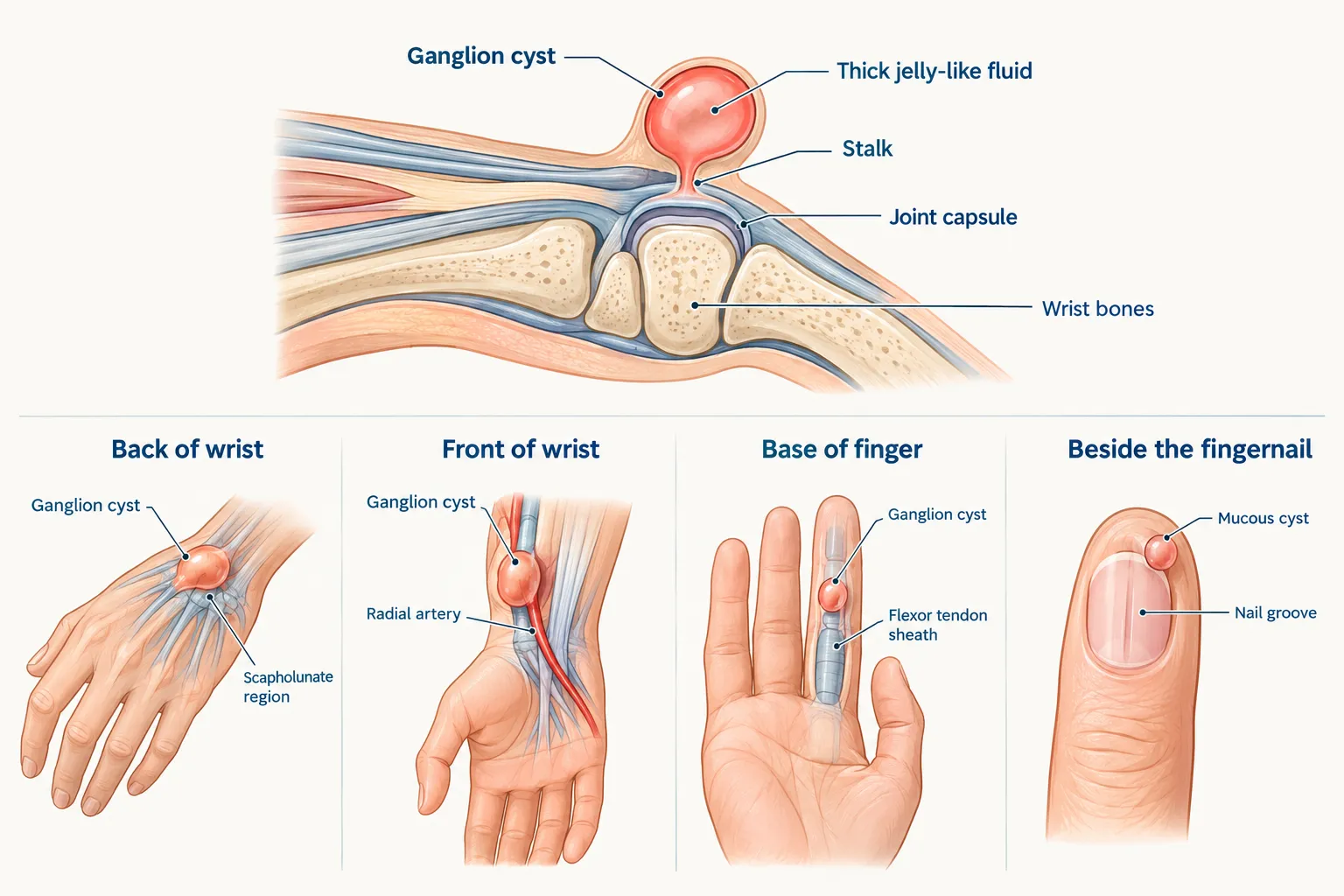
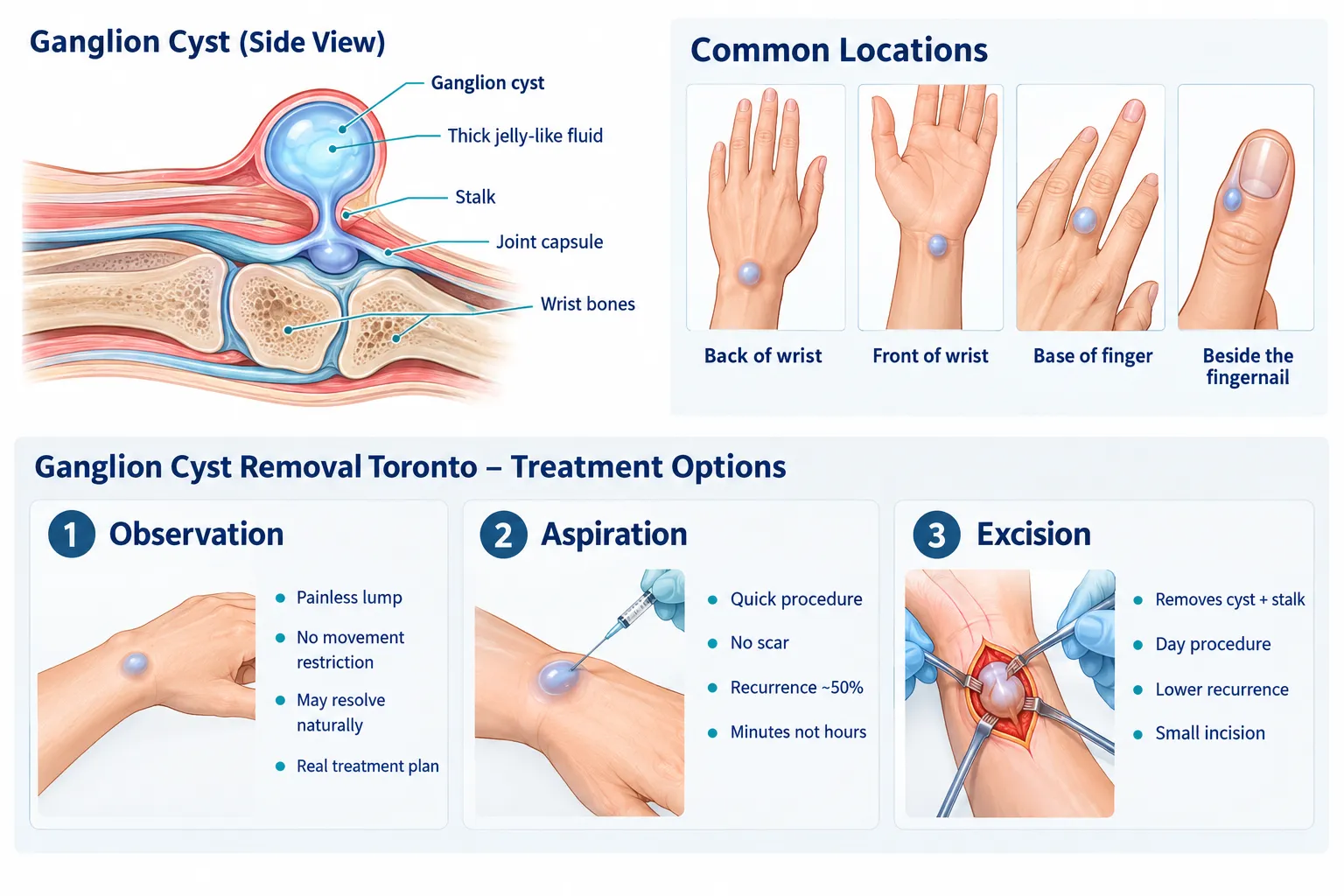
A ganglion is a fluid-filled sac connected to a joint or tendon sheath by a narrow stalk. Inside is thick, clear, jelly-like fluid, not pus, not fat, not a tumour, and not cancer.
The most useful clue is that a ganglion changes. It often swells after a heavy week of lifting, typing, gaming or tool work, then softens with rest. Some vanish for months and return. A simple bedside check is transillumination: shine a small light against the lump and fluid tends to glow, while solid lumps stay dark. Our overview of what a ganglion cyst is and why it forms covers the mechanics in more depth.
Ganglion cyst vs other wrist lumps: what's the difference
No one should be told over the internet that their lump is definitely a ganglion. Several other things look similar and behave differently.
Lipoma, a soft, fatty, doughy lump that doesn't fluctuate with activity. The distinctions are set out in this comparison of a lipoma versus a ganglion cyst.
Giant cell tumour of the tendon sheath, firm, doesn't transilluminate, and needs proper assessment.
Tendon and nerve problems, pain over the thumb-side wrist can be de Quervain's tenosynovitis rather than a cyst; tingling in the fingers can be nerve compression.
Decision rule: if the lump is firm, mobile, fluctuates in size and glows on transillumination, a ganglion is likely. If it's hard, fixed, steadily enlarging or dark under a light, it needs imaging or a tissue diagnosis before anyone drains anything.
Where They Appear, and Why Location Changes the Plan
The same diagnosis in four places is four different conversations. Position determines whether drainage is sensible, whether surgery is straightforward, and what the recovery looks like.
Back of the wrist (dorsal). The most common site, usually arising from the scapholunate ligament area. It's visible, it aches at the end of a long day, and it gets in the way of push-ups, planks and yoga. Access is good and excision here is well established. Our detailed piece on ganglion cysts of the wrist goes further on this location.
Front of the wrist (volar). Less common and more demanding. The radial artery runs immediately alongside, so circulation is checked before any procedure, and many clinicians are more cautious about putting a needle into this area. Volar cysts also sit close to nerve branches. This is the location where who holds the instruments matters most.
Base of the finger, in the palm. A small, firm, pea-sized cyst from the flexor tendon sheath. It rarely looks like much, but it can be genuinely sore against a steering wheel, a bag handle, a hockey stick or a barbell. More on ganglion cysts on the finger and how they differ from wrist cysts.
Beside the fingernail. A mucous cyst on the end joint, almost always linked to osteoarthritis in that joint. It behaves differently from every other ganglion, see the next section.
Foot and ankle. They occur there too, often over the top of the foot where a shoe presses. Footwear pressure and weight-bearing make recovery a different proposition from the hand.
Mucous Cysts and the Nail Groove
A mucous cyst at the last finger joint is a ganglion arising from a joint that already has osteoarthritis, and that changes the treatment. The arthritic bone spur is the source of the problem; the cyst is the symptom.
Because the cyst sits directly over the nail matrix, pressure there produces a lengthwise groove or ridge in the nail. That ridge is not a nail disease, and it usually grows out once the cyst is properly dealt with. Patients are often more bothered by the nail than the lump.
Durable treatment generally means addressing the underlying joint spur as well as removing the cyst, which is exactly why simple needle drainage tends to disappoint at this location. The skin over a mucous cyst can also become very thin and shiny. A mucous cyst that leaks or breaks through the skin needs prompt attention, because it is a direct channel into a joint and infection there is serious.
Do You Actually Need It Removed?
If a ganglion is painless, isn't restricting your wrist or fingers and isn't catching on anything, leaving it alone is a legitimate plan. A meaningful proportion resolve without any treatment, sometimes over many months.
People choose treatment for concrete reasons:
Pain, particularly at the ends of wrist movement
Weaker grip, or discomfort loading the wrist in the gym
Restricted wrist extension
Tingling or numbness suggesting pressure on a nerve
A cyst that catches on tools, gloves, an instrument or clothing
Nail deformity from a mucous cyst
The uncertainty itself, not knowing what it is
What happens if you don't remove it? Usually not much. Most ganglia sit there, fluctuate, and cause no lasting harm. Left alone, a long-standing cyst won't turn into cancer. The realistic downsides are ongoing discomfort, gradual limitation of movement, and living with an unanswered question.
Assessment shouldn't wait if the lump is growing quickly, feels hard rather than firm and doesn't transilluminate, hurts out of proportion to its size, causes numbness or weakness, or the skin over it is breaking down.
Aspiration Versus Surgical Excision
Aspiration empties the cyst; excision removes it. That single sentence explains the entire difference in recurrence.
Aspiration (non-surgical). A needle draws off the thick fluid, sometimes followed by a corticosteroid injection. It takes minutes, needs no incision, leaves no scar, and you go straight back to your day. But the sac wall and the stalk connecting it to the joint remain, so the joint can simply refill it. Reported recurrence after aspiration alone is high, commonly described as around half of cases, and higher again for mucous cysts at the fingertip. Other non-surgical options are limited: activity modification, a wrist splint for a flare, and time. There is no cream, supplement or brace that dissolves a ganglion.
Surgical excision. Through a small incision, the cyst is followed down its stalk to the joint capsule and removed together with the stalk and a small cuff of capsule. That's the reason recurrence is substantially lower than with drainage. The trade-offs are honest ones: a small scar, a longer recovery, and a few weeks of wrist stiffness and scar tenderness. Our general explainer on cyst removal versus cyst drainage applies the same logic to other cyst types.
Choose aspiration if you want a quick, incision-free answer, the cyst is on the back of the wrist and easily accessible, and you can accept that it may return. Choose excision if the cyst has already been drained and come back, it's painful or limiting, it's deforming a nail, or you want the more durable result.
Risks and complications of excision
Every operation carries some risk. For ganglion excision the recognised ones are scarring, temporary or occasionally lasting stiffness, numbness or hypersensitivity in a small patch of skin near the incision, bleeding, infection, and, uncommonly, injury to nearby nerves, tendons or vessels. Volar wrist cysts carry a slightly higher risk profile because of the radial artery. Recurrence remains possible even after a well-performed excision, just far less likely than after drainage.
What Excision Involves, and Recovery
Ganglion excision is a day procedure, typically taking about 20 to 30 minutes under local or regional anaesthetic, and you walk out the same day with a dressing.
The sequence is straightforward. The cyst is examined and marked, local anaesthetic is given, a small incision is made directly over it, and the stalk is traced to the joint capsule so the cyst can be removed intact where possible. The wound is closed and dressed.
Recovery, realistically:
First few days: keep the dressing dry, elevate the hand, expect some throbbing. A supportive dressing or light splint is often used on the wrist for a short period.
Sutures: usually removed around 10 to 14 days if non-dissolving.
Movement: gentle finger and wrist motion starts early, because prolonged immobilisation is what causes lasting stiffness.
Driving: once you can grip and turn the wheel comfortably without a bulky dressing.
Work: desk and computer work often within a few days; heavy gripping, trades, lifting and weight-bearing on the hand generally need two to four weeks or more.
Some stiffness and scar tenderness for several weeks is normal, and full comfort can take a couple of months. Our general guide to cyst removal recovery time and the piece on whether cyst removal leaves a scar cover aftercare and scar maturation in more detail.
Please Do Not Hit It With a Book
The old remedy of striking a ganglion with a heavy book, the reason they were once called Bible cysts, does sometimes rupture the sac. It also risks bruising, injury to the tendons and nerves underneath, and, rarely, a fracture. The stalk survives, so the cyst usually comes back.
The same applies to popping, squeezing or needling one at home. A ganglion connects directly to a joint, and a home needle can carry skin bacteria straight into that space. Septic arthritis is a hospital problem, not an inconvenience. If you're weighing it up, read whether it's safe to pop a ganglion cyst and whether you can drain a ganglion cyst yourself before you try anything.
Is Ganglion Cyst Removal Covered by OHIP?
Coverage generally follows medical need. Assessment and treatment of a symptomatic, diagnosed condition, pain, restricted movement, nerve compression, functional limitation documented in the chart, is handled differently from removal requested purely because of how the lump looks.
Whether OHIP applies in your case depends on your eligibility, the clinical circumstances and where the procedure is performed. Purely cosmetic removal is not an insured service.
What ganglion cyst removal in Toronto costs privately
For self-pay patients in Toronto as of 2026, needle aspiration typically falls in the range of roughly $300 to $650 CAD, and surgical excision commonly runs from about $500 to $1,500+ CAD, depending on location, complexity and anaesthetic. Broader figures are set out in this guide to cyst removal costs in Ontario. Ask for any non-insured fee in writing before booking, and confirm your own coverage at the consultation rather than assuming either way.
Getting Assessed for Ganglion Cyst Removal in Toronto
The Toronto clinic is at 2920 Dufferin Street, Suite 202. Additional locations include 85 Scarsdale Road, Unit 101 in York Mills (North York), plus Vaughan, Mississauga at 1224 Dundas Street West, and Oakville. Phone 647-614-1611, weekdays 9 a.m. to 4 p.m. No referral is required.
Procedures are performed by plastic surgeons with hand surgery experience, and for this condition that's a practical point rather than a credential: the stalk has to be followed to the joint capsule for a durable result, and on the front of the wrist the radial artery sits immediately alongside the cyst. If travelling across the city is awkward, the York Mills cyst removal clinic and the Mississauga cyst removal location run the same procedures.
To prepare, note how long the lump has been there and whether it changes size, mention any previous aspirations, and bring a current medication list including blood thinners. An ultrasound is sometimes arranged when the diagnosis isn't clear-cut.
This article is general information and not a substitute for individual medical advice. A lump in the hand should be examined in person before any conclusion is drawn.
Frequently Asked Questions
Is a ganglion cyst cancer? No. A ganglion is a benign fluid-filled sac from a joint or tendon sheath and does not become cancerous. That said, other lumps can mimic one, so a lump that is hard, fixed or growing steadily should be examined.
Will a ganglion cyst go away on its own? Often, yes. A meaningful proportion shrink or resolve without treatment, sometimes over many months. If it isn't painful or limiting, watching it is reasonable.
Does aspiration hurt? The fluid is thick, so there's usually a few seconds of pressure and a dull ache as it's drawn out. Local anaesthetic is generally used. Most people describe it as uncomfortable rather than painful.
How likely is it to come back after draining? Recurrence after aspiration alone is common, often described as around half of cases, and higher for fingertip mucous cysts. Recurrence after excision is much lower but not impossible.
How long does excision take? Usually about 20 to 30 minutes as an outpatient procedure under local or regional anaesthetic, with same-day discharge.
Will there be a scar? Yes, a small one. Wrist and finger scars typically fade over several months, and scar care in the first few weeks makes a difference.
How long off work? Desk work is often possible within a few days. Trades, gym training and any job needing a firm grip generally need two to four weeks or longer.
Why does my nail have a ridge? A mucous cyst beside the nail presses on the nail matrix, which produces a lengthwise groove. The nail usually grows out normally once the cyst and the underlying arthritic spur are treated.
Can I just leave it alone? If it's painless, stable and not restricting you, yes. Reassess if it starts to hurt, limits movement, causes numbness, or the skin over it thins or breaks.
The Bottom Line
A painless ganglion can often simply be watched. A painful, restricting or nail-deforming one deserves an assessment, and the honest choice then is between a quick fix that frequently returns and a small operation that usually doesn't.
If you want the lump examined and the options laid out plainly, call The Minor Surgery Center at 647-614-1611 or attend the Toronto clinic at 2920 Dufferin Street, Suite 202, weekdays 9 a.m. to 4 p.m. No referral needed.
References
American Society for Surgery of the Hand, Ganglion Cyst
American Academy of Orthopaedic Surgeons (OrthoInfo), Ganglion Cyst of the Wrist and Hand
Cleveland Clinic, Ganglion Cyst
StatPearls / NCBI Bookshelf, Ganglion Cyst
American Society for Surgery of the Hand, Mucous Cyst
DermNet, Digital Myxoid Cyst
Cleveland Clinic, Osteoarthritis of the Hand
Government of Ontario, What OHIP Covers
American Academy of Orthopaedic Surgeons (OrthoInfo), Arthritis of the Hand
The Minor Surgery Center’s York Mills clinic, located at 85 Scarsdale Rd, Unit 101 in North York, offers convenient access to specialized surgical care for a range of skin and hand conditions. Our Plastic Surgeons provide treatment for skin cancer, suspicious moles, cysts, lipomas, carpal tunnel syndrome and trigger finger, with a focus on timely care and personalized treatment. In many cases, patients may be able to have their consultation and treatment completed during the same visit when medically appropriate. For expert care in a welcoming clinical setting, contact our York Mills team at (647) 614-1611.
We are the experts in the field of Minor Surgery. All our Surgeons have completed 5 years of post Medical School Surgical Residencies. They are all Board Certified by the Royal College of Physicians and Surgeons of Ontario.They have been trained at Institutions including McGill, McMaster, Queen's, University of British Columbia, University of Toronto, University of Western Ontario, The Mayo Clinic, University of Pennsylvania, University of Southern California, Yale University, and Oxford.
In many clinics, you could wait months—sometimes over a year—for a procedure like cyst or lipoma removal, mole removal, or even carpal tunnel release. But at TMSC, we prioritize fast access to care. In many cases, we can schedule and complete your minor surgery on the same day as your initial consultation—no extra runaround required.
Our clinics are designed with your comfort, safety, and efficiency in mind. We use strict sterilization protocols to minimize any infection risk, and our advanced surgical equipment meets hospital-grade standards. Yet, you’ll never feel like you’ve stepped into a stark, clinical space—our friendly staff ensures you’re welcome and supported the moment you walk through the door.
Cosmetic results matter—even for the smallest procedures. Skin lesions can be excised by non surgeons in Ontario. Furthermore, any MD with 2 years of post graduate training even outside of a surgical field can perform removal. At TMSC we only have Surgeons under our roof. They are trained well above the level of the procedures we offer to ensure the surgery goes smoothly with minimal scaring and preserving your natural contours. Our Surgeons are trained to ensure both function and aesthetics are always front and center.
At TMSC, we specialize in surgical treatment of both benign and malignant skin lesions, as well as minor hand conditions. We offer significantly reduced wait times often allowing you to schedule your surgery on the same day as your consultation.
You can book your free consultation with The Minor Surgery Center in three easy ways: online through Cortico, by phone, or by requesting a callback from our team.
The initial consultation is free. During this consultation, one of our board certified surgeons will examine your condition and recommend a suitable solution.
Directly Online
Request a Callback
By Phone
By Text
Hours
Sunday
Closed
Monday
9 am — 4 pm
Tuesday
9 am — 4 pm
Wednesday
9 am — 4 pm
Thursday
9 am — 4 pm
Friday
9 am — 4 pm
Saturday
Toronto & Oakville Open Vaughan & Mississauga Closed







.avif)
%20(600%20x%20600%20px)%20(2).avif)
.avif)
%20(8).avif)
%20(7).avif)


.png)