
Last updated: June 2, 2026
Quick Answer: A ganglion cyst is a noncancerous, fluid-filled sac that grows near a joint or tendon, most often on the wrist or hand. It forms when tissue surrounding a joint bulges outward and fills with a thick, jellylike fluid. Ganglion cysts are the most common soft tissue masses found in the hand and wrist, accounting for 50 to 70 percent of all hand and wrist lumps [2]. Most are harmless, though some cause pain or limit movement.
A ganglion cyst is a round or oval, noncancerous lump filled with a thick, jellylike fluid similar to the synovial fluid that lubricates joints and tendons. It develops directly from the tissue surrounding a joint or tendon sheath [1]. The word "ganglion" comes from the Greek word for a knot of tissue, which describes the cyst's appearance well.
Common locations include:
The cyst can range from pea-sized to golf ball-sized. Its size often changes depending on activity level — it tends to grow larger when the nearby joint is used frequently and may shrink with rest [1].
For a broader look at how ganglion cysts compare to other wrist lumps, see this guide on cysts on the wrist: ganglion vs. epidermoid.
The exact cause of ganglion cysts remains unknown, but the leading theory is that a defect or irritation in the joint capsule or tendon sheath causes tissue to bulge outward, forming a sac that fills with fluid [3]. This fluid is similar in composition to synovial fluid, the natural lubricant inside joints.
Several contributing factors are recognized:
What does NOT cause ganglion cysts:
The cyst wall is made of fibrous connective tissue, and the fluid inside is thick and viscous — quite different from the watery fluid in an abscess or infected cyst. For a comparison between different types of lumps, the article on cyst vs. abscess covers the key differences clearly.
Yes. While anyone can develop a ganglion cyst, certain groups face a higher risk.
Key risk factors:
Risk FactorDetailAgeMost common between ages 15 and 40 [3]SexWomen are affected about three times more often than men [3]Joint or tendon injuryPrior trauma increases risk significantly [1]OsteoarthritisEspecially finger joint arthritis in older adults [1]Repetitive joint useActivities requiring repeated wrist motion (gymnastics, typing, manual labor)
Who is least likely to be affected: Young children and older adults over 60 develop ganglion cysts less frequently, though it is not impossible.
A practical note: Having one or more of these risk factors does not mean a ganglion cyst will definitely form. Many people with osteoarthritis or past wrist injuries never develop one. Conversely, some people with no apparent risk factors do.
Many ganglion cysts cause no pain at all and are noticed only because of their visible appearance. However, pain and other symptoms are possible, particularly when the cyst presses on a nearby nerve [1].
Possible symptoms include:
Factors that influence pain:
"A ganglion cyst that causes no symptoms and is not growing can reasonably be left alone. The decision to treat it is driven by discomfort or functional limitation, not the mere presence of the lump."
Ganglion cysts are not dangerous in the sense that they are benign, noncancerous, and do not spread. For most people, they are more of a cosmetic nuisance or a mild inconvenience than a medical threat [1].
That said, there are situations where a ganglion cyst deserves medical attention:
When to see a doctor promptly:
For context on how different cyst types compare, the 20+ types of cysts: symptoms, causes, and treatment guide is a useful reference.
A doctor can usually diagnose a ganglion cyst through a physical examination alone, without any imaging. The typical presentation — a smooth, round lump near a joint or tendon that transilluminates (allows light to pass through it) — is often enough for a confident diagnosis [4].
Diagnostic steps:
Common mistake: Assuming any wrist lump is a ganglion cyst without professional evaluation. Lipomas, carpal boss (a bony bump), and vascular anomalies can all mimic a ganglion cyst on casual inspection.
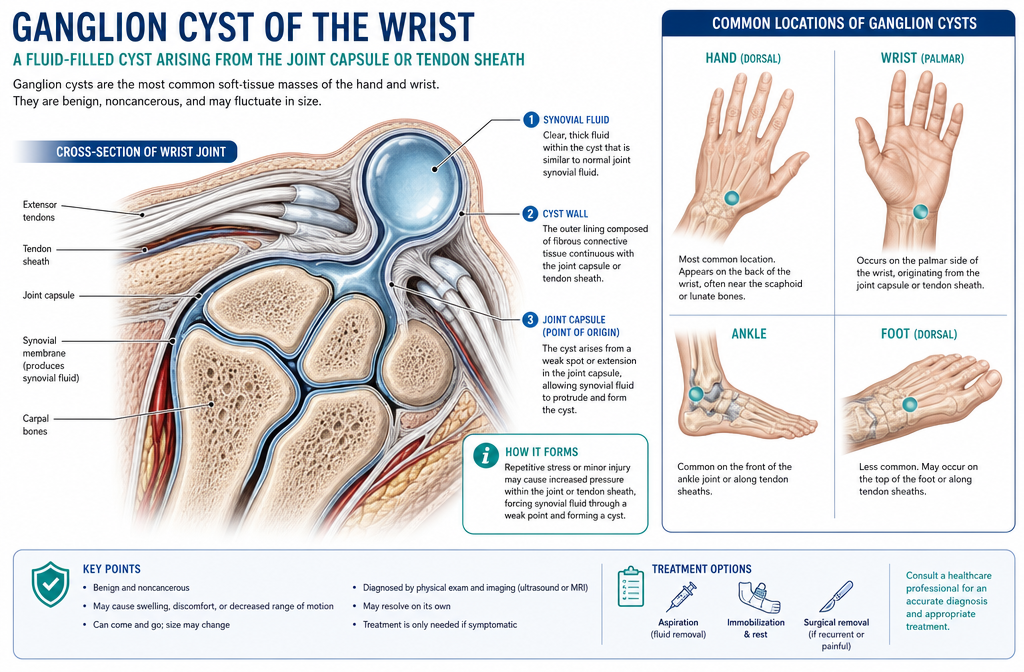
Yes, ganglion cysts can and often do resolve without any treatment. Studies suggest that roughly 40 to 58 percent of ganglion cysts disappear spontaneously over time, though this varies by location and individual factors [3].
Watchful waiting is appropriate when:
Treatment becomes worth considering when:
Treatment options at a glance:
OptionHow It WorksRecurrence RateObservation (watchful waiting)Monitor for spontaneous resolutionN/AImmobilization/splintingReduces joint movement to shrink cystModerateAspiration (needle drainage)Doctor drains fluid with a needleUp to 50 percent [3]Surgical excisionRemoves cyst and its root10 to 15 percent [3]
Choose aspiration if: the cyst is causing discomfort and you want a quick, minimally invasive option, accepting a higher chance it may return.
Choose surgery if: the cyst has returned after aspiration, is causing nerve symptoms, or significantly limits function.
Treatment for a ganglion cyst ranges from doing nothing to outpatient surgery, and the right choice depends on symptoms, location, and patient preference.
Because many ganglion cysts resolve on their own, observation is a valid first approach for asymptomatic cysts. The doctor monitors the cyst at regular intervals to check for changes in size or symptoms [1].
Wearing a wrist brace or splint reduces movement in the affected joint. Since ganglion cysts often enlarge with activity and shrink with rest, immobilization can reduce the cyst's size and relieve discomfort. This approach does not guarantee permanent resolution.
A doctor inserts a needle into the cyst and draws out the fluid. The procedure is done in an office setting under local anesthetic. It is quick and effective at reducing the cyst immediately, but the recurrence rate is relatively high — up to 50 percent in some studies — because the cyst's root (the stalk connecting it to the joint) remains in place [3].
Surgery removes the entire cyst, including its stalk and the portion of the joint capsule or tendon sheath it originates from. This is the most definitive treatment and carries the lowest recurrence rate (roughly 10 to 15 percent) [3]. It is typically performed as an outpatient procedure under local or regional anesthesia.
For those considering surgical removal, clinics such as The Minor Surgery Center in North York, Downtown Toronto, and Mississauga offer cyst removal procedures with board-certified surgeons.
For more on why self-treatment carries risks, see the detailed article on whether you can drain a ganglion cyst yourself.
The cost of ganglion cyst removal varies depending on the treatment method, the provider, and the location. In Canada, the following general ranges apply as of 2026 (these are estimates; actual costs vary by clinic and complexity):
For a personalized cost estimate, The Minor Surgery Center offers a minor surgery cost estimator tool that calculates pricing based on your specific situation. Additional location-specific pricing information is available in the cyst removal cost in Ontario guide.
Factors that affect cost:
For most people, ignoring a ganglion cyst is perfectly safe. Since these cysts are benign and many resolve on their own, watchful waiting is a medically accepted approach [1].
Possible outcomes of leaving a ganglion cyst untreated:
When ignoring it is not the right call:
The key principle: if a ganglion cyst has been diagnosed and causes no symptoms, observation is reasonable. If symptoms develop or worsen, prompt evaluation is warranted.
Yes, recurrence is possible after both aspiration and surgical removal. The recurrence rate after aspiration alone is estimated at up to 50 percent, while surgical excision carries a recurrence rate of approximately 10 to 15 percent [3].
Why do they come back?
The root cause is the connection between the cyst and the joint capsule or tendon sheath. If this stalk is not completely removed during surgery, or if the underlying joint continues to experience stress and irritation, a new cyst can form. Aspiration removes only the fluid, leaving the cyst wall and stalk intact, which is why recurrence is more common after this approach.
Reducing recurrence risk:
If a cyst returns after surgery, a second excision is possible. The recurrence rate for repeat surgery is generally similar to the first procedure when performed by an experienced surgeon.
Honest answer: no home remedy has been shown in clinical evidence to reliably eliminate a ganglion cyst. The most that home management can do is reduce discomfort while waiting for spontaneous resolution.
What may help with symptoms (not a cure):
What does NOT work and should be avoided:
The bottom line: home remedies are best used for symptom management while monitoring the cyst. If the cyst persists, grows, or causes nerve symptoms, professional evaluation and treatment are the appropriate next steps.
A ganglion cyst — what it is, why it forms, and what to do about it — is a question that affects a significant number of people, given that these cysts represent the most common soft tissue masses found in the hand and wrist [2]. The good news is that they are benign, often resolve on their own, and respond well to treatment when needed.
Actionable next steps based on your situation:
For those in Ontario seeking professional evaluation or removal, The Minor Surgery Center has locations across the region, including Markham, Brampton, and Oakville, with board-certified surgeons experienced in cyst removal. The minor surgery FAQ section also answers many common pre-procedure questions.
A ganglion cyst is rarely an emergency, but it deserves attention when it affects quality of life. Getting a confirmed diagnosis is always the right first step.
What is a ganglion cyst, exactly?
A ganglion cyst is a noncancerous, fluid-filled lump that forms near a joint or tendon, most often on the wrist or hand. It contains a thick, jellylike fluid and is the most common soft tissue mass found in the hand and wrist [1].
Is a ganglion cyst the same as a regular cyst?
Not exactly. While both are fluid-filled sacs, a ganglion cyst specifically originates from joint or tendon tissue and contains synovial-like fluid. Other cysts, such as epidermoid or sebaceous cysts, form in the skin and contain different material.
Can a ganglion cyst turn into cancer?
No. Ganglion cysts are benign and have no known potential to become cancerous [1]. However, any new or rapidly changing lump should be evaluated by a doctor to confirm the diagnosis.
How long does it take for a ganglion cyst to go away on its own?
There is no fixed timeline. Some cysts resolve within months; others persist for years. Roughly 40 to 58 percent resolve spontaneously, but the process can take anywhere from several months to a few years [3].
Does aspiration hurt?
The area is numbed with a local anesthetic before the needle is inserted, so most patients feel minimal discomfort during the procedure. Some soreness may follow for a day or two afterward.
Can I exercise with a ganglion cyst?
Generally yes, but activities that stress the affected joint may cause the cyst to enlarge temporarily and increase discomfort. A wrist brace during high-impact activities can help manage symptoms.
Why do ganglion cysts appear and disappear?
Their size is linked to joint fluid dynamics. Increased joint activity can push more fluid into the cyst, making it larger. Rest allows fluid to redistribute, shrinking the cyst. This fluctuation is a characteristic feature [1].
Is surgery for a ganglion cyst risky?
Surgical excision is a low-risk outpatient procedure when performed by an experienced surgeon. Potential complications include infection, scarring, nerve injury, and recurrence, but serious complications are uncommon. For more on what to expect, see the guide on whether cyst removal leaves a scar.
Can children get ganglion cysts?
Yes, though they are less common in young children than in teenagers and adults. Pediatric ganglion cysts often resolve on their own and are typically managed conservatively.
Are ganglion cysts related to carpal tunnel syndrome?
They are distinct conditions, but a ganglion cyst located within the carpal tunnel can compress the median nerve and produce symptoms similar to carpal tunnel syndrome. A doctor can differentiate between the two with physical examination and imaging.
What is a mucous cyst?
A mucous cyst is a specific type of ganglion cyst that forms at the end joint of a finger (the distal interphalangeal joint). It is strongly associated with osteoarthritis and is most common in adults over 50.
Do ganglion cysts affect both hands equally?
No. The dominant hand is more commonly affected, likely because it experiences greater repetitive stress and joint loading over time.
[1] Ganglion Cyst — Symptoms and Causes - https://www.mayoclinic.org/diseases-conditions/ganglion-cyst/symptoms-causes/syc-20351156
[2] Ganglion Cyst - https://www.osmosis.org/answers/ganglion-cyst
[3] Ganglion Cyst — Cleveland Clinic - https://my.clevelandclinic.org/health/diseases/ganglion-cyst
[4] Ganglion Cyst — WebMD - https://www.webmd.com/a-to-z-guides/ganglion-cyst