
Last updated: June 16, 2026
In Toronto, ganglion cyst wrist removal costs range from roughly $300 to $1,500+ at private clinics, depending on whether aspiration (needle drainage) or surgical excision is chosen. OHIP covers removal when the cyst causes medically significant problems such as nerve compression or loss of wrist function, but purely cosmetic removals are paid out of pocket. Most patients can book a consultation and procedure without a specialist referral at private minor surgery clinics.
A ganglion cyst is a benign, fluid-filled sac that grows directly from a joint capsule or tendon sheath. In the wrist, it most commonly appears on the dorsal (back) surface, though it can also form on the palmar (front) side or near the base of a finger. The fluid inside is a thick, gel-like substance similar to joint fluid (synovial fluid), and the cyst itself is not a tumor or cancer of any kind.
Ganglion cysts are the most common soft-tissue masses in the hand and wrist, making up approximately 60-70% of all wrist lumps [2]. They can appear suddenly, grow and shrink over time, and occasionally disappear without treatment. The cyst is connected to the underlying joint or tendon by a stalk, which is why simple drainage often leads to recurrence — the stalk remains intact.
For a deeper look at how these cysts form and why they behave the way they do, see this detailed guide on ganglion cysts: what they are and why they form.
Key structural facts:
Not every wrist lump is a ganglion cyst. Correctly identifying the type of lump matters because it changes both the treatment approach and the cost.
A ganglion cyst is smooth, round, and typically moves slightly under the skin. It transilluminates — meaning a flashlight pressed against it in a dark room will glow through it — because it is filled with clear fluid. A lipoma, by contrast, is soft and doughy, does not transilluminate, and is made of fatty tissue rather than fluid. A bone spur or carpal boss is hard and fixed, arising from the bone itself.
For a side-by-side breakdown of how ganglion cysts compare to lipomas, the lipoma vs. ganglion cyst comparison guide covers the key differences in detail.
FeatureGanglion CystLipomaBone SpurTextureFirm, smoothSoft, doughyHard, fixedTransilluminationYes (glows)NoNoContentsSynovial-like fluidFatty tissueBoneLocationNear joint or tendonSubcutaneous fatOver boneMoves with skinSlightlyYes, freelyNoTypical treatmentAspiration or excisionExcisionVaries
Common mistake: Many patients assume any wrist lump is a ganglion cyst. A proper clinical examination — and sometimes imaging — is needed before any treatment is planned.
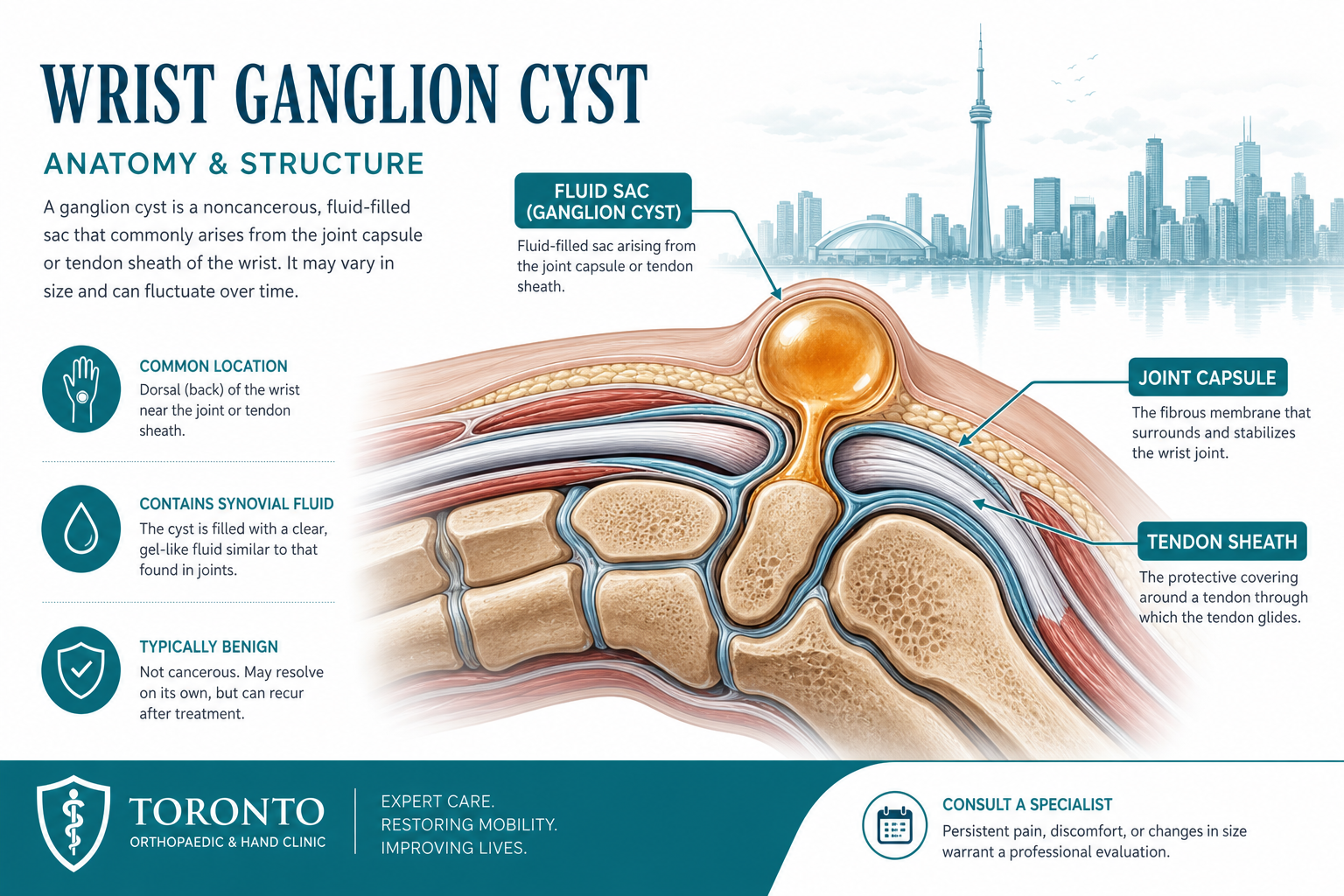
Ganglion cysts develop when synovial fluid leaks out of a joint or tendon sheath and pools into a sac, forming a one-way valve that allows fluid in but not out. The exact trigger is not always identifiable, but several factors are associated with their development.
Common contributing factors:
Women between the ages of 20 and 40 are diagnosed with ganglion cysts more frequently than men, though the cysts can appear at any age [2]. People who do repetitive hand and wrist work — including carpenters, gymnasts, and office workers — appear to have higher rates of occurrence, though a direct causal link has not been definitively established in the literature.
Yes. Certain groups are statistically more likely to develop wrist ganglion cysts. Women aged 20-40 represent the largest demographic, and the condition is also seen more frequently in people with a history of wrist trauma or those who perform repetitive wrist movements occupationally or in sports [2].
People with osteoarthritis — particularly at the base of the thumb (the trapeziometacarpal joint) — are also more prone to developing ganglion cysts in that area. Individuals who have had a prior ganglion cyst removed also face a small but real risk of recurrence, especially if the cyst was treated by aspiration rather than surgical excision.
Choose watchful waiting if: you are young, the cyst is small, it causes no pain, and it is not interfering with wrist function. Many cysts in this category resolve on their own within months to a few years.
Many ganglion cysts do resolve without any intervention. Estimates suggest that 40-50% of wrist ganglion cysts will disappear spontaneously over time [2]. This makes observation a reasonable first step for cysts that are painless and not affecting hand function.
However, some cysts persist for years, grow larger, or cause increasing discomfort. In those cases, active treatment becomes appropriate. The two main options are aspiration and surgical excision, each with different cost profiles and recurrence rates.
When to consider treatment rather than waiting:
Ganglion cysts are benign and do not become cancerous. Leaving one untreated is medically safe in most cases. That said, an untreated cyst that grows large enough can compress nearby nerves or tendons, leading to pain, weakness, or reduced grip strength.
The ulnar nerve and the radial artery pass close to common ganglion cyst locations on the wrist. A cyst pressing on the ulnar nerve can cause numbness or tingling in the ring and little fingers. A volar (palmar) cyst near the radial artery requires careful surgical planning to avoid vascular injury during removal.
Bottom line: A ganglion cyst will not harm you simply by existing, but one that is growing or causing neurological symptoms warrants prompt evaluation. If you are unsure whether your wrist lump is a ganglion cyst or something else, a consultation with a surgeon who specializes in hand and wrist conditions is the safest next step.
Diagnosis is primarily clinical. A physician or surgeon examines the lump, assesses its location relative to the wrist joint, tests its firmness, and checks whether it transilluminates. In most straightforward cases, no imaging is required.
Diagnostic steps in a typical Toronto clinic visit:
A study published in PMC found that 99.6% of excised wrist ganglion specimens were consistent with the preoperative diagnosis, confirming that clinical diagnosis is highly accurate and routine pathology after removal is rarely cost-effective [3].
Ganglion cysts themselves range from completely painless to moderately painful, depending on their location and size. Cysts on the dorsal wrist are often painless unless pressed directly. Volar cysts near the radial artery tend to be more tender. Cysts that compress a nerve cause a different type of discomfort: aching, burning, or tingling that radiates into the fingers.
Regarding removal:
Recovery after aspiration is essentially immediate. After surgical excision, patients typically limit heavy wrist use for 1-2 weeks and may wear a wrist splint for a short period [2].
For most people, yes. A small, painless ganglion cyst does not prevent normal work or sport. Many people live with ganglion cysts for years without modifying their activities at all.
However, activities that repeatedly load the wrist — such as gymnastics, weightlifting, tennis, or carpentry — can aggravate the cyst and increase pain. In those cases, a wrist brace worn during activity can reduce irritation. If the cyst is large enough to limit range of motion or causes pain during grip-intensive tasks, treatment becomes more practical than accommodation.
After removal: Most patients return to desk work within a few days of aspiration or within 1-2 weeks of surgery. Return to sport or manual labor after surgical excision is typically 4-6 weeks, depending on the surgeon's protocol and the patient's healing.
OHIP covers ganglion cyst removal when it is deemed medically necessary. The key threshold is functional impairment or nerve compression — not cosmetic concern [1].
OHIP will generally cover removal when:
OHIP will generally NOT cover removal when:
If OHIP coverage is denied or the patient prefers faster access without navigating the public system, private clinics in Toronto offer self-pay options. It is always advisable to confirm coverage with a physician before booking a procedure.
For patients outside central Toronto, The Minor Surgery Center operates clinics across the Greater Toronto Area, including locations in Whitby, Newmarket, Brampton, and Oakville.
Ganglion cyst wrist Toronto cost varies primarily by treatment method, clinic type, and whether OHIP coverage applies. At private clinics in Toronto as of 2026, aspiration typically costs $300-$600 and surgical excision ranges from $500 to $1,500 or more [1].
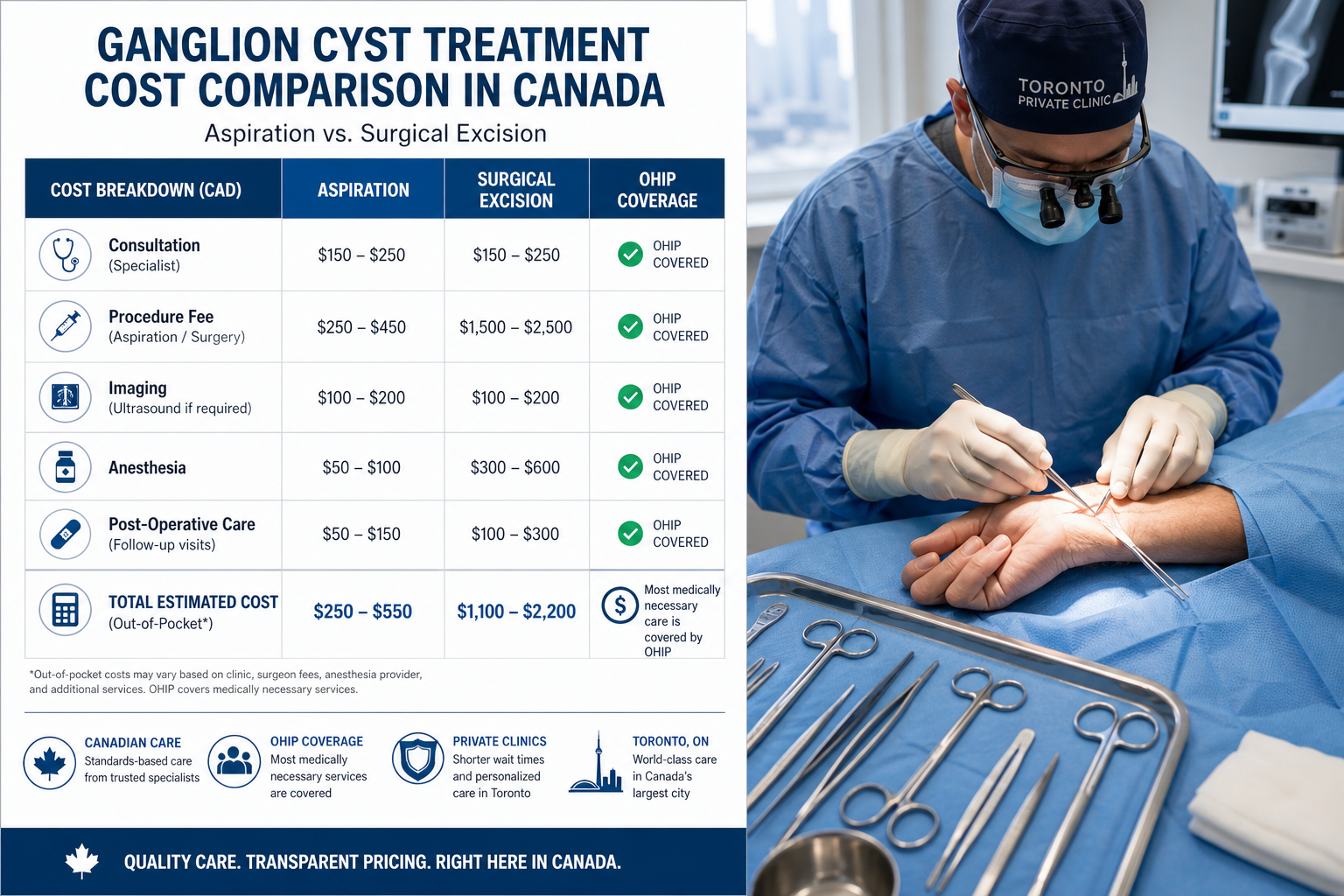
Aspiration is the less expensive option. A physician uses a needle and syringe to draw the fluid out of the cyst, often with ultrasound guidance for accuracy. The procedure takes 10-20 minutes in an office or clinic setting.
ProcedureEstimated Private Cost (Toronto, 2026)OHIP Covered?Aspiration (no ultrasound)$300 - $500If medically necessaryAspiration (ultrasound-guided)$400 - $650If medically necessarySurgical excision (local anesthetic)$500 - $1,200If medically necessarySurgical excision (sedation added)$900 - $1,500+Partial or no coverageConsultation fee$100 - $250Varies
The main drawback of aspiration is recurrence. Studies estimate recurrence rates of 50-80% after aspiration alone, compared to roughly 5-15% after complete surgical excision [2]. A cost-minimization analysis published in PubMed found that aspiration followed by surgical excision if needed can be a cost-effective strategy overall for dorsal wrist ganglion cysts [5].
Surgical excision removes the cyst along with its stalk, which is the primary reason recurrence rates are significantly lower. The procedure is performed under local anesthesia in a minor surgery clinic, takes 20-45 minutes, and requires no hospital stay.
Factors that push the cost higher:
Factors that keep costs lower:
For a broader look at how cyst removal pricing works across Toronto clinics, the Downtown Toronto Mole and Cyst Removal page provides current pricing context.
The true ganglion cyst wrist Toronto cost calculation should factor in the probability of recurrence. A patient who pays $400 for aspiration but then needs a $900 surgical excision six months later has spent $1,300 total — more than if they had chosen surgery first. For patients with a large, symptomatic, or previously recurrent cyst, going directly to surgical excision is often the more economical path over a 1-2 year horizon.
Non-surgical options are appropriate for patients with mild symptoms, small cysts, or a preference to avoid procedures. These approaches do not eliminate the cyst but can manage discomfort effectively.
Watchful waiting: As noted, 40-50% of cysts resolve spontaneously [2]. If the cyst is small and painless, monitoring it over 3-6 months is reasonable. A follow-up appointment with a physician can confirm whether the cyst is stable, shrinking, or growing.
Wrist splinting: Immobilizing the wrist reduces repetitive joint movement that may be aggravating the cyst. Some patients find that wearing a splint during high-demand activities reduces pain and may slow cyst growth. Splints do not cause the cyst to disappear.
Physiotherapy: Toronto physiotherapy clinics offer targeted treatment plans for ganglion cyst symptoms, including manual therapy, activity modification, and strengthening exercises to reduce joint stress [4]. Physiotherapy is most useful when the cyst is causing secondary muscle imbalances or when wrist mechanics are contributing to the problem. It does not remove the cyst.
Anti-inflammatory management: Over-the-counter NSAIDs (ibuprofen, naproxen) can reduce pain and local inflammation around the cyst. This is a symptom management strategy, not a cure.
What does not work:
For patients interested in hand and wrist conditions that sometimes co-occur with ganglion cysts, the Trigger Finger Treatment and Surgery page and the Expert Carpal Tunnel Surgery in Toronto page offer related reading on wrist and hand conditions treated at the same clinics.
Ganglion cyst excision is a low-risk procedure, but it is not risk-free. Patients should understand the following before consenting to surgery.
Common, minor risks:
Less common risks:
Rare but serious risks:
Choosing a board-certified surgeon with experience in hand and wrist procedures significantly reduces the risk of complications. The Minor Surgery Center works with FRCSC-certified plastic and general surgeons who specialize in minor surgical procedures.
Edge case to know: Patients with a volar ganglion cyst near the radial artery should always have an Allen test performed before surgery to confirm adequate collateral circulation. This is standard practice for experienced surgeons and protects against vascular complications.
How long does ganglion cyst removal surgery take in Toronto?
Most ganglion cyst excisions take 20-45 minutes under local anesthesia. Aspiration is faster, typically 10-20 minutes. Both are outpatient procedures with no hospital stay required.
Can a ganglion cyst come back after removal?
Yes. Recurrence after aspiration is estimated at 50-80%. After surgical excision, recurrence drops to approximately 5-15% [2]. Complete removal of the cyst stalk is the key factor in reducing recurrence.
Do I need a referral to see a surgeon about my wrist ganglion cyst in Toronto?
At public hospital-based clinics, a physician referral is typically required. Many private minor surgery clinics in Toronto accept patients without a referral and offer faster booking.
Is the ganglion cyst wrist Toronto cost tax-deductible?
Out-of-pocket medical expenses, including surgery costs, may be eligible for the Medical Expense Tax Credit on your Canadian federal tax return. Consult a tax professional for guidance specific to your situation.
How do I know if my wrist lump is a ganglion cyst and not something more serious?
A physician or surgeon can usually diagnose a ganglion cyst through physical examination and transillumination. If there is any doubt, ultrasound or MRI provides a definitive answer. Malignant soft-tissue tumors of the wrist are rare, but any rapidly growing, hard, or fixed lump warrants prompt evaluation.
Can I drain a ganglion cyst myself at home?
No. Home drainage attempts risk infection, incomplete drainage, and injury to nearby nerves and blood vessels. The procedure should only be performed by a trained medical professional using sterile technique.
How soon after surgery can I return to work?
Most patients doing desk or light office work return within 3-7 days after surgical excision. Manual laborers or those doing repetitive wrist work typically need 4-6 weeks before full return to those activities.
Will my ganglion cyst hurt more before it goes away on its own?
Some patients report that a cyst becomes more tender before it spontaneously ruptures or resolves. This is not universal. If pain is increasing noticeably, that is a reason to seek evaluation rather than wait longer.
Is aspiration or surgery better for a first-time ganglion cyst?
For a first-time, small, dorsal wrist cyst, aspiration is a reasonable starting point given its lower cost and minimal recovery. For large cysts, recurrent cysts, or those near major vessels, surgical excision is generally the preferred first-line treatment [5].
What is the difference between a ganglion cyst and a sebaceous cyst on the wrist?
A ganglion cyst arises from a joint capsule or tendon sheath and contains synovial-like fluid. A sebaceous cyst arises from a blocked hair follicle or sebaceous gland and contains keratin or sebum. Ganglion cysts are almost exclusively found near joints; sebaceous cysts can appear anywhere on the body. Treatment approaches differ. For more on cyst types, see the guide to sebaceous cysts.
Does physiotherapy help ganglion cysts resolve faster?
Physiotherapy does not directly cause a ganglion cyst to resolve, but it can reduce the joint stress and repetitive loading that aggravates the cyst. It is a useful adjunct for symptom management, particularly for patients who want to avoid or delay a procedure [4].
What should I look for when choosing a Toronto clinic for ganglion cyst removal?
Look for board-certified surgeons (FRCSC designation in Canada), transparent pricing, no-referral access, and a clinic that performs a meaningful volume of hand and wrist procedures. Reading patient reviews and confirming the surgeon's specific experience with wrist ganglion cysts is worthwhile before booking.
Ganglion cysts are common, benign, and manageable. For Toronto residents dealing with a wrist ganglion cyst, the decision between watchful waiting, aspiration, and surgical excision depends on symptom severity, cyst size, recurrence history, and budget.
Actionable next steps:
For patients across the Greater Toronto Area, The Minor Surgery Center offers board-certified surgeons, transparent pricing, and no-referral access at multiple locations — making it straightforward to get a professional assessment and a clear treatment plan without a long wait.
[1] Ganglion Cyst What Is It Why Does It Form - https://www.theminorsurgerycenter.com/blog/ganglion-cyst-what-is-it-why-does-it-form?utm_source=openai
[2] Ganglion Cyst Removal - https://www.advortho.org/procedures/ganglion-cyst-removal?utm_source=openai
[3] Pmc11653313 - https://pmc.ncbi.nlm.nih.gov/articles/PMC11653313/?utm_source=openai
[4] Ganglion Cysts Treatment Downtown Toronto - https://acephysio.ca/wrist-and-hand-conditions/ganglion-cysts-treatment-downtown-toronto/?utm_source=openai
[5] pubmed.ncbi.nlm.nih.gov - https://pubmed.ncbi.nlm.nih.gov/36402604/?utm_source=openai