
Last updated: June 16, 2026
Toronto residents can access ganglion cyst removal without a doctor's referral at several private minor surgery clinics, including The Minor Surgery Center, which operates multiple GTA locations. The procedure is typically performed as a same-day outpatient treatment by board-certified plastic surgeons. Because ganglion cyst removal is considered elective when not medically urgent, it is generally not covered by OHIP, and patients pay out of pocket or through private insurance.
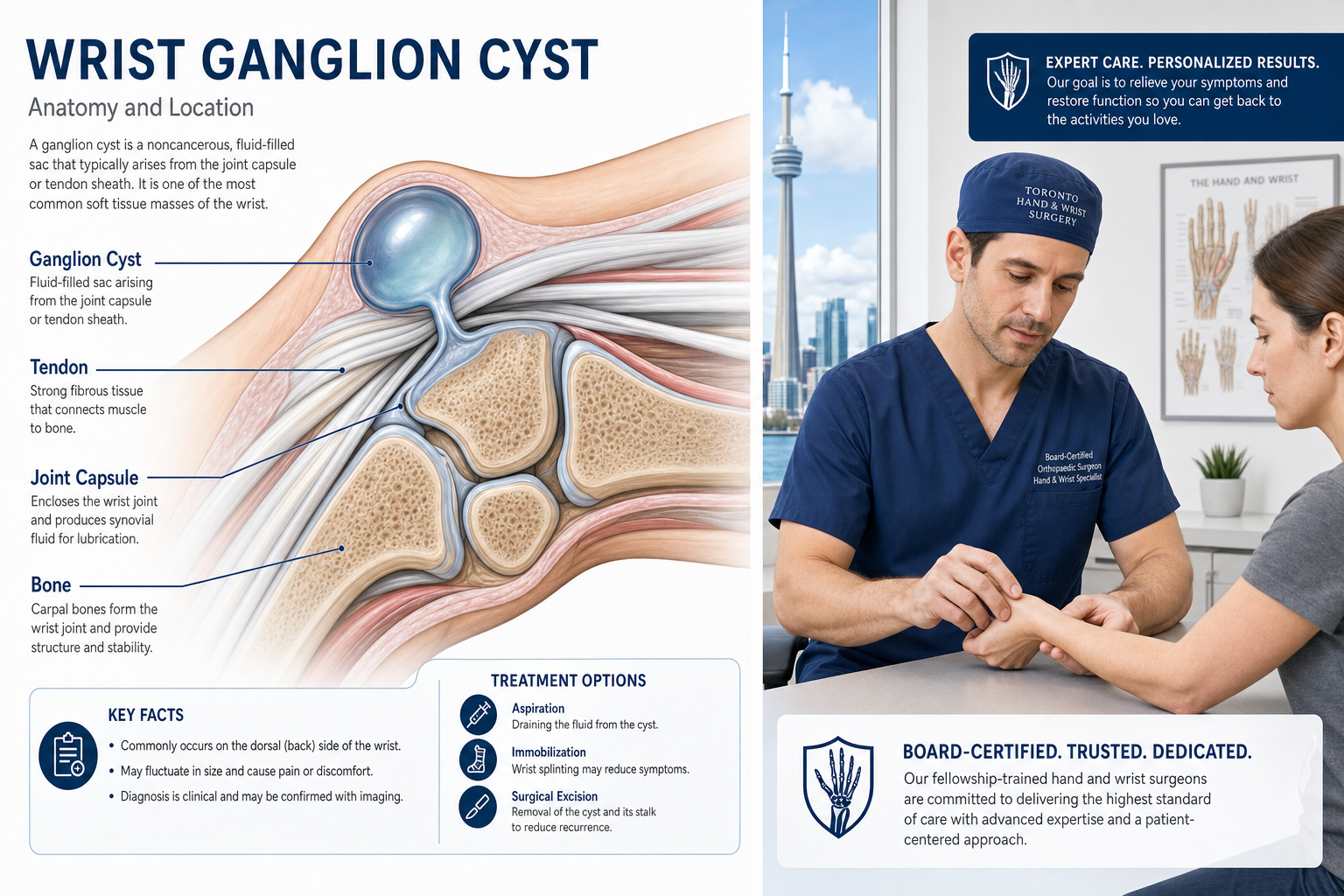
A ganglion cyst is a non-cancerous, fluid-filled sac that grows near a joint or tendon, most often on the wrist or hand. The fluid inside closely resembles the lubricating fluid found in joints, and the cyst is connected to the joint or tendon sheath by a stalk-like structure. For a deeper dive into the biology, see this guide on what a ganglion cyst is and why it forms.
Where they appear:
The exact cause is not fully understood, but the leading theory is that repetitive micro-trauma or joint irritation causes the joint capsule or tendon sheath to develop a one-way valve that allows fluid to escape and pool. The cyst grows as more fluid accumulates.
Common triggers include:
Ganglion cysts are benign. They do not spread, and they carry no risk of becoming cancerous. Some resolve on their own without any treatment, which is why watchful waiting is a legitimate option for painless cysts. [6]
Ganglion cysts affect people across all age groups, but certain populations are at higher risk. According to UCSF Health, ganglion cysts occur in roughly 55 out of every 100,000 people each year, and women are three times more likely to develop them than men. [7]
Higher-risk groups:
One important clarification: research does not show a clear link between dominant hand use and ganglion cyst formation. A cyst on the right wrist of a right-handed person is not necessarily caused by overuse of that hand. [7]
Ganglion cysts in children under 10 are less common and often resolve without treatment. In older adults, cysts near the finger joints (called mucous cysts) are more frequently associated with arthritis.
Yes. Ganglion cyst removal Toronto no referral is widely available at private minor surgery clinics across the GTA. Patients do not need to see a family doctor first or wait for a specialist referral through the public system.
The public healthcare pathway in Ontario typically requires a family doctor referral to see an orthopedic surgeon or plastic surgeon, followed by a wait that can stretch months. Private clinics bypass this entirely. Patients book directly, often receive a same-day or next-day consultation, and can have the procedure completed in the same visit if they choose.
How the no-referral process typically works:
The Minor Surgery Center operates clinics in downtown Toronto, Vaughan, Oakville, Mississauga, and other GTA locations, all offering direct-access ganglion cyst removal without requiring a referral. [1] For patients outside the core city, locations such as Woodbridge, Newmarket, and Brampton provide the same no-referral access.
Decision rule: Choose the no-referral private clinic route if you want faster access, a defined timeline, and the ability to choose your surgeon. Use the public system if cost is the primary concern and the cyst is causing medically significant symptoms that OHIP may cover.
Non-surgical options exist and are appropriate for certain patients, particularly those with small, painless cysts. The two main conservative approaches are watchful waiting and needle aspiration.
Watchful waiting: Because many ganglion cysts resolve on their own, doing nothing is a reasonable first step for a cyst that causes no pain and does not interfere with joint movement. The Mayo Clinic notes that ganglion cysts are often painless and may not require treatment. [6]
Needle aspiration (drainage): A doctor inserts a needle into the cyst and draws out the fluid. This can relieve pressure and reduce size quickly, and it is less invasive than surgery. However, aspiration does not remove the cyst sac or its stalk, so fluid can re-accumulate. Recurrence rates after aspiration are considerably higher than after surgical excision.
Splinting or bracing: Immobilizing the affected joint with a splint may reduce cyst size by limiting the movement that pumps fluid into the sac. The Mayo Clinic cautions that prolonged splinting can weaken nearby muscles, so this approach is generally used short-term. [6]
What does not work:
For a comparison of drainage versus full removal, the guide on cyst removal vs. cyst drainage explains the key differences in outcomes.
Surgical excision and needle aspiration are both valid treatments, but they differ significantly in invasiveness, recovery time, and long-term outcomes. Surgical excision removes the entire cyst including its stalk and attachment to the joint, while aspiration only drains the fluid.
FactorNeedle AspirationSurgical ExcisionInvasivenessMinimal (needle only)Minor surgery (small incision)AnesthesiaLocal or noneLocal anestheticProcedure time10-20 minutes30-60 minutesRecovery1-3 days2-6 weeksRecurrence rateHigh (estimated 50%+ in some studies)Low (5%-15%) [4]ScarNoneSmall scarOHIP coveragePossible if symptomaticPossible if symptomaticSame-day availabilityYesOften yes at private clinics
Choose aspiration if: The cyst is small, recently appeared, and you want a quick, low-risk first attempt before committing to surgery. Aspiration is also preferred when surgery carries higher risk due to the cyst's location near nerves or blood vessels.
Choose surgical excision if: The cyst has recurred after aspiration, is causing persistent pain or nerve compression, or is large enough to limit joint movement. Surgery offers the most durable result. [4]
Understanding why complete sac removal matters is explained in detail in this article on why removing the entire cyst sac is crucial.
The out-of-pocket cost for ganglion cyst removal in Toronto varies depending on the clinic, the technique used, and the complexity of the case. OHIP does not cover removal performed for cosmetic reasons or when the cyst is asymptomatic.
General cost ranges (2026 estimates):
One source cites a broader range of $3,000 to $8,000 for ganglion cyst removal in some markets, which likely reflects hospital facility fees and more complex cases in the United States. [5] Toronto private clinic fees for minor outpatient procedures are generally lower than those figures.
When OHIP may cover the procedure:
When OHIP will not cover it:
Most private insurance plans (employer benefits, group plans) may reimburse part or all of the cost when the procedure is deemed medically necessary. Patients should confirm coverage with their insurer before booking.
For context on how minor surgery pricing works in Toronto, the lipoma removal cost guide for 2026 offers a useful comparison since the pricing structures are similar.
Several private clinics in Toronto and the GTA offer ganglion cyst removal Toronto no referral, with same-day or rapid-access appointments. The most prominent is The Minor Surgery Center (TMSC), which has performed over 15,000 procedures annually across its network of clinics. [1]
TMSC clinic locations serving the GTA:
The downtown Toronto cyst removal clinic is the flagship location, staffed by board-certified plastic surgeons including FRCSC-designated specialists. [2]
The Centre for Minor Surgery is another Toronto option, where Royal College-certified plastic surgeons perform ganglion cyst removal without a referral, often completing the procedure the same day as the consultation. [3]
What to look for when choosing a clinic:
If you are unsure whether a growth is a ganglion cyst or something else (such as a lipoma or sebaceous cyst), the comparison guide on lipoma vs. ganglion cyst can help clarify the differences before your appointment.

Most patients report minimal pain during the procedure itself because local anesthetic is used. The level of discomfort afterward depends on the technique chosen and the cyst's location.
During the procedure:
After the procedure:
Factors that increase post-procedure discomfort:
The overall pain experience is generally described as mild to moderate and short-lived. For a detailed look at what recovery involves, the article on cyst removal recovery time covers timelines and what to expect at each stage.
Full recovery after surgical ganglion cyst removal typically takes two to six weeks, depending on the cyst's location and size. [4] Most patients can return to desk work within a few days but should avoid heavy lifting or repetitive wrist strain until cleared by their surgeon.
Week-by-week recovery outline:
Aftercare instructions typically include:
For patients wondering about stitches, the guide on dissolvable vs. non-dissolvable stitches after cyst removal explains what to expect.
Ganglion cyst removal is a low-risk outpatient procedure, but like any surgery, it carries a small chance of complications. Patients should be aware of these before consenting to the procedure.
Common minor issues (usually resolve on their own):
Less common but notable risks:
Recurrence is the most common long-term issue. After surgical excision, recurrence occurs in approximately 5% to 15% of cases. [4] After aspiration alone, recurrence rates are significantly higher.
Choosing a surgeon who is experienced in hand and wrist procedures, and who commits to removing the entire cyst sac and stalk, is the most effective way to reduce both complication risk and recurrence.
Surgical excision significantly reduces the chance of recurrence, but it does not eliminate it entirely. After surgery, ganglion cysts return in an estimated 5% to 15% of cases. [4] After aspiration, the recurrence rate is considerably higher because the cyst sac and stalk remain intact.
Factors that increase the chance of recurrence:
What to do if a cyst returns:
"Surgical removal significantly reduces the risk of recurrence, with ganglia returning in an estimated 5% to 15% of cases — compared to much higher rates following aspiration alone." [4]
Patients who experience a recurrence should not be discouraged. A second excision by an experienced surgeon, with careful attention to complete stalk removal, typically achieves a durable result.
OHIP covers ganglion cyst removal only when the procedure is medically necessary and performed through the public system with a physician referral. Removal for cosmetic reasons or patient convenience is not covered. [5]
OHIP may cover the procedure if:
Private insurance (employer benefits, group plans):
Many extended health benefit plans cover minor surgical procedures when deemed medically necessary. Coverage varies widely by plan. Patients should:
No insurance options:
Patients without coverage can often negotiate a payment plan with private clinics or pay a flat all-inclusive fee that covers consultation, procedure, and follow-up. Transparency in pricing is a key differentiator among Toronto's private minor surgery clinics.
Q: Do I need a referral to get a ganglion cyst removed in Toronto?
No. Private minor surgery clinics in Toronto, including The Minor Surgery Center, accept patients directly without a referral from a family doctor or specialist. You can book a consultation and, in many cases, have the procedure done the same day. [1]
Q: How long does the ganglion cyst removal procedure take?
Needle aspiration typically takes 10 to 20 minutes. Surgical excision usually takes 30 to 60 minutes, including preparation and local anesthetic administration. Both are outpatient procedures, meaning patients go home the same day.
Q: Is a ganglion cyst dangerous if left untreated?
Ganglion cysts are benign and not dangerous. However, if a cyst grows large enough to compress a nerve, it can cause pain, tingling, or weakness in the hand or fingers. In those cases, treatment is recommended. [6]
Q: Can a ganglion cyst go away on its own?
Yes. A significant proportion of ganglion cysts resolve without treatment. Watchful waiting is appropriate for small, painless cysts. If the cyst persists, grows, or causes symptoms, treatment becomes worthwhile. [6]
Q: What is the difference between a ganglion cyst and a sebaceous cyst?
A ganglion cyst is filled with joint fluid and is attached to a joint or tendon. A sebaceous cyst originates in a skin gland and contains a different type of material. They are treated differently and appear in different locations. For more on cyst types, see the best cyst removal information at TMSC.
Q: Will ganglion cyst removal leave a scar?
Surgical excision leaves a small scar at the incision site. Experienced surgeons use techniques to minimize scar size and appearance. Aspiration leaves no visible scar. Scar appearance typically improves significantly over six to twelve months.
Q: How soon can I return to work after ganglion cyst removal?
Most patients with desk jobs return to work within two to five days after surgical excision. Those with physically demanding jobs or jobs requiring repetitive hand use may need two to four weeks before returning to full duties.
Q: Is the procedure done under general anesthesia?
No. Ganglion cyst removal at private clinics is performed under local anesthetic. General anesthesia is not required and is not used for this type of outpatient procedure.
Q: Can ganglion cysts appear anywhere other than the wrist?
Yes. While the wrist and hand are the most common locations, ganglion cysts can also develop on the foot, ankle, knee, and occasionally the shoulder. The treatment approach is similar regardless of location.
Q: What happens if I just drain the cyst myself at home?
Attempting to drain a ganglion cyst at home carries a real risk of infection and does not remove the cyst sac, so the cyst almost always returns. Home drainage is not recommended. Seek professional treatment instead.
Q: How do I know if my lump is a ganglion cyst or something else?
A surgeon can typically diagnose a ganglion cyst through physical examination alone, sometimes confirmed with ultrasound or transillumination (shining a light through the lump). If there is any doubt, imaging such as an MRI can rule out other conditions. [6] The comparison of lipoma vs. ganglion cyst is a helpful starting point.
Q: Are there any clinics outside downtown Toronto that offer no-referral ganglion cyst removal?
Yes. The Minor Surgery Center has locations across the GTA and surrounding regions, including Oakville, Barrie, Ajax, and Milton, all offering direct-access minor surgery without a referral. [1]
Ganglion cyst removal Toronto no referral is not only possible in 2026 — it is straightforward, accessible, and completed in a single outpatient visit at multiple private clinics across the GTA. Patients no longer need to navigate the public referral system or wait months for a specialist appointment when same-day access is available through board-certified plastic surgeons at private minor surgery centers.
Actionable next steps:
For patients unsure about which clinic or procedure is right for their situation, a no-obligation consultation is the best first step. The process is faster, more transparent, and far less complicated than most people expect.
[1] The Minor Surgery Center - https://www.theminorsurgerycenter.com/?utm_source=openai
[2] Sebaceous Cyst - https://www.torontominorsurgery.com/conditions/sebaceous-cyst?utm_source=openai
[3] minorsurgery.ca - https://www.minorsurgery.ca/?utm_source=openai
[4] Ganglion Cyst - https://my.clevelandclinic.org/health/diseases/ganglion-cyst?utm_source=openai
[5] Ganglion Cyst Removal - https://www.advortho.org/procedures/ganglion-cyst-removal?utm_source=openai
[6] Drc 20351160 - https://www.mayoclinic.org/diseases-conditions/ganglion-cyst/diagnosis-treatment/drc-20351160?utm_source=openai
[7] Ganglion Cyst - https://www.ucsfhealth.org/care/conditions/ganglion-cyst?utm_source=openai