Cyst Removal York Mills: Where to Get Safe, Same-Day Treatment
Last updated: August 27, 2026
Quick Answer
Cyst removal in York Mills means surgically excising the entire cyst, including its sac, so it does not grow back. The newly opened Minor Surgery Center at 85 Scarsdale Rd Unit 101, North York, offers same-week consultations and same-day excision for epidermoid, pilar, and sebaceous cysts, usually without needing a doctor's referral[2][1]. The procedure typically takes 15 to 30 minutes under local anesthetic, with most patients back to normal activity within a day or two.
Key Takeaways
Cyst removal in York Mills is now available locally through The Minor Surgery Center's new clinic at 85 Scarsdale Rd Unit 101, North York, ON M3B 2R2, with no referral required[2].
A true cyst removal excises the entire sac, not just the fluid or keratin inside; incomplete removal is the main reason cysts come back[13][10].
Most cyst excisions take 15 to 30 minutes under local anesthetic and are done as walk-out, same-day procedures[9].
Squeezing or draining a cyst at home almost never removes the sac wall, so the cyst usually refills or becomes infected[10].
Cysts differ from lipomas in depth, texture, and the presence of a visible central pore called a punctum.
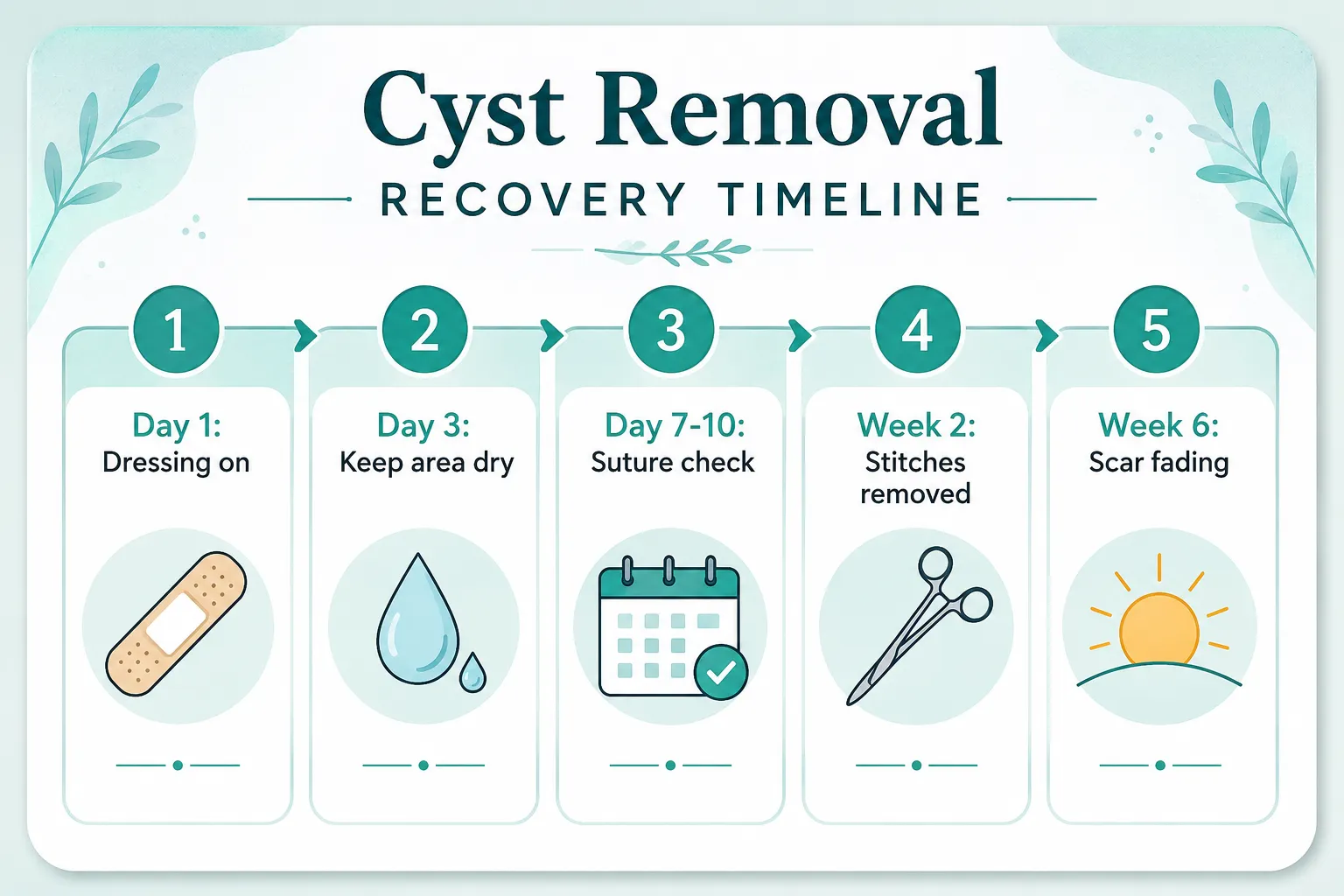
Recovery is generally quick: light activity within 24 to 48 hours, sutures out in 7 to 14 days depending on location[6].
Insurance coverage for cyst removal in Ontario depends on whether the procedure is deemed medically necessary versus cosmetic.
Scarring can be minimized through proper incision placement, wound care, and following a surgeon's suture-removal schedule.
The York Mills clinic operates weekdays with rapid-access booking by phone or email, positioning it as one of the fastest routes to treatment in the area[12].
What Is a Cyst and Why Does It Need to Be Removed?
A cyst is a closed sac under the skin filled with fluid, keratin, or semi-solid material, and it needs removal when it grows, becomes painful, gets infected, or bothers a patient cosmetically. Left alone, many cysts stay small and harmless for years, but a portion will slowly enlarge or become inflamed[13].
The most common types seen in a minor surgery setting include:
Epidermoid cysts, the most frequent type, formed from trapped skin cells, often on the face, neck, back, or scalp.
Pilar cysts, usually found on the scalp, arising from hair follicle cells, and often firmer than epidermoid cysts.
Sebaceous cysts, a term still used commonly by patients, though true sebaceous gland cysts are rarer than epidermoid or pilar cysts.
A cyst does not always need removal. It becomes a medical priority when it is growing quickly, has ruptured or leaked, shows signs of infection (redness, warmth, pus), or sits in a spot where clothing or movement keeps irritating it. Removal is also reasonable simply because a patient wants it gone, even if it is not medically dangerous[13][9].
Choose removal if: the cyst is enlarging, recurring after a previous drainage, painful, infected, or visibly bothersome. Skip removal for now if: the cyst is small, stable for months, and not causing any symptoms, though it should still be checked to confirm the diagnosis.
What Causes Cysts to Form on Skin?
Skin cysts form when cells or keratin get trapped beneath the surface instead of shedding normally, creating a sac that slowly fills with material over time. The exact trigger varies by cyst type, but blocked follicles and skin injury are the two most common starting points.
Typical causes include:
Blocked hair follicles or pores that trap dead skin cells under the surface.
Injury or trauma to the skin, including cuts, acne, or repeated friction.
Genetic tendency, since some people (and some families) form pilar or epidermoid cysts more easily than others.
Hormonal shifts, which can increase oil gland activity and follicle blockage, especially during adolescence or times of hormonal change.
A common mistake is assuming a cyst is caused by poor hygiene. In most cases, cyst formation has little to do with cleanliness and much more to do with follicle structure and skin cell turnover. Squeezing the area to "clean it out" typically makes things worse by irritating the sac wall.
What's the Difference Between a Cyst and a Lipoma?
A cyst is a sac filled with keratin or fluid that usually sits closer to the skin surface and often has a visible central pore, while a lipoma is a soft, slow-growing lump of fat tissue that sits deeper and moves freely under the skin without a pore. Both are benign and common, but they need different surgical approaches.
FeatureCystLipomaDepthCloser to skin surfaceDeeper, under the fat layerTextureFirm, sometimes tenderSoft, doughy, movableCentral pore (punctum)Often visibleNever presentGrowth speedCan flare and shrinkSlow, steady growthInfection riskHigherVery low
A quick example: a bump on the back of the scalp that has a tiny central dot and occasionally leaks a thick, cheesy substance is more likely a pilar cyst. A soft, rubbery lump on the forearm that slides under a fingertip with no pore is more likely a lipoma. If uncertain, a clinical exam settles it fast, since surgical technique differs, cysts require sac excision, while lipomas are typically shelled out from the fat layer.
Best Dermatologist and Clinic for Cyst Removal Near York Mills
The Minor Surgery Center's new York Mills clinic at 85 Scarsdale Rd Unit 101, North York, ON M3B 2R2, is the strongest local option for cyst removal near York Mills because it combines rapid, no-referral access with surgeons focused specifically on skin and minor surgical procedures[2][1]. The clinic opened in July 2026 as a dedicated site for the assessment and surgical removal of common cyst types, including epidermoid, pilar, and commonly called sebaceous cysts[2].
What sets this clinic apart for patients weighing their options:
No referral required, patients can book directly rather than waiting on a family doctor appointment first[2].
Individualized surgical planning, each cyst is assessed for size, depth, and location before deciding on incision approach and scar placement[2].
Weekday rapid access, the York Mills location operates Monday to Friday, 9:00 a.m. to 4:00 p.m., closed weekends, with booking available by phone or email[12].
Part of a larger network, the York Mills site joins the organization's other Greater Toronto clinics, which helps reduce wait times across the region for common procedures like cyst removal[8].
Focus on complete excision, the surgical approach emphasizes removing the full cyst sac, not just draining contents, which is the accepted best practice for reducing recurrence[13][10].
For comparison, other providers in the wider North York and Toronto area also offer cyst treatment. Dermatelier on Avenue Road performs cyst excision under local anesthetic, replacing the cyst with a flat linear scar and typically leaving sutures in place for up to two weeks[6]. Toronto Dermatology Centre similarly excises epidermoid cysts under local anesthetic in procedures lasting 15 to 20 minutes, stressing that the sac must come out along with the cyst contents[9]. The Centre for Minor Surgery in Toronto also provides mole, skin tag, and cyst removal under local anesthetic in a traditional minor-surgery setting with weekday hours[11]. All of these confirm the same clinical standard: complete sac excision, done under local anesthetic, in a short outpatient visit.
Decision rule: choose a dedicated minor surgery clinic like the York Mills location if speed of access and no-referral booking matter most. Choose a dermatology practice if the cyst is complicated by other skin conditions needing broader dermatologic evaluation. For a wider look at options across the region, see this overview of cyst removal in York Region and the dedicated Minor Surgery Center York Mills clinic page.
Note: searches for "New York Mills clinic" sometimes surface results from Minnesota, where Perham Health operates a New York Mills Clinic that lists skin tag and cyst removal among its services. That location is geographically unrelated to Toronto's York Mills neighborhood and worth ruling out when searching locally[4].
Cyst Removal Cost York Mills: What to Expect
Cyst removal cost in York Mills depends on whether the procedure is classified as medically necessary or cosmetic, the size and location of the cyst, and whether pathology testing is needed. Medically necessary removals (infected, painful, or rapidly growing cysts) are more likely to qualify for OHIP coverage, while removals done purely for cosmetic reasons are typically billed privately[8].
Factors that influence the final cost include:
Cyst size, larger cysts require a longer excision and more suturing.
Location on the body, facial or scalp cysts often need more careful technique to protect surrounding structures and minimize scarring.
Number of cysts, some patients have multiple cysts removed in one visit, which can affect total pricing.
Pathology submission, sending the removed tissue for lab analysis, common practice for unusual or recurrent cysts, may add a fee.
Whether it is medically necessary or elective, this is usually the single biggest cost factor, since it determines insurance eligibility.
For a broader breakdown of typical price ranges across the province, see this guide to cyst removal cost in Ontario. A common mistake patients make is assuming all cyst removals are automatically covered by OHIP; coverage depends on medical necessity, which is why a proper consultation and documentation matter before booking.
Can You Get Cyst Removal Covered by Insurance in York Mills?
Cyst removal may be covered by OHIP in Ontario, including in York Mills, when the cyst is infected, painful, rapidly growing, or otherwise medically necessary to remove; purely cosmetic removals are generally not covered and are billed as private, out-of-pocket procedures. The distinction is made by the treating physician based on the clinical presentation of the cyst.
Practical steps to figure out coverage:
Book a consultation and have the cyst assessed in person.
Ask directly whether the clinic will bill the procedure as medically necessary or cosmetic.
Request documentation if there is any ambiguity, since some extended health benefits plans also cover a portion of costs not covered by OHIP.
Confirm before the procedure date, not after, since billing classification is set at the time of surgery.
Edge case: a cyst that has never caused symptoms but has grown noticeably larger over a few months may still qualify for coverage if it is now at risk of rupture or infection, this is a judgment call best made during an in-person exam rather than guessed at from home.
Cyst Removal Surgery vs Non-Invasive Options
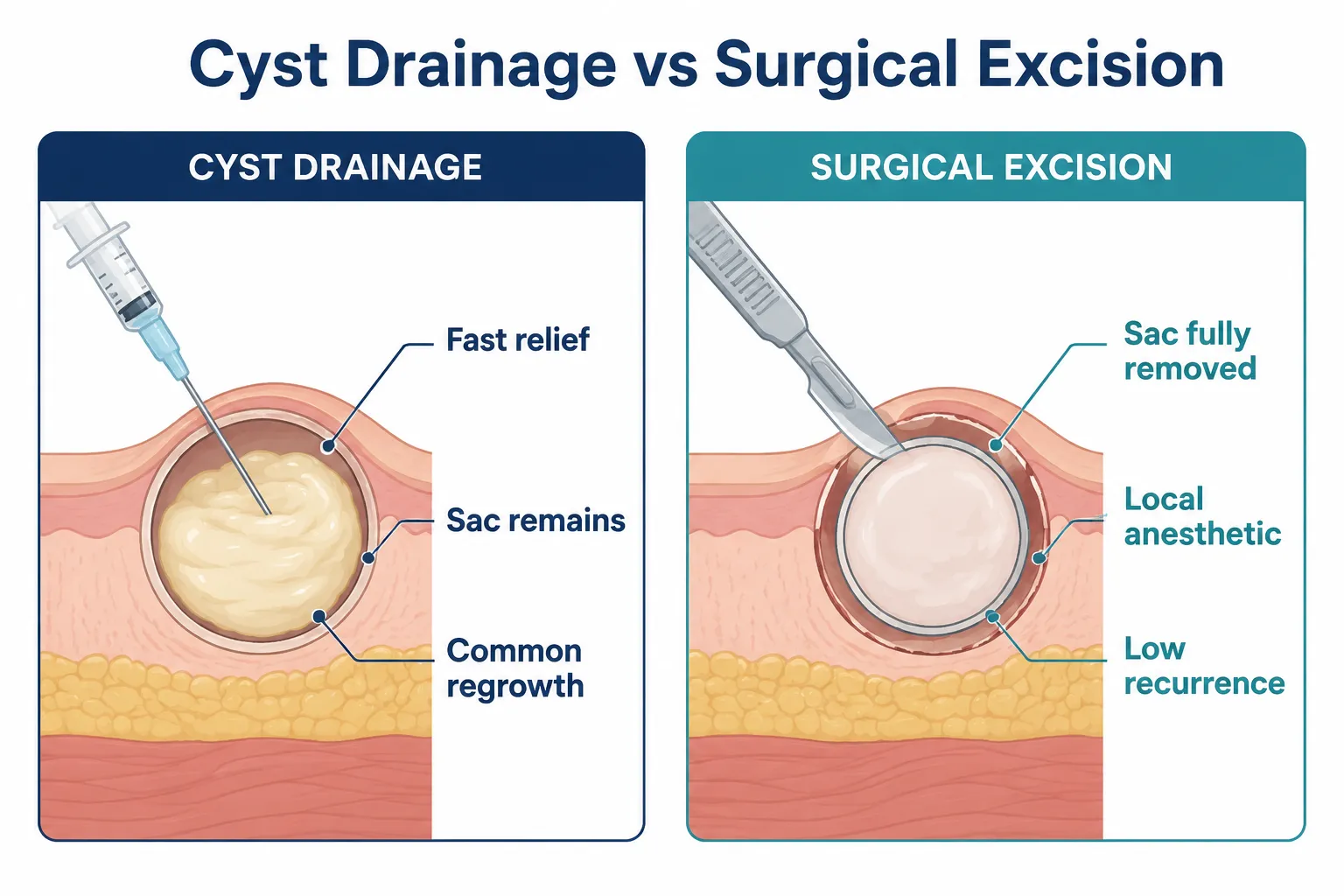
Surgical excision is the only reliable way to permanently remove a cyst, while non-invasive options like drainage only relieve pressure temporarily and leave the sac behind, which is why most cysts treated by drainage alone eventually return. Understanding this difference is the single most important decision point for anyone dealing with a recurring cyst[10].
Here is how the two approaches compare directly:
FactorDrainage OnlySurgical ExcisionRemoves the sac wallNoYesRecurrence riskHighLowSpeed of reliefImmediate pressure reliefSame-day, permanentBest used forAcute infected/painful flare-upsDefinitive, long-term removal
Drainage alone can still be the right first step when a cyst is acutely infected and swollen, since draining relieves pressure and pain quickly. But most dermatology and minor surgery providers agree that surgical excision of the whole sac is the preferred long-term solution, precisely because leaving any part of the sac behind allows the cyst to refill[10][9]. For a deeper side-by-side comparison, read Cyst Removal vs Cyst Drainage and why removing the entire cyst sac matters.
Choose excision if: the cyst has come back before, is not currently infected, and a full appointment can be scheduled. Choose drainage first if: the cyst is acutely infected, tense, and painful right now, excision can follow once the infection settles.
How Long Does Cyst Removal Take?
Most cyst removal procedures take between 15 and 30 minutes from the first injection of local anesthetic to the final suture, though total appointment time including numbing and prep can run 45 minutes to an hour[9]. Larger or deeper cysts, or those in complex areas like the scalp or back, may take slightly longer.
A typical visit breaks down like this:
Consultation and marking (5-10 minutes), the surgeon examines the cyst, plans the incision line, and marks the skin.
Local anesthetic (a few minutes), a numbing injection is given directly around the cyst.
Excision (10-20 minutes), the cyst and its sac are carefully separated from surrounding tissue and removed.
Closure (5-10 minutes), the incision is closed with sutures, sized appropriately for the wound.
Dressing and instructions (a few minutes), a bandage is applied and aftercare instructions are given.
Quick example: a small epidermoid cyst on the back, about the size of a pea, is often finished start to finish in under 20 minutes of actual procedure time. A larger pilar cyst on the scalp, or one that has scarred from a previous infection, may take closer to 30 to 40 minutes because of extra care needed around hair follicles and blood vessels.
Is Cyst Removal Painful?
Cyst removal itself is not typically painful during the procedure because the area is fully numbed with local anesthetic before any incision is made; most patients report pressure or a mild pulling sensation rather than sharp pain. Some soreness, tenderness, or throbbing is common for a day or two after the anesthetic wears off.
What patients usually feel at each stage:
During numbing: a brief pinch or sting from the injection, similar to a dental anesthetic shot.
During excision: pressure, tugging, or mild discomfort, but not sharp pain.
First 24-48 hours after: mild soreness, similar to a bruise or a shallow scrape, usually managed with over-the-counter pain relief.
After the first two days: discomfort typically fades quickly as the wound begins to close.
A common mistake is delaying treatment out of fear of pain. In practice, the anesthetic makes the excision itself far more tolerable than most people expect, and the post-procedure soreness is generally milder than the pain caused by an infected or inflamed cyst left untreated.
Cyst Removal at Home vs Professional Treatment
Attempting to remove a cyst at home by squeezing, popping, or lancing it is not the same as professional removal and carries real risks, because home methods almost never take out the sac wall and can introduce infection. Professional treatment, by contrast, is done under sterile conditions with proper anesthesia and complete sac excision.
Here is a direct comparison of outcomes:
Infection risk: Home attempts introduce bacteria through unsterile tools and unwashed hands; professional removal uses sterile instruments and technique.
Recurrence: Home squeezing leaves the sac behind almost every time, so the cyst refills within weeks or months; professional excision removes the sac entirely.
Scarring: Home attempts often cause jagged, uneven wounds that heal with worse scarring than a clean surgical incision.
Pain control: No anesthesia is used at home, so any cutting or squeezing is done without numbing, unlike a professional local anesthetic.
Complication management: A clinic can immediately address bleeding, deep infection, or unexpected findings; home attempts have no such backup.
Edge case: a cyst that has already ruptured on its own and is draining should still be seen by a professional, since the sac usually remains under the skin even after the visible material has come out. Cleaning the area at home does not replace the need for excision if recurrence is a concern.
For readers curious about how cysts are distinguished from other bumps before deciding on treatment, see this explainer on cyst vs. pimple vs. boil, which covers the visual and symptomatic differences in more depth.
Cyst Removal Recovery Time and Aftercare
Recovery from cyst removal is generally fast: most patients resume light daily activity within 24 to 48 hours, with sutures typically removed within one to two weeks depending on the cyst's location[6]. Full healing of the deeper skin layers can take several weeks longer, even after the surface looks closed.
Standard aftercare steps include:
Keep the dressing dry for the first 24 to 48 hours to reduce infection risk.
Clean gently with mild soap and water once cleared to do so, avoiding scrubbing.
Avoid strenuous activity that stretches the incision site, especially for cysts on the back, shoulders, or joints.
Watch for infection signs, increasing redness, warmth, swelling, or discharge should be reported to the clinic.
Attend the suture removal appointment, usually scheduled 7 to 14 days after surgery depending on location[6].
Protect the healing scar from sun exposure for several months, since UV exposure can darken a fresh scar.
Recovery timing varies by cyst location. A small cyst on the forearm heals faster than one on the scalp or back, where tension on the skin is higher. Anyone with cysts in multiple locations, such as those researching options for cyst removal on the back or scalp cysts, should ask specifically about location-based healing expectations during the consultation.
Cyst Removal Scars: How to Minimize Them
Cyst removal scars can be minimized by choosing an experienced surgeon who plans incision placement carefully, following aftercare instructions precisely, and protecting the healing skin from sun exposure and tension. In most cases, a well-performed excision heals into a thin, flat line rather than a raised or noticeable mark[6].
Practical steps that make a measurable difference:
Incision planning: Surgeons who align incisions with natural skin creases or tension lines produce less visible scars.
Suture timing: Removing sutures at the right time (not too early, not too late) affects final scar width.
Sun protection: Fresh scars are more prone to hyperpigmentation if exposed to UV light within the first few months.
Avoiding tension: Keeping the wound stable and avoiding stretching movements reduces scar widening.
Silicone sheets or scar gels: Some patients use these after full closure to support smoother healing, though results vary by individual.
A common mistake is picking at healing scabs or removing dressings early out of impatience, which increases the risk of a wider or more textured scar. For a full breakdown of what determines whether a scar forms and how visible it becomes, see Does Cyst Removal Leave a Scar.
When Should You See a Doctor About a Cyst?
See a doctor about a cyst if it is growing quickly, becoming painful, showing signs of infection, or has already come back after a previous drainage attempt. A cyst that has stayed the same size for years without symptoms is lower priority but should still be examined at least once to confirm the diagnosis.
Red flags that call for prompt evaluation:
Sudden increase in size over days or weeks.
Redness, warmth, or pus, which suggest infection.
Pain that is worsening rather than stable.
A cyst that has ruptured, drained, and refilled more than once.
Any uncertainty about whether a lump is actually a cyst versus something else, such as a lipoma or an enlarged lymph node.
Decision rule: book an appointment within days, not weeks, if there are signs of infection. For a stable, symptom-free cyst, a routine consultation within the next few weeks is reasonable. Patients dealing with cysts in cosmetically sensitive areas, such as the face, may also want earlier evaluation to plan for scar minimization; see this facial cyst removal guide for specifics on technique and healing in that area.
Complications and Risks of Cyst Removal Surgery
Cyst removal surgery is generally safe with a low complication rate, but as with any minor surgical procedure, risks include infection, bleeding, scarring, and, in a small number of cases, cyst recurrence if part of the sac is left behind. Most complications are manageable and resolve with proper follow-up care.
Key risks to be aware of:
Infection: Redness, swelling, or discharge after the procedure should be reported promptly.
Bleeding or bruising: Minor bruising is common; significant bleeding is rare but should be checked immediately.
Recurrence: Happens mainly when the sac is incompletely removed, reinforcing why complete excision technique matters[13][10].
Nerve or tissue irritation: Rare, but possible in areas with dense nerve networks, such as near the jawline or behind the ear.
Scarring: Some scarring is expected with any incision; the goal of good technique is to make it as thin and flat as possible.
Edge case: patients on blood thinners or with bleeding disorders should discuss this with the surgeon beforehand, since it can affect both the procedure plan and aftercare instructions. Anyone considering removal of a cyst in a high-risk area, such as near a joint or on the scalp near hair follicles, should specifically ask how the clinic manages those risks during the consultation.
Is cyst removal available in York Mills without a doctor's referral? Yes. The Minor Surgery Center's York Mills clinic accepts direct bookings for cyst assessment and removal without requiring a family doctor referral first[2].
How much does cyst removal cost in York Mills? Cost depends on whether the removal is medically necessary (often OHIP-eligible) or cosmetic (privately billed), plus factors like cyst size and number. See the Ontario cyst removal cost guide for typical ranges.
Can a cyst come back after removal? Yes, but recurrence is uncommon when the entire cyst sac is surgically removed. Recurrence is far more likely after drainage-only treatment, which leaves the sac intact[10][13].
What is the difference between a cyst and a boil? A cyst is a slow-growing sac under the skin, while a boil is an acute, painful bacterial infection of a hair follicle that develops quickly. Details are covered in this boil vs. cyst comparison.
Do stitches from cyst removal dissolve on their own? It depends on the type used. Some clinics use dissolvable sutures, while others use non-dissolvable ones that require a follow-up removal visit; see this dissolvable vs. non-dissolvable stitches guide for specifics.
Can I pop a cyst myself instead of getting it removed? Popping a cyst at home does not remove the sac wall, so it usually refills and carries a higher infection risk than professional excision performed under sterile conditions.
How soon can I get an appointment at the York Mills clinic? The York Mills location is positioned as a rapid-access clinic, with weekday hours from 9:00 a.m. to 4:00 p.m., Monday through Friday, and booking available by phone or email[12].
Are all cysts the same type? No. Epidermoid, pilar, and sebaceous-type cysts are the most common, but they differ in origin and typical location on the body, which can affect surgical approach[13].
Does insurance cover cyst removal in Ontario? OHIP typically covers cyst removal when it is medically necessary, such as for infection or pain, but not when it is purely cosmetic. Confirm classification with the clinic before the procedure.
What happens if a cyst is left untreated? Many stay stable for a long time, but some grow, become painful, or get infected. Watching for the red flags described earlier in this guide helps decide when to seek evaluation.
Conclusion
Cyst removal in York Mills comes down to one clear choice: complete surgical excision of the cyst and its sac, done by an experienced provider, versus temporary drainage that often leads to recurrence. The clinical consensus across dermatology and minor surgery providers in the region is consistent, removing the entire sac under local anesthetic is the most reliable way to prevent a cyst from coming back[10][9][13].
The Minor Surgery Center's new York Mills clinic at 85 Scarsdale Rd Unit 101, North York, ON M3B 2R2, is built specifically for this kind of care: no-referral booking, weekday rapid access, and a surgical approach focused on individualized planning and complete removal[2][12]. For anyone dealing with a cyst that is growing, recurring, or simply unwanted, the next step is straightforward:
Note how the cyst has changed, size, pain, or any signs of infection.
Call or email the York Mills clinic to book a consultation.
Ask directly whether the removal will be classified as medically necessary or cosmetic for billing purposes.
Schedule the excision and follow the aftercare plan closely to support clean healing and minimal scarring.
Cysts rarely resolve on their own, and home attempts to drain them usually make things worse. A short, well-planned surgical visit remains the most direct path to a permanent solution.
The Minor Surgery Center’s York Mills clinic, located at 85 Scarsdale Rd, Unit 101 in North York, offers convenient access to specialized surgical care for a range of skin and hand conditions. Our Plastic Surgeons provide treatment for skin cancer, suspicious moles, cysts, lipomas, carpal tunnel syndrome and trigger finger, with a focus on timely care and personalized treatment. In many cases, patients may be able to have their consultation and treatment completed during the same visit when medically appropriate. For expert care in a welcoming clinical setting, contact our York Mills team at (647) 614-1611.
We are the experts in the field of Minor Surgery. All our Surgeons have completed 5 years of post Medical School Surgical Residencies. They are all Board Certified by the Royal College of Physicians and Surgeons of Ontario.They have been trained at Institutions including McGill, McMaster, Queen's, University of British Columbia, University of Toronto, University of Western Ontario, The Mayo Clinic, University of Pennsylvania, University of Southern California, Yale University, and Oxford.
In many clinics, you could wait months—sometimes over a year—for a procedure like cyst or lipoma removal, mole removal, or even carpal tunnel release. But at TMSC, we prioritize fast access to care. In many cases, we can schedule and complete your minor surgery on the same day as your initial consultation—no extra runaround required.
Our clinics are designed with your comfort, safety, and efficiency in mind. We use strict sterilization protocols to minimize any infection risk, and our advanced surgical equipment meets hospital-grade standards. Yet, you’ll never feel like you’ve stepped into a stark, clinical space—our friendly staff ensures you’re welcome and supported the moment you walk through the door.
Cosmetic results matter—even for the smallest procedures. Skin lesions can be excised by non surgeons in Ontario. Furthermore, any MD with 2 years of post graduate training even outside of a surgical field can perform removal. At TMSC we only have Surgeons under our roof. They are trained well above the level of the procedures we offer to ensure the surgery goes smoothly with minimal scaring and preserving your natural contours. Our Surgeons are trained to ensure both function and aesthetics are always front and center.
At TMSC, we specialize in surgical treatment of both benign and malignant skin lesions, as well as minor hand conditions. We offer significantly reduced wait times often allowing you to schedule your surgery on the same day as your consultation.
You can book your free consultation with The Minor Surgery Center in three easy ways: online through Cortico, by phone, or by requesting a callback from our team.
The initial consultation is free. During this consultation, one of our board certified surgeons will examine your condition and recommend a suitable solution.
Directly Online
Request a Callback
By Phone
By Text
Hours
Sunday
Closed
Monday
9 am — 4 pm
Tuesday
9 am — 4 pm
Wednesday
9 am — 4 pm
Thursday
9 am — 4 pm
Friday
9 am — 4 pm
Saturday
Toronto & Oakville Open Vaughan & Mississauga Closed




.avif)
%20(600%20x%20600%20px)%20(2).avif)
.avif)
%20(8).avif)
%20(7).avif)

.png)