Cyst vs Pimple vs Boil: A Photo Guide to Common Bumps on the Skin
Discovering an unexpected bump on your skin can trigger immediate concern. Is it a harmless pimple that will disappear in a few days, a cyst that requires monitoring, or a boil that needs medical attention? Understanding the differences between Cyst vs Pimple vs Boil is essential for proper care and knowing when to seek professional help. While these three skin conditions may appear similar at first glance, they have distinct characteristics, causes, and treatment approaches that every person should understand in 2025.
This comprehensive photo guide will help you identify, understand, and appropriately manage these common skin bumps. By learning to distinguish between cysts, pimples, and boils, you'll be better equipped to make informed decisions about your skin health and avoid potentially serious complications.
Key Takeaways
Boils are bacterial infections that develop rapidly in hair follicles, while pimples form from clogged pores and cysts are slow-growing tissue sacs with various causes
Visual identification is crucial: Boils appear red, swollen, and painful with pus; pimples are smaller and superficial; cysts are flesh-colored, dome-shaped, and usually painless
Contagion differs significantly: Boils can spread through bacterial contact, while pimples and cysts are non-contagious
Treatment approaches vary: Never pop a boil due to infection risk; pimples may be extracted properly; cysts often require professional removal
Seek medical attention if boils don't improve with home care, show signs of spreading, or are accompanied by fever and systemic symptoms
Understanding the Basics: What Are Cysts, Pimples, and Boils?
Before diving into the detailed comparison of Cyst vs Pimple vs Boil, it's important to understand what each of these skin conditions actually represents. While they all manifest as bumps on the skin, their underlying causes and structures differ significantly.
What Is a Cyst? 🔵
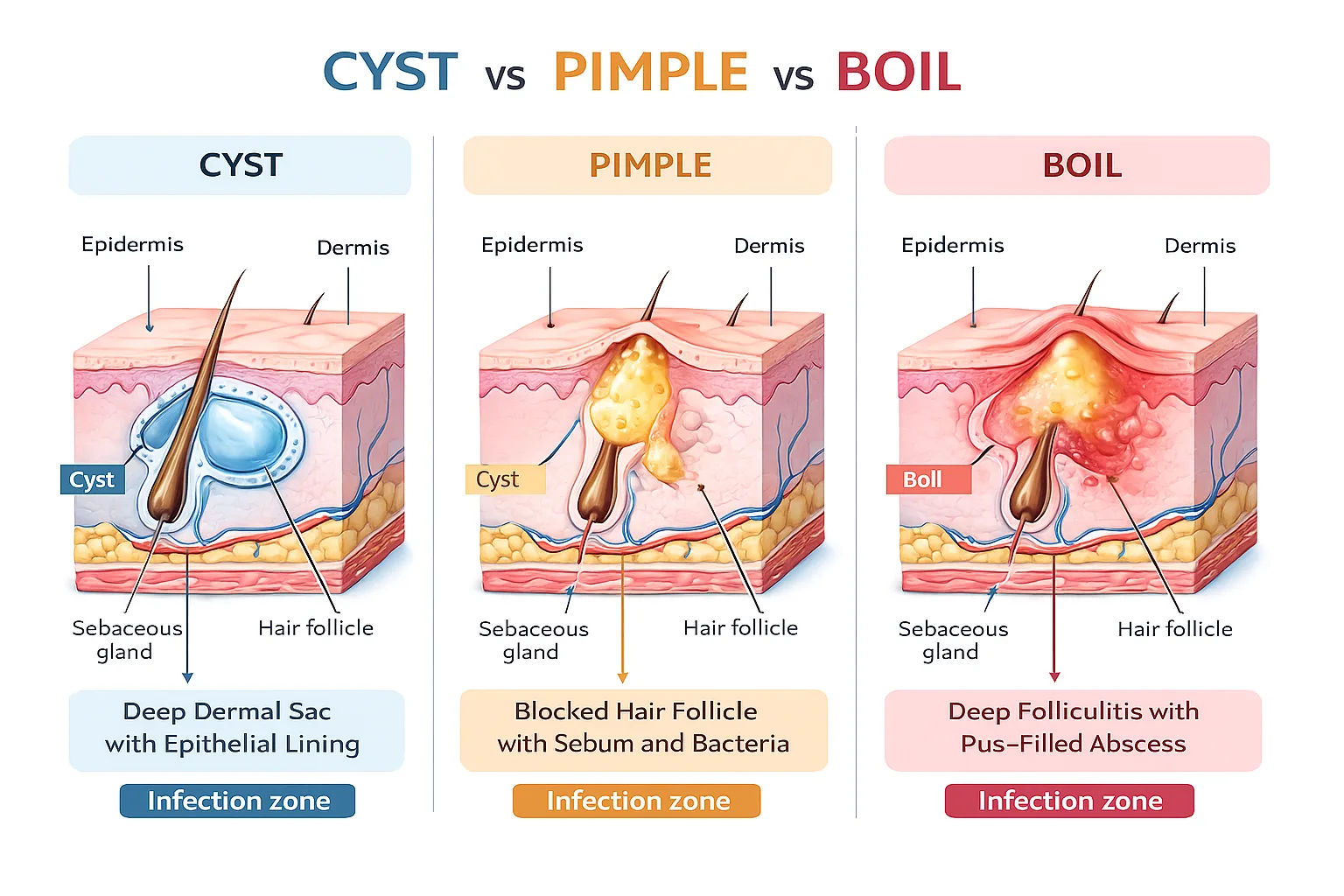
A cyst is a closed sac-like structure within the skin that contains liquid, semi-solid material, or gas. Cysts develop slowly over weeks to months and can persist for extended periods. They form beneath the skin's surface and are typically filled with keratin, a protein found in skin cells. Most cysts are benign (non-cancerous) and painless unless they become infected or inflamed.
Cysts can develop anywhere on the body and come in various types, including epidermoid cysts, sebaceous cysts, and pilar cysts. They appear as smooth, round bumps that are usually flesh-colored or slightly bluish. The bump is movable under the skin and has a distinct, well-defined border. For more detailed information about different types, visit our guide on 17 types of cysts.
What Is a Pimple? 🟡
A pimple, also called acne or a zit, forms when a single hair follicle becomes clogged with dead skin cells, excess oil (sebum), and bacteria. Pimples are part of the acne family and develop relatively quickly—usually within a few days. They are primarily superficial, affecting only the upper layers of skin.
Pimples commonly appear on the face, chest, shoulders, and back—areas with high concentrations of sebaceous (oil) glands. They can range from small whiteheads and blackheads to larger, inflamed papules and pustules. Unlike cysts and boils, pimples are typically smaller and resolve on their own within days to a couple of weeks.
What Is a Boil? 🔴
A boil, medically known as a furuncle, is a painful, pus-filled bump that results from a bacterial or fungal infection deep within a hair follicle or oil gland. Boils develop rapidly—often within just a few days—and are typically caused by Staphylococcus aureus bacteria[1]. They represent a more serious infection than a simple pimple.
Boils start as red, tender bumps that quickly become swollen and filled with pus. Within days, they develop a white or yellow center as the infection progresses. Boils can range from pea-sized to as large as a golf ball and may develop into larger abscesses if left untreated. When multiple boils cluster together, they form a carbuncle, which indicates a more severe infection[2].
Visual Identification: How to Tell Them Apart
The most practical way to distinguish between cysts, pimples, and boils is through careful visual examination and understanding their physical characteristics.
Identifying a Cyst
Visual characteristics:
Smooth, round, dome-shaped bump beneath the skin
Flesh-colored, white, or slightly bluish appearance
Well-defined borders that are easy to see and feel
Movable when touched—slides beneath the skin
No visible opening or pore on the surface
Typically painless unless infected or inflamed
May have a small, dark plug (punctum) in the center
Size and texture: Cysts vary considerably in size, from a few millimeters to several centimeters in diameter. They feel firm but slightly compressible, similar to a small water balloon beneath the skin. The overlying skin appears normal unless the cyst becomes infected.
Identifying a Pimple
Visual characteristics:
Small, raised bump on the skin surface
Red or pink inflammation around the bump
May have a white or yellow head (pustule)
May have a black center (blackhead/open comedone)
May be flesh-colored without a visible head (papule)
Centered on a hair follicle or pore
Superficial—doesn't extend deep into skin
Size and texture: Pimples are generally smaller than cysts and boils, ranging from 1-5 millimeters in diameter. They feel firm to the touch and may be tender when pressed. The inflammation is limited to the immediate area around the clogged pore.
Identifying a Boil
Visual characteristics:
Starts as a red, tender, swollen bump
Rapidly increases in size over 24-48 hours
Develops a white or yellow pus-filled center
Surrounding skin appears red, inflamed, and shiny
May have a visible opening where pus drains
Extremely painful and tender to touch
Warm to the touch due to active infection
May be accompanied by swelling in surrounding tissue
Size and texture: Boils typically measure between 1-5 centimeters (pea to golf ball size) and feel hard and swollen. The center becomes softer as pus accumulates. Unlike pimples, boils extend deep into the skin and involve more extensive tissue inflammation.
🔸 Certain medications (corticosteroids, androgens)
🔸 High-glycemic diet
🔸 Stress
🔸 Friction or pressure on skin (from helmets, tight collars, backpacks)
🔸 Poor skincare habits
🔸 Using comedogenic (pore-clogging) cosmetics
What Causes Boils?
Boils are primarily infectious in nature, with bacterial infection being the leading cause:
Primary causes:
🔴 Bacterial infection: Most commonly Staphylococcus aureus bacteria[1]
🔴 Fungal infection: Less common but possible
🔴 Compromised skin barrier: Cuts, scrapes, or other breaks in skin allow bacteria entry
🔴 Infected hair follicles: Folliculitis that progresses to deeper infection
Risk factors for boils:
Close contact with someone who has a staph infection
Weakened immune system (HIV/AIDS, chemotherapy, immunosuppressive medications)
Diabetes, which affects immune function and healing
Skin conditions like acne, psoriasis, or eczema that compromise skin integrity
Poor hygiene or infrequent bathing
Obesity
Friction from tight clothing
Living in crowded or unsanitary conditions
Frequent nose picking (can transfer staph bacteria)
Previous history of boils
Important Note: If you have recurring boils, consult a healthcare provider. You may be a carrier of staph bacteria or have an underlying condition that needs treatment.
Location Matters: Where Do They Typically Appear?
The location of a skin bump can provide valuable clues about whether you're dealing with a cyst, pimple, or boil.
Common Locations for Cysts
Cysts can develop anywhere on the body, but certain types favor specific locations:
Face and neck: Epidermoid and pilar cysts commonly appear here
Scalp: Pilar cysts frequently develop on the scalp
Back and chest: Epidermoid cysts often occur in these areas
Genitals: Bartholin's cysts affect the vaginal area
Wrists and hands: Ganglion cysts develop near joints
Groin and inner thighs: Friction and moisture create ideal conditions
Buttocks: Pressure and friction from sitting
Back: Especially upper back
Breasts: Under the breasts where friction occurs
Waistline: Where clothing creates pressure
Understanding that boils favor areas with high hair follicle and sweat gland density helps distinguish them from pimples, which prefer oil-rich areas.
Symptoms and Associated Signs
Beyond visual appearance, cysts, pimples, and boils each present with distinctive symptoms that can help with identification.
Cyst Symptoms
Primary symptoms:
Smooth, round bump beneath the skin
Usually painless
Slow growth over weeks to months
May remain the same size for years
Movable when touched
No warmth or redness (unless infected)
Symptoms of an infected cyst:
Pain and tenderness
Redness and warmth
Rapid increase in size
Pus or foul-smelling discharge
Boil-like appearance
When a cyst becomes infected, it may develop symptoms similar to a boil, which can make differentiation challenging. However, the underlying structure remains a cyst that requires infection treatment[3].
Pimple Symptoms
Primary symptoms:
Small, raised bump
Redness around the bump
Mild to moderate tenderness
May be itchy
Visible white, yellow, or black center
Localized inflammation only
No systemic symptoms
Types of pimples and their symptoms:
Whiteheads: Closed comedones with white appearance
Blackheads: Open comedones with dark center
Papules: Small, red, tender bumps without pus
Pustules: Red bumps with white or yellow pus-filled center
Nodules: Large, painful, solid lumps deep beneath skin
Cysts (cystic acne): Large, painful, pus-filled lumps deep in skin
Note: Cystic acne is different from a true cyst and represents severe inflammatory acne.
Boil Symptoms
Primary symptoms:
Painful, tender, swollen bump
Rapid development (days)
Increasing pain as it grows
Warmth to the touch
Red, inflamed surrounding skin
White or yellow pus-filled center
May spontaneously drain pus
Firm, hard texture initially, becoming softer as pus accumulates
Systemic symptoms (indicating more serious infection):
🌡️ Fever
😴 Fatigue and general malaise
🤒 Chills
💪 Body aches
🔴 Red streaks extending from the boil (lymphangitis)
💧 Swollen lymph nodes near the affected area
The presence of systemic symptoms is a key distinguishing feature of boils compared to pimples and cysts, indicating that the infection is affecting your entire body, not just the local area[2].
Medical Emergency: If you experience fever, red streaks extending from a boil, or severe pain, seek immediate medical attention. These signs indicate the infection may be spreading.
Boil vs Cyst: Understanding the Confusion
The distinction between boils vs cysts can be particularly confusing because infected cysts can look remarkably similar to boils. Understanding the key differences is essential for proper treatment.
Structural Differences
Cyst structure:
Enclosed sac with epithelial lining
Contains keratin, fluid, or semi-solid material
Well-defined capsule
Slow-growing
Benign tissue growth
Boil structure:
Infected hair follicle or oil gland
Filled with pus (dead white blood cells, bacteria, dead tissue)
No capsule or sac structure
Rapid development
Active infection
When a Cyst Mimics a Boil
An infected or inflamed cyst may develop symptoms that closely resemble a boil:
Sudden onset of pain
Redness and warmth
Swelling
Pus formation
Tender to touch
How to differentiate:
History: Did the bump exist before becoming painful? If yes, likely an infected cyst
Development speed: Cysts that suddenly become painful had a pre-existing structure; boils develop rapidly from normal skin
Movement: Even when infected, cysts often retain some mobility; boils are typically fixed
Recurrence: Infected cysts may recur in the exact same location; boils may occur in the same general area but not the identical spot
Treatment Implications
The distinction between boils vs cysts matters for treatment:
Infected cyst treatment:
Antibiotics to clear infection
Possible incision and drainage
Eventual complete cyst removal to prevent recurrence
The cyst capsule must be removed
Boil treatment:
Warm compresses to promote drainage
Antibiotics if severe or systemic symptoms present
Incision and drainage for large boils
No capsule to remove
For expert evaluation and treatment of cysts and boils in Ajax, professional medical assessment ensures appropriate care.
Cysts Pimples and Their Relationship
Understanding the relationship between cysts pimples helps clarify the spectrum of acne-related conditions and true cysts.
Cystic Acne vs True Cysts
Cystic acne is often confused with true cysts, but they are different conditions:
Cystic acne:
Severe form of inflammatory acne
Develops from clogged pores and bacterial infection
Large, painful, pus-filled lesions deep in skin
Part of the acne spectrum
Caused by hormones, bacteria, oil, and dead skin cells
Typically appears on face, chest, back
May resolve with acne treatment
Can cause scarring
True cysts:
Benign growth with epithelial lining
Not related to acne or pore blockage
Contains keratin or other material (not pus)
Can occur anywhere on body
Not caused by acne-related factors
Persist indefinitely unless removed
Rarely cause scarring unless infected
Can Pimples Turn Into Cysts?
A common question is whether a pimple can transform into a cyst. The answer is nuanced:
Regular pimples cannot become true cysts because they have fundamentally different structures. However:
A pimple can develop into cystic acne if the infection and inflammation extend deep into the skin
Severe inflammatory acne can create deep, cyst-like lesions
Repeated trauma to pimples (picking, squeezing) can drive infection deeper and create cyst-like structures
An ingrown hair can lead to cyst formation in some cases
🧪 Consider testing for staph carrier status if boils recur
💪 Maintain healthy immune system through diet and lifestyle
When to See a Doctor: Red Flags and Warning Signs
Knowing when to seek professional medical care for cysts, pimples, or boils can prevent complications and ensure appropriate treatment.
Seek Immediate Medical Attention If:
🚨 Emergency warning signs:
High fever (over 101°F/38.3°C)
Red streaks extending from the bump
Severe pain that interferes with daily activities
Rapid spreading of redness or swelling
Boil on face, spine, or rectal area
Signs of systemic infection (chills, body aches, confusion)
Multiple boils appearing simultaneously
Boil in a person with diabetes or immune compromise
Schedule a Medical Appointment If:
For any skin bump:
Rapid growth or change in appearance
Bleeding or discharge
Persistent pain
Interferes with movement or function
Cosmetic concerns
Uncertainty about diagnosis
For pimples:
Severe or cystic acne
Acne not responding to OTC treatments after 6-8 weeks
Acne causing scarring
Acne affecting self-esteem or quality of life
For cysts:
Cyst becomes painful, red, or warm
Rapid increase in size
Interferes with daily activities
Located in a cosmetically sensitive area
You want it removed
For boils:
Boil doesn't improve with home treatment after 3-4 days
Boil larger than 2 inches
Recurring boils (more than one in 6 months)
Boil accompanied by fever
You have diabetes, heart problems, or immune system issues
Professional evaluation at a skin cancer clinic can also rule out more serious conditions that may mimic benign bumps.
Complications and Risks
Understanding potential complications of cysts, pimples, and boils emphasizes the importance of proper care and timely treatment.
Pimple Complications
Scarring:
Picking or squeezing pimples increases scarring risk
Cystic acne more likely to cause permanent scars
Types: ice pick scars, boxcar scars, rolling scars, hypertrophic scars
Post-inflammatory hyperpigmentation:
Dark spots that remain after pimple heals
More common in darker skin tones
Can take months to fade
Psychological impact:
Decreased self-esteem
Social anxiety
Depression in severe cases
Cyst Complications
Infection:
Can develop into abscess requiring drainage
May need antibiotics
Infected cysts can be very painful
Rupture:
Cyst may rupture internally
Causes inflammation and pain
May require surgical intervention
Recurrence:
Incomplete removal leads to cyst returning
Proper surgical excision prevents recurrence
Rarely, malignancy:
Most cysts are benign
Certain types may rarely become cancerous
Any suspicious changes should be evaluated
Boil Complications
Abscess formation:
Boil may develop into larger abscess
Requires medical drainage
More difficult to treat
Cellulitis:
Spreading bacterial infection of skin and tissues
Causes expanding redness, warmth, swelling
Requires antibiotic treatment
Can become serious if untreated
Sepsis:
Life-threatening systemic infection
Rare but serious complication
Requires emergency medical treatment
More likely in immunocompromised individuals
Carbuncle formation:
Multiple boils cluster together
Deeper infection than single boil
Often causes fever and systemic symptoms
Requires medical treatment
Scarring:
Large boils may leave permanent scars
Picking or squeezing increases scarring risk
Recurrent furunculosis:
Repeated boil outbreaks
May indicate staph carrier status
Requires investigation and treatment
MRSA infection:
Methicillin-resistant Staphylococcus aureus
More difficult to treat
Requires specific antibiotics
Can spread to others
Critical Point: Squeezing or popping a boil can push infection deeper into tissues, spread bacteria to other areas, and significantly increase complication risk. Always allow boils to drain naturally or seek professional drainage[1].
Special Populations and Considerations
Certain groups face unique challenges or risks when dealing with cysts, pimples, and boils.
Children and Adolescents
Pimples:
Very common during puberty due to hormonal changes
May affect self-esteem during critical developmental period
Early treatment can prevent scarring
Education about proper skincare is essential
Boils:
Children in close contact (schools, daycare) may spread infections
Important to teach proper hygiene
May be more frightening for children
Require careful monitoring
Cysts:
Less common in children
May be congenital or developmental
Should be evaluated by pediatrician
Pregnant Women
Hormonal changes during pregnancy can affect all three conditions:
Pimples:
Pregnancy hormones may worsen or improve acne
Many acne medications are unsafe during pregnancy
Consult healthcare provider before using any treatments
Boils:
Pregnancy doesn't increase boil risk directly
Immune system changes may affect infection response
Some antibiotics are safe during pregnancy; others are not
Always inform doctor of pregnancy status
Cysts:
Hormonal changes may affect cyst development
Generally safe to monitor during pregnancy
Removal can usually wait until after delivery unless problematic
People with Diabetes
Increased risk for boils and complications:
High blood sugar impairs immune function
Slower wound healing
Higher risk of serious infections
May develop carbuncles more easily
Require prompt medical attention for any skin infection
Blood sugar control is essential for prevention and healing
Special precautions:
Monitor skin carefully for any bumps or infections
Seek medical care early
Never attempt to drain boils at home
Keep blood sugar well-controlled
Practice meticulous hygiene
Immunocompromised Individuals
People with weakened immune systems face higher risks:
Separating fact from fiction about cysts, pimples, and boils helps ensure proper care and prevents harmful practices.
Common Myths About Pimples
❌ Myth: Popping pimples helps them heal faster ✅ Fact: Popping pimples can push infection deeper, cause scarring, and spread bacteria to other areas. It typically delays healing.
❌ Myth: Acne is caused by dirty skin ✅ Fact: Acne is caused by hormones, oil production, bacteria, and dead skin cells—not dirt. Over-washing can actually worsen acne.
❌ Myth: Tanning or sun exposure clears acne ✅ Fact: While sun may temporarily dry out pimples, it causes skin damage and can worsen acne long-term. Some acne medications increase sun sensitivity.
❌ Myth: Only teenagers get pimples ✅ Fact: Adult acne is common, especially in women due to hormonal fluctuations.
❌ Myth: Toothpaste is a good pimple treatment ✅ Fact: Toothpaste can irritate skin and cause burns. Use products specifically designed for acne.
Common Myths About Cysts
❌ Myth: Cysts are always cancerous ✅ Fact: The vast majority of skin cysts are completely benign (non-cancerous).
❌ Myth: You can pop a cyst like a pimple ✅ Fact: Attempting to pop a cyst can cause infection and won't remove the cyst capsule, leading to recurrence.
❌ Myth: Cysts will go away on their own ✅ Fact: While some cysts may shrink or remain stable, they typically persist indefinitely unless surgically removed.
❌ Myth: All bumps under the skin are cysts ✅ Fact: Many conditions can cause bumps under skin, including lipomas, lymph nodes, and other growths.
Common Myths About Boils
❌ Myth: Boils are a sign of poor hygiene ✅ Fact: While hygiene matters, anyone can develop boils. Many factors contribute, including immune function and bacterial exposure.
❌ Myth: You should squeeze a boil to drain it ✅ Fact: NEVER squeeze a boil. This can spread infection and cause serious complications. Allow natural drainage or seek professional care.
❌ Myth: Boils aren't contagious ✅ Fact: Boils are contagious. The bacteria can spread through direct contact or contaminated items.
❌ Myth: Antibiotics alone will cure a boil ✅ Fact: Large boils often require drainage in addition to antibiotics for effective treatment.
❌ Myth: Boils only affect certain body parts ✅ Fact: Boils can develop anywhere on the body with hair follicles, though they favor certain areas.
Living with Recurring Skin Bumps
For individuals who experience frequent cysts, pimples, or boils, long-term management strategies are essential.
Managing Chronic Acne
Medical management:
Work with dermatologist for personalized treatment plan
While many skin bumps can be managed at home, professional medical care plays a crucial role in diagnosis, treatment, and prevention of complications.
Benefits of Professional Evaluation
Accurate diagnosis:
Distinguish between cysts, pimples, boils, and other conditions
Identify serious conditions that may mimic benign bumps
Rule out skin cancer or other malignancies
Determine underlying causes
Appropriate treatment:
Access to prescription medications
Professional drainage procedures when needed
Surgical removal with proper technique
Reduced risk of complications and scarring
Specialized expertise:
Dermatologists specialize in skin conditions
Surgeons trained in proper removal techniques
Access to advanced diagnostic tools
Evidence-based treatment approaches
What to Expect During Your Visit
Medical history:
Duration and progression of the bump
Previous similar bumps
Associated symptoms
Medical conditions and medications
Family history of skin conditions
Physical examination:
Visual inspection of the bump
Palpation to assess texture, mobility, tenderness
Examination of surrounding skin
Assessment of lymph nodes if infection suspected
Diagnostic procedures (if needed):
Dermoscopy: Magnified examination of skin
Biopsy: Tissue sample for laboratory analysis
Culture: Testing pus or discharge to identify bacteria
Imaging: Ultrasound or other imaging for deep or complex lesions
Treatment options:
Discussion of available treatments
Explanation of risks and benefits
Development of personalized treatment plan
Instructions for home care
Follow-up:
Scheduled follow-up appointments
Monitoring for recurrence
Assessment of treatment effectiveness
Adjustment of treatment plan if needed
Choosing the Right Healthcare Provider
For pimples and acne:
Start with primary care physician or dermatologist
Dermatologist for moderate to severe acne
Consider esthetician for professional extractions and skincare guidance
For cysts:
Primary care physician for initial evaluation
Dermatologist for diagnosis and small cyst removal
Surgeon for larger or complex cysts
Specialized centers for cyst removal procedures
For boils:
Primary care physician for most boils
Emergency department for severe infections or systemic symptoms
Infectious disease specialist for recurrent or resistant infections
Dermatologist for chronic furunculosis
Explore The Minor Surgery Center blog for additional educational resources on skin conditions and treatment options.
Conclusion: Taking Control of Your Skin Health
Understanding the differences between Cyst vs Pimple vs Boil empowers you to make informed decisions about your skin health. While these three conditions may initially appear similar, they have distinct characteristics, causes, and treatment requirements that are essential to recognize.
Key points to remember:
Identification is crucial: Pimples are small, superficial, and related to clogged pores; cysts are slow-growing, painless sacs beneath the skin; boils are painful, rapidly developing bacterial infections that can cause systemic symptoms.
Treatment approaches differ significantly: Never squeeze a boil due to serious infection risks. Pimples may respond to over-the-counter treatments and proper skincare. Cysts often require professional surgical removal for permanent resolution.
Know when to seek help: While many pimples can be managed at home, boils often require medical attention, especially if accompanied by fever, severe pain, or systemic symptoms. Cysts should be evaluated by a healthcare professional for proper diagnosis and treatment planning.
Prevention matters: Good hygiene practices can prevent boils, consistent skincare routines help manage pimples, and while cysts are often unavoidable, maintaining healthy skin reduces infection risk.
Don't ignore warning signs: Red streaks, fever, rapid spreading, or severe pain warrant immediate medical attention. Early intervention prevents complications and promotes better outcomes.
Your Next Steps
If you have a skin bump:
✅ Use this guide to identify the type of bump
✅ Assess severity and associated symptoms
✅ Apply appropriate home care if suitable
✅ Seek professional evaluation if uncertain or if warning signs present
✅ Follow treatment recommendations consistently
✅ Monitor for changes or recurrence
For ongoing skin health:
Establish a consistent skincare routine appropriate for your skin type
Practice good hygiene, especially in areas prone to boils
Monitor your skin regularly for new or changing bumps
Maintain overall health through proper nutrition, exercise, and stress management
Build a relationship with a dermatologist or healthcare provider for ongoing care
Take action today: Don't let uncertainty about a skin bump cause unnecessary worry or delay appropriate treatment. Whether you're dealing with a persistent pimple, a concerning cyst, or a painful boil, professional evaluation provides peace of mind and access to effective treatment options.
Remember, your skin is your body's largest organ and deserves attentive care. By understanding the differences between cysts, pimples, and boils, you're better equipped to protect your skin health and seek appropriate care when needed.
For expert evaluation and treatment of skin bumps, cysts, and other skin conditions, contact a qualified healthcare provider. Professional care ensures accurate diagnosis, effective treatment, and optimal outcomes for your skin health journey in 2025 and beyond.
References
[1] Stevens DL, Bisno AL, Chambers HF, et al. Practice guidelines for the diagnosis and management of skin and soft tissue infections: 2014 update by the Infectious Diseases Society of America. Clinical Infectious Diseases. 2014;59(2):147-159.
[2] Ibler KS, Kromann CB. Recurrent furunculosis – challenges and management: a review. Clinical, Cosmetic and Investigational Dermatology. 2014;7:59-64.
[3] Moore RB, Fagan EB, Hulkower S, Skolnik DC, O'Sullivan A. Clinical inquiries. What's the best treatment for sebaceous cysts? Journal of Family Practice. 2007;56(4):315-316.