
Last updated: November 3, 2026
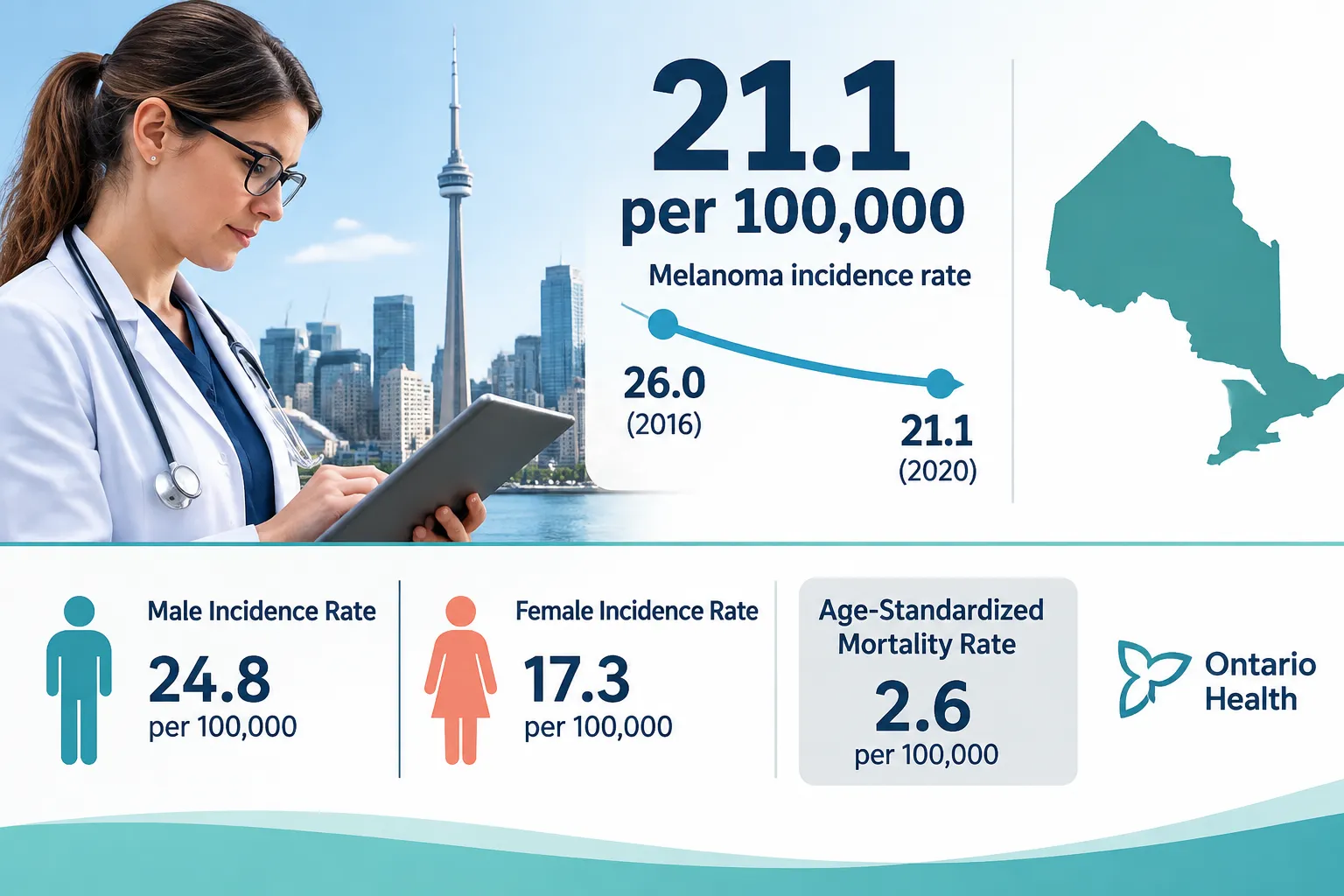
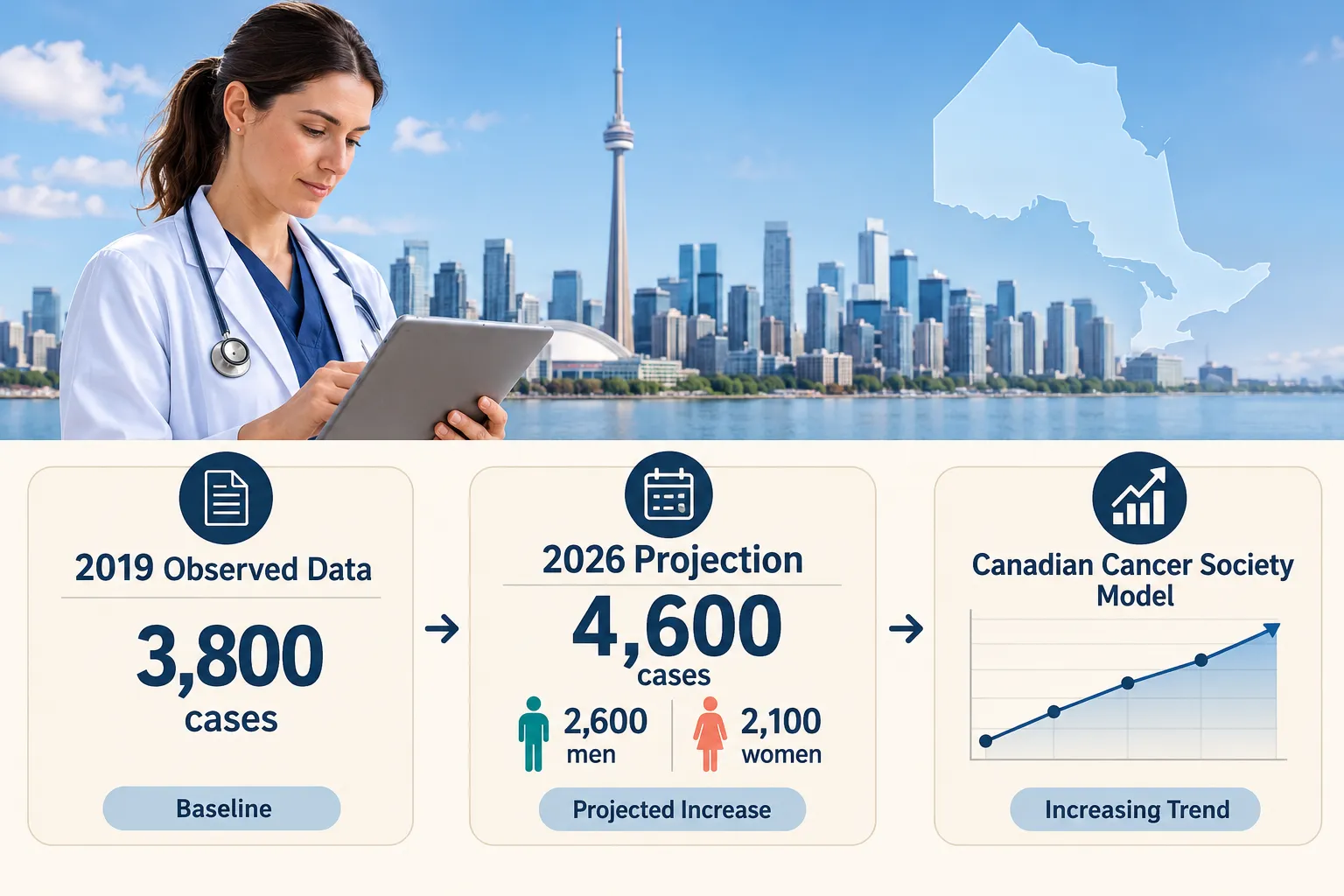
Ontario's most recent observed melanoma data, published by Ontario Health, show an age-standardized incidence rate of 21.1 per 100,000 in 2020, down from 26.0 per 100,000 in 2016 [7]. For 2026, the Canadian Cancer Society projects 4,600 new melanoma cases and 570 deaths in Ontario, based on historical trends through 2019 and 2022 [1]. Non-melanoma skin cancers (basal cell and squamous cell carcinoma) are far more common but are not systematically tracked in most Canadian cancer registries [3].
This mix of observed data and projections matters. Anyone citing "skin cancer statistics Ontario" should know which numbers are actual counts and which are estimates, the gap between them is a recurring theme throughout this report.
These are the most citable, sourced figures currently available on skin cancer statistics Ontario residents and researchers are searching for.
The most current figure is a projection: 4,600 Ontario melanoma diagnoses expected in 2026, split roughly 2,600 among men and 2,100 among women [1]. This is a Canadian Cancer Society estimate modeled from incidence data through 2019, not a confirmed 2026 count [1].
The last fully observed Ontario incidence data comes from Ontario Health's 2024 Cancer System Quality Index, covering diagnoses through 2020 [7]. That report found the age-standardized incidence rate falling from 26.0 to 21.1 per 100,000 between 2016 and 2020 for both sexes combined [7].
Common mistake: treating the 2026 projection as an actual diagnosis count. It is a model-based estimate, and actual registry-confirmed numbers for 2024-2026 are not yet published. For background on how these projections are built nationally, see this complete breakdown of global and Canadian melanoma data.
Ontario Health's technical supplement recorded approximately 523 melanoma deaths in 2020-350 among men and 173 among women [8]. The Canadian Cancer Society's 2026 projection estimates 570 melanoma deaths in Ontario, including 380 male and 190 female deaths [1].
Ontario's age-standardized mortality rate declined modestly from 3.4 to 3.1 deaths per 100,000 between 2016 and 2020 [7]. That is a small improvement, but it sits against rising projected case counts, which is why mortality projections for 2026 are higher than the last observed 2020 death count.
Edge case: mortality counts lag behind diagnosis counts by several years because registries need time to confirm cause of death and finalize records. Readers tracking "melanoma deaths Ontario" should always check whether a figure is observed or projected. For more context on how age affects mortality risk, see this analysis of melanoma death rates by age.
The answer depends on the measure. Observed age-standardized incidence rates actually declined between 2016 and 2020, from 26.0 to 21.1 per 100,000 [7]. But projected raw case counts for 2026 are higher than past actual counts, because Ontario's population is growing and aging [1].
This is not a contradiction. Rate-based measures adjust for population size and age structure; raw counts do not. A shrinking rate combined with a growing, aging population can still produce more total diagnoses each year.
Decision rule: if someone claims skin cancer rates are "rising" in Ontario, ask whether they mean rate per 100,000 or total case volume, these can move in different directions. Learn more about screening options at Skin Cancer Screening Ontario.
Men in Ontario have consistently higher melanoma incidence than women across the 2016-2020 period measured by Ontario Health [7]. Older adults, particularly those 70 and above, carry the highest age-specific incidence burden [7].
Example: a 72-year-old man in Ontario statistically faces a meaningfully higher melanoma incidence rate than a 35-year-old woman, based on Ontario Health's age-specific breakdowns [7]. For a plain-language guide to spotting early signs across ages, see the ABCDEs of melanoma.
Ontario's five-year relative survival rate for melanoma reached 91.3% for cases diagnosed between 2016 and 2020, an improvement from earlier diagnosis periods [7]. The national comparison figure sits around 89% [7].
This high survival rate reflects, in part, melanoma's visibility on the skin, which supports earlier detection compared with many internal cancers. Survival depends heavily on stage at diagnosis, localized melanoma carries a much better outlook than melanoma that has spread.
Common mistake: assuming survival rate equals cure rate. Relative survival compares outcomes against the general population and does not capture individual prognosis, which depends on stage, tumor thickness, and treatment timing. See a full breakdown in this guide to melanoma survival rate and melanoma stages explained.
Basal cell carcinoma (BCC) and squamous cell carcinoma (SCC) are the most common skin cancers in Canada, but they are generally excluded from standard cancer registry counts, so no reliable annual Ontario or Canada-wide total exists [3]. This is a structural limitation of how registries are built, not a sign these cancers are rare.
Most provincial and national registries, including the data behind Ontario Health's reports, focus on reportable cancers, and non-melanoma skin cancers are typically excluded because of their high volume and generally low mortality [3]. This means any number claiming to be a precise "BCC and SCC case count for Ontario" should be treated with caution unless the source clearly explains its methodology.
What is verifiable: Ontario's 2026 Mole Mobile screenings flagged 156 suspected basal cell carcinomas and 29 possible squamous cell carcinomas among 2,564 people screened across 27 stops [6]. These are screening findings requiring clinical follow-up, not confirmed registry diagnoses [6]. For details on the four main skin cancer types and how they differ, read 4 Types of Skin Cancer and BCC Skin Cancer.
Ontario's melanoma incidence rate has historically run slightly higher than the Canadian comparison rate. In 2018, Ontario recorded 25.1 per 100,000 against 22.1 per 100,000 for Canada excluding Quebec [7].
Ontario also outperforms the national average on survival: 91.3% versus roughly 89% for the five-year relative survival benchmark [7]. The Canadian Cancer Society's national 2026 estimates place Ontario's projected 4,600 cases and 570 deaths within a broader national context that includes all provinces, so provincial-level nuance matters when comparing Ontario against national totals [1].
Total skin cancer case counts in Ontario are rising mainly because of population growth and an aging demographic, even as age-adjusted incidence rates have declined in the most recent measured period [1][7]. Melanoma risk accumulates with cumulative sun exposure over a lifetime, so an aging population naturally produces more diagnoses in absolute terms.
Key contributing factors, based on cited data and established risk patterns:
Read more on sun exposure risk factors in Tanning Beds and Skin Cancer Risk and Skin Type and Cancer Risk.
The data points to one practical takeaway: early detection substantially improves outcomes, and Ontario's 91.3% five-year survival rate reflects cases caught across all stages, including many found early [7]. Regular skin checks and prompt follow-up on changing moles remain the most actionable response to these statistics.
Practical steps:
Sunscreen reduces UV damage but is not a complete shield on its own; missed spots, reapplication gaps, and UVA-only protection are common issues. Combining sunscreen with physical barriers and regular screening is the more reliable approach. For step-by-step guidance, see Skin Self Exams and Where Can I Get a Free Skin Cancer Screening in Ontario.
If a suspicious lesion is confirmed, Ontario residents can access OHIP-covered removal of basal cell carcinoma, squamous cell carcinoma, and melanoma without a referral at The Minor Surgery Center's five GTA locations (Toronto/North York, York Mills, Vaughan, Mississauga, and Oakville), where board-certified plastic and reconstructive surgeons perform removals. A free consultation is available by calling (647) 614-1611. Explore Skin Cancer Screening Toronto for more detail.
Ontario's melanoma statistics come primarily from the Ontario Cancer Registry, compiled and reported through Ontario Health's Cancer System Quality Index, which involves multi-year data verification and reporting lag [7]. The most recent finalized Ontario Health provincial melanoma series covers diagnoses only through 2020, meaning no equivalent finalized dataset exists yet for 2021-2026 [3].
Key limitations to understand:
How common is skin cancer in Ontario?
Melanoma is projected at 4,600 new cases in Ontario for 2026, while non-melanoma skin cancers like basal cell and squamous cell carcinoma are far more common but not systematically tracked in Canadian registries [1][3].
How many people get melanoma in Ontario each year?
The 2026 projection is 4,600 cases; the last fully observed Ontario Health incidence data covers through 2020, when the age-standardized rate was 21.1 per 100,000 [1][7].
Is melanoma increasing in Ontario?
Age-standardized incidence rates declined from 2016 to 2020, but projected raw case counts for 2026 are higher due to population growth and aging [1][7].
What is the survival rate for melanoma in Ontario?
Ontario's five-year relative survival rate for melanoma diagnosed between 2016 and 2020 was 91.3%, above the roughly 89% national figure [7].
Why aren't basal cell carcinoma cases counted?
Most Canadian cancer registries exclude basal cell and squamous cell carcinoma from standard reportable cancer counts due to high volume and generally low mortality, so no precise annual Ontario total exists [3].
Who is most at risk of melanoma in Ontario?
Men and adults aged 70 and older show the highest incidence rates, according to Ontario Health's 2016-2020 data, alongside people with fair skin and high cumulative sun exposure [7][10].
This article is educational only. All figures are drawn from the cited sources and years shown; they should not replace individual medical advice.
[1] On Specific Stats 2026 - https://cdn.cancer.ca/-/media/files/research/cancer-statistics/2026-cmaj/province-specific/on-specific-stats-2026.pdf
[2] Statistics - https://cancer.ca/en/cancer-information/cancer-types/melanoma-skin/statistics
[3] 2026 Cancer Specific En - https://cdn.cancer.ca/-/media/files/research/cancer-statistics/2026-cmaj/2026_cancer-specific_en.pdf
[4] Ontario Cancer Profiles - https://ontariohealth.ca/system/data/ontario-cancer-profiles
[5] Mole Mobile Skin Cancer Screening Clinic Rolling Into Orillia - https://www.orilliamatters.com/local-news/mole-mobile-skin-cancer-screening-clinic-rolling-into-orillia-12553259
[6] Mole Mobile Skin Cancer Screening Clinic Rolling Into Orillia - https://www.orilliamatters.com/local-news/mole-mobile-skin-cancer-screening-clinic-rolling-into-orillia-12553259
[7] Cancer Statistics At A Glance - https://cancer.ca/en/research/cancer-statistics/cancer-statistics-at-a-glance
[8] E526.full - https://www.cmaj.ca/content/cmaj/198/14/E526.full.pdf
[9] Canadian Cancer Statistics - https://cancer.ca/en/research/cancer-statistics/canadian-cancer-statistics
[10] Stats And Facts - https://melanomacanada.ca/understanding-skin-cancer/melanoma/stats-and-facts/
Ontario's melanoma picture is a story of two trends moving in opposite directions: age-standardized incidence rates have declined through 2020, while projected raw case counts and deaths are expected to rise toward 2026 because of population growth and aging [1][7]. Survival rates remain a genuine strength, with 91.3% of Ontarians diagnosed between 2016 and 2020 surviving five years [7]. Non-melanoma skin cancers remain the most common skin cancers overall, even though registries do not capture reliable totals for them [3].
The practical response does not change based on which statistic is cited. Check skin monthly, book annual screenings, protect against UV exposure, and act quickly on changing moles. For Ontario residents seeking OHIP-covered assessment or removal without a referral, The Minor Surgery Center offers free consultations across five GTA clinics by calling (647) 614-1611.
Source: Ontario Health Cancer System Quality Index, 2024 report. Figures are observed rates through 2020, not projections.