Trigger Finger Release in Toronto: Injection, Surgery, and How to Tell Which One You Need
Last updated: September 8, 2026
Quick Answer
Trigger finger happens when a flexor tendon can no longer glide smoothly under the A1 pulley at the base of the finger, so the digit catches, clicks or locks, usually worst first thing in the morning. A corticosteroid injection into the tendon sheath is the usual first treatment and settles a good number of early cases; trigger finger release is a short procedure under local anaesthetic that divides the A1 pulley so the tendon runs freely again. Adults across Toronto and the GTA can be assessed for trigger finger release Toronto-wide at The Minor Surgery Center without a referral.
Key Takeaways
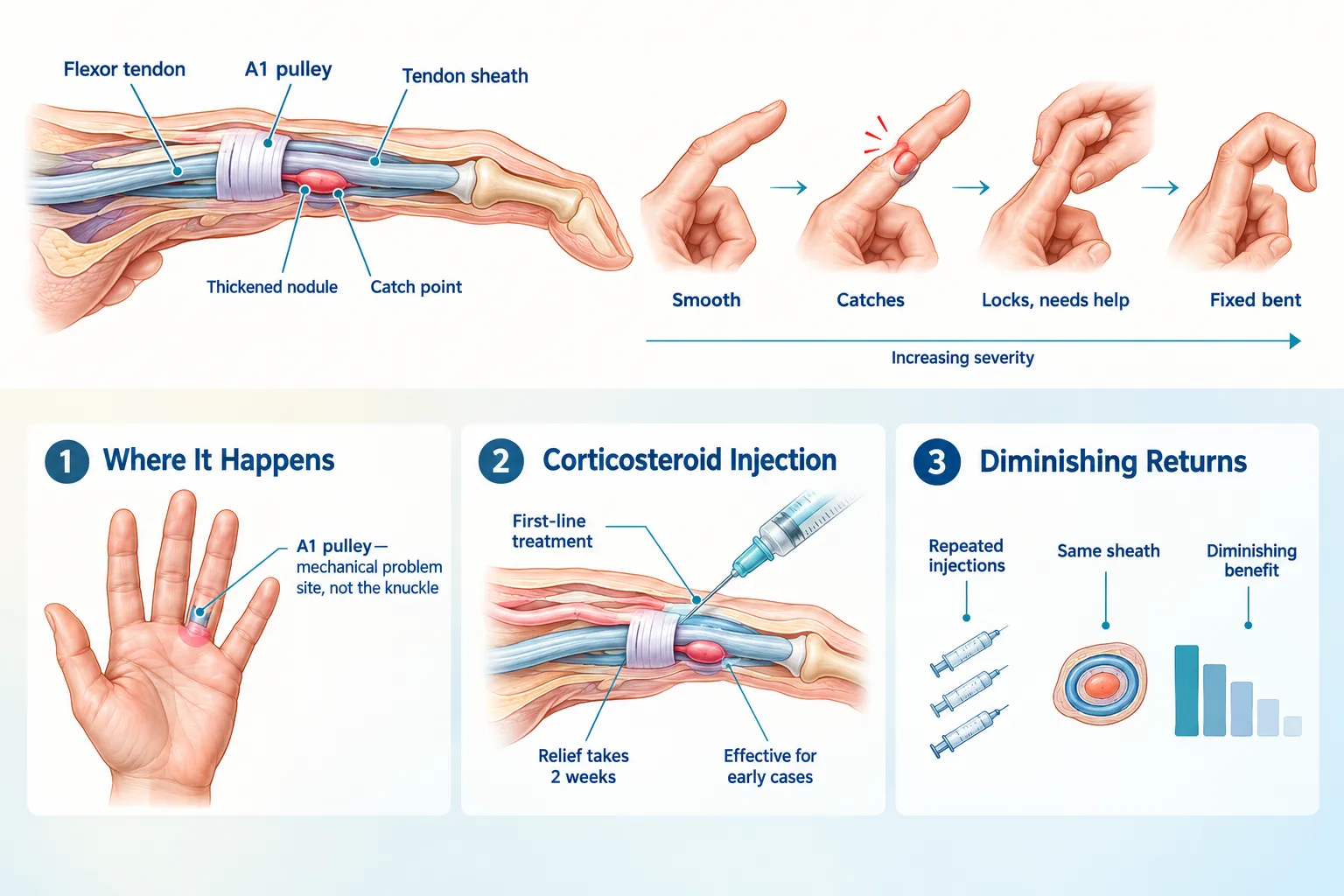
Trigger finger is a mechanical problem at the A1 pulley in the palm, not a problem at the knuckle that appears to be stuck.
A corticosteroid injection is genuinely first-line for most early cases, and relief can take a couple of weeks to arrive.
Repeated injections into the same sheath have diminishing returns; two is a common practical limit before surgery is discussed.
A digit that locks or won't straighten deserves assessment sooner, because the middle-joint stiffness it causes can outlast a successful release.
People with diabetes more often have several digits involved and shorter-lived injection relief, and a steroid injection can raise blood glucose for a few days.
Open and percutaneous release divide the same pulley; open release is preferred for the thumb and whenever the anatomy needs to be seen.
Triggering usually stops immediately after release, while palm tenderness and swelling settle over weeks.
What Trigger Finger Actually Is
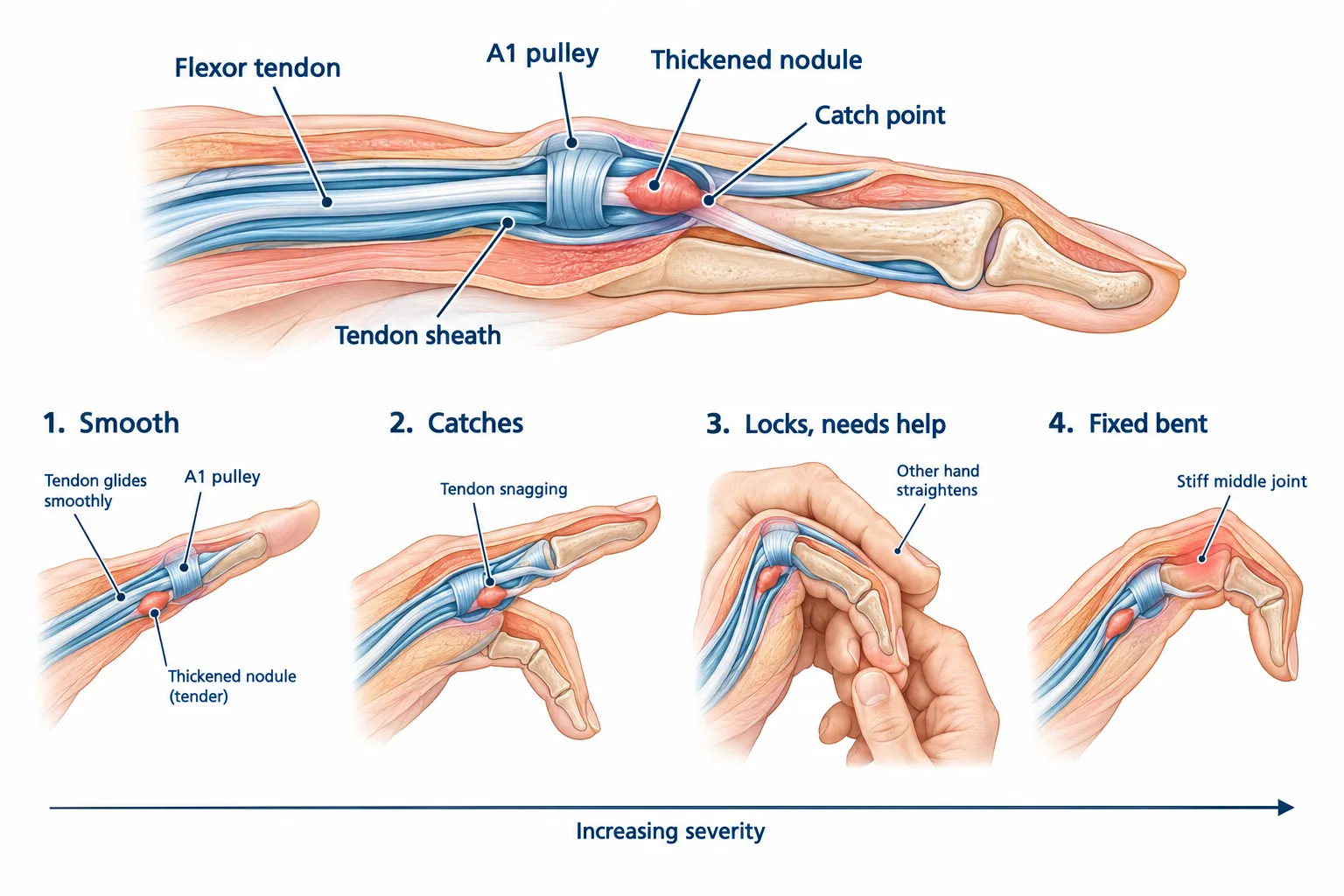
Each finger's flexor tendon runs inside a sheath and passes under a series of fibrous pulleys that hold it against the bone. The first of those, the A1 pulley, sits at the base of the finger in the palm, and that is where trigger finger begins. When the tendon thickens or the pulley narrows, the tendon stops sliding smoothly, so it catches on entry and then snaps through with a click.
Symptoms are usually worst on waking because fluid accumulates in the sheath overnight while the hand is still, so the first few movements of the day have the tightest fit. The other detail that surprises most patients: the sore, thickened spot is in the palm, not at the middle knuckle that looks stuck. The knuckle is simply where the mechanical failure shows up. The ring finger and the thumb are affected most often, and the difference between trigger finger and trigger thumb matters more than most people expect once treatment is being planned.
Not every catching finger is trigger finger. Dupuytren's contracture, thumb-base arthritis and de Quervain's tenosynovitis can all produce similar complaints, which is why the diagnosis is made by examining the hand rather than from a description.
The Stages, and Why a Locked Finger Is Different
Trigger finger progresses through fairly predictable stages, and the stage, not the pain level, is what determines whether an injection is still a sensible plan. The turning point is locking.
)
Stage one. A tender, slightly thickened spot in the palm at the base of the finger. Motion is still smooth. Nothing catches yet.
Stage two. Painful catching or clicking as the finger moves through its arc. It still straightens under its own power, but it hesitates.
Stage three. True locking. The finger sticks bent and has to be pulled straight with the other hand. Many people first notice this in bed at night.
Stage four. The digit sits in a bent position and will not straighten at all, even passively.
Here's the part that matters most. The early stages have good non-surgical options and no real deadline. A digit that has been locked or fixed for months is different, because the middle joint, the PIP joint, starts to stiffen from disuse. Release the pulley and the triggering stops, but that stiffness can persist and may need weeks of hand therapy to recover. Some of it may not fully recover. The stiffness, not the triggering, is the reason not to leave a locked finger indefinitely.
Injection First: What It Does and How Well It Works
A corticosteroid injection into the flexor tendon sheath reduces the inflammation and swelling inside the sheath so the tendon can glide again. For most people with a first episode caught early, it is the correct first treatment rather than a way of stalling.
The realistic picture: a substantial proportion of first-time, early-stage cases settle with a single injection. A meaningful number of those who don't respond fully will improve with a second. Relief is rarely instant, it commonly takes one to two weeks to build, and the finger can feel slightly worse for a day or two first. Details of technique, aftercare and what to expect are covered in the guide to corticosteroid injection for trigger finger.
It is not a guarantee, and response is reliably lower in a few situations: symptoms present for many months, a digit that already locks, several fingers involved at once, and diabetes. Gentle tendon-gliding work can help maintain motion alongside treatment, and the trigger finger exercises worth doing are simple and take a few minutes a day. Splinting the digit at night is another reasonable non-surgical option, most useful in early, non-locking cases; it can reduce catching but rarely resolves an established nodule, so it is best thought of as a supplement to injection rather than a substitute for release.
When Injection Stops Being the Right Answer
An injection stops being the right answer when the finger locks, when relief from a second injection fades within weeks or months, when several digits are involved, or when someone needs a durable result to do their job safely.
The general principle is straightforward: repeated corticosteroid injections into the same tendon sheath give diminishing returns. Each subsequent injection tends to work less well and for less time, and repeated steroid exposure carries its own local risks to the tendon and the skin. Most hand surgeons will discuss surgical release after two injections into the same digit have failed to hold, and sooner if the digit is fixed.
A few specific triggers for moving on:
The finger locks daily, or has to be unlocked with the other hand
The digit will not fully straighten passively
Two injections have been given and symptoms returned quickly
Three or more digits are involved, which shifts the maths on repeated injections
Work involves sustained gripping, tools, steering wheels, instruments, where a catching finger is a safety issue
A clinic worth seeing will offer the injection first when it's appropriate, and will tell you plainly when it isn't. Both are the same conversation.
Trigger Finger and Diabetes
Trigger finger is considerably more common in people with diabetes than in the general population, and the pattern of disease is different: more than one digit is often involved, both hands can be affected, and symptoms tend to be more persistent. This is thought to relate to changes in connective tissue and collagen associated with long-term glucose exposure.
Two practical consequences. First, injections tend to work less reliably and relief is often shorter-lived, so surgery is reached earlier in this group, not urgently, just sooner in the sequence. Second, a corticosteroid injection can raise blood glucose for several days afterwards, sometimes noticeably. Anyone who monitors should expect a temporary rise, check more often than usual for about a week, and speak to whoever manages their diabetes if readings run high.
None of this is a reason to rush. It is a reason to have the conversation with accurate expectations. If several fingers catch at once, the approach to managing multiple trigger fingers is planned differently from a single digit, including whether to treat more than one at the same sitting.
Percutaneous Versus Open Release: An Honest Comparison
Both techniques divide the same structure: the A1 pulley. They differ in whether the surgeon can see it while doing so.
Open release. A small incision in the palm at the base of the finger, and the pulley is divided under direct vision. The advantage is certainty, the tendon, the pulley edges and the digital nerves are all visible. It is preferred when the anatomy needs to be seen, when there's a co-existing problem to address such as tendon adhesions requiring tenolysis, in revision cases, and in the thumb.
Percutaneous release. A needle or fine blade is passed through the skin and used to divide the pulley without an incision. It can be quicker, leaves a smaller mark, and suits selected fingers well. The trade-off is that it's done without direct visualisation, so case selection carries more weight. It is generally avoided in the thumb, where the radial digital nerve runs unusually close to the A1 pulley, and it is less suitable when the diagnosis is uncertain or the anatomy is atypical.
Neither is simply better. The factors that decide it are which digit is involved, how long it has been symptomatic, whether the joint is already stiff, whether there's a nodule that needs inspecting, and the surgeon's own experience with each approach. Broader developments in technique are covered in the overview of advances in trigger finger management.
What the Procedure Involves, and Recovery
Trigger finger release is a day procedure done under local anaesthetic, and the surgical part typically takes about ten to twenty minutes. You stay awake, drive-in and walk out the same visit.
The sequence: the digit is examined and the incision marked at the base of the finger in the palm; local anaesthetic is injected, which stings briefly and then numbs the area; a small incision is made; the A1 pulley is identified and divided along its length; then the patient is usually asked to bend and straighten the finger on the table. Seeing it move freely, immediately, is often the most reassuring moment of the appointment. The wound is closed with a few sutures and dressed.
Recovery, in plain terms:
Day one. Start moving the finger. Early motion matters more here than rest, it prevents the tendon from sticking down in scar tissue.
Dressing. Keep it clean and dry for the first few days; a light dressing is usually enough after that.
Sutures. Typically removed around ten to fourteen days.
Driving. Often reasonable within a few days to a week, once you can grip the wheel confidently and comfortably.
Work. Desk work is commonly resumed within a few days. Heavy-grip work, tools, lifting, sustained squeezing, usually needs two to four weeks, sometimes longer.
Triggering normally stops immediately. Palm tenderness, some swelling and a slightly sensitive scar settle over several weeks, and the scar can feel firm for a couple of months. A finger that was stiff before surgery may need structured therapy afterwards; the hand therapy roadmap after trigger finger release sets out what that involves, and the trigger finger surgery recovery guide covers week-by-week expectations.
As for durability: division of the A1 pulley is generally reliable, and recurrence of true triggering in the same digit after a complete open release is uncommon. Symptoms developing in a different finger later is a separate event, not a failure of the first operation.
Is Trigger Finger Release Covered by OHIP?
Assessment and treatment of a diagnosed medical condition such as trigger finger is handled differently from elective or cosmetic procedures under Ontario's health insurance plan. Whether a specific service is insured depends on eligibility, the clinical circumstances, and where the procedure is performed.
Some patients pursue a private pathway purely for speed, since non-urgent hand surgery consultations in the public system in Toronto can involve a long wait. Fees for any non-insured service should be quoted in writing before you agree to anything, in Canadian dollars, with what's included made clear.
Don't assume either way from a web page. Confirm your own situation at the consultation, where the digit, the diagnosis and the proposed procedure can all be considered together.
Getting Assessed in Toronto
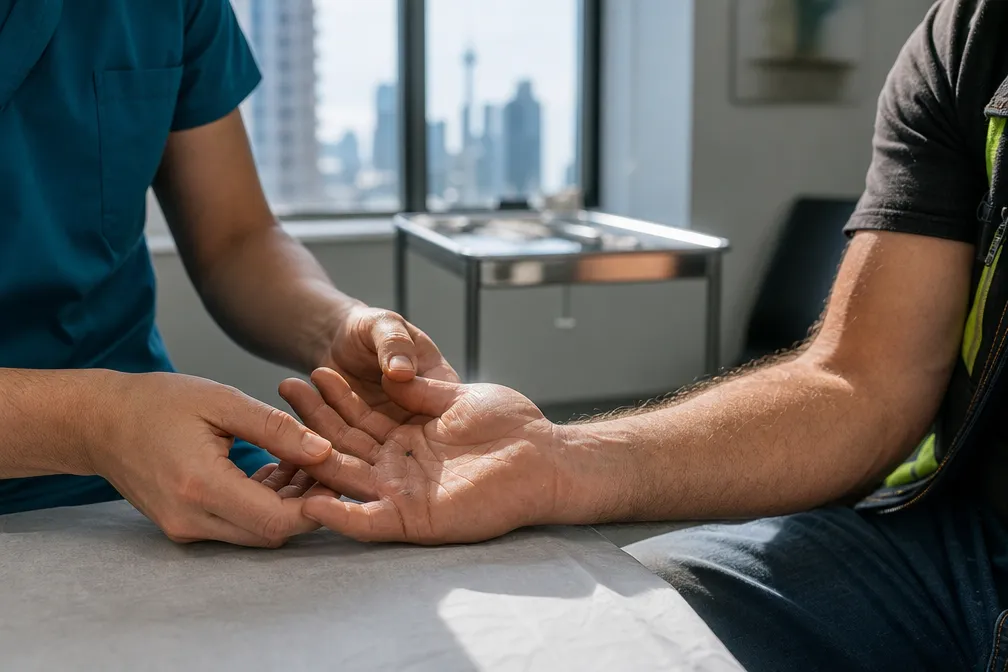
Trigger finger assessment in Toronto is available without a referral, and the examination itself takes only a few minutes, the surgeon feels for the nodule at the A1 pulley, watches the digit move through its arc, and checks whether it can be straightened passively.
The Minor Surgery Center's Toronto clinic is at 2920 Dufferin Street, Suite 202. Additional locations include 85 Scarsdale Road, Unit 101 in York Mills (North York), plus Vaughan, Mississauga at 1224 Dundas Street West, and Oakville. Phone 647-614-1611, weekdays 9 a.m. to 4 p.m. Procedures are performed by plastic surgeons with hand surgery experience, which matters specifically here because the digital nerves run close to the A1 pulley, particularly in the thumb, where the margin is smallest.
To make the visit useful, come prepared with three things: which digit is affected and roughly how long it has been going on; whether you've had injections, how many and when; and a current medication list, including any blood thinners. If more than one finger is involved, mention it at booking so enough time is allowed. For a sense of how local options compare, the roundup of trigger finger clinics in Toronto is a reasonable starting point, and hand complaints that turn out to be nerve-related are addressed in the guide to carpal tunnel syndrome surgery in Toronto. Trigger finger causes catching and a sore palm; carpal tunnel causes numbness, tingling and night-time hand pain. They are different problems, and they can coexist.
Children occasionally develop a locked thumb that behaves differently from the adult condition, see the note on trigger finger in children.
Frequently Asked Questions
Will an injection fix trigger finger permanently? Sometimes, yes. A single corticosteroid injection resolves a good proportion of early, first-episode cases for the long term. It is less likely to be durable in long-standing disease, in a digit that already locks, and in people with diabetes.
How many injections can I have in the same finger? Most hand surgeons will consider two into the same tendon sheath. Beyond that, each injection tends to work less well and for less time, and repeated steroid exposure carries local risks, so surgical release is usually the better option.
Does trigger finger release surgery hurt? The local anaesthetic stings for a few seconds, then the area is numb and the procedure itself isn't painful. Afterwards, most people manage with over-the-counter analgesia for a few days; the palm feels bruised rather than sharply sore.
How long does trigger finger release take? The surgical portion is generally ten to twenty minutes. Allow about an hour at the clinic for preparation, the procedure, dressing and instructions.
When can I use my hand normally again? Light use starts the same day and gentle movement is encouraged from day one. Full, forceful gripping usually takes two to four weeks depending on the work involved.
Can trigger finger come back after release? Recurrence of triggering in the same digit after a complete open release is uncommon. Developing trigger finger in a different finger later is possible, especially in people who have already had more than one, and is a new problem rather than a recurrence.
Can trigger finger go away on its own? Occasionally, mild early triggering settles without treatment, particularly if it followed a burst of unusual hand use. Established catching with a palpable nodule rarely resolves spontaneously, and a locked digit does not.
Can more than one finger be released at the same time? Often yes, if the digits are on the same hand and the plan is discussed in advance. Mention every affected finger at booking so the appointment is scheduled with enough time.
The Bottom Line
Early triggering usually deserves an injection first, it's effective often enough to be the right opening move, and it costs you nothing but a couple of weeks to find out. A finger that locks, or one that won't straighten, deserves an assessment sooner rather than later, because the middle-joint stiffness is the part that lingers after the triggering has been fixed.
If a digit is catching and you're unsure which stage you're at, book an examination and get a straight answer. The Minor Surgery Center's Toronto clinic is at 2920 Dufferin Street, Suite 202; call 647-614-1611, weekdays 9 a.m. to 4 p.m. No referral needed.
This article is general information and not a substitute for individual medical advice. A catching or locked finger should be examined in person, because Dupuytren's contracture, thumb-base arthritis and de Quervain's tenosynovitis can present in similar ways.
References
American Society for Surgery of the Hand, Trigger Finger
American Academy of Orthopaedic Surgeons (OrthoInfo), Trigger Finger
The Minor Surgery Center’s York Mills clinic, located at 85 Scarsdale Rd, Unit 101 in North York, offers convenient access to specialized surgical care for a range of skin and hand conditions. Our Plastic Surgeons provide treatment for skin cancer, suspicious moles, cysts, lipomas, carpal tunnel syndrome and trigger finger, with a focus on timely care and personalized treatment. In many cases, patients may be able to have their consultation and treatment completed during the same visit when medically appropriate. For expert care in a welcoming clinical setting, contact our York Mills team at (647) 614-1611.
We are the experts in the field of Minor Surgery. All our Surgeons have completed 5 years of post Medical School Surgical Residencies. They are all Board Certified by the Royal College of Physicians and Surgeons of Ontario.They have been trained at Institutions including McGill, McMaster, Queen's, University of British Columbia, University of Toronto, University of Western Ontario, The Mayo Clinic, University of Pennsylvania, University of Southern California, Yale University, and Oxford.
In many clinics, you could wait months—sometimes over a year—for a procedure like cyst or lipoma removal, mole removal, or even carpal tunnel release. But at TMSC, we prioritize fast access to care. In many cases, we can schedule and complete your minor surgery on the same day as your initial consultation—no extra runaround required.
Our clinics are designed with your comfort, safety, and efficiency in mind. We use strict sterilization protocols to minimize any infection risk, and our advanced surgical equipment meets hospital-grade standards. Yet, you’ll never feel like you’ve stepped into a stark, clinical space—our friendly staff ensures you’re welcome and supported the moment you walk through the door.
Cosmetic results matter—even for the smallest procedures. Skin lesions can be excised by non surgeons in Ontario. Furthermore, any MD with 2 years of post graduate training even outside of a surgical field can perform removal. At TMSC we only have Surgeons under our roof. They are trained well above the level of the procedures we offer to ensure the surgery goes smoothly with minimal scaring and preserving your natural contours. Our Surgeons are trained to ensure both function and aesthetics are always front and center.
At TMSC, we specialize in surgical treatment of both benign and malignant skin lesions, as well as minor hand conditions. We offer significantly reduced wait times often allowing you to schedule your surgery on the same day as your consultation.
You can book your free consultation with The Minor Surgery Center in three easy ways: online through Cortico, by phone, or by requesting a callback from our team.
The initial consultation is free. During this consultation, one of our board certified surgeons will examine your condition and recommend a suitable solution.
Directly Online
Request a Callback
By Phone
By Text
Hours
Sunday
Closed
Monday
9 am — 4 pm
Tuesday
9 am — 4 pm
Wednesday
9 am — 4 pm
Thursday
9 am — 4 pm
Friday
9 am — 4 pm
Saturday
Toronto & Oakville Open Vaughan & Mississauga Closed






.avif)
%20(600%20x%20600%20px)%20(2).avif)
.avif)
%20(8).avif)
%20(7).avif)


.png)