Skin Tag Removal in Toronto: Why Location Changes Everything, Including the Awkward Ones
Last updated: September 9, 2026
Quick Answer
A skin tag is a small, soft growth of ordinary skin that hangs from a narrow stalk, and it forms where skin rubs against skin or clothing. Removal is a brief in-office procedure done under local anaesthetic, and the single biggest factor in how it's done is where it sits on the body, an eyelid, an underarm and a perianal tag are three different procedures and three different conversations. Adults across Toronto and the GTA can be assessed at The Minor Surgery Center without a referral, and several tags are commonly treated in one visit.
Key Takeaways
Skin tags are benign and not contagious, but several look-alikes exist, and a few of those are contagious, which is why an in-person look matters more than a photograph.
Body site drives everything: the method, the anaesthetic, the aftercare and how long the appointment takes.
Tags in genital, perianal and under-breast areas are a routine, frequent request. No location is too awkward to ask about.
Developing many tags over a short period is associated with insulin resistance and metabolic factors, and is also common in pregnancy, an association worth raising with your family physician, not a diagnosis.
A properly removed tag doesn't regrow in that spot, but new ones can form elsewhere because the underlying tendency and the friction haven't changed.
Removal for appearance alone is generally not an insured service in Ontario; removal of a tag that catches, bleeds or is clinically uncertain is assessed differently.
What a Skin Tag Is, and Why Friction Is the Whole Story
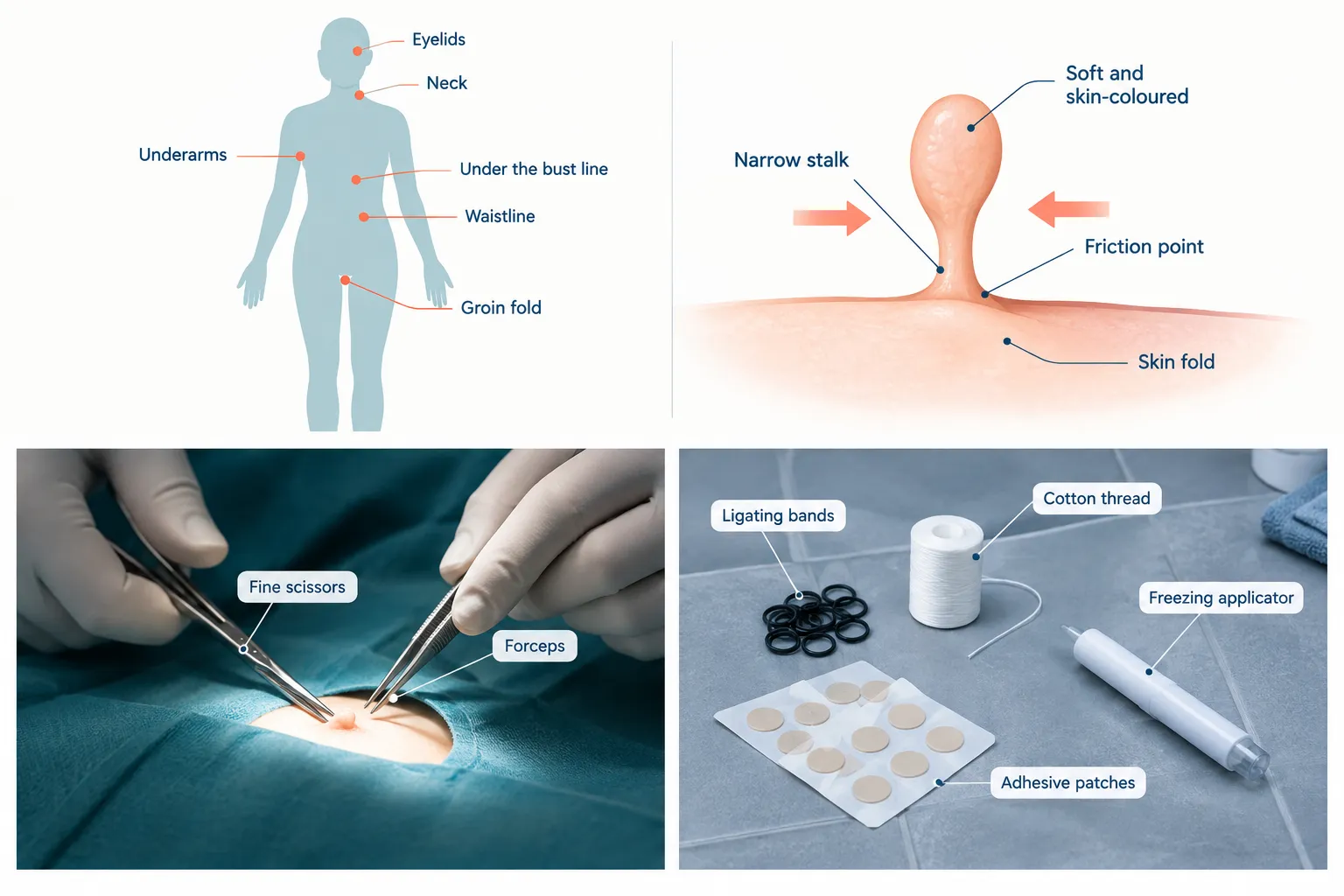
A skin tag (acrochordon) is a soft, skin-coloured or slightly darker growth made of normal surface skin and loose collagen, attached by a thin stalk. It isn't a tumour, it isn't infectious, and it doesn't turn into skin cancer.
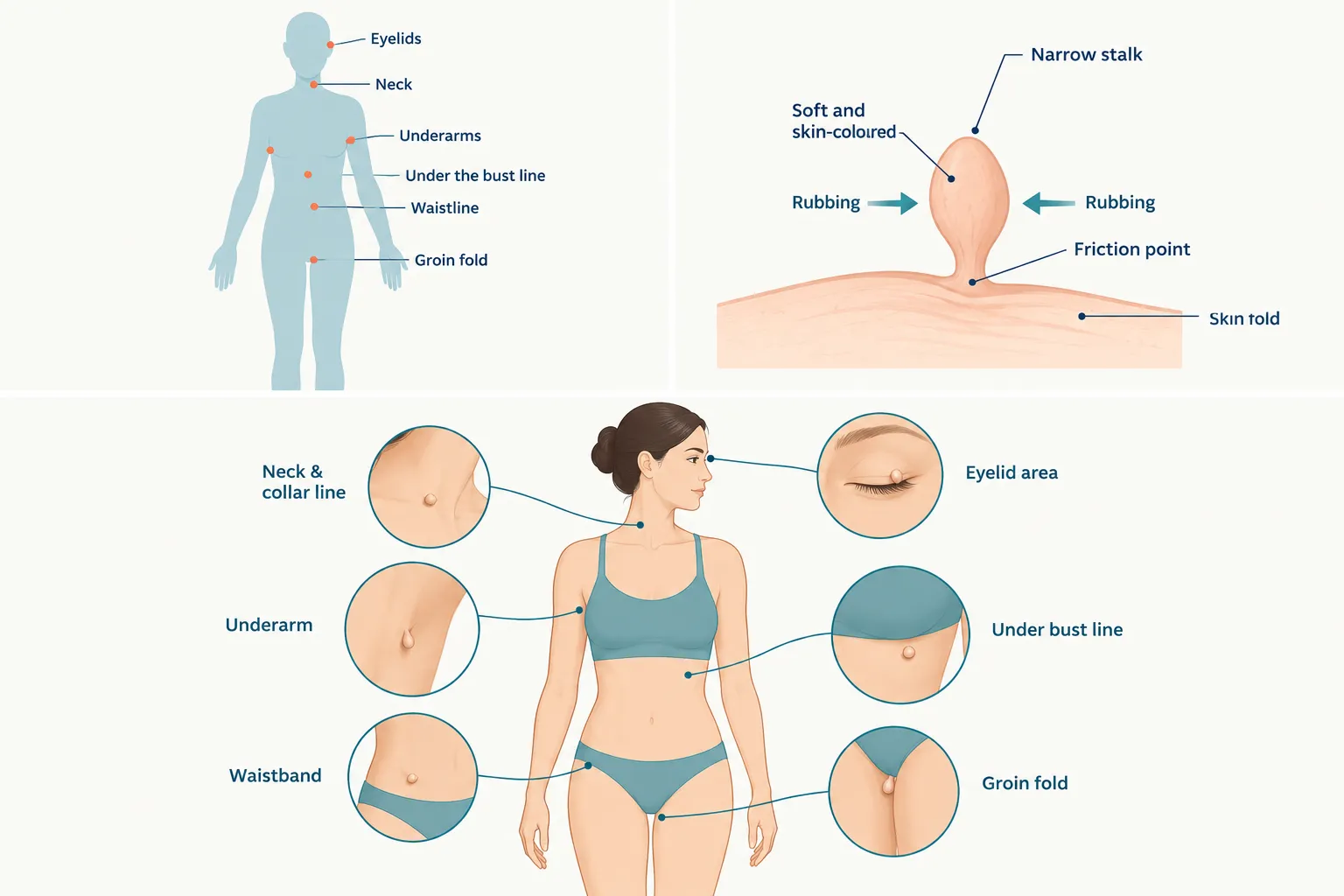
Friction explains almost everything about them. They form where skin repeatedly moves against skin or fabric, which is why they cluster in body folds and line up neatly along collars, waistbands and bra straps. Weight, genetics, hormones and age all feed into the tendency, the reasons skin tags form in the first place are mechanical as much as anything else.
Most cause no symptoms at all. A tag that suddenly becomes sore, dark or bleeds has usually twisted on its stalk and lost its blood supply, which is uncomfortable but not sinister. Still get it looked at, because a darkening lesion is exactly the situation where certainty matters.
Where It Is Changes What Happens Next
The same small growth in six different places is six different procedures. Site determines the instrument, the amount of local anaesthetic, whether stitches are even a consideration, and what the healing looks like.
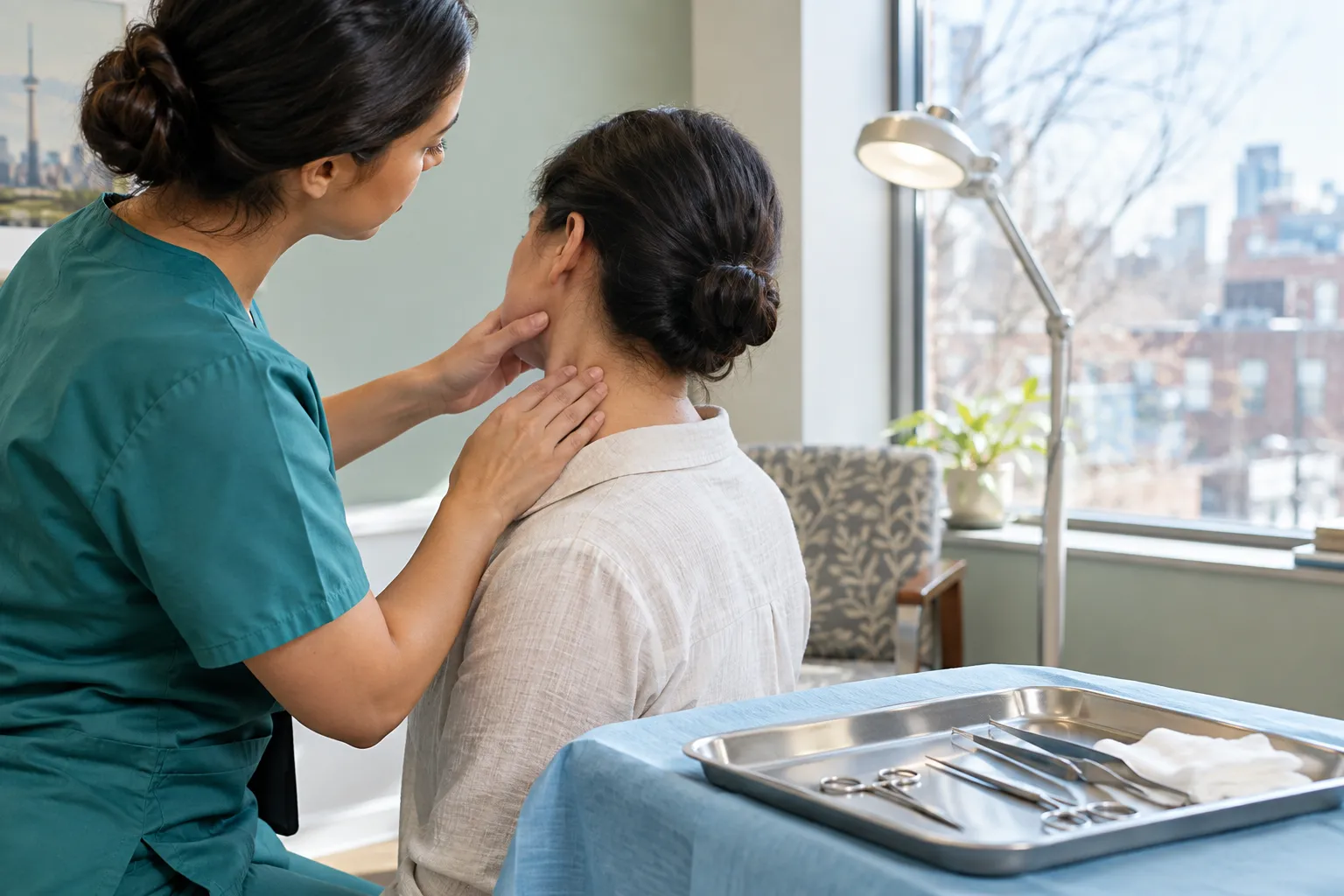
Neck and collar line. The most common request, and usually multiple tags rather than one. Chains, collars and seatbelts catch them repeatedly. Because the neck is highly visible, the priority is a flat, unobtrusive result, and clusters are typically cleared in a single sitting.
Eyelids and around the eyes. Proximity to the eye rules out some techniques outright, freezing sprays and cautery near the lid margin are handled with real caution or avoided. Precision beats speed here. Lid skin is thin and mobile, so fine excision with careful shielding of the eye is usually the sensible route, and tags near the lash line often warrant a plastic surgeon's hands. A skin tag under the eye is a legitimate reason to be seen rather than left alone.
Underarms. Tags cluster here and get nicked by razors, then sting under deodorant. The area is warm, moist and constantly in motion, so aftercare focuses on keeping it dry and skipping shaving for a few days.
Under the bust line. An underwire or band sits directly on these, so they're often the ones that hurt. Removal here is straightforward; the useful conversation is about bra fit afterward, because a wire returning to the same crease keeps the process going.
Waistband and groin folds. Friction is constant, tags are frequently multiple, and healing is slower simply because the skin keeps moving. Looser clothing for a week makes a genuine difference.
Trunk, back and under jewellery. Larger tags on the trunk can be broad-based rather than narrow-stalked, and a large or thick-based skin tag is treated as a small excision rather than a snip.
The Ones People Are Embarrassed to Ask About
Skin tags in the genital, perianal and under-breast areas are common, and clinicians see them constantly. There is nothing unusual about the request, nothing to apologise for, and no version of this appointment where anyone reacts.
Here's the part that actually matters clinically: in these areas, the look-alikes are more consequential than anywhere else on the body. Several different things get called "a skin tag" by patients, and they're managed in completely different ways.
Genital warts are caused by HPV and are transmissible. They're treated as an infection, not snipped off as a cosmetic nuisance. Telling a wart apart from a skin tag is often straightforward on examination and almost impossible from a photo.
Molluscum contagiosum is a common viral skin infection that is also contagious and looks nothing like a tag under magnification, but very much like one to the naked eye.
Haemorrhoids and perianal skin tags overlap constantly. A perianal tag is often the residual fold of skin left behind after a healed fissure or a thrombosed haemorrhoid. Removing the fold without addressing what caused it is usually the wrong order of operations.
Anything firm, fixed, ulcerated or changing in these areas needs assessment on its own merits, regardless of what it resembles.
This is precisely the situation where guessing at home is the worst available option. An examination settles it in minutes, and if removal is appropriate, skin tag removal in sensitive areas uses generous local anaesthetic and takes very little time. In pregnancy, perianal tags are frequent and are usually left alone until after delivery unless they're symptomatic.
Suddenly Have a Lot of Them?
Developing many skin tags over a relatively short period is associated in the medical literature with insulin resistance and related metabolic factors, and it's also common during pregnancy and after significant weight change. That's an association, not a diagnosis. Plenty of people with numerous tags have entirely normal blood work.
The useful action is simple. If you've noticed a lot of new tags and haven't had blood sugar and general metabolic health reviewed in a while, raise it with your family physician at your next visit. It's a reasonable, low-drama question. The same applies if the new tags come alongside velvety dark patches in the folds of the neck or armpits, which is worth mentioning specifically.
One thing to be clear about: removing the tags does nothing to the underlying tendency. It clears what's there. Whether skin tags point to other health issues is a separate discussion from whether the ones catching on your collar should come off, and both can be true at once.
Why They Come Back, and What That Actually Means
A properly removed skin tag does not regrow at that spot. When people say theirs "came back", what's almost always happened is that new tags have formed nearby, because the friction and the individual tendency that produced the first ones haven't changed.
So removal is a clean-up, not a cure. People who form tags readily should expect to have new ones dealt with occasionally over the years, in the same way some people have the odd mole checked. That's normal and not a sign anything went wrong.
Reducing the mechanical cause helps more than anything sold in a bottle:
Wear collars, straps and waistbands that don't sit tight over areas where tags keep appearing.
Keep skin folds dry, a light dusting powder or moisture-wicking fabric in summer reduces rubbing.
Don't shave blind over known tags; nicking one is how a painless tag becomes a painful one.
Get properly fitted for bras if tags recur along the band or underwire line.
How They Are Removed
Removal is done in the office under local anaesthetic, takes minutes per tag, and rarely needs stitches. The choice of technique follows the site, the size, and whether the diagnosis is certain.
Snip excision with fine sterile scissors, for narrow-stalked tags. Quick and precise.
Electrocautery, using controlled heat to remove the tag and seal the base, useful for small clusters.
Cryotherapy, freezing with liquid nitrogen, suited to some sites and avoided near the eye.
Surgical excision for larger, broad-based or atypical lesions, which may need a suture or two.
The most important clinical line on this page: anything that isn't clearly a skin tag is removed in a way that preserves the tissue so it can be sent for pathology. Freezing or burning a lesion destroys the evidence. If there's genuine doubt about whether something is a tag, a mole, or a lesion that needs a biopsy, that decision is made before anything is touched.
The visit itself is unremarkable. Assessment, a plan, freezing with a fine needle, the removal, then a dressing. You can shower and go back to normal activity the same day, and most sites are fully healed within a couple of weeks.
Home Removal Kits, Bands and String
Bands, freezing kits, patches and thread do sometimes detach a tag. The problem is the failure modes, and they're not theoretical: incomplete removal, infection, bleeding that's hard to stop, permanent pigment change, and scarring worse than the tag.
The serious one is different. These products cannot tell what a lesion is, and neither can a photograph. Destroying something that was never a skin tag removes both the lesion and the ability to find out what it was. The risks of do-it-yourself skin tag removal are highest near the eye and in genital and perianal areas, where the look-alikes are most consequential and the skin is least forgiving. Home methods and kitchen remedies are best left alone in those locations entirely.
Is Skin Tag Removal Covered by OHIP?
Removal for appearance alone is generally not an insured service in Ontario. That's the default position for a benign, symptom-free lesion.
Removal is assessed differently when the tag is repeatedly irritated, catching, bleeding, becoming infected, interfering with daily activity, or clinically uncertain. The reason for removal is what matters, not the fact that it's a skin tag. That determination is made by the physician at the assessment, not in advance over the phone.
Some private plans and health spending accounts contribute to uninsured removals. Fees for anything not covered are quoted at the consultation and should be provided to you in writing before you agree to anything. The specifics of OHIP coverage and private-pay skin tag removal in Ontario are worth reading if you want the detail beforehand.
Getting Assessed in Toronto
The Toronto clinic is at 2920 Dufferin Street, Suite 202. Other locations include 85 Scarsdale Road, Unit 101 in York Mills (North York), plus Vaughan, Mississauga at 1224 Dundas Street West, and Oakville. Phone 647-614-1611, weekdays 9 a.m. to 4 p.m. No referral is required.
Procedures are performed by GP dermatologists and plastic surgeons. That matters most for eyelid tags, where a millimetre of lid margin counts, and for sensitive-area lesions where diagnosis and technique both need to be right. If North York is closer, the York Mills skin tag and skin lesion removal service covers the same ground.
Three things that make the appointment go smoothly:
Count roughly how many tags you want dealt with and note where they are, so enough time is booked. Several are commonly treated in one visit.
Don't shave over them immediately beforehand, an irritated or nicked tag is harder to work with.
Mention any blood thinners, bleeding disorders, or a history of keloid scarring before the procedure starts.
Frequently Asked Questions
Are skin tags dangerous? No. Skin tags are benign and don't become cancerous. The caution is that other lesions can resemble them, so any growth that is firm, changing colour, ulcerated or bleeding without being caught should be examined rather than assumed to be a tag.
Does skin tag removal hurt? There's a brief sting from the local anaesthetic injection, and after that the area is numb and the removal itself isn't painful. Most people describe mild tenderness for a day or two afterward, easily managed without prescription medication.
Can several be removed at once? Yes. Treating multiple tags in a single visit is routine, especially on the neck, underarms or trunk. Tell the clinic roughly how many you have when booking so the appointment is long enough.
Will it leave a scar? Small tags removed cleanly usually heal with a faint flat mark that fades over months. Larger or broad-based tags, and anything needing a suture, leave a small line. Tell the clinician if you scar thickly or form keloids, because that changes the approach.
Do skin tags grow back after removal? Not at the same spot, if the tag was fully removed. New tags can appear nearby over time because the friction and personal tendency remain, which is why removal is best thought of as clearing what's there.
Are skin tags contagious? No. Skin tags don't spread between people or to other parts of your own body. Some look-alikes, including genital warts and molluscum contagiosum, are contagious, which is one more reason to have an uncertain lesion identified.
What if it's in an intimate area, will that be awkward? No. Tags in genital, perianal and under-breast areas are a frequent reason for assessment, the examination is brief and focused, and the main clinical value is confirming what the lesion actually is before anything is done.
What if a skin tag turns black? A tag that darkens has usually twisted on its stalk and lost its blood supply, and it may fall off on its own. It's still worth having looked at, because colour change is one of the features that needs to be distinguished from other lesions.
Do I need a referral? No referral is required for assessment or removal. You can book directly.
Who shouldn't have skin tags removed right away? Elective removal is usually deferred for anyone with an active skin infection at the site, poorly controlled bleeding risk, or during pregnancy for non-symptomatic perianal tags. Those situations are managed, not refused, the timing simply changes.
The Bottom Line
Skin tags are harmless, common, and quick to deal with. Only two things really matter: being certain what the lesion is, and choosing a method suited to where it sits. Everything else is detail.
No location is too awkward to ask about, and the ones people hesitate over are the ones where an examination adds the most value. To arrange skin tag removal in Toronto, call The Minor Surgery Center at 647-614-1611 or visit 2920 Dufferin Street, Suite 202, weekdays 9 a.m. to 4 p.m. No referral needed.
This article is general information about skin tags and their removal, not medical advice, and it can't substitute for an in-person assessment of your own skin. If a growth is changing, painful or bleeding, arrange to have it examined.
References
DermNet, Skin Tag (Acrochordon)
Cleveland Clinic, Skin Tags (Acrochordon)
American Academy of Dermatology Association, Skin Tags: Diagnosis and Treatment
StatPearls, NCBI Bookshelf, Acrochordon
Canadian Dermatology Association, Benign Skin Growths
We are the experts in the field of Minor Surgery. All our Surgeons have completed 5 years of post Medical School Surgical Residencies. They are all Board Certified by the Royal College of Physicians and Surgeons of Ontario.They have been trained at Institutions including McGill, McMaster, Queen's, University of British Columbia, University of Toronto, University of Western Ontario, The Mayo Clinic, University of Pennsylvania, University of Southern California, Yale University, and Oxford.
In many clinics, you could wait months—sometimes over a year—for a procedure like cyst or lipoma removal, mole removal, or even carpal tunnel release. But at TMSC, we prioritize fast access to care. In many cases, we can schedule and complete your minor surgery on the same day as your initial consultation—no extra runaround required.
Our clinics are designed with your comfort, safety, and efficiency in mind. We use strict sterilization protocols to minimize any infection risk, and our advanced surgical equipment meets hospital-grade standards. Yet, you’ll never feel like you’ve stepped into a stark, clinical space—our friendly staff ensures you’re welcome and supported the moment you walk through the door.
Cosmetic results matter—even for the smallest procedures. Skin lesions can be excised by non surgeons in Ontario. Furthermore, any MD with 2 years of post graduate training even outside of a surgical field can perform removal. At TMSC we only have Surgeons under our roof. They are trained well above the level of the procedures we offer to ensure the surgery goes smoothly with minimal scaring and preserving your natural contours. Our Surgeons are trained to ensure both function and aesthetics are always front and center.
At TMSC, we specialize in surgical treatment of both benign and malignant skin lesions, as well as minor hand conditions. We offer significantly reduced wait times often allowing you to schedule your surgery on the same day as your consultation.
You can book your free consultation with The Minor Surgery Center in three easy ways: online through Cortico, by phone, or by requesting a callback from our team.
The initial consultation is free. During this consultation, one of our board certified surgeons will examine your condition and recommend a suitable solution.
Directly Online
Request a Callback
By Phone
By Text
Hours
Sunday
Closed
Monday
9 am — 4 pm
Tuesday
9 am — 4 pm
Wednesday
9 am — 4 pm
Thursday
9 am — 4 pm
Friday
9 am — 4 pm
Saturday
Toronto & Oakville Open Vaughan & Mississauga Closed




.avif)
%20(600%20x%20600%20px)%20(2).avif)
.avif)
%20(8).avif)
%20(7).avif)

.png)