Carpal Tunnel Syndrome Treatment Toronto: From Splints to Surgery
Last updated: October 28, 2026
Treatment for carpal tunnel syndrome depends on severity. Mild cases usually start with night splints and activity changes. Injections give short-term relief at best. Surgery, known as carpal tunnel release, is the most reliable fix for moderate-to-severe or persistent cases and is OHIP-covered in Ontario when performed by a surgeon.
What is the best treatment for carpal tunnel syndrome?
There is no single best treatment. The right option depends on how severe your symptoms are, how long you've had them, and whether conservative care has already failed.
Carpal tunnel syndrome happens when the median nerve, which runs through a narrow tunnel of bone and ligament in the wrist, gets compressed. This causes numbness, tingling, and sometimes pain in the thumb, index, middle, and part of the ring finger. It often develops gradually from repetitive wrist motion, pregnancy-related swelling, diabetes, arthritis, or prolonged wrist flexion during sleep or work.
For mild, intermittent symptoms, splints and ergonomic changes are reasonable first steps and many people improve without surgery. For moderate symptoms that persist despite these changes, or for severe cases with constant numbness or muscle weakness, surgery tends to offer more durable relief than ongoing conservative care [1][2]. We treat carpal tunnel surgically at our Toronto clinics, but we also believe patients deserve a clear picture of what conservative care can and cannot do before they book a consultation.
How do you know how severe your carpal tunnel is?
Severity is judged by how often symptoms occur, whether numbness is constant, and whether there's measurable weakness or muscle wasting in the hand. A short self-check can help you decide whether to try splints first or seek an assessment sooner. For a fuller breakdown, see our guide on carpal tunnel severity: mild vs moderate vs severe.
Mild
Symptoms come and go, usually triggered by specific activities like typing, driving, or holding a phone. Numbness at night is occasional and resolves quickly after shaking out the hand. This stage usually responds well to splints and activity changes.
Moderate
Numbness and tingling happen more frequently, including most nights, and may linger into the day. Grip strength may feel slightly reduced. Conservative care is still worth trying, but if it doesn't improve things within a few weeks, a surgical opinion becomes reasonable.
Severe
Numbness is constant, not just intermittent. There may be visible wasting of the thumb muscle (at the base of the thumb) or noticeable weakness, like dropping objects. At this stage, conservative treatment rarely reverses the damage, and surgical assessment should not be delayed [1][3].
Non-surgical carpal tunnel treatments
Non-surgical carpal tunnel treatment in Toronto typically combines splinting, activity changes, and sometimes injections or hand therapy. Evidence for each varies quite a bit, and some popular options have weaker support than clinics suggest.
Night splints
Wearing a wrist splint at night keeps the wrist in a neutral position, reducing pressure on the median nerve while you sleep. This is often the first recommendation for mild to moderate cases [4][5][6]. That said, the AAOS 2024 guideline gives a moderate recommendation against routine splinting as a blanket solution, meaning it should be targeted to the right candidates rather than used indefinitely without reassessment. See our guide to the best carpal tunnel braces for day vs night use.
Activity and ergonomic changes
Reducing repetitive wrist flexion, adjusting keyboard and mouse position, and taking breaks during repetitive tasks can lower strain on the median nerve. This won't reverse existing nerve damage but may slow progression in mild cases [4][6].
Corticosteroid injections
A steroid injection into the carpal tunnel can reduce inflammation and ease symptoms temporarily. The AAOS 2024 guideline reports strong evidence that corticosteroid injections do not provide long-term improvement, so they're best understood as a short-term bridge, not a cure. Duration of relief varies by patient.
Physiotherapy, nerve glides and hand therapy
Physiotherapists in Toronto often prescribe nerve and tendon gliding exercises, wrist circles, and flexor stretches as part of a structured program [4][5][6]. These drills aim to improve nerve mobility within the tunnel. Evidence on how much they change long-term outcomes is mixed, but they are low-risk and may help mild cases alongside splinting. Our guide on carpal tunnel stretches vs nerve glides breaks down what the exercises actually do.
Treatments with weak evidence (laser, ultrasound, supplements, chiropractic)
Low-level laser therapy, therapeutic ultrasound, vitamin B6 supplementation, and chiropractic adjustment are sometimes marketed for carpal tunnel. Current evidence for these approaches is weak or inconsistent, and none should replace splinting, documented activity changes, or a surgical opinion if symptoms are moderate to severe. If you're weighing non-surgical paths more broadly, our article on carpal tunnel surgery alternatives covers the options in more depth.
Treatment comparison
TreatmentBest for (severity)What the evidence saysTypical duration of reliefOHIP-covered?Night splintMildCommon first-line option; not recommended as routine blanket therapy per AAOS 2024VariesCheck your plan (device cost not OHIP)Activity/ergonomic changesMild to moderateSupportive, low risk, slows progressionVariesNo cost to implementCorticosteroid injectionMild to moderateStrong evidence against long-term benefitShort-term, variesCheck your planPhysiotherapy/nerve glidesMild to moderateMixed evidence, low riskVariesCheck your plan (private physio generally not OHIP)Carpal tunnel release surgeryModerate to severe, or failed conservative careStrong evidence of durable symptom relief; local anesthesia supportedGenerally long-lastingYes, OHIP-covered
See a surgeon sooner if:
Numbness is constant rather than coming and going
You notice wasting or flattening of the muscle at the base of your thumb
You're dropping objects or losing grip strength
Symptoms haven't improved after several weeks of splinting and activity changes
These red flags reflect established indications for surgical referral used by hand surgeons [1][3].
When should you stop conservative treatment and see a surgeon?
If splints, activity changes, and a few weeks of effort haven't meaningfully reduced your symptoms, it's reasonable to stop cycling through more conservative options and get a surgical opinion. This is especially true if numbness has become constant or thumb strength is declining.
Toronto-area surgical practices generally describe surgery as the recommended path when conservative treatment has failed, when numbness is constant, or when there's measurable weakness or muscle wasting [1][2][3][7]. Waiting longer in these cases risks permanent nerve damage rather than just prolonging discomfort. If you're unsure where you stand, our page on how to know if you have carpal tunnel can help clarify your symptoms before booking a consultation.
How is carpal tunnel diagnosed?
Diagnosis usually starts with a clinical exam and symptom history, not imaging. The AAOS 2024 guideline supports using a clinical tool called CTS-6, based on symptom pattern and physical exam findings, in place of routine ultrasound or nerve conduction studies for many patients.
Nerve conduction studies or EMG may still be used in ambiguous cases or before surgery to confirm severity, but they are not always required to start treatment. Our overview of carpal tunnel syndrome explains the diagnostic pathway in more detail.
What does carpal tunnel surgery involve?
Carpal tunnel release is a short outpatient procedure that relieves pressure on the median nerve by cutting the ligament that forms the roof of the carpal tunnel. The AAOS 2024 guideline supports performing this release under local anesthesia alone, and notes strong evidence of no meaningful difference in patient-reported outcomes between mini-open and endoscopic techniques.
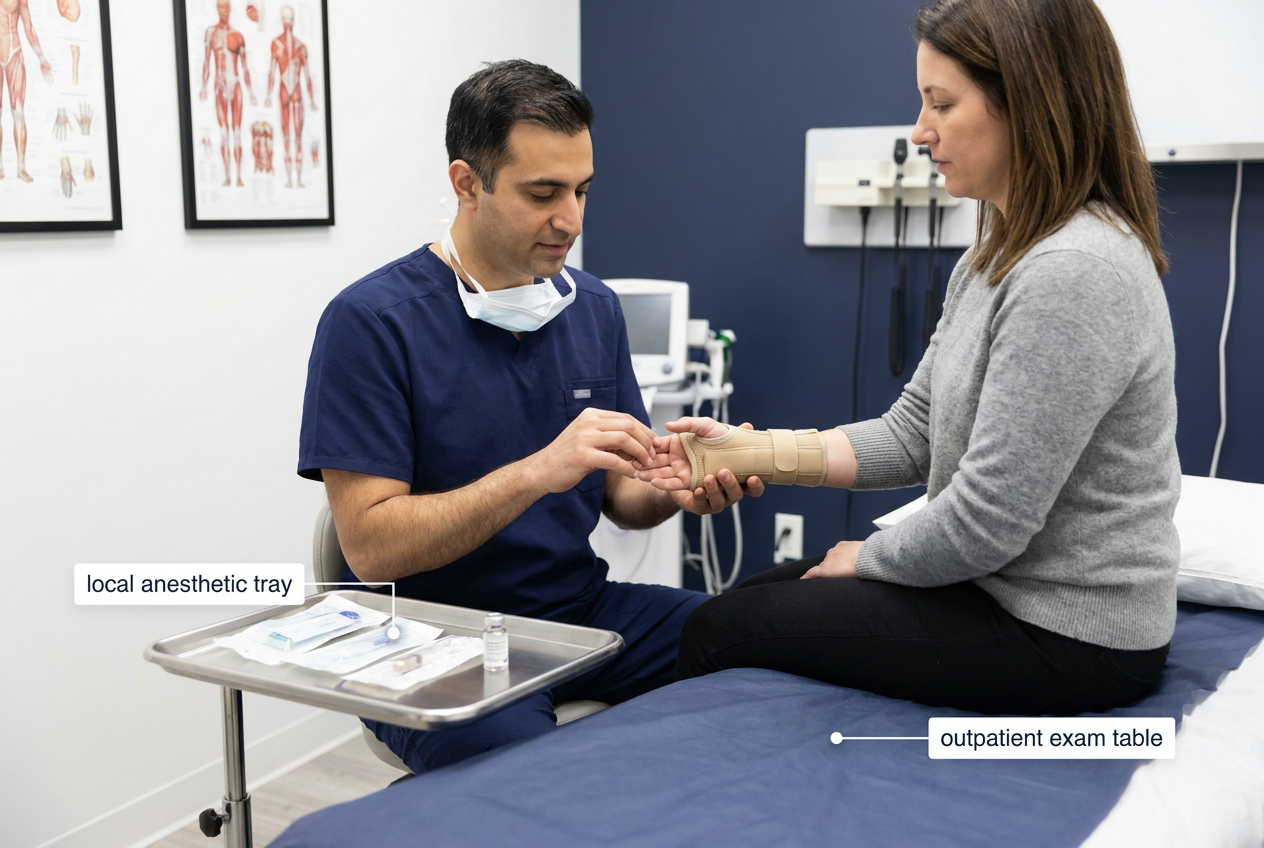
At our clinics, surgery is performed under local anesthetic in an outpatient setting, and patients go home the same day. We do not perform endoscopic release. Co-founders Dr. Kunaal Jindal and Dr. Roberto Tutino are board-certified plastic and reconstructive surgeons who assess patients for carpal tunnel release when conservative care has not worked or symptoms are already severe. For what to expect afterward, see our guide to carpal tunnel surgery recovery. You can also read more about carpal tunnel surgery in Toronto directly.
The AAOS guideline also gives a moderate recommendation against routine supervised therapy after release, and against routine post-operative splinting or immobilization, suggesting that early, guided movement is generally favoured over prolonged immobilization for most patients.
Is carpal tunnel treatment covered by OHIP?
Carpal tunnel release surgery is covered by OHIP for Ontario residents with a valid health card, and no referral is required to book a consultation at our clinic. Conservative treatments like physiotherapy, splints, and private injections are generally not covered by OHIP, so check your own extended health plan for those costs.
We offer a free consultation before any decision about surgery, and appointments are required. This lets a surgeon assess your symptoms and severity before anything is scheduled.
How long is the wait for carpal tunnel treatment in Toronto?
Wait times for carpal tunnel release vary by pathway and provider, and we do not publish a specific number because it depends on individual scheduling and clinic capacity. In general, publicly funded surgical wait times in Ontario are tracked from the date a decision for surgery is made to the date of the procedure [8].
If you're looking for a carpal tunnel specialist in Toronto for a surgical opinion, we offer assessments at two Toronto-area locations plus clinics in Vaughan, Mississauga, and Oakville.
North York/Toronto clinic: 2920 Dufferin Street, Suite 202, Toronto, ON M6B 3S8
York Mills clinic: 85 Scarsdale Road, Unit 101, North York, ON M3B 2R2
Phone: (647) 614-1611
No referral is needed, and the initial consultation is free. If you're also dealing with a locked or catching finger alongside hand numbness, our trigger finger release page may be relevant too.
Frequently asked questions
Can carpal tunnel go away without surgery? Mild cases sometimes improve with splinting, activity changes, and time, especially if caused by a temporary factor like pregnancy. Moderate to severe cases are less likely to resolve fully without surgery. See our article on whether carpal tunnel can go away on its own for more detail.
Do steroid shots cure carpal tunnel? No. Corticosteroid injections can reduce symptoms short-term, but the AAOS 2024 guideline reports strong evidence against long-term improvement from these injections.
Does physio work for carpal tunnel? Physiotherapy and nerve gliding exercises may help mild cases and are low risk, but evidence for long-term benefit is mixed. They are not a reliable fix for moderate to severe cases.
How long should I wear a splint before trying something else? If a splint and activity changes haven't improved symptoms after several weeks, it's reasonable to seek a surgical opinion, especially if numbness is becoming more constant.
Do I need a referral to see a surgeon? No referral is required at our clinic. A valid Ontario health card is required, and the initial consultation is free.
Is carpal tunnel surgery covered by OHIP? Yes. Carpal tunnel release surgery is OHIP-covered for Ontario residents with a valid health card.
Conclusion with booking CTA
Carpal tunnel treatment works best when it matches the actual severity of your symptoms. Mild, occasional numbness usually deserves a fair trial of splints and activity changes first. But if those steps haven't helped after several weeks, or if numbness has become constant, thumb strength is fading, or you're dropping things, continuing to cycle through conservative options can mean more nerve damage, not less.
If splints and activity changes haven't worked after several weeks, or your symptoms are already constant, call (647) 614-1611 or book a free surgeon consultation to find out whether carpal tunnel release is the right next step for you.
At TMSC, we specialize in surgical treatment of both benign and malignant skin lesions, as well as minor hand conditions. We offer significantly reduced wait times often allowing you to schedule your surgery on the same day as your consultation.
You can book your free consultation with The Minor Surgery Center in three easy ways: online through Cortico, by phone, or by requesting a callback from our team.
The initial consultation is free. During this consultation, one of our board certified surgeons will examine your condition and recommend a suitable solution.
Directly Online
Request a Callback
By Phone
By Text
Hours
Sunday
Closed
Monday
9 am — 4 pm
Tuesday
9 am — 4 pm
Wednesday
9 am — 4 pm
Thursday
9 am — 4 pm
Friday
9 am — 4 pm
Saturday
Toronto & Oakville Open Vaughan & Mississauga Closed