Carpal Tunnel Surgery Wait Times in Ontario: What to Expect and How to Shorten Them
Last updated: October 7, 2026
Quick Answer
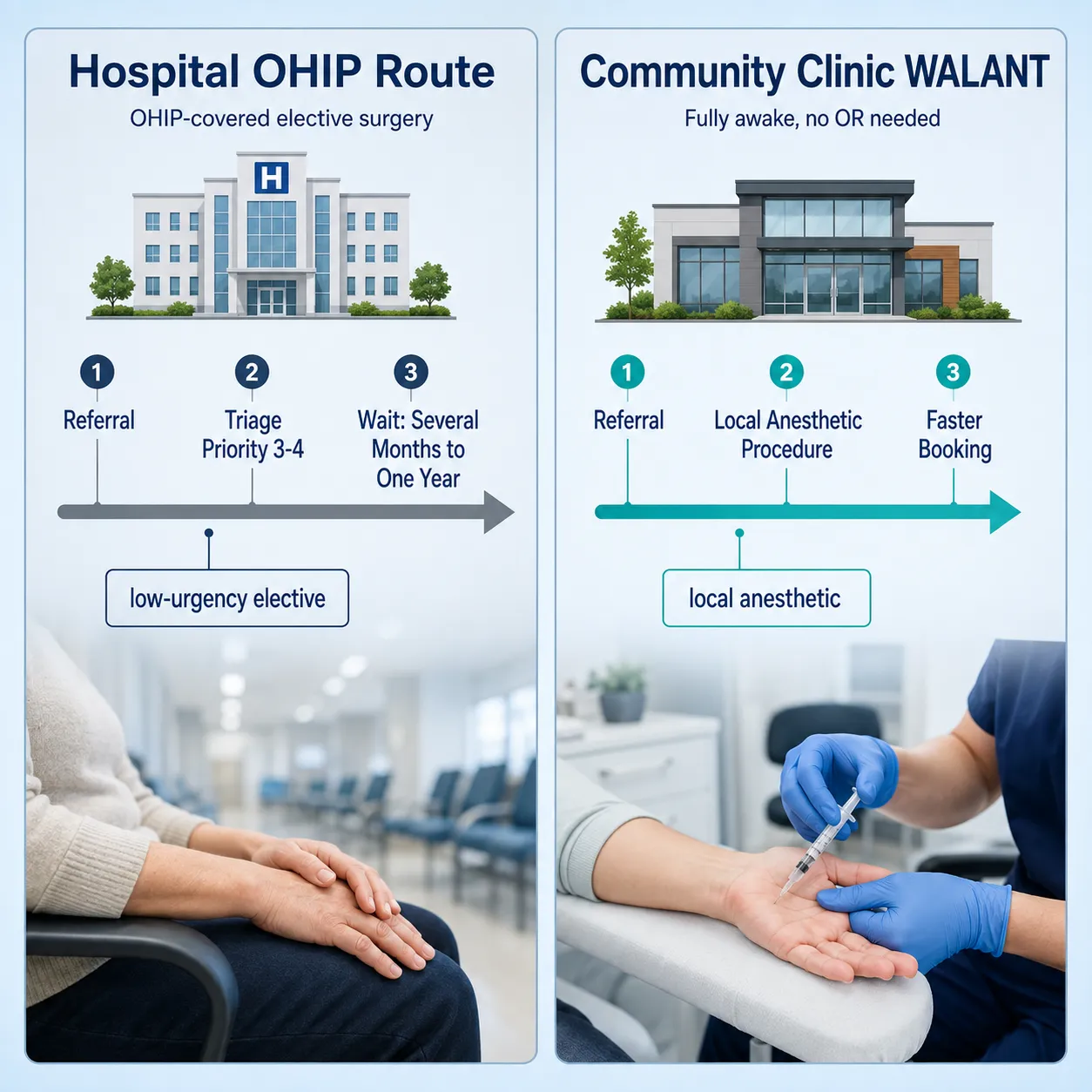
Carpal tunnel release is covered by OHIP when it is medically necessary, but hospital-based wait lists commonly stretch from several months to close to a year because the procedure is triaged as low-urgency elective surgery [3][10]. The same operation can also be done under local anesthetic while fully awake (WALANT) in a community clinic setting, which avoids an operating-room booking and often shortens the wait to weeks rather than months [10]. Most patients return to light desk work within days of either approach.
Key Takeaways
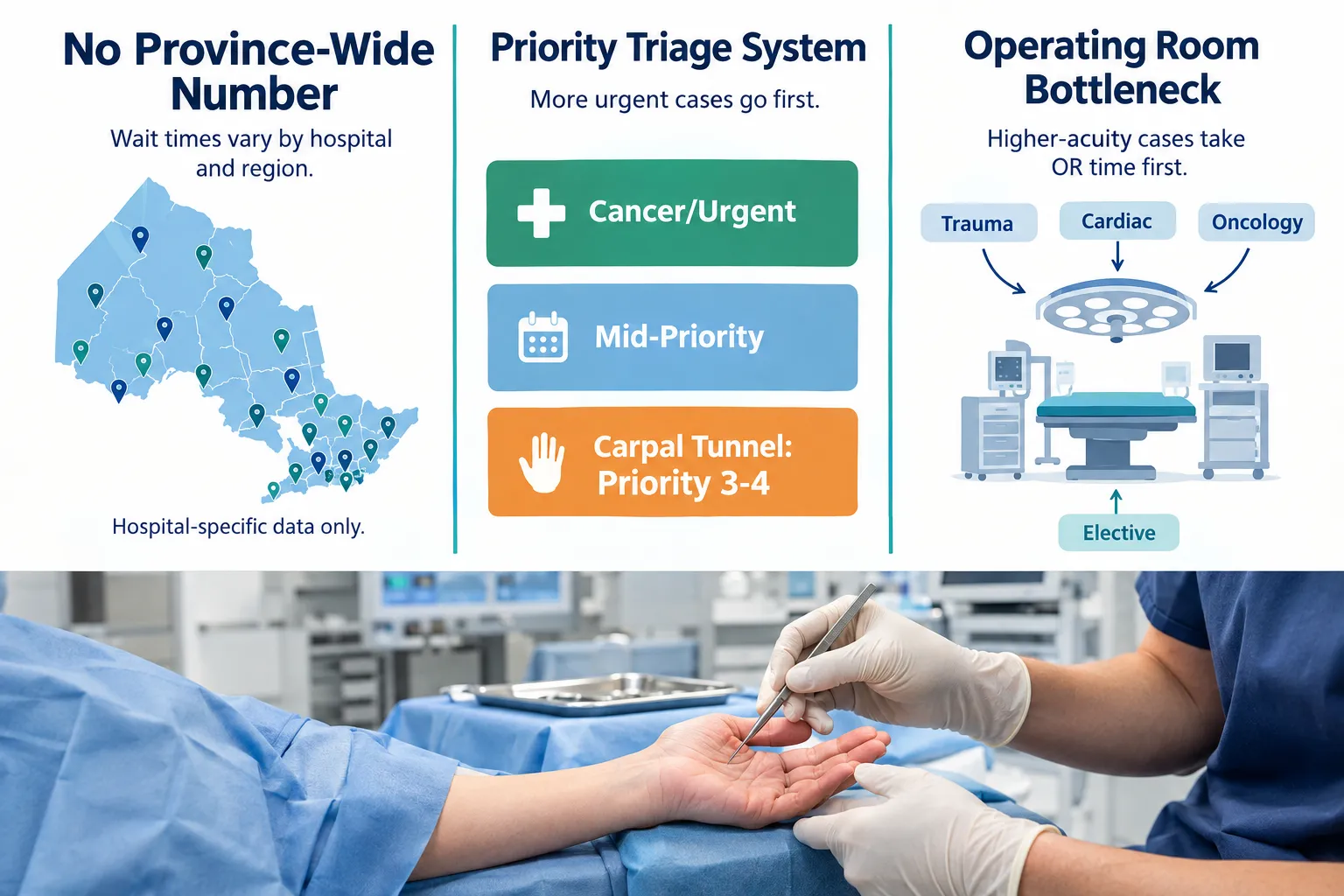
Ontario does not publish one province-wide number for carpal tunnel surgery wait times; the Ontario Health wait times tool shows hospital-specific data instead [1][3].
Carpal tunnel release is usually ranked as a non-urgent (priority 3 or 4) elective procedure, which puts it behind urgent cancer and trauma cases for operating-room time [3][10].
Real-world reports describe 6 to 12 months just to see a specialist, plus additional months to surgery, in parts of the public system [10].
A peer-reviewed study of peripheral nerve surgery wait times in Ontario found mean waits of about 42 days from referral to specialist consult and 45 days from consult to surgery, with 93-94% of cases meeting provincial targets, though this reflects peripheral nerve cases broadly, not carpal tunnel release specifically [2].
Wait times vary a lot by hospital: a CBC analysis found some Ontario hospitals' patients waiting up to 15 times longer than others for the same type of surgery [9].
WALANT (Wide-Awake Local Anesthesia No Tourniquet) lets a hand surgeon perform carpal tunnel release in a procedure room instead of a hospital OR, which can reduce scheduling delays [10].
Private, self-pay clinics in Canada report access to carpal tunnel surgery in roughly 2 to 8 weeks for patients willing to pay out of pocket [8].
Waiting too long with severe nerve compression risks permanent numbness and thenar muscle wasting, so red-flag symptoms should prompt faster follow-up rather than more waiting.
How long is the wait for carpal tunnel surgery in Ontario?
There is no single official wait-time figure for carpal tunnel surgery across Ontario; waits depend heavily on the hospital, the surgeon's caseload, and how the referral is triaged, and they can range from a few months to close to a year. The most reliable way to get a current number for a specific hospital is the Ontario Health wait times tool, which tracks surgical waits by procedure and location [1][3].
Ontario's system splits the wait into two parts, both published on hospital-level dashboards [4][5]:
Wait 1: time from a family doctor's referral to the first consultation with a hand surgeon or plastic surgeon.
Wait 2: time from the surgeon's decision to operate to the actual date of surgery.
A peer-reviewed analysis of delayed surgical treatment for peripheral nerve conditions in Ontario found mean waits of about 42 days for Wait 1 and 45 days for Wait 2, with 93 to 94 percent of cases meeting provincial target times [2]. That study covers peripheral nerve surgery broadly rather than carpal tunnel release specifically, and it does not match the longer timelines described in real-world patient accounts, where waiting 6 to 12 months just for a first specialist consultation, followed by several more months to surgery, has been reported for carpal tunnel cases in Ontario [10]. The gap between the study's targets and these lived experiences is a useful reminder that averages can look better than what many individual patients actually experience.
How to check your carpal tunnel surgery wait time in Ontario
The Ontario Health wait times tool and the Surgery Wait Times Dashboard are the two official resources for checking current, hospital-specific numbers. Both let a patient or referring physician search by procedure type and city or postal code to see recent median and 90th-percentile wait times for hand and wrist surgery, including carpal tunnel release [1][5].
Steps to check a personal wait estimate:
Visit the Ontario Health wait times search tool and select the relevant surgical category.
Filter by hospital or region to compare nearby options.
Ask the referring family doctor or the surgeon's office for the hospital's current Wait 1 and Wait 2 averages, since dashboard updates can lag real scheduling.
Confirm with the surgeon's office whether the hospital triages carpal tunnel release as priority 3 or 4, since this affects how quickly a surgery date gets assigned [3].
Carpal tunnel surgery wait times by region in Ontario
Wait times for carpal tunnel surgery differ substantially from one Ontario hospital to the next, even within the same region, because operating-room capacity and surgeon availability vary by site. A CBC analysis of Ontario surgical wait times found differences of up to 15 times longer at some hospitals compared with others for the same standardized procedure, despite shared provincial targets [9]. This means a patient in one part of the Greater Toronto Area, Durham Region, or elsewhere in Ontario may face a very different timeline than someone referred to a different hospital just a short drive away, which is why checking hospital-specific data (rather than relying on a province-wide average) matters.
Why are carpal tunnel surgery waits so long in Ontario?
Carpal tunnel surgery waits are long mainly because the procedure is classified as elective and non-urgent, which places it behind emergency and cancer surgeries for limited hospital operating-room time. Hospital ORs are frequently occupied by trauma, cardiac, and oncology cases, creating a backlog for scheduled procedures like carpal tunnel release [10].
A few structural reasons drive this:
Low triage priority: Carpal tunnel release is typically coded priority 3 or 4, meaning it is rarely urgent enough to bump ahead of other scheduled cases [3][10].
Shared OR time with complex cases: Outpatient centres note that hospital-based carpal tunnel release competes with far more complex procedures for the same rooms and staff [10].
Specialist supply: A limited number of hand surgeons and plastic surgeons manage a large referral volume, which lengthens Wait 1 before a patient is even seen.
System-wide variation: Hospital-to-hospital differences compound the problem, since some sites simply have more capacity than others for a given month [9].
Ontario has announced plans to expand operating-room hours and invest in system efficiency for orthopedic procedures, and similar capacity gains are expected to gradually help elective hand surgery wait lists as well, though no specific carpal tunnel figures have been published to confirm that effect yet.
Urgent vs routine carpal tunnel surgery wait times in Ontario
Urgent carpal tunnel cases, such as acute median nerve compression after a wrist fracture, are scheduled on a much faster track than routine, chronic carpal tunnel syndrome. Routine carpal tunnel release, even with a confirmed diagnosis and a positive nerve conduction study, is generally placed in the standard elective queue rather than bumped ahead [3].
How to speed up a carpal tunnel surgery referral in Ontario
A referral can sometimes move faster by making sure the paperwork gives the surgeon everything needed to triage accurately the first time. Useful steps include:
Completing a nerve conduction study (NCS/EMG) before the referral, since objective evidence of nerve damage helps a surgeon triage the case correctly.
Asking the family doctor to note specific red-flag findings (constant numbness, muscle wasting, weakness) directly in the referral letter.
Asking whether the surgeon's office accepts referrals to multiple hospitals, since some surgeons operate at more than one site with different wait lists.
Asking about a community clinic option for OHIP-covered carpal tunnel release, which may have a separate, shorter queue than the main hospital surgical list.
Is carpal tunnel surgery covered by OHIP?
Yes, carpal tunnel release is covered by OHIP when a physician determines it is medically necessary, regardless of whether it is performed in a hospital or an OHIP-billing community clinic. Coverage applies to the surgery itself; what differs between settings is how quickly a surgery date becomes available, not whether the public plan pays for it [10].
Patients are placed on a wait list when hospital demand exceeds the available surgeons, equipment, or operating-room time at a given site. Some private, self-pay clinics in Canada market carpal tunnel surgery as a way to bypass that public wait list entirely, but that route involves paying out of pocket rather than billing OHIP [8]. For a broader look at how public and private pathways differ for minor procedures generally, see this comparison of OHIP versus private clinic care for minor surgery in Ontario.
Decision rule: Choose the OHIP-covered public pathway if the wait time is acceptable given symptom severity and there is no urgent nerve damage; consider a private, self-pay option only if symptoms are worsening quickly and the cost is affordable, since private surgery is not reimbursed by OHIP.
What is wide-awake (WALANT) carpal tunnel release?
WALANT stands for Wide-Awake Local Anesthesia No Tourniquet, a technique where a hand surgeon performs carpal tunnel release using only local anesthetic injected directly at the wrist, with the patient awake throughout and no sedation, IV, or tourniquet involved. Because WALANT does not require an anesthesiologist, fasting, or recovery from sedation, it can often be scheduled in a procedure room rather than a hospital operating room [10].
Key features of WALANT carpal tunnel release:
No general anesthesia and no IV sedation.
No pre-operative fasting requirement.
The surgeon can ask the patient to move the fingers during the procedure to confirm the tendons and median nerve are protected.
Typically finished within about 15 to 30 minutes of actual procedure time, though total time on site includes consultation and post-operative instructions.
Hospital vs community clinic: which route is faster for carpal tunnel surgery wait times in Ontario?
A community clinic using WALANT can often offer a faster path to surgery than a hospital, because it does not need to book a full operating room, anesthesiologist, or recovery bay for the procedure. Hospital-based carpal tunnel release remains a valid OHIP-covered option, but it is scheduled alongside far more complex surgeries, which tends to push elective hand cases further out [10].
FactorHospital-based surgeryCommunity clinic (WALANT)AnesthesiaGeneral or IV sedation plus local, in an ORLocal only, patient fully awakeTypical wait for a surgery dateOften several months, reflecting elective triage priority [3][10]Often weeks, since it does not require OR booking [10]OHIP coverageYes, when medically necessaryYes, when billed as an OHIP-insured serviceTime on siteSeveral hours, including sedation recoveryRoughly 1-2 hours, consultation to dischargeFasting requiredUsually yes, before sedation or general anesthesiaNo, since there is no sedation or IV
Can you get carpal tunnel surgery faster through private clinics in Ontario?
Yes, self-pay private clinics generally schedule carpal tunnel surgery faster than the public system, because patients are not placed on a hospital wait list at all. One Canadian private surgery provider reports access to hand surgery within roughly 2 to 8 weeks, with some patients moving from consultation to surgery in as little as 14 days [8].
Private carpal tunnel surgery clinics in Ontario: what about cost?
Private carpal tunnel surgery in Ontario is paid out of pocket rather than billed to OHIP, since it falls outside the publicly funded pathway when performed through a self-pay clinic. No verified, current price figures are cited here; anyone considering this route should request a written cost estimate directly from the clinic before booking, since fees are not standardized across providers. For a closer look at the trade-offs between hospital-based and outpatient-based carpal tunnel care, see this review of carpal tunnel treatment options in Mississauga.
Common mistake: Assuming a private clinic quote already includes OHIP billing. Confirm in writing whether a specific clinic bills OHIP for the surgical fee or charges entirely out of pocket, since practices vary.
Open vs endoscopic carpal tunnel release: what's the difference?
Open carpal tunnel release uses a single incision in the palm to directly visualize and divide the ligament pressing on the median nerve, while endoscopic carpal tunnel release uses a small camera and one or two smaller incisions to do the same thing with less direct visualization. Both techniques relieve pressure on the median nerve and are OHIP-covered when medically necessary; the choice usually depends on surgeon training and preference rather than a clear outcome advantage for most patients.
Comparison points:
Open release: Longer-used technique, clear direct view of the nerve and ligament, typically a single palm incision of a few centimetres.
Endoscopic release: Smaller incisions, uses a camera to guide the surgeon, may be associated with slightly less palm tenderness in the first weeks for some patients, but requires specialized equipment and training.
Some surgeons also use a minimally invasive variant; details on one such approach are covered in this explainer on micro-knife carpal tunnel release.
Decision rule: Choose whichever technique the operating surgeon performs most routinely, since outcomes depend heavily on surgeon experience with a specific method rather than the method itself in isolation.
How long will I be off work after carpal tunnel surgery?
Most patients can return to light desk work within a few days to about a week after carpal tunnel release, while jobs involving repetitive gripping, vibration, or heavy lifting typically require several weeks off, depending on the surgical technique and the physical demands of the role. Recovery timing also depends on whether open or endoscopic release was performed and how the hand responds to the first days of healing.
Can you work while waiting for carpal tunnel surgery?
Many patients continue working while on the surgical wait list, often with activity modifications such as wrist splinting, reduced typing time, or ergonomic adjustments. Whether work is manageable during the wait depends on symptom severity: mild, intermittent tingling is usually compatible with modified work, while constant numbness or weakness that causes dropped objects may require a workplace accommodation or a medical note limiting repetitive hand tasks.
When should carpal tunnel surgery not wait?
Carpal tunnel surgery should not be delayed when there are signs of advancing nerve damage, since waiting through worsening symptoms can lead to permanent loss of sensation or hand strength rather than a condition that simply stays the same. Any of the following findings should prompt an urgent conversation with a family doctor or hand surgeon about moving up the timeline, rather than continuing to wait on a routine list.
Red flags that warrant urgent reassessment:
Constant numbness in the thumb, index, and middle fingers that no longer comes and goes.
Thenar muscle wasting, meaning visible flattening or shrinking of the muscle at the base of the thumb.
New weakness or dropping objects, such as repeatedly dropping a coffee cup or struggling to button a shirt.
Severe findings on a nerve conduction study (NCS/EMG), which a hand surgeon or neurologist can flag as indicating advanced nerve compression.
What happens if carpal tunnel surgery is delayed too long?
Delaying surgery when these red flags are present risks permanent median nerve damage, meaning numbness, weakness, and muscle wasting may not fully reverse even after a technically successful operation. This is different from mild or moderate carpal tunnel syndrome, where surgical outcomes are generally very good regardless of a few months of waiting. A side-by-side look at how severity affects the urgency of treatment is covered in this guide to carpal tunnel surgery alternatives, which also addresses what to try before committing to surgery at all.
Edge case: A patient whose nerve conduction study already shows severe, chronic compression should not be placed on the standard routine wait list without first confirming with the surgeon's office that the referral has been flagged appropriately, since paperwork delays can unintentionally slow down a case that actually needs faster attention.
What can I do while I wait for carpal tunnel surgery?
While waiting for a surgery date, most patients can manage symptoms with night splinting, activity changes, and in some cases a corticosteroid injection, none of which cure carpal tunnel syndrome but can reduce discomfort and protect hand function until the operation. These measures are reasonable for mild to moderate symptoms; they are not a substitute for surgery once red-flag signs of nerve damage appear.
Options to discuss with a family doctor or hand surgeon during the wait:
Night wrist splinting to keep the wrist in a neutral position and reduce pressure on the median nerve while sleeping.
Activity and ergonomic changes, such as adjusting keyboard height or taking more frequent breaks from repetitive gripping tasks.
A corticosteroid injection, which can provide temporary symptom relief for some patients, though benefits are often short-lived and injections do not reverse structural nerve compression.
Reviewing a complete list of conservative options in this overview of carpal tunnel surgery alternatives before deciding whether to continue waiting or seek a faster surgical pathway.
Is carpal tunnel surgery worth the wait? For most people with confirmed moderate to severe carpal tunnel syndrome, yes: surgical outcomes are generally favourable once the operation happens, and a wait of several months rarely changes the final result for straightforward cases. The calculation changes for anyone showing thenar wasting, constant numbness, or significant weakness, where a faster path (through an expedited referral or a community clinic option) is worth actively pursuing rather than sitting on a standard list. Some patients also want to understand why symptoms occasionally return after surgery; that is addressed separately in this analysis of carpal tunnel surgery failure and why symptoms come back.
Note: This article provides general information about carpal tunnel surgery wait times in Ontario and is not a substitute for medical advice. Anyone with worsening hand symptoms should speak with a family doctor or hand surgeon directly.
FAQ
How long does it typically take to see a surgeon for carpal tunnel syndrome in Ontario? Time to first consultation (Wait 1) varies by hospital and region; some provincial data suggest averages near 42 days [2], while real-world patient reports describe waits of 6 to 12 months for an initial specialist appointment in parts of the public system [10]. Checking the Ontario Health wait times tool for a specific hospital gives the most current picture [1].
Does OHIP cover carpal tunnel surgery at a community clinic? Yes, OHIP covers medically necessary carpal tunnel release whether it is performed in a hospital or a community clinic that bills OHIP for the procedure, including WALANT-based surgery [10].
Is WALANT carpal tunnel release as effective as surgery under general anesthesia? WALANT and traditional anesthesia approaches both involve the same surgical release of the ligament compressing the median nerve; the anesthesia method affects comfort and scheduling logistics, not the underlying surgical technique itself.
Can a family doctor refer directly to a faster clinic option? Yes, a family doctor can refer to any OHIP-enrolled surgeon or clinic performing carpal tunnel release, including community-based options, and patients can ask specifically about community clinic availability when requesting a referral.
What is the difference between Wait 1 and Wait 2 in Ontario's surgical system? Wait 1 is the time from referral to the first specialist consultation, and Wait 2 is the time from the surgeon's decision to operate to the actual surgery date; both are tracked separately on Ontario's hospital-level wait time reports [4][5].
Should symptoms get worse while waiting, is that normal? Mild fluctuation in tingling or numbness can be normal, but new constant numbness, visible muscle wasting at the base of the thumb, or new weakness are not expected changes and should prompt an earlier follow-up rather than continued waiting.
Conclusion
Carpal tunnel surgery wait times in Ontario depend far more on which hospital and surgeon are involved than on any single province-wide average, and the gap between official targets and real patient experience can be significant [2][9][10]. The most useful first step is checking the Ontario Health wait times tool for the specific hospital in question, since that data is more current and more relevant than any general estimate [1]. For anyone with mild to moderate symptoms and no red-flag findings, a routine OHIP-covered wait list remains a reasonable option, especially alongside conservative measures like night splinting. For anyone showing constant numbness, thenar muscle wasting, or new weakness, raising those findings explicitly with a family doctor or hand surgeon, and asking about faster pathways such as a WALANT-based community clinic, is a more appropriate next step than waiting out a standard queue.
Treatment is personalized and usually starts with the least invasive option that makes sense. For mild to moderate cases, that can include activity changes, splinting, or other physician-guided strategies to reduce nerve irritation. If symptoms are persistent, severe, or impacting function, a procedure may be recommended to relieve pressure on the nerve. If a procedure is appropriate, you’ll be walked through what it involves, what recovery typically looks like, and what results are realistic for your case—especially if symptoms have been present for a long time.
Coverage in Ontario can depend on medical necessity and the setting of care. If your assessment shows that a procedure is indicated, the clinic can explain the pathway, timelines, and any costs that may apply before you commit to anything. The goal is straightforward: stop guessing, protect hand function, and get you back to normal use of your hand and wrist with a plan you understand.
You can book your free consultation with The Minor Surgery Center in three easy ways: online through Cortico, by phone, or by requesting a callback from our team.
The initial consultation is free. During this consultation, one of our board certified surgeons will examine your condition and recommend a suitable solution.
Directly Online
Request a Callback
By Phone
By Text
Hours
Sunday
Closed
Monday
9 am — 4 pm
Tuesday
9 am — 4 pm
Wednesday
9 am — 4 pm
Thursday
9 am — 4 pm
Friday
9 am — 4 pm
Saturday
Toronto & Oakville Open Vaughan & Mississauga Closed