
Imagine waking up at 3 a.m. with your hand completely numb—again. You shake it out, waiting for the pins-and-needles sensation to fade, wondering how much longer you can live like this. If you're dealing with carpal tunnel syndrome, you're not alone. Thousands of people in Mississauga face this exact scenario every night, searching for answers about Carpal Tunnel Treatment Options in Mississauga: whether to pursue minimally invasive solutions at an outpatient clinic or head to a traditional hospital setting.
The good news? You have more choices than ever before. And understanding the difference between in-office procedures and hospital-based surgery could be the key to getting back to your life faster, with less hassle, and more personalised care.
This comprehensive guide walks you through everything you need to know about carpal tunnel treatment in Mississauga—from diagnosis to recovery, and from conservative management to surgical intervention. We'll compare the benefits of expert outpatient care versus hospital procedures, so you can make an informed decision that fits your lifestyle, budget, and health needs.

Before we dive into treatment options, let's talk about what carpal tunnel syndrome actually is—because understanding the problem helps you choose the right solution.
Your carpal tunnel is a narrow passageway on the palm side of your wrist. Think of it like a small tunnel made of bones and ligaments. Running through this tunnel is your median nerve, along with nine tendons that help you move your fingers.
When the tissues surrounding these tendons become swollen or inflamed, they squeeze the median nerve. That compression causes the classic symptoms: numbness, tingling, pain, and eventually weakness in your hand.
The symptoms of carpal tunnel syndrome typically develop gradually. You might notice:
One patient described it perfectly: "It felt like my hand was constantly waking up from being asleep, but the pins-and-needles never fully went away."
Several factors contribute to developing carpal tunnel syndrome [1]:
Understanding these causes helps inform your treatment approach. For instance, if your carpal tunnel stems from workplace ergonomics, addressing those factors becomes crucial alongside any medical intervention.
Before choosing any treatment path, you need an accurate diagnosis. While your symptoms might strongly suggest carpal tunnel syndrome, confirmation through proper testing ensures you're addressing the right problem.
Your healthcare provider will start with a thorough physical exam, including:
Tinel's Test: Tapping over the median nerve at your wrist. If this produces tingling in your fingers, it suggests nerve compression.
Phalen's Test: Holding your wrists in a flexed position for 60 seconds. Numbness or tingling indicates a positive test.
Grip Strength Assessment: Comparing the strength of both hands to identify weakness.
Sensory Testing: Checking for decreased sensation in the fingers supplied by the median nerve.
These tests are quick, non-invasive, and provide valuable initial information. But they're usually not enough on their own.
The gold standard for diagnosing carpal tunnel syndrome involves electrodiagnostic testing [2]:
Nerve Conduction Studies (NCS): Small electrodes measure how quickly electrical signals travel through your median nerve. Slower conduction suggests compression.
Electromyography (EMG): A thin needle electrode inserted into specific muscles measures electrical activity. This helps determine if muscle damage has occurred due to prolonged nerve compression.
These tests sound intimidating, but they're tolerable and provide objective data about the severity of your condition. The results help determine whether conservative treatment might work or if surgery is the better path forward.
While not always necessary, imaging can rule out other conditions:
At The Minor Surgery Center, our experienced surgical team reviews all diagnostic information to create a personalised treatment plan tailored to your specific situation.
Here's something important: not everyone with carpal tunnel syndrome needs surgery. In fact, if you catch it early enough, conservative treatments can provide significant relief and may even resolve the problem completely.
Let's explore the non-surgical options available in Mississauga.
Wrist splints work by keeping your wrist in a neutral position—neither flexed nor extended. This reduces pressure on the median nerve, especially during sleep when we unconsciously bend our wrists.
How to Use Wrist Splints Effectively:
Studies show that wearing wrist splints at night can reduce symptoms in mild to moderate carpal tunnel syndrome by up to 80% [3]. That's a significant improvement without any invasive procedures.
Physiotherapy in Mississauga offers specialized treatment for carpal tunnel syndrome through several approaches:
Soft Tissue Massage: Reduces tension in the forearm muscles and tendons that pass through the carpal tunnel.
Joint Mobilization: Gentle movements of the wrist and hand joints improve mobility and reduce stiffness.
Nerve Gliding Exercises: Specific movements help the median nerve slide more freely through the carpal tunnel.
Therapeutic Ultrasound: Uses sound waves to reduce inflammation and promote healing.
A skilled physiotherapist can also assess your workstation ergonomics and recommend modifications to prevent symptom recurrence. Think of it as addressing the root cause, not just the symptoms.
Non-steroidal anti-inflammatory drugs (NSAIDs) like ibuprofen can help reduce swelling and pain. However, they're typically most effective when combined with other treatments like splinting or physiotherapy.
Important considerations:
For more persistent symptoms, a corticosteroid injection directly into the carpal tunnel can provide relief. The medication reduces inflammation around the median nerve, creating more space in the tunnel.
What to expect:
If your carpal tunnel syndrome stems from work-related activities, changing how you work can make a dramatic difference:
These modifications work best as prevention and in combination with other treatments. They're also essential after any surgical procedure to prevent recurrence.
How do you know when it's time to consider surgery? Watch for these signs:
If you're experiencing any of these, it's time to have a serious conversation about surgical options. And that's where understanding the difference between in-office and hospital procedures becomes crucial.
Learn more about carpal tunnel syndrome and when surgery becomes necessary.
When conservative treatments haven't provided adequate relief, carpal tunnel release surgery becomes the next step. The good news? This is one of the most common and successful procedures in hand surgery, with success rates exceeding 95% [4].
Let's demystify what actually happens during the procedure.
Carpal tunnel release surgery has one straightforward objective: relieve pressure on the median nerve.
Surgeons accomplish this by cutting the transverse carpal ligament—the "roof" of the carpal tunnel. When this ligament is divided, the tunnel opens up, giving the median nerve more room and eliminating compression.
Think of it like loosening a tight watch band. The contents (your nerve and tendons) don't change, but they suddenly have more space to function properly.
There are two primary approaches to carpal tunnel release surgery, and understanding the difference helps you make informed decisions about where to have your procedure.
This traditional approach involves:
Advantages:
Considerations:
This minimally invasive approach uses:
Advantages:
Considerations:
Both techniques are safe and efficient surgery options when performed by experienced surgical teams. The choice often depends on your specific anatomy, the severity of compression, and your surgeon's expertise.
Now we're getting to the heart of the matter: Carpal Tunnel Treatment Options in Mississauga: specifically, why more people are choosing in-office procedures at specialized outpatient centers.
Let's explore what makes the outpatient experience different—and often better—for carpal tunnel surgery.
In-office carpal tunnel surgery takes place at a dedicated outpatient surgical facility rather than a traditional hospital. These specialized centers focus exclusively on minor surgical procedures that don't require overnight stays or general anesthesia.
At facilities like The Minor Surgery Center, the entire experience is designed around efficiency, comfort, and personalized care.
Before Your Procedure:
Day of Surgery:
After Your Procedure:
Let's break down why the outpatient approach offers significant benefits:
Hospital operating rooms serve emergency cases, complex surgeries, and scheduled procedures. This creates scheduling challenges and long wait lists.
Outpatient centers specialize in efficient, scheduled procedures. You're not competing with emergency surgeries or complex cases. Many patients schedule their carpal tunnel release within 2-4 weeks of their consultation.
When you're dealing with pain, numbness, and disrupted sleep, waiting months for relief isn't just inconvenient—it's potentially harmful. Prolonged nerve compression can lead to permanent damage.
This is a big one. Hospital-based procedures come with facility fees, operating room charges, anesthesia fees, and various administrative costs that add up quickly.
Outpatient surgical centers operate with lower overhead and streamlined processes. These savings translate directly to lower costs for patients.
Cost comparison example (approximate ranges in Mississauga):
Check out the minor surgery cost estimator to get a better sense of what you might expect to pay.
Hospitals are designed for efficiency at scale. Outpatient centers are designed for individual patient experience.
At The Minor Surgery Center, the comfort-first approach means:
One patient put it this way: "I felt like a person with a problem that needed solving, not a case number in a system."
Here's a common misconception: some people assume hospital surgery means better surgeons. That's simply not true.
The surgeons performing carpal tunnel releases at specialized outpatient centers are the same highly trained, board-certified specialists who work in hospitals. Many maintain privileges at both locations.
The difference isn't the surgeon's skill—it's the setting and the focus. An outpatient center dedicated to minor surgeries has refined every aspect of the experience for procedures like carpal tunnel release.
Visit our team page to learn about our experienced surgical team and their credentials.
Hospitals treat seriously ill patients with infectious diseases. Despite rigorous cleaning protocols, hospital-acquired infections remain a concern.
Outpatient surgical centers perform only scheduled, elective procedures on relatively healthy patients. The infection risk is statistically lower in these environments [5].
For a procedure like carpal tunnel release where you're going home the same day, minimizing infection risk is paramount.
Time is valuable. The in-office approach respects that.
From check-in to discharge, the entire process typically takes 2-3 hours. Compare that to hospital-based surgery where you might spend 4-6 hours navigating different departments, waiting rooms, and recovery areas.
You arrive, have your procedure, recover briefly, and head home—all in a single, efficient visit.
Most people with carpal tunnel syndrome are excellent candidates for outpatient surgery. You're likely a good fit if:
Certain situations may require hospital-based surgery:
Your surgeon will discuss the best setting for your specific situation during your consultation. Explore the conditions we treat to learn more about what's suitable for outpatient care.

While we've highlighted the advantages of outpatient care, hospital-based carpal tunnel surgery absolutely has its place. Let's discuss when the hospital setting might be the better choice.
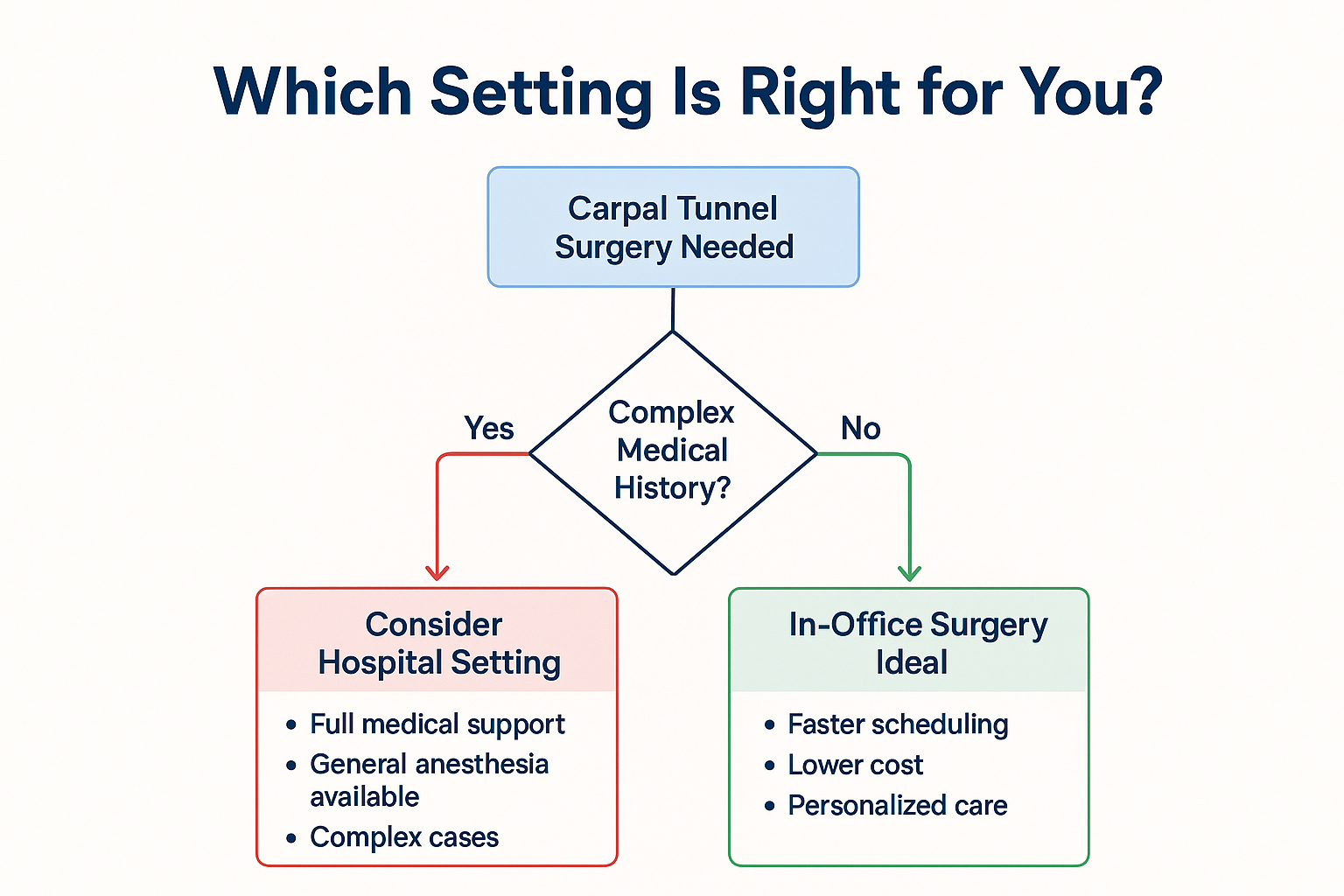
Hospitals have full medical teams, intensive care units, and emergency equipment immediately available. For patients with complex medical histories or those at higher risk for complications, this infrastructure provides peace of mind.
Some patients prefer or require general anesthesia (being completely asleep) rather than local anesthesia with sedation. Hospitals are better equipped to provide general anesthesia with anesthesiologists and full monitoring.
If you've had previous carpal tunnel surgery that failed, or if imaging shows unusual anatomy or complications, a hospital operating room might offer advantages in terms of equipment and specialist availability.
Hospital operating rooms serve many departments and emergency cases. Scheduled procedures like carpal tunnel release often face longer wait times—sometimes several months.
When you're in pain and losing sleep, waiting months for relief can feel unbearable. Prolonged compression also increases the risk of permanent nerve damage.
As mentioned earlier, hospital facility fees, operating room charges, and administrative costs typically result in significantly higher bills for the same procedure.
If you're paying out-of-pocket or have high-deductible insurance, this cost difference can be substantial.
Hospitals handle hundreds of patients daily across multiple departments. While the care is professional, the experience can feel impersonal and rushed.
You might see different staff members at each visit, navigate complex phone systems for questions, and spend considerable time in waiting areas.
Let's be honest: hospitals can feel intimidating and stressful. The sights, sounds, and atmosphere aren't designed for comfort—they're designed for efficiency and emergency readiness.
For an elective procedure like carpal tunnel release, a calmer, more welcoming environment can reduce anxiety and improve your overall experience.
Here's a simple decision framework:
Choose hospital-based surgery if:
Choose in-office surgery if:
For most people with carpal tunnel syndrome, in-office surgery at a specialized outpatient center offers the best combination of safety, efficiency, cost-effectiveness, and patient experience.
You've made the decision to proceed with surgery. Now let's talk about what happens next—because understanding the recovery process helps you plan and sets realistic expectations.
Right After Surgery:
Your hand will be bandaged, and you'll likely have a splint to keep your wrist in a neutral position. You'll feel some numbness from the local anesthetic for several hours.
Pain Management:
Most people describe post-operative discomfort as mild to moderate. Over-the-counter pain relievers like acetaminophen or ibuprofen are usually sufficient. Your surgeon may prescribe stronger medication if needed.
What You Can Do:
What to Avoid:
Days 2-7:
The initial bandage is typically removed after 1-3 days, revealing a lighter dressing. You'll notice some bruising, swelling, and tenderness—all normal.
Activity Level:
You can perform light activities with your hand:
Avoid:
Follow-Up:
You'll likely have a follow-up appointment within 5-7 days to check healing and possibly remove stitches (if non-dissolvable sutures were used).
What's Happening:
The incision is healing, swelling is decreasing, and nerve function is beginning to improve. Many people notice their nighttime numbness and tingling resolve within the first few weeks.
Activity Progression:
Physical Therapy:
Some surgeons recommend hand therapy to optimize recovery. A therapist can guide you through:
Strength Returns:
Grip strength continues improving, though it may take 2-3 months to reach pre-surgery levels (or better, since the nerve compression is resolved).
Work Considerations:
Driving:
Most people can drive within 1-2 weeks, once they can comfortably grip the steering wheel and have stopped taking prescription pain medication.
Symptom Resolution:
For the vast majority of patients, carpal tunnel release surgery provides excellent relief [6]:
Success Rates:
Studies consistently show success rates exceeding 95% when surgery is performed before severe, permanent nerve damage occurs. This is true for both open and endoscopic techniques, and for both in-office and hospital settings.
The key is the surgeon's skill and experience—not the location.
Potential Complications:
While rare, it's important to be aware of possible complications:
Choosing an experienced surgical team significantly reduces these risks. Review our frequently asked questions for more information about safety and outcomes.
Carpal tunnel syndrome can recur, though it's uncommon after successful surgery. To minimize risk:
Think of surgery as resetting the clock—but you still need to take care of your hands moving forward.
Let's talk money. Healthcare costs in Canada can be complex, and understanding what you'll actually pay helps you make informed decisions.
Carpal tunnel surgery costs typically include:
In Ontario, carpal tunnel release surgery is covered by OHIP when medically necessary and performed by an OHIP-registered physician. This applies to both hospital and in-office settings.
However, there are scenarios where you might pay out-of-pocket:
When paying privately, here's what you might expect in Mississauga:
Hospital-Based Carpal Tunnel Release:
In-Office Carpal Tunnel Release:
The cost difference reflects lower overhead at outpatient centers and more efficient processes. You're getting the same quality surgical care at a lower price point.
Use our cost estimator to get a personalized estimate based on your specific situation.
If you have private health insurance:
Many extended health plans cover a portion of private surgical procedures, especially when they're medically necessary and reduce wait times for treatment.
Consider the hidden costs of waiting:
When you factor in these considerations, paying $1,500-$2,500 for faster access to expert outpatient care often makes financial and personal sense.
One patient shared: "I waited four months for my hospital surgery date. In those four months, I took 12 sick days, slept terribly every night, and couldn't pick up my grandkids. Looking back, I would have gladly paid to have it done sooner."
The success of your carpal tunnel surgery depends heavily on your surgeon's skill and experience. Here's how to choose wisely.
Your surgeon should be:
Don't hesitate to ask about credentials during your consultation.
Surgeons who perform carpal tunnel releases regularly develop refined techniques and better outcomes. Ask:
High-volume surgeons (performing 50+ procedures annually) typically have better outcomes than those who do the procedure occasionally.
Your surgeon should:
If you feel rushed or dismissed during your consultation, that's a red flag.
Read what other patients say about their experiences. Look for:
Check out The Minor Surgery Center reviews to see what patients are saying.
Whether in-office or hospital-based, the facility should:
Modern facilities should have:
Consider practical factors:
Our clinics throughout the Greater Toronto Area are designed with patient convenience in mind.
Come prepared with questions:
A good surgeon welcomes these questions and provides thorough, honest answers.
Be cautious if:
Trust your instincts. If something feels off, seek a second opinion.
Many people develop carpal tunnel syndrome in both hands. This raises an important question: should you have both hands done at once, or one at a time?
Simultaneous (Both Hands at Once):
Advantages:
Disadvantages:
Staged (One Hand, Then the Other):
Advantages:
Disadvantages:
The majority of hand surgeons recommend staged surgery—doing one hand first, then the other after 4-8 weeks of recovery.
This approach allows you to:
However, simultaneous surgery can work well if:
Discuss your lifestyle, work demands, and support system with your surgeon to make the best choice for your situation.
Sometimes the best way to understand what to expect is hearing from people who've been through it. Here are real experiences from carpal tunnel surgery patients (details changed to protect privacy).
Background: Sarah, 42, spent 8-10 hours daily at her computer. Her carpal tunnel symptoms started gradually—tingling in her fingers, then nighttime numbness that woke her up several times nightly.
Treatment Journey: She tried wrist splints and ergonomic modifications for six months with minimal improvement. Nerve conduction studies confirmed moderate carpal tunnel syndrome.
Surgery Choice: Sarah chose in-office endoscopic release at an outpatient center in Mississauga.
Recovery: "The procedure itself was quick and surprisingly painless. I was nervous about the local anesthetic injection, but it was just a small pinch. I could feel pressure during the surgery but no pain. I was home within two hours."
Results: "The nighttime numbness stopped immediately—like, the first night after surgery. It took about three weeks before I felt comfortable using my mouse all day, and two months before my grip strength fully returned. I wish I'd done it sooner instead of suffering for months."
Background: Michael, 55, worked in a warehouse lifting boxes and using power tools. His carpal tunnel symptoms included severe pain radiating up his arm and weakness that made him drop things.
Treatment Journey: Conservative treatment provided minimal relief. His doctor recommended surgery before permanent nerve damage occurred.
Surgery Choice: Michael had open carpal tunnel release at a hospital due to his preference for general anesthesia.
Recovery: "The first week was rough—I needed help with everything. But by week three, I was doing light tasks around the house. My surgeon cleared me to return to work after eight weeks with lifting restrictions."
Results: "It's been six months now, and I'm back to full duty. The pain is gone, and my grip is actually stronger than before because I can use my hand properly again. The scar on my palm is barely noticeable now."
Background: Jennifer, 38, a dental hygienist, developed carpal tunnel syndrome in both hands from years of repetitive hand movements.
Treatment Journey: After diagnosis, she faced a difficult decision: both hands at once or staged surgery?
Surgery Choice: Jennifer opted for staged surgery—right hand first (her dominant hand), then left hand six weeks later. Both procedures were done in-office.
Recovery: "Having one functional hand made a huge difference. I could still drive, work on my computer, and take care of myself. When I had the second hand done, I knew exactly what to expect, which reduced my anxiety."
Results: "Three months after my second surgery, I'm pain-free and sleeping through the night for the first time in two years. I modified my work techniques and take more breaks now. I feel like I got my life back."
These stories highlight common themes: relief from nighttime symptoms happens quickly, full recovery takes weeks to months, and most people wish they'd had surgery sooner rather than continuing to suffer.
Let's address the most common questions patients ask about carpal tunnel treatment options.
Surgery becomes necessary when:
Your surgeon will review your diagnostic tests and symptoms to make a recommendation.
The procedure itself is not painful—you'll have local anesthesia numbing your hand and wrist. You might feel pressure or movement, but not pain.
Post-operative discomfort is typically mild to moderate and well-controlled with over-the-counter pain relievers. Most people describe it as soreness rather than severe pain.
The actual surgical procedure takes 15-30 minutes for most carpal tunnel releases. However, plan for 2-3 hours total for check-in, preparation, surgery, and recovery time before going home.
For in-office procedures, most patients receive local anesthesia with optional light sedation. You're awake but comfortable and relaxed. You won't see the surgery happening.
Hospital-based procedures may offer general anesthesia (being completely asleep) if you prefer or if medically necessary.
This depends on your job:
Your surgeon will provide specific guidance based on your occupation and recovery progress.
OHIP covers medically necessary carpal tunnel release surgery in Ontario. However, there may be wait times.
Private insurance may cover some or all of the costs for private-pay procedures at outpatient centers. Check with your insurance provider about coverage and pre-authorization requirements.
Success rates exceed 95% for carpal tunnel release surgery when performed by experienced surgeons. However, if symptoms persist or recur:
Choosing an experienced surgical team minimizes the risk of unsuccessful outcomes.
Recurrence is uncommon (less than 5% of cases) but possible. Factors that increase recurrence risk include:
Maintaining good hand ergonomics and addressing underlying health conditions helps prevent recurrence.
Both techniques have excellent success rates when performed by skilled surgeons. The choice depends on:
Discuss the pros and cons of each approach with your surgeon during consultation.
For more detailed answers, visit our FAQ page.
You've learned about Carpal Tunnel Treatment Options in Mississauga: from diagnosis through recovery, and from conservative treatments to surgical interventions. Now it's time to create your personal action plan.
If you haven't already:
A proper diagnosis is the foundation of effective treatment.
Unless your condition is severe or causing muscle wasting, start with non-surgical options:
Give these approaches a fair trial—they work for many people with mild to moderate carpal tunnel syndrome.
If conservative treatment doesn't provide adequate relief:
Consider in-office surgery if:
Consider hospital-based surgery if:
Take time to find the right surgeon:
Don't rush this decision. The surgeon you choose significantly impacts your outcome.
Once you've identified your preferred surgeon and facility:
A thorough consultation sets you up for success.
Once you've scheduled your procedure:
Good preparation makes recovery smoother.
After surgery:
Your commitment to recovery determines your final outcome.
If you're leaning toward in-office carpal tunnel surgery in Mississauga, here's why The Minor Surgery Center stands out.
Our experienced surgical team specializes in minor surgical procedures including carpal tunnel release. We perform these procedures regularly, refining our techniques and optimizing outcomes.
You're not just another case on a busy hospital schedule. You're a person who deserves to get back to your life, pain-free and fully functional.
We offer both open and endoscopic carpal tunnel release techniques. During your consultation, we'll recommend the approach best suited to your specific anatomy and condition severity.
Our focus on minimally invasive solutions means smaller incisions, less scarring, and often faster recovery—without compromising safety or effectiveness.
No two patients are exactly alike. We create personalised treatment plans based on:
This individualized approach ensures the best possible outcome for your unique situation.
Our outpatient facility meets rigorous safety standards while offering the efficiency and convenience hospitals can't match:
You get hospital-quality safety in a comfortable, efficient outpatient setting.
From your first consultation to your final follow-up, we prioritize your comfort:
We understand that surgery—even minor surgery—can be stressful. Our comfort-first approach helps you feel confident and cared for throughout the process.
Our Mississauga clinic is easily accessible with ample parking. We also have multiple locations throughout the Greater Toronto Area for your convenience.
We believe you deserve to know what you'll pay before committing to treatment. We provide clear, upfront pricing with no hidden fees.
Use our cost estimator or discuss pricing during your consultation. We'll also help you understand insurance coverage and payment options.
Living with carpal tunnel syndrome doesn't have to be your reality. Whether you're waking up with numb hands, struggling to grip objects, or watching your quality of life diminish, effective treatment is available right here in Mississauga.
You now understand the full spectrum of Carpal Tunnel Treatment Options in Mississauga:—from conservative approaches like splinting and physiotherapy to surgical interventions performed in both in-office and hospital settings.
The key takeaways:
✅ Early intervention matters—don't wait until permanent nerve damage occurs
✅ Conservative treatment works for many people with mild to moderate symptoms
✅ Surgery is highly successful with 95%+ success rates when performed by experienced surgeons
✅ In-office procedures offer significant advantages including faster scheduling, lower costs, and personalized care
✅ Your choice of surgeon impacts your outcome more than the setting
The decision between in-office and hospital-based surgery depends on your specific health status, preferences, and priorities. For most people with carpal tunnel syndrome, specialized outpatient centers provide the optimal combination of safety, efficiency, expertise, and patient experience.
Don't let carpal tunnel syndrome control your life any longer. Here's what to do now:
1. Schedule a consultation at The Minor Surgery Center to discuss your symptoms and explore treatment options.
2. Bring your questions about the procedure, recovery timeline, costs, and what to expect.
3. Get your diagnostic testing if you haven't already had nerve conduction studies.
4. Make an informed decision based on your specific situation, not fear or uncertainty.
5. Commit to the process—from pre-operative preparation through full recovery.
Relief is closer than you think. Most patients wish they'd pursued treatment sooner instead of suffering through months or years of symptoms.
You deserve to sleep through the night without numbness. You deserve to use your hands without pain. You deserve to get back to your life.
Ready to take the first step?
Contact The Minor Surgery Center today to schedule your carpal tunnel consultation. Our experienced surgical team is here to provide expert outpatient care, answer your questions, and help you choose the treatment path that's right for you.
Your journey to pain-free hands starts with a simple phone call or online booking. Don't wait—take control of your hand health today.
[1] American Academy of Orthopaedic Surgeons. (2022). "Carpal Tunnel Syndrome." OrthoInfo. https://orthoinfo.aaos.org/en/diseases--conditions/carpal-tunnel-syndrome/
[2] American Association of Neuromuscular & Electrodiagnostic Medicine. (2021). "Electrodiagnostic Testing for Carpal Tunnel Syndrome." AANEM Clinical Practice Guidelines.
[3] Page, M.J., et al. (2012). "Splinting for carpal tunnel syndrome." Cochrane Database of Systematic Reviews, Issue 7. DOI: 10.1002/14651858.CD010003
[4] Scholten, R.J., et al. (2007). "Surgical treatment options for carpal tunnel syndrome." Cochrane Database of Systematic Reviews, Issue 4. DOI: 10.1002/14651858.CD003905.pub3
[5] Ambulatory Surgery Center Association. (2020). "Patient Safety in Ambulatory Surgery Centers." ASCA Quality and Patient Safety Report.
[6] Atroshi, I., et al. (2006). "Outcomes of endoscopic surgery compared with open surgery for carpal tunnel syndrome among employed patients: randomised controlled trial." BMJ, 332(7556), 1473. DOI: 10.1136/bmj.38863.632789.1F