Carpal Tunnel Surgery in Toronto: When You Need It, When to Wait, and What the Operation Involves
Last updated: September 8, 2026
Quick Answer
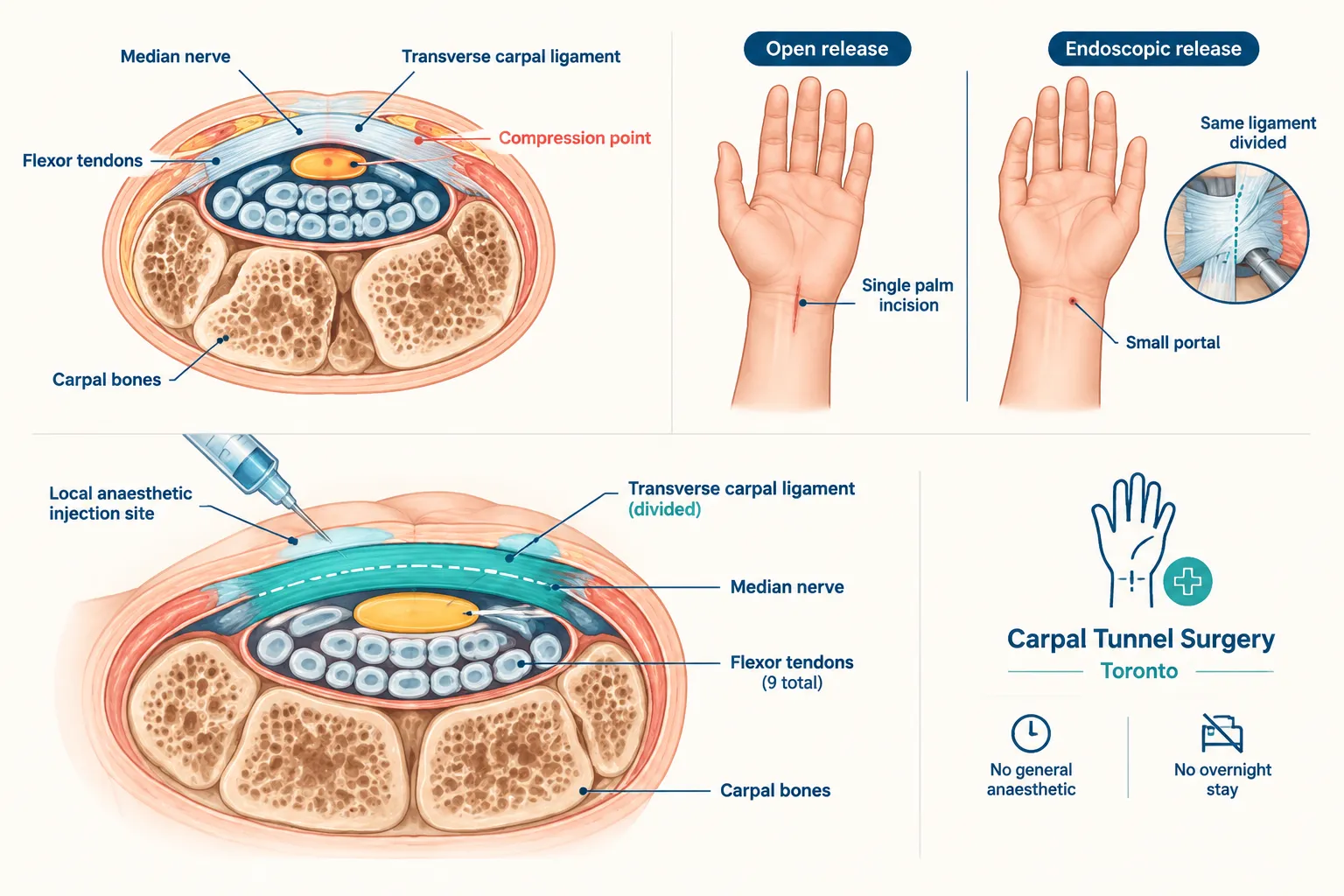
Carpal tunnel surgery, properly called carpal tunnel release, divides the transverse carpal ligament across the front of the wrist to take pressure off the median nerve. It is usually a short procedure done under local anaesthetic while you are awake, with no general anaesthetic and no overnight stay. Adults across Toronto and the GTA can be assessed for carpal tunnel surgery in Toronto without a referral at The Minor Surgery Center, and treatment is arranged when the assessment supports it.
Key Takeaways
Carpal tunnel release relieves pressure on the median nerve by cutting one ligament; the nerve itself is not touched.
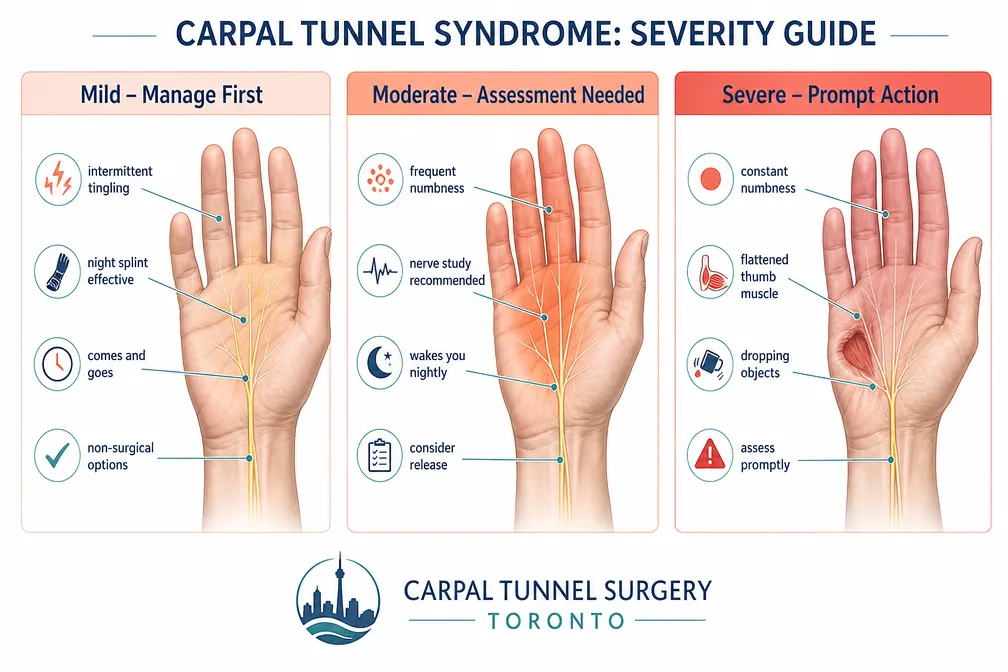
Severity drives the recommendation. Intermittent tingling can often be managed with a night splint; constant numbness with wasting of the thumb muscle should be assessed promptly.
A nerve conduction study is not always needed before treatment, but it is important when the picture is atypical or a neck problem is suspected.
Open and endoscopic release both divide the same ligament and both work; the choice depends on anatomy, prior surgery and surgeon experience.
Night-time symptoms often settle within days to weeks. Numbness and grip strength recover over weeks to months, and long-standing severe compression may not fully reverse.
Assessment and surgical treatment of diagnosed carpal tunnel syndrome is handled as a medical service in Ontario, not a cosmetic one, confirm your own coverage at the consultation.
What Carpal Tunnel Syndrome Actually Is
Carpal tunnel syndrome is compression of the median nerve inside a narrow canal at the base of the palm. The floor and walls are formed by the carpal bones; the roof is a tough band called the transverse carpal ligament. Nine flexor tendons share that space with the nerve, so there is very little room to spare.
When pressure rises in the tunnel, the nerve stops working properly. That produces numbness and tingling in the thumb, index, middle and half of the ring finger, and typically not the little finger, which has a different nerve supply. That sparing is a genuinely useful clue, and it's one of the features that separates this from other conditions that mimic carpal tunnel such as tendonitis or thumb-base arthritis.
Symptoms are usually worst at night because most people sleep with the wrist bent, which narrows the tunnel further and reduces blood flow to the nerve. People instinctively hang the hand over the bed or shake it out, and the tingling eases. If you're waking at 3 a.m. shaking your hand, that pattern of night-time carpal tunnel pain is one of the most characteristic findings there is.
Mild, Moderate or Severe: Why Staging Changes the Recommendation
Carpal tunnel syndrome is a spectrum, not a yes-or-no diagnosis, and where you sit on that spectrum should decide what happens next. Mild disease has real non-surgical options. Severe disease does not benefit from waiting.
Mild. Tingling comes and goes. It wakes you some nights, or shows up after a long stretch of typing, driving or holding a hairdryer, then clears within minutes. Sensation between episodes is normal. Night splinting, activity change and time are reasonable first steps here, and a meaningful number of people improve.
Moderate. Symptoms are present most days. Numbness lasts longer after it starts, an hour rather than a minute, and fine tasks like buttons, coins or guitar strings feel clumsy. Grip starts to feel unreliable. This is the stage where surgery genuinely moves onto the table, because conservative care has a lower ceiling once symptoms are continuous.
Severe. Numbness is constant. The pad of the thumb and index finger feels permanently dulled. The muscle bulge at the base of the thumb may look flatter than the other hand, and objects slip out of the hand without warning. That combination reflects nerve fibre loss, not just irritation.
The central point, said plainly: in mild disease, waiting is a reasonable clinical decision. In severe disease, waiting has a cost, because some nerve changes do not fully reverse even after a technically perfect operation. Our detailed breakdown of mild versus moderate versus severe carpal tunnel walks through the staging in more depth.
Nerve Conduction Studies: When You Actually Need One
A nerve conduction study with EMG measures how fast and how strongly electrical signals travel along the median nerve across the wrist, compared with normal values and with your other nerves. It does three jobs: confirms the diagnosis, grades severity, and helps rule out a pinched nerve in the neck or a more generalised neuropathy.
Here's the honest part. A classic history, night waking, thumb-to-middle-finger numbness, positive findings on examination, little finger spared, often doesn't require testing before conservative treatment begins. Testing earns its place when:
The pattern is atypical, involves the whole hand, or crosses into the forearm and shoulder.
Diabetes, thyroid disease or another cause of widespread neuropathy is in play.
Surgery is being planned and the diagnosis isn't clear-cut.
One practical Ontario point: these studies are arranged when clinically indicated and can add weeks to the timeline. That's part of why an unambiguous case is sometimes managed on history and examination, while an uncertain one is worth testing properly before anyone picks up a scalpel. Also worth knowing: nerve studies can be normal in early disease. A normal result doesn't automatically mean nothing is wrong, and an abnormal result doesn't automatically mean you need an operation.
When Surgery Is Not the Answer Yet
Plenty of people who ask about surgery don't need it yet. A clinic worth seeing will tell you that.
Night splinting. A wrist brace holds the wrist in a neutral position, which is the position of lowest pressure inside the tunnel. Position matters more than price. Many drugstore braces hold the wrist bent back, which is counterproductive, so choosing between day and night carpal tunnel braces is worth a few minutes of thought. Give a night splint six to eight weeks before judging it.
Activity and ergonomics. Vibrating tools, sustained forceful grip and prolonged wrist flexion all raise tunnel pressure. Changing tool grips, keyboard height or the way you hold a hairdryer or a steering wheel can shift symptoms. Tendon and nerve glide exercises help some people and irritate others; they're a trial, not a guarantee.
Corticosteroid injection. An injection into the tunnel can reduce swelling and settle symptoms. It also gives useful diagnostic information, a good response supports the diagnosis of median nerve compression at the wrist. Relief is often temporary, and repeated injections are not a long-term strategy.
Pregnancy.Carpal tunnel symptoms during pregnancy are common and frequently settle in the weeks to months after delivery as fluid retention resolves. Splinting and observation are usually the right approach unless symptoms are severe or persist well past the postpartum period.
Symptoms coming from elsewhere. Neck-based nerve compression, thoracic outlet problems, generalised neuropathy and even trigger finger can be mistaken for carpal tunnel. Releasing the wrong structure fixes nothing.
Open Versus Endoscopic Release: An Honest Comparison
Both techniques divide the same transverse carpal ligament and both relieve pressure on the median nerve. Neither is universally better; the deciding factors are anatomy, prior surgery and the surgeon's experience with the technique.
Open release. A short incision in the palm, typically a couple of centimetres, gives direct view of the ligament and the structures beneath it. That visualisation is the main argument in its favour, particularly if the anatomy is unusual, there's a co-existing problem to address, or a previous release needs revising.
Endoscopic release. A smaller portal and a camera, with the ligament divided from inside the tunnel. Reported advantages centre on less palm tenderness and a somewhat faster return to heavy gripping in the first few weeks. Comparative studies generally find that the difference narrows over the following months, with similar symptom relief between techniques by around six months to a year.
The trade-offs. Open release can leave tenderness along the palmar scar for several weeks. Endoscopic release depends more heavily on operator volume, and if visualisation is inadequate the surgeon should convert to an open approach, that's good judgement, not failure. Open release is generally preferred for revision surgery, previous wrist trauma, significant tenosynovitis, or anatomy that needs to be seen directly.
If you need to be back on the tools in ten days, that argues one way. If you've had a previous release on the same wrist, it argues the other. The technique should be chosen at the consultation, in front of your hand, not from an article.
What the Procedure Involves, and Recovery
Carpal tunnel release usually takes about 15 to 30 minutes of operating time, with the whole visit longer than that once consent, positioning, freezing and dressings are counted. You are awake, the arm is numb, and you go home the same day.
The sequence is straightforward. The surgeon examines and marks the hand, then injects local anaesthetic, a brief sting and a pressure sensation for perhaps 20 to 30 seconds, then nothing. The skin is opened, the ligament is identified and divided under direct vision, the median nerve is inspected, and the skin is closed with sutures. A soft dressing goes on. Most people are surprised at how undramatic it is.
The first week. Keep the dressing dry and the hand elevated. Move the fingers from day one. Expect soreness in the palm rather than sharp pain; simple analgesia is usually enough. Sutures typically come out around 10 to 14 days.
Driving. Often reasonable within a few days to a week for an automatic, once the hand can grip the wheel confidently and you're off any sedating medication. Check with your surgeon, and don't drive with a bulky dressing on the dominant hand.
What recovers when. Night waking and tingling often improve within days to a few weeks, that's usually the first thing patients notice. Numbness and grip strength recover more slowly, over weeks to months, and the extent varies with how long and how severely the nerve was compressed. Pillar pain, a tender ache at the base of the palm on either side of the scar, is common for several weeks and generally settles.
Is Carpal Tunnel Surgery Covered by OHIP?
In Ontario, assessment and surgical treatment of a diagnosed medical condition such as carpal tunnel syndrome is handled differently from elective or cosmetic procedures. Carpal tunnel release for a symptomatic, confirmed median nerve compression is treated as a medically necessary insured service for eligible patients with a valid health card.
Coverage depends on your own eligibility, where the procedure is performed, and the specific clinical circumstances. Some patients also look at private pathways purely for speed, since public-system consultation and surgical waits in the GTA vary considerably by hospital and by triage priority. Fees for non-insured services should always be quoted in writing.
Don't assume either way. Bring your health card and confirm your specific situation at the consultation.
Getting Assessed in Toronto for Carpal Tunnel Surgery
The Toronto clinic is at 2920 Dufferin Street, Suite 202, Toronto, with additional locations at 85 Scarsdale Road, Unit 101 in York Mills (North York), plus Vaughan, Mississauga at 1224 Dundas Street West, and Oakville. Phone 647-614-1611, Monday to Friday, 9 a.m. to 4 p.m. No referral is required.
Procedures are performed by plastic surgeons with hand surgery experience. That matters for a specific reason: the median nerve gives off a small palmar cutaneous branch and a recurrent motor branch near the release site, and knowing where those sit, and recognising anatomical variants, is what keeps a routine operation routine. Surgeons who also handle trigger finger and other hand procedures see these variations regularly. You can review the full list of procedures offered at the Toronto location before booking.
Three practical things before you come in:
Bring any previous nerve conduction or EMG reports, and a list of your medications, especially blood thinners.
Arrange a drive home if both hands are being treated, or if it's your driving hand.
Wear a short-sleeved or loose-sleeved top so the forearm is easy to access.
Consultation and treatment are often arranged efficiently, and same-visit treatment happens only when it is clinically appropriate for your case.
Frequently Asked Questions
How do I know if it's carpal tunnel and not something else? The typical pattern is numbness or tingling in the thumb, index, middle and half the ring finger, worse at night, relieved by shaking the hand, with the little finger spared. Neck-related nerve compression, tendonitis, thumb-base arthritis and generalised neuropathy can all mimic it, so an in-person examination is the only reliable way to sort it out.
Do I need a referral for carpal tunnel surgery in Toronto? No referral is required to be assessed at The Minor Surgery Center's Toronto or GTA locations. You can call 647-614-1611 directly on weekdays between 9 a.m. and 4 p.m.
Does the surgery hurt? The local anaesthetic injection stings briefly, usually under half a minute. After that the hand is numb and you should feel pressure and movement but not pain. Soreness in the palm for a few days afterwards is normal and usually managed with simple over-the-counter analgesia.
How long does carpal tunnel surgery take? The release itself generally takes about 15 to 30 minutes. Budget longer for the overall appointment, including consent, freezing and dressings.
When can I drive after carpal tunnel release? Many people drive an automatic vehicle within a few days to a week, once they can grip the wheel and steer confidently and are not taking sedating medication. Confirm the timing with your surgeon before you get behind the wheel.
How long will I be off work? Desk-based work is often possible within a few days to two weeks. Manual work involving heavy gripping, vibration or repetitive force usually needs around four to six weeks, sometimes longer. Our article on carpal tunnel surgery recovery and time off work covers the variables.
Will the numbness definitely go away? No one can promise that. Night-time symptoms and intermittent tingling usually improve quickly. Constant numbness and thumb-muscle weakness improve more slowly and, if the nerve has been severely compressed for a long time, may not fully reverse, which is the main argument against waiting once symptoms are constant.
Can carpal tunnel come back after surgery? Recurrence is uncommon but possible, and persistent symptoms after surgery can also mean incomplete release, scarring, or a second diagnosis that was present all along. Our discussion of why carpal tunnel symptoms sometimes return after surgery explains how those situations are worked up.
The Bottom Line
Mild, intermittent symptoms have genuine non-surgical options, and a well-fitted night splint plus a few sensible changes is a reasonable place to start. Constant numbness, dropping objects, or a thumb muscle that looks flatter than the other side is a different situation, and it deserves assessment sooner rather than later, because nerve recovery depends on how long the compression has been there.
If you want a straight answer about where you stand, book an assessment at 2920 Dufferin Street, Suite 202, Toronto, or call 647-614-1611 weekdays between 9 a.m. and 4 p.m. No referral needed. Bring your health card and any previous nerve testing.
This article is general information about carpal tunnel syndrome and its treatment. It is not a substitute for individual medical advice. Symptoms in the hand can have several causes, and only an in-person assessment can tell you which one applies to you.
Meta title: Carpal Tunnel Surgery Toronto: When You Need It & Recovery
Meta description: Carpal tunnel surgery in Toronto explained by hand surgeons: severity staging, nerve tests, open vs endoscopic release, recovery time, OHIP and no-referral booking.
Tags: carpal tunnel surgery Toronto, carpal tunnel release, median nerve compression, carpal tunnel recovery time, nerve conduction study Ontario, OHIP carpal tunnel, open vs endoscopic release, hand surgery GTA, carpal tunnel severity, wrist splint, no referral surgery Toronto, return to work after hand surgery
The Minor Surgery Center’s York Mills clinic, located at 85 Scarsdale Rd, Unit 101 in North York, offers convenient access to specialized surgical care for a range of skin and hand conditions. Our Plastic Surgeons provide treatment for skin cancer, suspicious moles, cysts, lipomas, carpal tunnel syndrome and trigger finger, with a focus on timely care and personalized treatment. In many cases, patients may be able to have their consultation and treatment completed during the same visit when medically appropriate. For expert care in a welcoming clinical setting, contact our York Mills team at (647) 614-1611.
We are the experts in the field of Minor Surgery. All our Surgeons have completed 5 years of post Medical School Surgical Residencies. They are all Board Certified by the Royal College of Physicians and Surgeons of Ontario.They have been trained at Institutions including McGill, McMaster, Queen's, University of British Columbia, University of Toronto, University of Western Ontario, The Mayo Clinic, University of Pennsylvania, University of Southern California, Yale University, and Oxford.
In many clinics, you could wait months—sometimes over a year—for a procedure like cyst or lipoma removal, mole removal, or even carpal tunnel release. But at TMSC, we prioritize fast access to care. In many cases, we can schedule and complete your minor surgery on the same day as your initial consultation—no extra runaround required.
Our clinics are designed with your comfort, safety, and efficiency in mind. We use strict sterilization protocols to minimize any infection risk, and our advanced surgical equipment meets hospital-grade standards. Yet, you’ll never feel like you’ve stepped into a stark, clinical space—our friendly staff ensures you’re welcome and supported the moment you walk through the door.
Cosmetic results matter—even for the smallest procedures. Skin lesions can be excised by non surgeons in Ontario. Furthermore, any MD with 2 years of post graduate training even outside of a surgical field can perform removal. At TMSC we only have Surgeons under our roof. They are trained well above the level of the procedures we offer to ensure the surgery goes smoothly with minimal scaring and preserving your natural contours. Our Surgeons are trained to ensure both function and aesthetics are always front and center.
At TMSC, we specialize in surgical treatment of both benign and malignant skin lesions, as well as minor hand conditions. We offer significantly reduced wait times often allowing you to schedule your surgery on the same day as your consultation.
You can book your free consultation with The Minor Surgery Center in three easy ways: online through Cortico, by phone, or by requesting a callback from our team.
The initial consultation is free. During this consultation, one of our board certified surgeons will examine your condition and recommend a suitable solution.
Directly Online
Request a Callback
By Phone
By Text
Hours
Sunday
Closed
Monday
9 am — 4 pm
Tuesday
9 am — 4 pm
Wednesday
9 am — 4 pm
Thursday
9 am — 4 pm
Friday
9 am — 4 pm
Saturday
Toronto & Oakville Open Vaughan & Mississauga Closed







.avif)
%20(600%20x%20600%20px)%20(2).avif)
.avif)
%20(8).avif)
%20(7).avif)


.png)