

Last updated: October 28, 2026
Trigger finger is often worse in the morning because the tendon and its sheath stiffen and swell overnight while the finger stays curled and still. Movement during the day warms and lubricates the tendon, so catching tends to ease. Frequent morning locking can signal the condition is progressing. Splints, injections, and surgery all help, depending on severity.
Trigger finger (medically called stenosing tenosynovitis) happens when a tendon in the finger or thumb cannot glide smoothly through its pulley system. A ring-shaped structure called the A1 pulley normally lets the flexor tendon slide freely. When the tendon or its sheath (the thin tunnel wrapping the tendon) becomes swollen or develops a small nodule, that nodule catches at the pulley opening [1][2].
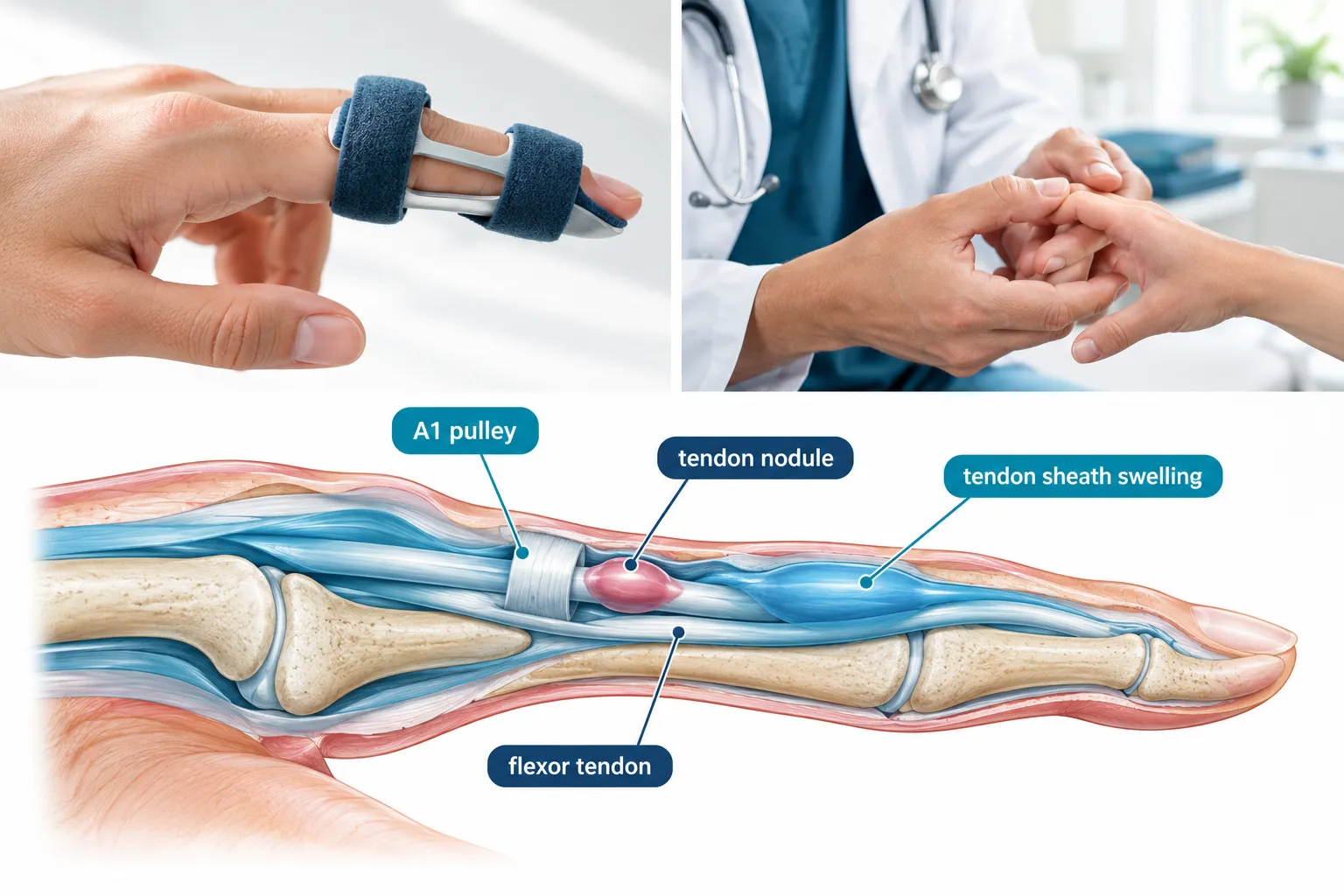
The result is a finger or thumb that clicks, catches, or locks when bending or straightening. In more advanced cases, the finger locks bent and needs to be pulled straight with the other hand. Cleveland Clinic and Mayo Clinic both describe this catching-and-locking pattern as the hallmark symptom [1][2].
Common causes include repetitive gripping, certain occupations and hobbies, and underlying conditions such as diabetes or rheumatoid arthritis, which are both linked to higher rates of trigger finger [1][2]. Anyone considering treatment options can review the trigger finger condition overview for a broader summary.
Trigger finger is typically worse in the morning because three things happen at once overnight: fluid pools in the hand, fingers rest curled for hours, and the tendon sheath stiffens from lack of movement. The American Academy of Orthopaedic Surgeons (AAOS) notes that triggering and locking tend to worsen after periods of inactivity, such as sleep, and improve with gentle, consistent hand use [3].
Lying down for hours reduces normal fluid drainage from the hands. Mild overnight swelling around an already irritated tendon sheath can make the narrowed passage at the A1 pulley even tighter by morning [2].
Most people sleep with their hands loosely curled into a light fist. NHS Highland notes this resting position can leave an affected finger locked or harder to straighten on waking, because the tendon has sat bunched up against the narrowed pulley for hours [3].
Tendons rely on repeated motion to stay lubricated and pliable. Without that motion overnight, the tendon and its sheath stiffen. The first movements of the day then force a thickened or nodular tendon through a tight pulley opening, producing the classic morning click, snap, or lock [2][3].
Decision rule: if your finger only catches once or twice in the first hour of the day and then moves normally, this fits a mild, early presentation. If it locks bent and needs manual help to straighten most mornings, treat that as a sign to seek assessment rather than wait it out.
Trigger finger often hurts more at night for the same underlying reason it is worse in the morning: tendon inflammation tends to build after a day of repeated gripping, and discomfort becomes more noticeable once hand activity stops and attention is not distracted by tasks. Pain that was masked during a busy day can feel sharper once a person is still and resting.
Some people also notice increased stiffness or aching settling in through the evening after cumulative use of the hand that day. This matches general NHS and AAOS descriptions of symptoms worsening with inactivity and after heavy use, though neither source gives a specific percentage for how many patients report night pain [3][4]. If pain is disrupting sleep, a night splint (discussed below) is a reasonable first step to raise with a clinician.
Trigger finger symptoms usually ease during the day because repeated bending and straightening helps the tendon glide through the narrowed pulley more smoothly as local tissues warm and loosen. AAOS describes this pattern directly: symptoms are worse after inactivity and may improve with gentle use [3].
This improvement is mechanical, not curative. The tendon nodule or sheath thickening that causes the catching is still present; movement simply allows it to pass the pulley with less resistance once warmed up [5]. That is why symptoms can return the next morning, or after any extended period of rest, such as a long drive or a nap.
Common mistake: assuming daytime improvement means the problem is resolving on its own. Without changes to activity, splinting, or further treatment, the underlying pulley narrowing generally persists even as daily symptoms fluctuate.
Frequent or worsening morning locking can be a sign that trigger finger is progressing, especially if the finger increasingly needs help to straighten or stays locked longer each day. This progression is commonly tracked using the Quinnell (also called Green) grading scale, which clinicians use to describe severity.
GradeWhat you noticeUsual next stepGrade IPain or tenderness near the base of the finger, no catching yetActivity modification, monitorGrade IICatching reported by the patient, demonstrable on examSplinting, NSAIDs, consider injectionGrade IIIFinger locks and requires passive help to straighten (or actively straightens with difficulty)Corticosteroid injection; surgery if recurrentGrade IVFinger is fixed in a flexed position, cannot be passively straightenedSurgical release typically recommended
Grading language varies slightly between sources, but the general pattern, mild tenderness, then catching, then locking, then fixed flexion, is consistent across clinical descriptions [4][6][7]. If mornings have shifted from occasional clicking to daily locking, that shift itself is a reason to book an assessment rather than wait for the grade to climb further.
See a doctor sooner if:
Based on general guidance from NHS and ASSH-aligned sources on trigger finger management [4][6].
Morning trigger finger symptoms can often be eased with a combination of overnight splinting, gentle warm-up movement, and avoiding aggravating grips first thing in the day. None of these fix the underlying pulley narrowing, but they can reduce the intensity of morning catching.
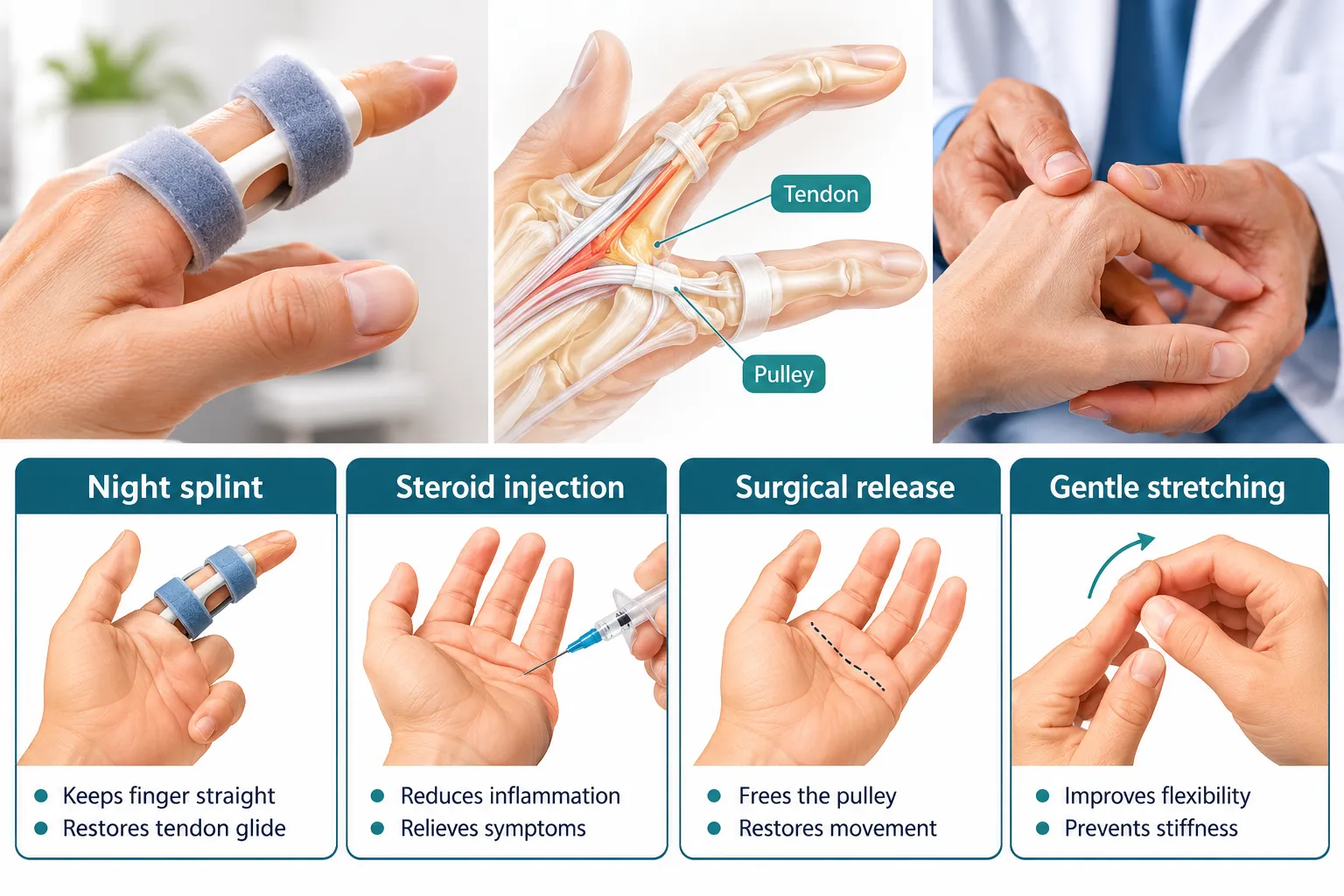
A night splint holds the finger in a straighter position while sleeping, which can reduce the tendon's time spent curled against the pulley. NHS guidance describes splinting as a standard conservative option, typically used for about 3 to 12 weeks [4]. A 2025 randomized trial following 104 patients with 122 trigger fingers for an average of 29 months found overall conservative treatment (splinting, injection, or both) succeeded in 68.9% of cases, though success rates varied by approach [8]. See trigger finger exercises for specific stretching routines that pair with splinting.
Slow, gentle bending and straightening, sometimes paired with a few minutes of warm water soak, can help loosen the tendon before the day's activities begin. Heat may ease stiffness temporarily, but it does not correct the narrowed pulley itself [3].
Avoid forcing the finger straight with sudden force, gripping tools tightly first thing in the morning, or ignoring a finger that is hot, red, or swollen. Cold weather can also make stiffness feel worse, since cold tends to stiffen tendons and joints generally, so keeping hands warm before use is a reasonable habit.
Trigger finger can sometimes improve on its own in mild, early cases, particularly if the aggravating activity is reduced, but it does not reliably resolve without some form of treatment once locking has developed. Mild Grade I or early Grade II cases have the best chance of settling with rest and activity changes alone.
Once a finger reaches the locking stages (Grade III or IV), spontaneous resolution becomes less likely, and NHS and AAOS-aligned sources generally recommend structured conservative treatment, splinting, activity changes, and possibly corticosteroid injection, before considering surgery [3][4]. Trigger finger can also appear suddenly, sometimes after a period of unusually repetitive gripping, rather than building gradually, so a sudden locking episode does not necessarily mean a worse prognosis, it depends on the grade at presentation.
How long trigger finger takes to heal varies by severity and treatment: splinting courses often run 3 to 12 weeks, a single steroid injection may resolve symptoms within days to a few weeks for many patients, and surgical release typically resolves mechanical locking immediately, with soft tissue healing over several weeks [4]. For a deeper comparison of non-surgical paths, see the ultimate guide to trigger finger treatment.
Steroid injections are usually tried first for Grade II and III trigger finger, while surgery is generally reserved for cases that do not respond to injections, recur, or present at Grade IV with a fixed, locked finger. The right choice depends on grade, recurrence history, and whether diabetes is present, since recurrence after injection is more likely in people with diabetes [4].
OptionHow it worksSuccess/recurrenceDowntimeBest forNight splintHolds finger extended overnight to reduce tendon strainPart of conservative treatment with 68.9% overall success in one 2025 trial of combined approaches [8]NoneMild-to-moderate, early catchingCorticosteroid injectionReduces inflammation around tendon sheathOne or two injections generally successful per NHS evidence review; recurrence more likely with diabetes [4]Minimal, brief sorenessGrade II-III, first-line before surgerySurgical releaseDivides the A1 pulley to free tendon passageConsidered definitive for persistent or recurrent cases per NHS guidance [4]Local anesthetic, same-day, days to weeks of soft tissue healingGrade III-IV, recurrent or injection-resistant cases
For readers weighing injections against surgery, the trigger finger steroid injection guide walks through what to expect from that option specifically, and advances in trigger finger management covers how treatment approaches have evolved.
Surgical release can often be done without a long recovery process. The Minor Surgery Center, with five clinics across the GTA (Toronto/North York, York Mills, Vaughan, Mississauga, and Oakville), performs trigger finger release under local anesthetic as a same-day procedure. The procedure is OHIP-covered and does not require a referral. Co-founders Dr. Kunaal Jindal and Dr. Roberto Tutino, both board-certified plastic and reconstructive surgeons, lead the practice. A free consultation is available by calling (647) 614-1611. Details on coverage and process are outlined on the trigger finger release in Toronto page and the trigger finger surgery OHIP coverage page.
Trigger finger is most common in adults between roughly 40 and 60 years old, affects women more often than men, and occurs at notably higher rates in people with diabetes or rheumatoid arthritis [1][2]. These associations are well established across clinical sources, though exact prevalence figures differ between studies.
Diabetes is of particular interest because people with diabetes face both higher risk of developing trigger finger and higher recurrence rates after corticosteroid injection, which affects treatment planning [4]. Can carpal tunnel cause trigger finger? The two conditions are not causally linked in a direct sense, but they share risk factors and anatomical proximity, and they commonly occur together, since both involve tendon or nerve compression in the same crowded wrist and hand passages. Anyone with both numbness/tingling and finger locking should mention both symptoms to a clinician; the carpal tunnel syndrome overview explains that condition's mechanism for comparison.
Trigger finger in both hands, or multiple affected fingers, is more common in people with diabetes or inflammatory arthritis than in isolated cases from repetitive strain. The multiple trigger fingers guide covers how widespread symptoms are typically managed differently from a single affected finger.
Trigger finger differs from arthritis in presentation: trigger finger causes localized catching or locking at the base of one finger, while arthritis more often causes joint-centered pain and stiffness lasting more than about 30 minutes, frequently across multiple joints, sometimes with warmth and redness. NHS materials recommend assessment when stiffness pattern matches that arthritis-type description rather than isolated mechanical catching [3].
Why does my finger lock in the morning?
Overnight inactivity lets the tendon and sheath stiffen while the finger rests curled, so the first movements of the day force a swollen or nodular tendon through a narrowed pulley, producing catching or locking [2][3].
Can trigger finger go away on its own?
Mild, early cases sometimes settle with rest and activity changes, but once locking develops, spontaneous resolution is less likely and treatment such as splinting or injection is generally recommended [3][4].
Does a night splint help trigger finger?
Yes, for many people. Night splints hold the finger extended during sleep and are part of standard conservative care, typically used for about 3 to 12 weeks, often alongside other treatments [4].
Is trigger finger linked to diabetes?
Yes. Diabetes raises the risk of developing trigger finger and increases the likelihood of recurrence after corticosteroid injection, according to NHS evidence review findings [4].
Can carpal tunnel cause trigger finger?
They are not directly causal, but they share risk factors and often occur in the same hand, so having one condition does not prevent or cause the other but should prompt checking for both.
Is trigger finger surgery covered by OHIP?
Yes, trigger finger release is covered by OHIP in Ontario when performed by a qualified surgeon, and no referral is required at The Minor Surgery Center's GTA clinics.
Morning and nighttime trigger finger symptoms trace back to the same mechanism: a thickened tendon or narrowed pulley that struggles to glide after hours of stillness. Movement loosens things during the day, but it does not repair the underlying narrowing. Mild cases may improve with rest and activity changes, while catching that progresses to locking usually needs splinting, injection, or surgery.
Track how your mornings change over a few weeks. If locking becomes daily, if a finger needs manual help to straighten, or if more than one finger is affected, book an assessment rather than waiting. A free consultation with The Minor Surgery Center, available across its five GTA locations, can clarify whether OHIP-covered, same-day surgical release under local anesthetic is the right next step, call (647) 614-1611 to arrange one.