Trigger Finger Surgery in Ontario: OHIP Coverage, Wait Times and Your Options
Last updated: October 14, 2026
Quick Answer
Trigger finger release is covered by OHIP in Ontario, whether done in a hospital or an OHIP-billing community clinic. Trigger finger surgery Ontario OHIP wait times vary by region and provider, and hospital-based queues for this elective procedure can run several months, though community clinic pathways are often faster. Many patients try a corticosteroid injection first, and surgery becomes the recommended option when triggering keeps coming back or the finger locks.
Key takeaways
OHIP pays for medically necessary trigger finger release, including percutaneous release, open trigger finger release, and the WALANT technique.
Trigger finger is almost always classified as a Priority 4 (elective, non-urgent) procedure, which affects where it sits in the surgical queue.
Province-wide, the average wait for Priority 4 elective surgery was about 175 days as of October 2026, according to Ontario Health's wait-times reporting [3].
Community clinics performing OHIP-covered trigger finger release can sometimes offer shorter waits than a full hospital surgical queue, without any extra patient cost, because the service is still billed to OHIP.
Patients cannot pay privately to jump the queue for an OHIP-insured procedure in Ontario; choosing a different in-network provider is different from paying for faster access.
Corticosteroid injection and splinting are reasonable first steps for many people before surgery is considered.
Recovery after trigger finger release is usually shorter than after carpal tunnel surgery, though full resolution of stiffness can take several weeks.
This article is general information, not medical advice.
Is trigger finger surgery covered by OHIP, and what does it cost without coverage?
Trigger finger release is covered by OHIP in Ontario when a physician determines it is medically necessary, so eligible residents with a valid OHIP card do not pay for the surgery itself, the surgeon's fee, or the facility fee at a participating hospital or clinic. There is no routine scenario in which an Ontario resident needs to pay out of pocket for a standard, medically indicated trigger finger release.
Because the procedure is OHIP-insured, asking "how much does trigger finger surgery cost without OHIP coverage" mainly applies to a narrow group: visitors without valid Ontario health coverage, people in a waiting period after moving to Ontario, or those who want a cosmetic or non-medically-indicated version of the procedure outside the OHIP system. For anyone with active OHIP coverage and a documented diagnosis of stenosing tenosynovitis (the medical term for trigger finger), the release itself is not a private-pay service. The Minor Surgery Center performs OHIP-covered trigger finger release in Toronto across several GTA community clinics, and background on the trigger finger condition is available for patients comparing options.
How long is the wait for trigger finger surgery in Ontario under OHIP?
Trigger finger surgery Ontario OHIP wait times depend on whether the procedure is booked through a hospital surgical department or an OHIP-billing community clinic, and on local surgeon capacity. As a general benchmark, Ontario Health reported a province-wide average wait of about 175 days for Priority 4 elective surgeries as of October 2026, a category that includes most trigger finger releases [3].
That average hides real variation between hospitals, surgeons, and regions.
Wait time has two parts: the time to see a hand surgeon for an initial consult, and the time from booking to the actual operating-room date.
Hospitals in high-demand areas of the GTA often have longer elective queues than smaller community sites with dedicated minor-procedure capacity.
Ontario Health's wait times tool lets patients look up current, hospital-specific data for hand and plastic surgery procedures, which is more accurate for planning than any single province-wide average [2].
A CCPA analysis of wait-time trends from 2017 to 2025 found that, despite policy efforts, many surgical wait times have not meaningfully shortened over that period [8].
Decision rule: if a surgeon's office cannot give a specific date within a reasonable range, use the Ontario Health wait times tool to compare that hospital against others performing hand surgery in the same region before accepting a long wait as fixed.
Can I get trigger finger surgery faster by paying privately in Ontario?
Patients cannot pay out of pocket to skip the queue for an OHIP-insured trigger finger release in Ontario, because provincial law prohibits extra-billing for medically necessary, insured services. What can change the wait is choosing a different OHIP-billing provider, such as a community clinic with available operating capacity, rather than paying more money for the same hospital queue.
Recent coverage has looked at whether shifting procedures to private, for-profit clinics actually shortens Ontario's surgical wait times overall. A CP24 report from September 2026 noted that wait times for some procedures outsourced to for-profit clinics have been increasing rather than improving system-wide [6]. A related Yahoo News report on priority surgeries in Ontario raised similar concerns about uneven progress across procedure types [7]. A York Region report also examined the cost and queue implications of private clinic care for Ontario patients considering faster access outside the standard hospital system [9].
Common mistake: assuming that any clinic calling itself "private" means paying cash for the operation. In Ontario, a community clinic can be privately operated as a business while still billing OHIP for the insured procedure, which is the model used for OHIP-covered trigger finger release, the surgery itself remains free at the point of care, even though the clinic is not a hospital. For more on this distinction, see the comparison of OHIP versus private-clinic minor surgery in Ontario.
When is surgery recommended instead of injections or splinting, and what if it's left untreated?
Surgery is typically recommended when a corticosteroid injection has already been tried and triggering returns, when the finger locks in a bent position, or when stiffness and pain are significantly limiting hand use. Left untreated, trigger finger does not usually cause permanent nerve damage the way some other hand conditions can, but it can progress to a fixed contracture that is harder to correct later and that limits grip strength and daily tasks.
Good candidates for surgery: persistent or recurrent triggering after one or two corticosteroid injections, a finger that locks and must be manually straightened, or trigger thumb with similar locking symptoms.
Less ideal candidates: first-time, mild triggering with no locking, where injection or splinting is reasonable to try first.
Edge case: people with diabetes often have a lower response rate to injections and may move to surgery sooner after discussion with their surgeon, per general hand-surgery literature.
Readers comparing symptoms in the thumb versus the fingers may find it useful to review the differences between trigger finger and trigger thumb before a consult.
What are the alternatives to surgery for trigger finger?
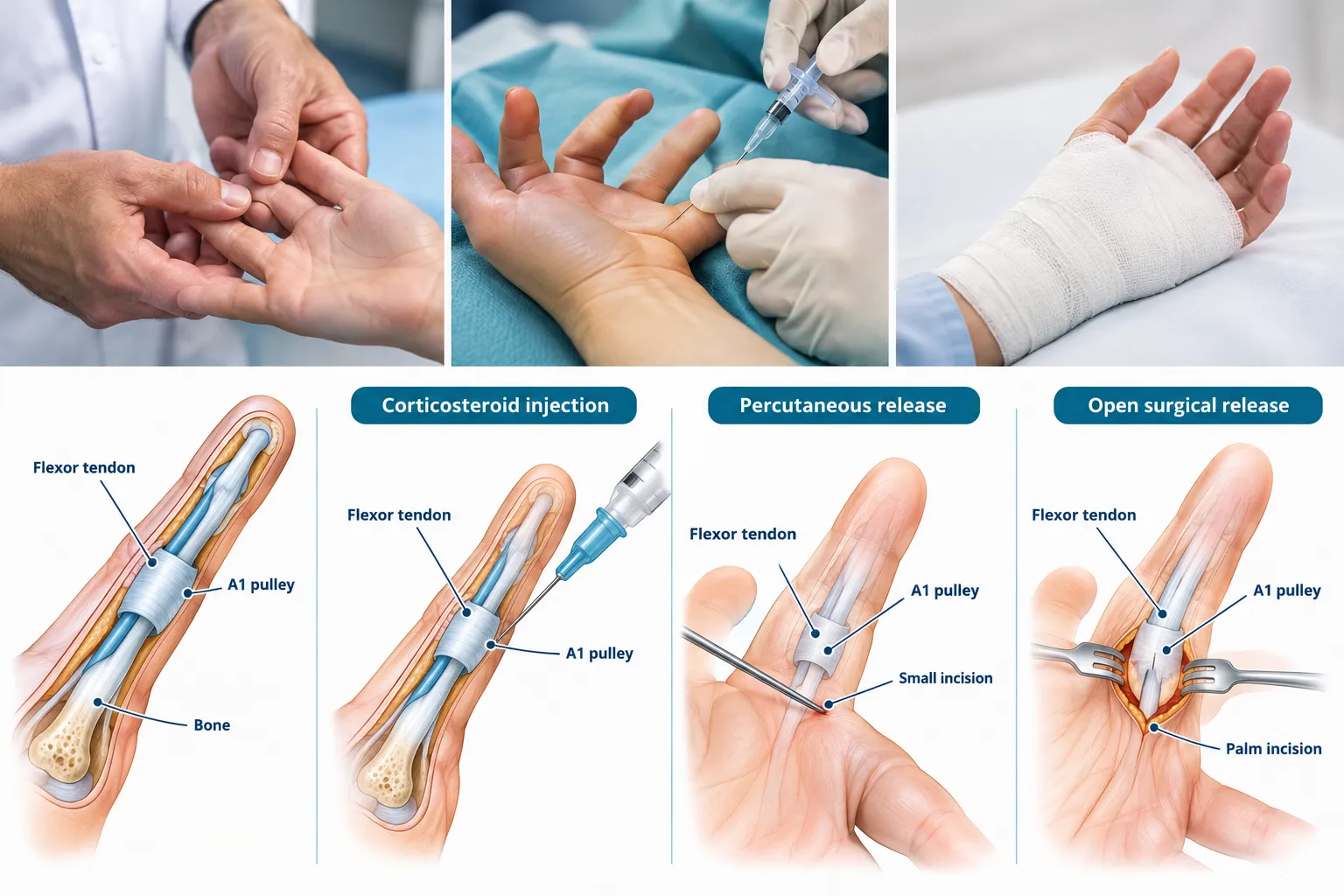
The main non-surgical alternatives are activity modification and splinting, hand therapy and stretching, and corticosteroid injection into the area around the A1 pulley. Each has a different success rate and time course, and physiotherapy-style exercises can help some mild cases without replacing surgery when triggering is already locking the finger.
OptionHow it worksTypical successRecoveryWhen usedSplintingKeeps the affected joint still to reduce irritation of the flexor tendonModest for mild, early casesWeeks of wearFirst-line for mild symptomsCorticosteroid injectionReduces inflammation around the A1 pulley and tendon sheathOften effective, especially on first injectionDays to weeksFirst or second-line treatmentPercutaneous releaseA needle is used to divide the tight A1 pulley through the skinHigh success reported in hand-surgery literatureFaster early recovery than open surgeryWhen injections fail or triggering recursOpen trigger finger releaseA small incision lets the surgeon directly divide the A1 pulleyHigh, durable success rate per ASSH-aligned literatureDays to a few weeksPersistent, locking, or recurrent cases
Decision rule: choose injection or splinting first if symptoms are mild and intermittent; choose surgical release if the finger locks, if two injections have already failed, or if grip function is affected daily. A full walkthrough of these choices is covered in the ultimate guide to trigger finger treatment, and details specific to injections are covered separately in the trigger finger steroid injection guide.
What is trigger finger surgery and how does WALANT release work?
Trigger finger surgery is a short procedure that divides the tight A1 pulley so the flexor tendon can glide smoothly again, and it is most commonly done today using WALANT (wide-awake local anesthesia, no tourniquet), which keeps the patient awake and comfortable throughout. The surgeon numbs the area with local anesthetic containing epinephrine, makes either a small skin puncture (percutaneous release) or a short incision in the palm (open release), and releases the pulley so the tendon no longer catches.
The patient stays awake and can actively bend and straighten the finger during the procedure, which helps the surgeon confirm the release worked before closing.
No general anesthetic and no fasting beforehand are required for WALANT cases.
Open release gives the surgeon direct visual confirmation of the pulley and tendon, while percutaneous release is quicker but used more selectively based on the finger involved and surgeon preference.
WALANT is used both in hospital operating rooms and in OHIP-billing community clinics performing minor hand surgery.
Hospital vs community clinic: which route is faster under OHIP?
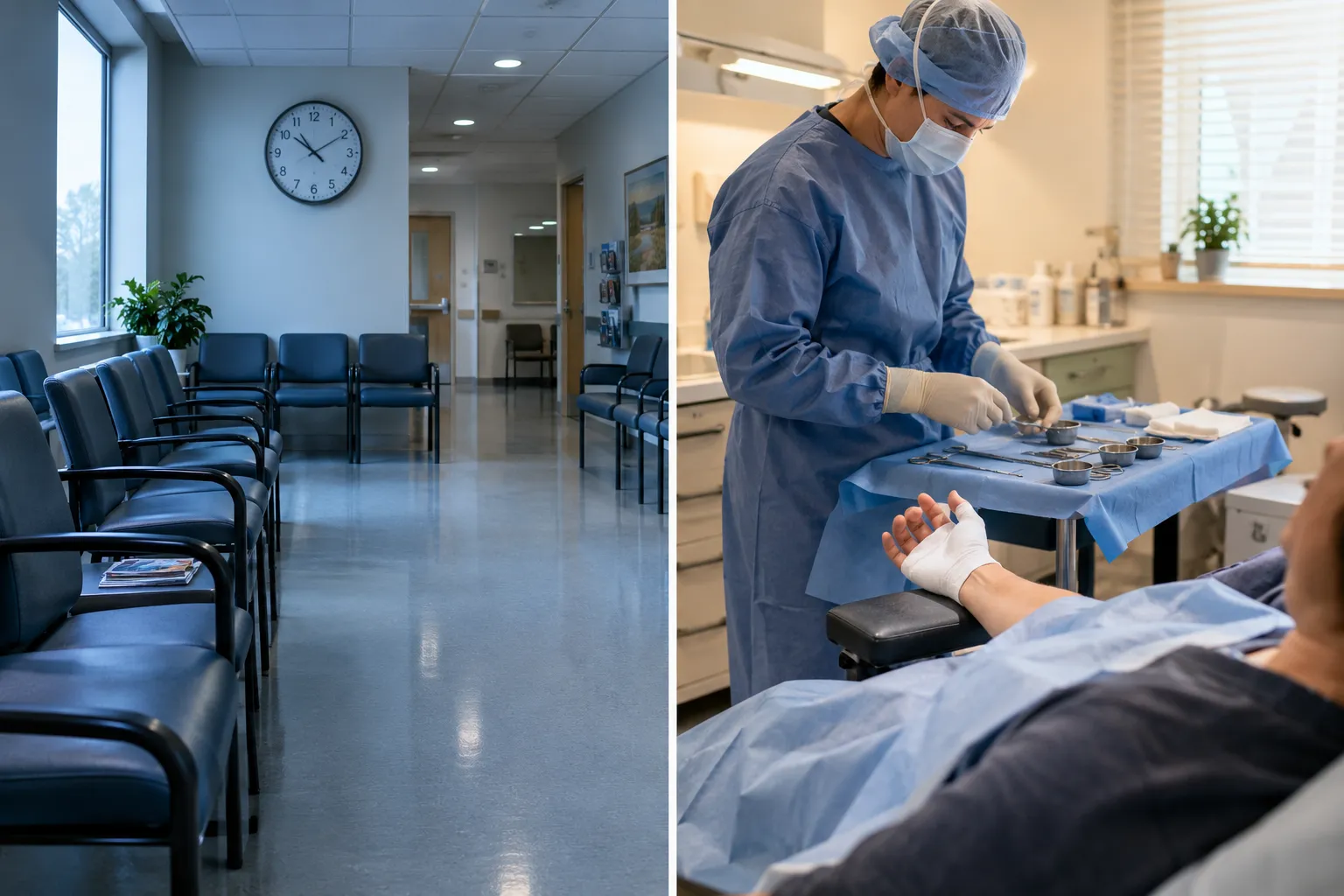
Both hospital operating rooms and OHIP-billing community clinics can perform trigger finger release under the same provincial coverage, but the time from referral to surgery date often differs because of how each site schedules elective procedures. A community clinic focused on minor procedures may have more available slots for a short, local-anesthetic case than a general hospital operating room juggling many surgical specialties.
FactorHospital OROHIP-billing community clinicAnesthesiaGeneral, regional, or WALANTUsually WALANT (local only)Typical waitCan run several months depending on siteOften shorter, varies by clinic capacityOHIP coverageYesYesTime on siteSeveral hours including pre-op and recovery bayOften under two hours totalFasting requiredOften yes, if sedation/general anesthetic usedUsually no, with local-only anesthesia
Example: a patient referred to a large downtown hospital for a routine, non-locked trigger finger may wait longer than one referred to a community clinic doing dedicated WALANT hand procedures, even though both bill OHIP for the same release. Readers weighing a similar hospital-versus-clinic decision for a related hand condition can compare notes in the guide to carpal tunnel surgery in Toronto.
What should I do while waiting for trigger finger surgery?
While waiting, the priority is protecting the hand from worsening lock-ups and keeping the referral moving, not simply letting the date arrive on its own. Patients can reasonably manage symptoms with the same conservative measures used before surgery is scheduled.
Keep using a splint at night if one was recommended, to reduce irritation.
Avoid repetitive gripping tasks that trigger locking episodes where possible.
Ask the surgeon's office for a realistic timeframe, and check the Ontario Health wait times tool for that specific hospital [2].
Call the referring clinic if the finger becomes fixed in a bent position or pain suddenly worsens, since this can sometimes move a case up the queue.
If a corticosteroid injection has not yet been tried and triggering is mild, ask whether it is appropriate while waiting.
What are the risks and complications of trigger finger surgery?
Trigger finger release is generally a low-risk procedure, but like any surgery it carries some chance of infection, stiffness, nerve irritation, incomplete release, or scar tenderness. Serious complications are uncommon when the procedure is done by an experienced hand surgeon.
Infection: uncommon, usually minor and treatable with antibiotics if it occurs.
Nerve irritation: the digital nerves run close to the A1 pulley, so temporary numbness or tingling can occur, particularly with percutaneous technique.
Incomplete release: a small percentage of cases may still trigger afterward and need a repeat procedure.
Stiffness or scar sensitivity: usually improves with time and hand therapy.
Edge case: people with diabetes or inflammatory arthritis may have a slightly higher complication rate and should discuss this with their surgeon.
How long does recovery take after trigger finger release?
Most people regain comfortable use of the hand within one to two weeks after trigger finger release, with full resolution of any residual stiffness taking up to several weeks longer. Recovery is typically quicker than after carpal tunnel surgery because the incision is smaller and the structures involved are more superficial.
Days 1-3: a bandage covers the incision; light use of the hand for non-gripping tasks is usually fine.
Week 1-2: stitches (if used) are removed or dissolve; light grip activities often resume.
Weeks 2-6: strength and full range of motion continue to improve, sometimes supported by hand therapy exercises.
Returning to heavy manual work or sport is usually guided by the surgeon based on job demands and healing progress.
Trigger finger can recur after surgery, but it is uncommon when the A1 pulley has been fully released, and recurrence is more likely to reflect a new case in the same or a different finger than a true failure of the original surgery. Patients with diabetes, rheumatoid arthritis, or multiple affected fingers at baseline have a somewhat higher chance of developing triggering again, sometimes in a different digit.
True recurrence in the same finger after a complete, confirmed release is uncommon.
A new trigger finger in another digit is different from recurrence and is managed the same way as the first episode.
Anyone noticing new locking or catching after a prior release should see their surgeon rather than assume it will resolve on its own.
FAQ
Is trigger finger surgery free in Ontario? Yes, for Ontario residents with valid OHIP coverage and a medically necessary diagnosis, the surgery, surgeon's fee, and facility fee are covered with no patient charge.
Do I need a referral to see a hand surgeon for trigger finger? Most pathways to a hand surgeon in Ontario start with a referral from a family doctor or nurse practitioner, who may also discuss a corticosteroid injection first.
Is percutaneous release as effective as open surgery? Both approaches have high reported success rates in hand-surgery literature; the surgeon's choice often depends on which finger is affected and the clinical picture, not a fixed rule that one is always better.
Will I be awake during trigger finger surgery? With WALANT technique, patients are awake and comfortable, with the area numbed by local anesthetic; this avoids the risks and recovery time associated with general anesthesia.
Can children get trigger finger surgery under OHIP? Pediatric trigger thumb and trigger finger are managed differently than in adults, and treatment decisions depend on age and severity, so a referral to a specialist familiar with pediatric hand conditions is the appropriate next step.
How do I check current wait times for my hospital? Use Ontario Health's public wait times reporting tool, which lists hospital-specific data for hand and plastic surgery procedures and is updated regularly [2][3].
Conclusion
Trigger finger release is an OHIP-covered procedure in Ontario, and the real question for most patients is not whether it is covered but how long the wait will be and which pathway gets them there sooner. Trigger finger surgery Ontario OHIP wait times vary by hospital and region, with a province-wide elective average near 175 days as of October 2026 [3], though OHIP-billing community clinics performing WALANT release can sometimes offer a shorter path to the same covered procedure. Next steps: ask a family doctor for a referral, check the Ontario Health wait times tool for specific hospitals in the area, ask about corticosteroid injection if it has not been tried, and compare hospital versus community clinic options before accepting the first available date without checking alternatives.
This article provides general information and is not medical advice. Discuss diagnosis and treatment options with a qualified physician or hand surgeon.
You can book your free consultation with The Minor Surgery Center in three easy ways: online through Cortico, by phone, or by requesting a callback from our team.
The initial consultation is free. During this consultation, one of our board certified surgeons will examine your condition and recommend a suitable solution.
Directly Online
Request a Callback
By Phone
By Text
Hours
Sunday
Closed
Monday
9 am — 4 pm
Tuesday
9 am — 4 pm
Wednesday
9 am — 4 pm
Thursday
9 am — 4 pm
Friday
9 am — 4 pm
Saturday
Toronto & Oakville Open Vaughan & Mississauga Closed