

Last updated: October 28, 2026
Most lipomas never cause a problem. They sit quietly under the skin for years, grow a little, and never need a surgeon's attention. But some do change, press on something important, or simply bother a person enough that removal makes sense. Understanding what happens if you don't remove a lipoma means understanding both the common, uneventful path and the less common path that calls for action.
A lipoma is a soft, slow-growing lump made of fat cells that sits just under the skin. If you leave one alone, nothing dangerous usually happens: most stay small, soft, and harmless for years. Removal becomes worth considering only if the lump grows, hurts, limits movement, or bothers you cosmetically. Any lump that is hard, fixed, fast-growing, or larger than about 5 cm should be checked by a doctor.
Yes, in most cases. A correctly diagnosed, superficial lipoma that is soft, moves freely under light finger pressure, and has not changed in months is considered safe to simply watch.
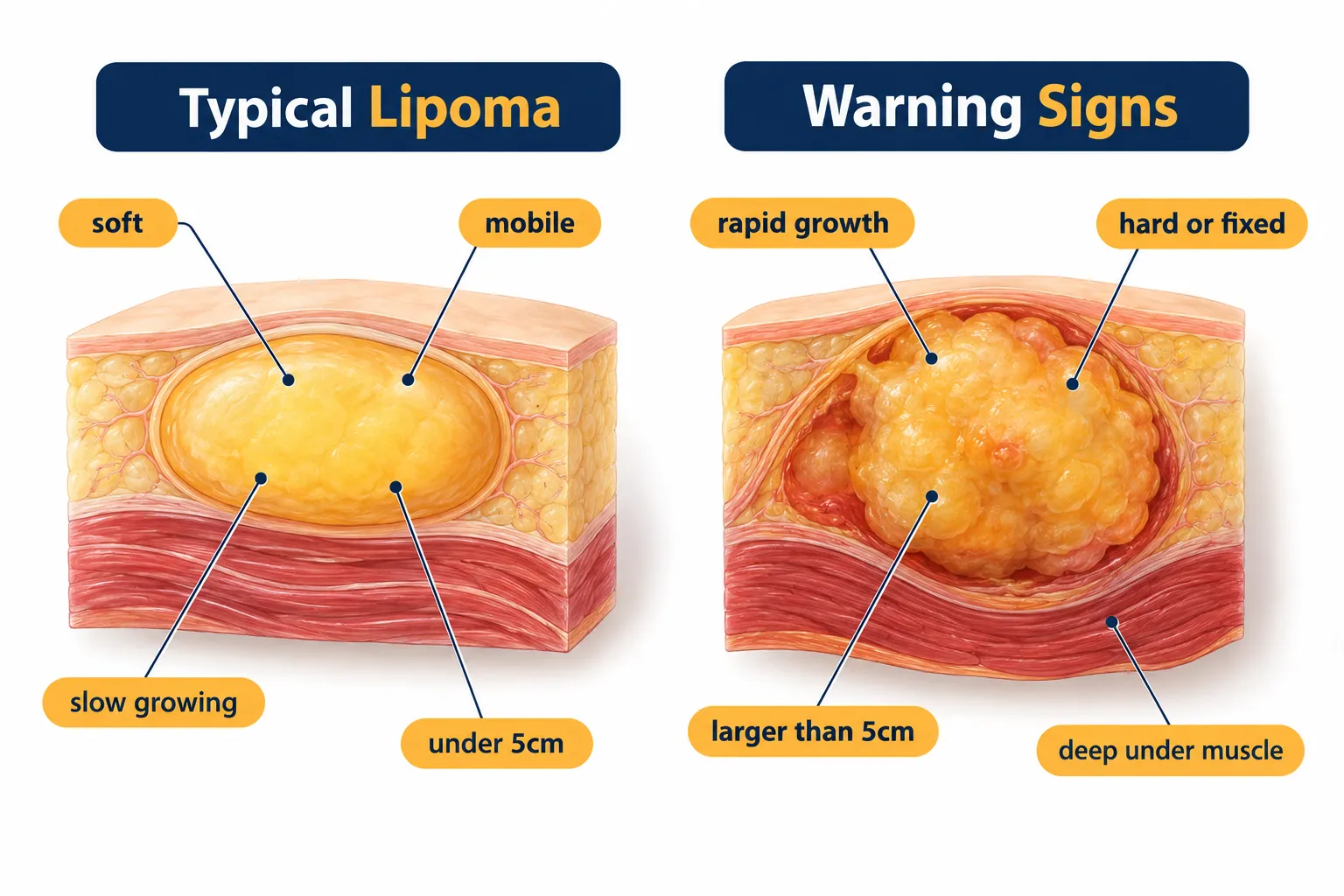
Clinical guidance supports this. The National Institutes of Health's StatPearls reference notes that observation is appropriate for an asymptomatic, clinically classic superficial lipoma when the patient understands the diagnosis and knows which changes should prompt reassessment [1]. Mayo Clinic's patient information, updated in October 2026, states plainly that treatment is generally unnecessary unless the lump becomes bothersome, painful, or starts growing [2]. NHS guidance reviewed on October 27, 2026 echoes this: lipomas are usually harmless and don't normally need removal, though any new lump deserves a look, especially one that is painful, red, hot, hard, immobile, or getting bigger [3].
Safety here depends on an accurate diagnosis. A lump that was never properly examined or imaged carries more uncertainty than one a doctor has confirmed as a typical lipoma.
Yes, lipomas commonly keep growing slowly over months or years, though the rate varies a lot between people and even between lipomas on the same person. They rarely shrink on their own [1].
A few points worth knowing about lipoma growth:
This growth pattern is also why some people develop more lipomas over time rather than one lump getting dramatically bigger, a condition sometimes called multiple lipomatosis. The tendency to form new lipomas relates to genetics and, in some cases, family history, rather than the original lipoma "spreading." If you're managing several lumps at once, see our guide on managing multiple lipomas.
Leaving a confirmed, benign lipoma in place does not normally cause it to turn into cancer [1][4]. The rare cancer sometimes confused with lipoma, called liposarcoma, is generally understood to be a separate tumor type rather than a lipoma that transformed.
Recent clinical guidance distinguishes an ordinary lipoma from an atypical lipomatous tumor, also called a well-differentiated liposarcoma. These more concerning masses are not typically viewed as lipomas that changed into cancer. Instead, the mass may have been misclassified at the first exam, or it may have been a different tumor from the start [1]. This distinction matters: it means the real risk of "not removing" a lipoma is diagnostic uncertainty, not malignant transformation of a known benign tumor.
A lump that is larger than roughly 5 cm, growing quickly, feels hard or fixed to surrounding tissue, or sits deep under muscle deserves prompt evaluation rather than ongoing observation [1][3].
Red flags, get it checked:
For a deeper side-by-side comparison, see our dedicated post on lipoma vs. liposarcoma symptoms.
Yes, though most lipomas are painless. Pain and other problems tend to show up when a lipoma presses on a nerve, sits near a joint, or grows large enough to interfere with daily movement [1][5].
A lipoma that sits close to a nerve can cause tenderness, aching, or even a tingling sensation in the surrounding area. A specific subtype called an angiolipoma, which contains blood vessels as well as fat, is more often tender or painful than a typical lipoma [1][5]. For more detail on this subtype, see is lipoma painful and the complete angiolipoma treatment guide.
A lipoma located near a joint, tendon, or along the back can create pressure-related discomfort, especially with movement or when clothing rubs against it [1][5]. This is one way a lump on the back can produce localized back discomfort: it's not that the lipoma itself damages the spine, but a large or awkwardly placed one can irritate surrounding tissue. Deep or anatomically confined lipomas, such as those near the neck, airway, or major nerves and vessels, warrant assessment based on location and symptoms rather than indefinite observation [1][2].
A lipoma on the face, scalp, neck, or arms can cause real cosmetic distress even when it's medically harmless. Cosmetic concern alone is a reasonable basis for elective removal, once scarring and procedure risks have been discussed [1][5].
No, lipomas do not typically shrink or disappear without treatment. They may stay the same size for long stretches, but spontaneous resolution is not something clinical sources describe as a normal outcome [1].
This is a common misconception. People sometimes assume a soft lump will fade the way a bruise or cyst occasionally does. Lipomas don't behave that way because they're made of mature fat cells enclosed in a thin fibrous capsule, not inflammation or fluid that the body can reabsorb. If a lump that was thought to be a lipoma shrinks or disappears, it's worth getting it re-examined, since that pattern is more typical of a cyst. See the comparison in sebaceous cyst vs. lipoma.
Removal is worth considering when a lipoma is growing, causing pain, interfering with movement or clothing, or bothering a person cosmetically. It is not generally necessary just because a lipoma exists [1][2][3].
The decision usually comes down to a few practical questions: Is it getting bigger? Does it hurt? Does it get in the way? Does it bother you to look at? If the answer to any of those is yes, removal tends to make sense. If the answer to all of them is no, observation is a reasonable, medically supported choice rather than neglect.
SituationLeave it and monitorConsider removalSee a doctor soonSmall, soft, stable for monthsYes,,Slowly growing, no pain, confirmed benignYesOptional,Painful or pressing on a nerve,Yes,On face, neck, or visible area, bothers you,Yes,Larger than ~5 cm or growing fast,,YesHard, fixed, or deep under muscle,,YesRecurs after a previous removal,,Yes
A smaller lipoma generally allows for a shorter incision and a less noticeable scar than a lipoma that has grown large over several years [1][5].
This is one of the few genuinely time-sensitive reasons to consider early removal even for a lump that isn't otherwise bothersome. As a lipoma enlarges, the surgical opening needed to remove it tends to grow too, and the capsule can become more adherent to surrounding tissue. Choosing removal while a lipoma is still small is a reasonable, low-risk decision if cosmetic outcome matters to you. Our breakdown of what to expect from lipoma removal results covers scarring and healing in more detail.
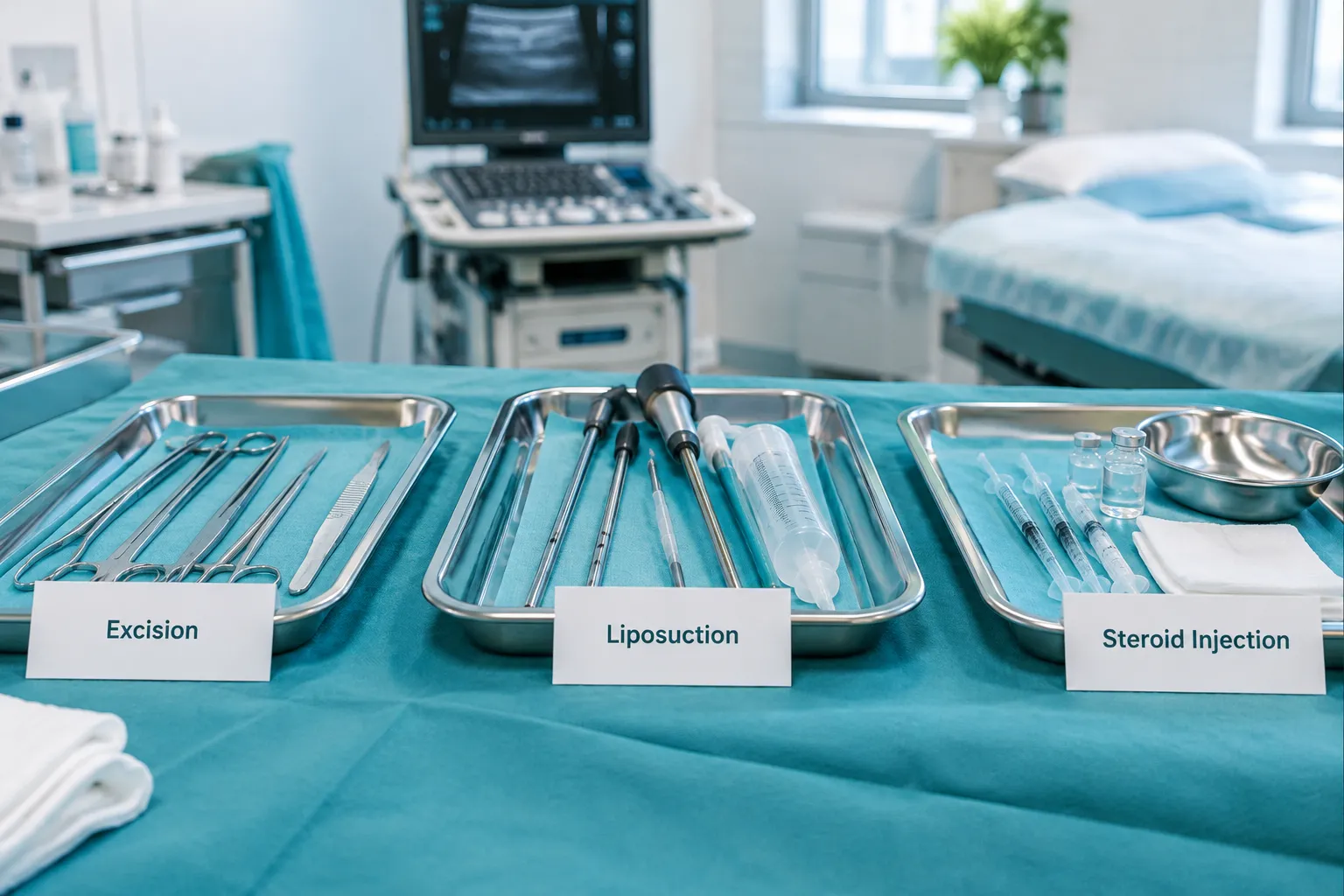
The three main approaches are surgical excision, liposuction-style extraction, and steroid injection, and they differ in effectiveness, scarring, and recurrence [1][6].
No major new drug, device, or treatment approval for routine non-surgical lipoma removal has emerged recently. Watchful waiting and complete excision remain the principal evidence-based approaches, and injection therapies are still considered nonstandard or off-label by most sources [1][6].
MethodHow it worksRecurrenceScarBest forExcisionSurgeon removes the entire lipoma with its capsuleLow when the capsule is fully removed [6]A single linear incision, length depends on lump sizeMost lipomas, especially larger or symptomatic onesLiposuction-style extractionA cannula breaks up and suctions fatty tissue through a small openingHigher, since the capsule often stays behind [6]Very small entry pointLarger, soft lipomas where scar size matters mostSteroid injectionInjected steroid shrinks fatty tissue over timeOften incomplete resolution; nonstandard approach [6]NoneSmall lipomas where surgery is undesirable
For people exploring non-surgical options first, see can a lipoma be removed without surgery with creams and will my mole, cyst, or lipoma grow back.
Lipoma removal in Ontario is typically not covered by OHIP unless the lump is causing a documented medical problem, and self-pay prices vary by clinic and lump size.
At The Minor Surgery Center, lipoma removal starts at $695, with an additional $250 for each extra lipoma removed in the same visit. The center operates five GTA clinics, in Toronto/North York, York Mills, Vaughan, Mississauga, and Oakville, and procedures are performed by board-certified plastic and reconstructive surgeons, including co-founders Dr. Kunaal Jindal and Dr. Roberto Tutino. No referral is required, a free consultation is available, and removal is done under local anesthetic on the same day as the visit. To ask questions or book a consultation, call (647) 614-1611.
Detailed cost context is also available in lipoma removal cost in Ontario and recovery expectations in how long does it take to recover from lipoma removal surgery.
See a doctor promptly for any new lump you haven't had checked, and especially one that is growing quickly, feels hard or fixed, is painful, or sits deep under muscle [1][3].
A doctor can usually diagnose a lipoma through a physical exam alone. Imaging, such as ultrasound, is sometimes used for deeper or larger lumps to confirm the diagnosis before deciding on monitoring versus removal [1]. If a lump looks or behaves differently than a typical lipoma, that uncertainty, not the lipoma itself, is the real reason to seek medical evaluation rather than simply waiting.
Can a lipoma go away on its own?
No. Lipomas typically do not shrink or disappear without treatment; they tend to stay the same size or grow slowly over time [1].
Can a lipoma turn into cancer?
A confirmed benign lipoma does not generally turn into cancer. Liposarcoma is considered a separate tumor type, and concerning cases are usually explained by an initial misdiagnosis rather than transformation [1][4].
Do lipomas get bigger over time?
Many do grow slowly over months or years, though some stay stable. Sudden, fast growth is different and should be checked [1][3].
Is lipoma removal worth it?
It's worth it when the lipoma is growing, painful, limiting movement, or bothering you cosmetically. For a small, stable, asymptomatic lipoma, many people choose to simply monitor it [1][2].
Does OHIP cover lipoma removal?
Generally no, unless removal is medically necessary and documented as such. Most elective lipoma removals in Ontario are paid out of pocket.
Will a lipoma come back after removal?
Recurrence is uncommon after complete surgical excision that removes the full capsule, but it's more likely after liposuction-style removal, which can leave capsule tissue behind [6].
Most lipomas are harmless, and leaving one alone is a reasonable, medically supported choice as long as it stays soft, mobile, and unchanged. What happens if you don't remove a lipoma usually comes down to slow growth and nothing more serious. Removal becomes worth discussing when a lump grows quickly, causes pain, presses on a nerve or joint, or sits somewhere that affects comfort or confidence. A lump that's hard, fixed, deep, larger than about 5 cm, or growing fast should be checked by a doctor rather than watched. If you're trying to decide what's right for your own lump, a short consultation can usually settle the question faster than ongoing uncertainty.