
Last updated: August 19, 2026
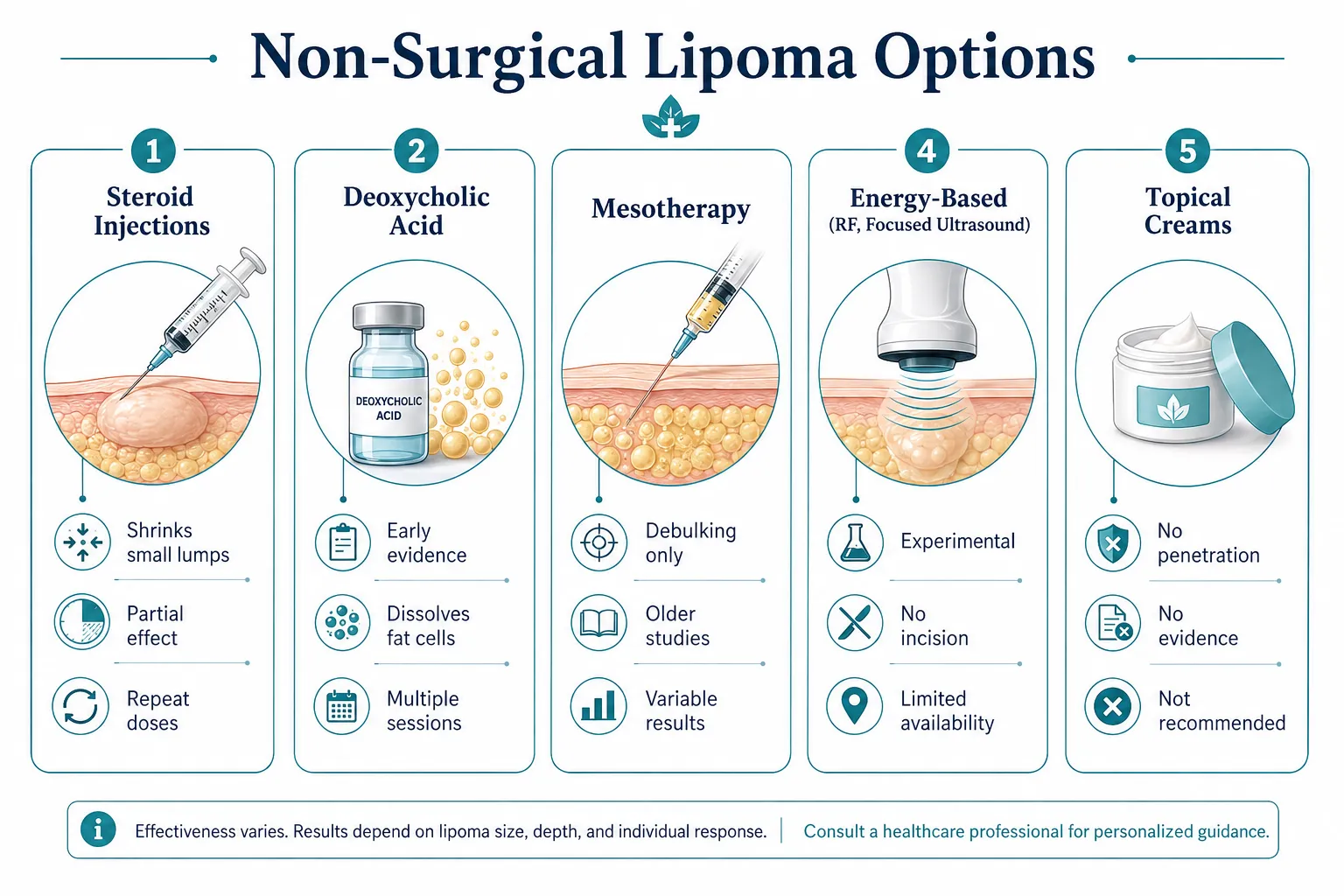
Surgical excision is still the only method that reliably removes a lipoma completely and keeps it from coming back in the same spot. So, can a lipoma be removed without surgery? Partially, in some cases, steroid injections, deoxycholic acid (Kybella-style) injections, liposuction, and a handful of experimental energy-based treatments can shrink or debulk a lipoma, but none of them match the completeness of removing the fatty lump and its capsule through minor surgery. Creams do not work on lipomas at all.
A lipoma is a benign, slow-growing lump made of fat cells that sits just under the skin, usually on the neck, shoulders, back, arms, or thighs. It forms a soft, movable capsule of tissue, which is the main reason topical products and diets cannot reach or shrink it.
Doctors do not fully understand why lipomas form. What is known:
A lipoma feels soft, doughy, and slides slightly under the fingers when pressed. It is different from a cyst, which often has a central punctum, and very different from a liposarcoma, a rare cancerous tumor that can look similar on the surface. For a deeper breakdown of how these lumps form and behave, see this lipoma disease explained guide, and for a visual reference, this complete visual guide to lipoma pictures shows what typical presentations look like.
Decision rule: If a lump is growing quickly, feels hard or fixed to underlying tissue, or is larger than 5 centimeters, it needs a medical evaluation before anyone assumes it is a simple lipoma.
Yes and no. Non-surgical methods can shrink some lipomas, but they rarely eliminate the lump completely the way excision does, and the evidence behind most of them is still limited.
Here is the honest breakdown:
ApproachRemoves lipoma completely?Evidence qualityTypical resultSurgical excisionYes, in most casesStrong, long-establishedLump and capsule removed in one visitLiposuctionPartialModerateSize reduction, capsule may remainSteroid injectionsRarelyLimitedShrinkage in small, soft lipomasDeoxycholic acid injectionsRarely, still emergingSmall case series [1]Gradual size reduction over sessionsMesotherapy/lipolytic injectionsRarelyOlder, small studiesDebulking, not full removalEnergy-based (RF, focused ultrasound)Unclear, experimentalEarly trials [2][4]InvestigationalTopical creamsNoNoneNo measurable effect
Patients searching for how to remove a lipoma without surgery are usually hoping to avoid a scar or downtime. That is a reasonable goal, and some smaller or superficial lipomas are good candidates for less invasive approaches. But anyone expecting a cream or a single injection to make a lipoma vanish permanently is working from a myth, not medical evidence.
Common mistake: Assuming that because liposuction is "less invasive," it is automatically a better choice. Liposuction is less invasive to the skin, but it is not more effective, and it can leave enough capsule tissue behind that the lipoma partially regrows.
Lipomas almost never go away completely on their own. They tend to stay the same size for years, grow very slowly, or occasionally grow faster after weight gain, but spontaneous, complete resolution is rare.
Observation is a legitimate medical strategy for many lipomas, especially small ones that are not painful, not growing quickly, and not bothering the patient cosmetically. A doctor may recommend simply monitoring a lipoma over months or years rather than treating it right away [10].
That said, "going away" and "being left alone" are two different things:
Edge case: Multiple lipomas appearing at once, especially in someone under 40, sometimes signal a hereditary condition. That pattern is worth flagging to a physician even if none of the individual lumps are causing problems.
No. Lipoma removal creams do not work, and mainstream medical sources do not recommend them because a lipoma sits beneath several skin layers inside a fibrous capsule that topical ingredients cannot penetrate.
The skin's outer barrier is designed to keep substances out, not let them in deeply enough to dissolve fat cells sitting under the dermis. Even ingredients marketed as "fat dissolving" in cosmetic creams have no documented ability to cross that barrier and reach a lipoma's capsule.
Why these products keep getting sold despite lacking evidence:
This mirrors a pattern seen in other skin-lesion myths. The same evidence gap shows up with topical mole treatments, see this breakdown of whether mole removal creams actually work for a similar myth-busting comparison.
Quick example: A patient applies a "lipoma dissolving" cream daily for eight weeks and sees no change in size, firmness, or mobility of the lump, a pattern reported consistently anytime these products are tested against a real benign fatty tumor, because there is no clinical mechanism for them to work through intact skin.
Several non-surgical techniques exist, ranging from established injections to experimental energy-based devices, but all trade some completeness of removal for reduced invasiveness. None currently rivals excision for permanence.
Steroid injections can shrink small, soft lipomas by causing local fat atrophy, but they rarely eliminate the lump entirely. This approach works best on lipomas under 2-3 centimeters and often requires multiple sessions spaced weeks apart. Results vary widely, and firmer or larger lipomas typically respond poorly.
Deoxycholic acid, the same compound used to dissolve submental fat under the chin, is being studied as an off-label option for small lipomas. A notable case series presented on this approach reported measurable size reduction in treated lipomas after a series of injections, though the total number of patients studied remains small and long-term recurrence data is still limited [1]. This is considered an emerging option, not a standard first-line treatment.
Mesotherapy involves injecting a mixture of compounds intended to break down fat cells locally. It can debulk a lipoma somewhat, but the supporting research is mostly older and involves small patient groups [8]. Results are inconsistent, and there is no guarantee the lump will not regrow or simply reduce partially and plateau.
Newer injectable compounds such as CBL-514 are currently being tested in clinical trials for lipoma and localized fat reduction, with some studies actively recruiting participants as of recent trial registries [3][7]. Cooled saline injection techniques are also under investigation as a lower-cost alternative. Neither is available as routine clinical care yet, both remain investigational.
Radiofrequency ablation and related energy-based methods are being studied as ways to heat and break down lipoma tissue without a traditional incision [2][4]. Early research is ongoing, but these techniques are not widely available outside of specialized research settings or select cosmetic clinics.
Focused ultrasound can theoretically disrupt fat tissue without any incision at all, and laser-assisted lipolysis uses heat energy through a small probe to liquify fat before it is drawn out. Both approaches tend to produce partial reduction rather than guaranteed full removal, and focused ultrasound in particular remains largely experimental and not widely available [6][9].
Decision rule: Choose a non-surgical injection or energy-based option only if the lipoma is small, soft, cosmetically bothersome but not medically concerning, and the patient understands the lump may only shrink rather than disappear. Choose excision if complete removal, a tissue diagnosis, or permanence matters.
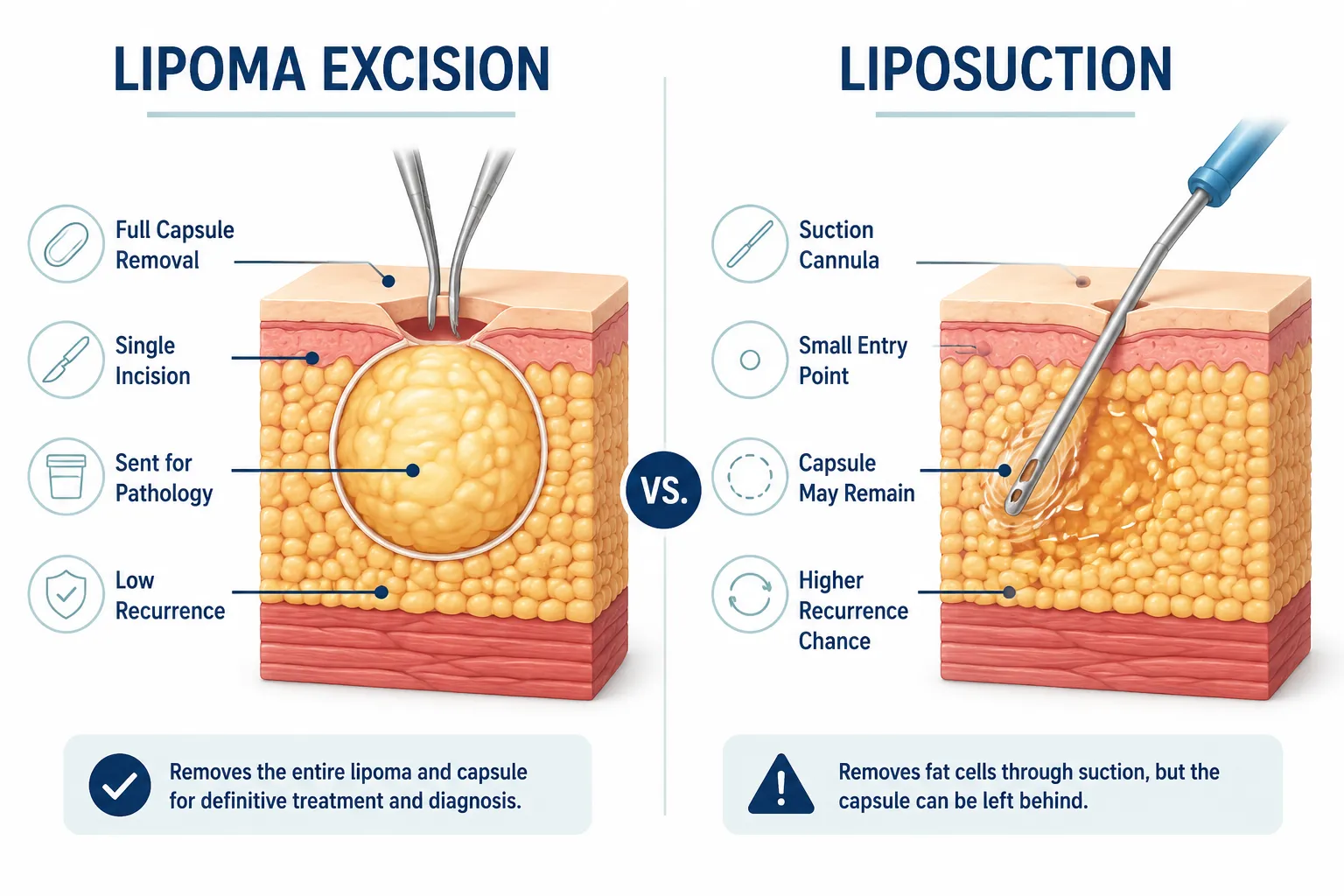
Liposuction can effectively reduce the size of a lipoma through a small entry point, but it often leaves some capsule tissue behind, which means the lump can partially regrow over time. It is a reasonable middle-ground option for larger, soft lipomas in cosmetically sensitive areas where a long incision is undesirable.
How liposuction for lipoma removal typically works:
The tradeoff: because the fibrous capsule surrounding a lipoma is tougher than surrounding fat, standard liposuction cannulas do not always remove it fully. Any capsule tissue left behind can act as a scaffold for the lipoma to regrow.
Best candidate profile: Liposuction suits larger, soft lipomas in areas where minimal scarring matters most, such as the face or forearm, in patients who accept a somewhat higher chance of partial regrowth in exchange for a smaller scar.
Excision removes the entire lipoma and its capsule through a single incision, giving the lowest recurrence rate and a tissue sample for pathology. Liposuction removes fat through suction via a smaller entry point, offering less scarring but a higher chance the lump returns because capsule tissue can be left behind.
Key differences at a glance:
For anyone uncertain about a growing or unusual lump, the ability to send tissue for pathology after excision matters. This distinction is discussed further in this comparison of lipoma versus liposarcoma symptoms, which explains why a definitive diagnosis sometimes outweighs cosmetic considerations.
Choose excision if: the lump is growing, the diagnosis needs confirming, or permanent removal matters most.
Choose liposuction if: the lipoma is large but soft, located somewhere scarring is a major concern, and the patient accepts some recurrence risk.
No. Diet and exercise do not shrink an existing lipoma because it is encapsulated fat tissue, biologically separate from the fat stores the body burns for energy during weight loss.
This is one of the most persistent myths about lipomas. What actually happens with weight change:
Some sources online suggest specific "anti-lipoma" diets. There is no strong clinical evidence that any food, supplement, or diet plan shrinks an existing lipoma. For readers curious about general dietary patterns sometimes discussed alongside lipoma management, this lipoma diet chart covers the topic without overstating what diet can realistically achieve.
Common mistake: Delaying a medical evaluation for months while trying diet changes, hoping a lump will shrink. If a lipoma is growing or causing discomfort, diet changes alone will not resolve it and can waste valuable time.
Lipoma removal surgery cost depends on the lipoma's size, location, complexity, and whether the procedure is done for medical reasons versus purely cosmetic reasons, with prices varying significantly between regions and clinics.
Factors that influence the final price:
Because pricing varies by clinic and country, readers researching this closely should check a detailed, currency-specific breakdown. For a full price guide, see this lipoma removal cost in Toronto 2026 price guide, and for coverage rules specifically, this guide on whether lipoma removal is covered by OHIP or insurance breaks down when a procedure qualifies as medically necessary versus elective.
Decision rule: If a lipoma causes pain, restricts movement, or is rapidly growing, ask a clinic whether it qualifies as medically necessary before assuming the full cost falls on the patient.
Every lipoma removal method carries some risk, though excision performed by an experienced provider is generally low-risk. Risks scale with the method chosen and the lipoma's size and location.
Common risks by method:
A key uncertainty across nearly all non-surgical techniques is the lack of long-term outcome data. Short case series and early trials can show promising initial shrinkage, but researchers have not yet tracked most of these methods over many years to confirm lasting results or rule out delayed complications.
Anyone noticing a lump that is hard, fixed in place, growing rapidly, or larger than 5 centimeters should get it evaluated before assuming it is a routine lipoma. This distinction matters because rare cases can be something more serious. This guide on when to seek medical advice for lumps under the skin covers the warning signs worth acting on.
Get a lipoma removed if it is painful, growing quickly, restricting movement, located somewhere it catches on clothing or is cosmetically distressing, or if there is any diagnostic uncertainty. Leave it alone if it is small, stable, painless, and the diagnosis is confirmed.
A simple checklist to weigh the decision:
Nothing dangerous typically happens if a stable, benign lipoma is left untreated, most stay the same size for years and cause no health problems. The lump may slowly grow, occasionally become uncomfortable if it presses on a nerve or sits in a tight space (like under a bra strap or waistband), or remain purely cosmetic indefinitely.
The main downside of leaving a lipoma untreated is not medical danger in most cases, it is the small chance the lump keeps growing to a size where later removal requires a larger incision and longer recovery than if it were treated earlier.
Quick example: A 2-centimeter lipoma on the back that stays unnoticed for five years may still be 2 centimeters at the end of that period, requiring the same small procedure it would have needed on day one. But a lipoma left alone for years while actively growing could reach a size where excision becomes a bigger procedure with a longer scar.
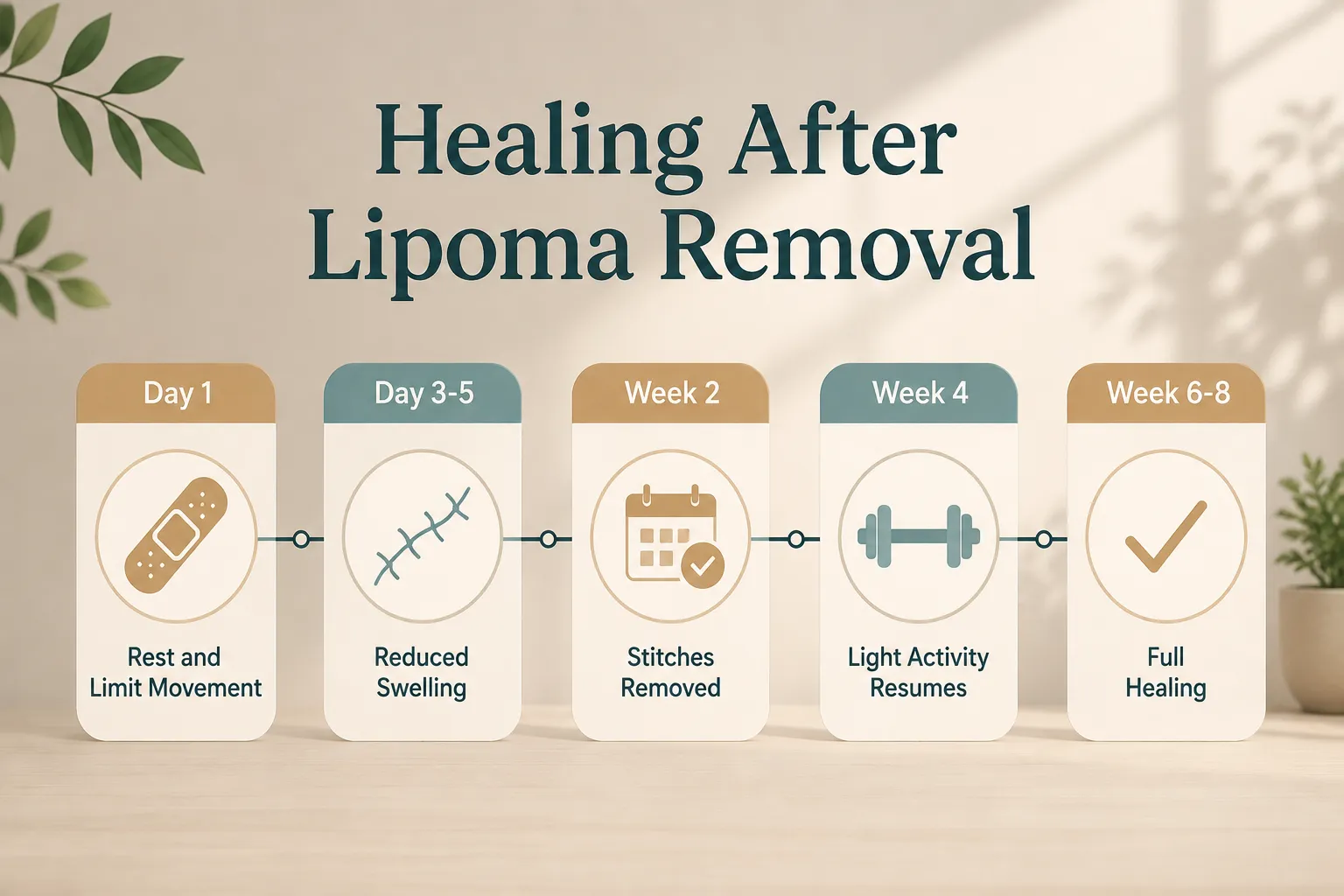
Most people recover from lipoma excision within one to two weeks for daily activities, with full healing of the incision site taking around four to six weeks. Recovery time depends on the lipoma's size, location, and the removal method used.
A general recovery timeline:
Liposuction-based removal tends to have less visible scarring but can involve a similar bruising and swelling timeline. Non-surgical injections generally involve less downtime per session but may require multiple visits spread across weeks or months, which extends the overall treatment timeline even though each session itself is quick.
For specifics on returning to physical activity safely, see this guide on when you can exercise after lipoma surgery, and for what proper aftercare looks like weeks and months later, this resource on long-term care after lipoma surgery covers scar management and monitoring for changes.
Common mistake: Resuming heavy lifting or intense exercise too early, which can increase swelling, delay healing, or in rare cases affect how the scar settles.
Lipomas can come back after removal, though the likelihood depends heavily on the method used. Complete surgical excision that removes the entire capsule has the lowest recurrence rate, while liposuction and non-surgical injections carry a higher chance of partial regrowth because they can leave capsule tissue behind.
Factors that influence recurrence:
It is worth distinguishing between a lipoma regrowing at the same site (true recurrence, more common with incomplete removal methods) and a new lipoma developing at a different site (common in patients prone to multiple lipomas, unrelated to how well the first one was removed). For a broader explanation of regrowth patterns across different skin lesions, see will my mole, cyst, or lipoma grow back.
Decision rule: If minimizing recurrence risk is the top priority, complete surgical excision with capsule removal is the most reliable choice among current options.
Can a lipoma be removed without surgery permanently?
Not reliably. Injections and liposuction can shrink or reduce a lipoma, but surgical excision that removes the entire capsule remains the most permanent solution available today.
Do lipoma removal creams have any scientific support?
No. There is no clinical evidence that topical creams can penetrate the skin deeply enough to affect a lipoma's fatty capsule, and mainstream medical sources do not recommend them.
Is deoxycholic acid (Kybella) approved specifically for lipomas?
Kybella is approved for submental fat reduction; its use for lipomas is considered off-label and based on early case series rather than large-scale approval studies [1].
What is the least invasive effective option for a small lipoma?
For small, soft lipomas, steroid injections or liposuction offer less invasive alternatives to excision, though both carry a higher chance of incomplete resolution compared with surgical removal.
How do I know if a lump is a lipoma and not something more serious?
A soft, mobile, slow-growing lump under the skin is typically consistent with a lipoma, but a firm, fixed, rapidly growing, or painful lump should be evaluated by a medical provider to rule out other causes.
Does insurance or public health coverage pay for lipoma removal?
Coverage often depends on whether removal is deemed medically necessary (pain, function limitation, rapid growth) versus cosmetic. Check specific coverage rules with a provider before scheduling.
Can exercise make a lipoma smaller?
No. Exercise reduces general body fat but does not shrink the encapsulated fat inside an existing lipoma.
Are newer treatments like CBL-514 available to the public yet?
No. Agents like CBL-514 and cooled saline injections remain in clinical trial phases and are not yet part of standard dermatology or surgical practice [3][7].
The honest answer to "can a lipoma be removed without surgery" is that some shrinkage is possible through injections, liposuction, or experimental energy-based techniques, but complete, lasting removal still belongs to surgical excision. Creams do not work at all, and most non-surgical injectable options are still building their evidence base rather than replacing minor surgery as a standard.
For anyone weighing options, the most useful next step is a proper in-person or clinical assessment rather than trial-and-error with unproven products. A qualified provider can confirm the lump is truly a lipoma, discuss whether observation, injection-based shrinkage, liposuction, or excision fits the specific size and location, and flag anything that looks atypical before it becomes a bigger concern. To see what a professional lipoma evaluation and removal process typically involves, review this overview of lipoma conditions and treatment or check the minor skin surgery FAQ section for answers to common pre-procedure questions.
[1] Dr Cameron Rokhsar Presents First Large Case Series On Nonsurgical Treatment Of Lipomas Using Kybella Deoxycholic Acid Injections - https://www.barchart.com/story/news/36655515/dr-cameron-rokhsar-presents-first-large-case-series-on-nonsurgical-treatment-of-lipomas-using-kybella-deoxycholic-acid-injections
[2] pubmed.ncbi.nlm.nih.gov - https://pubmed.ncbi.nlm.nih.gov/40988800/
[3] Phase Lipoma 5 2025 3b433 - https://www.withpower.com/trial/phase-lipoma-5-2025-3b433
[4] pubmed.ncbi.nlm.nih.gov - https://pubmed.ncbi.nlm.nih.gov/40526965/
[5] Pmc7909353 - https://pmc.ncbi.nlm.nih.gov/articles/PMC7909353/
[6] The Future Of Lipoma Care New Treatments And Modern Lipoma Removal Options In 2025 - https://lipomaremovals.com/blogs/news/the-future-of-lipoma-care-new-treatments-and-modern-lipoma-removal-options-in-2025
[7] Phase 2 Lipoma 1 2025 744da - https://www.withpower.com/trial/phase-2-lipoma-1-2025-744da
[8] Pmc4086534 - https://pmc.ncbi.nlm.nih.gov/articles/PMC4086534/
[9] Lipoma Removal Alternatives Non Surgical Options Explored - https://londonskinclinic.london/lipoma-removal-alternatives-non-surgical-options-explored/
[10] Lipoma Removal - https://www.floridamedicalclinic.com/blog/lipoma-removal/