
Last updated: August 18, 2026
When a lipoma is removed completely, including its capsule, it rarely comes back at that site. The scar is often shorter than the lump was wide, because a lipoma is a discrete fatty mass that can sometimes be delivered through a small opening. The early issues that surprise patients are not the scar. They are swelling, bruising and sometimes a pocket of fluid where the lump used to be. Final lipoma removal results, including how the contour looks, take months rather than weeks to settle.
Three separate results come out of one procedure, and they are worth judging separately.
)
1. Complete removal. Did the whole lipoma, including its thin surrounding capsule, come out? This is the result that decides whether the lump returns. It is a surgical result, not a cosmetic one, and you generally cannot see it in a photograph.
2. Cosmetic result. This is two things, not one: the scar line and the contour of the area. A scar can heal to a fine pale line while the area still looks slightly flat or dipped, because fat that used to fill that space is gone. Patients who only inspect the scar often miss this.
3. Pathology result. Removed tissue is normally sent to a laboratory to confirm it was a benign lipoma. This is routine confirmation, not a sign that anyone suspected something serious.
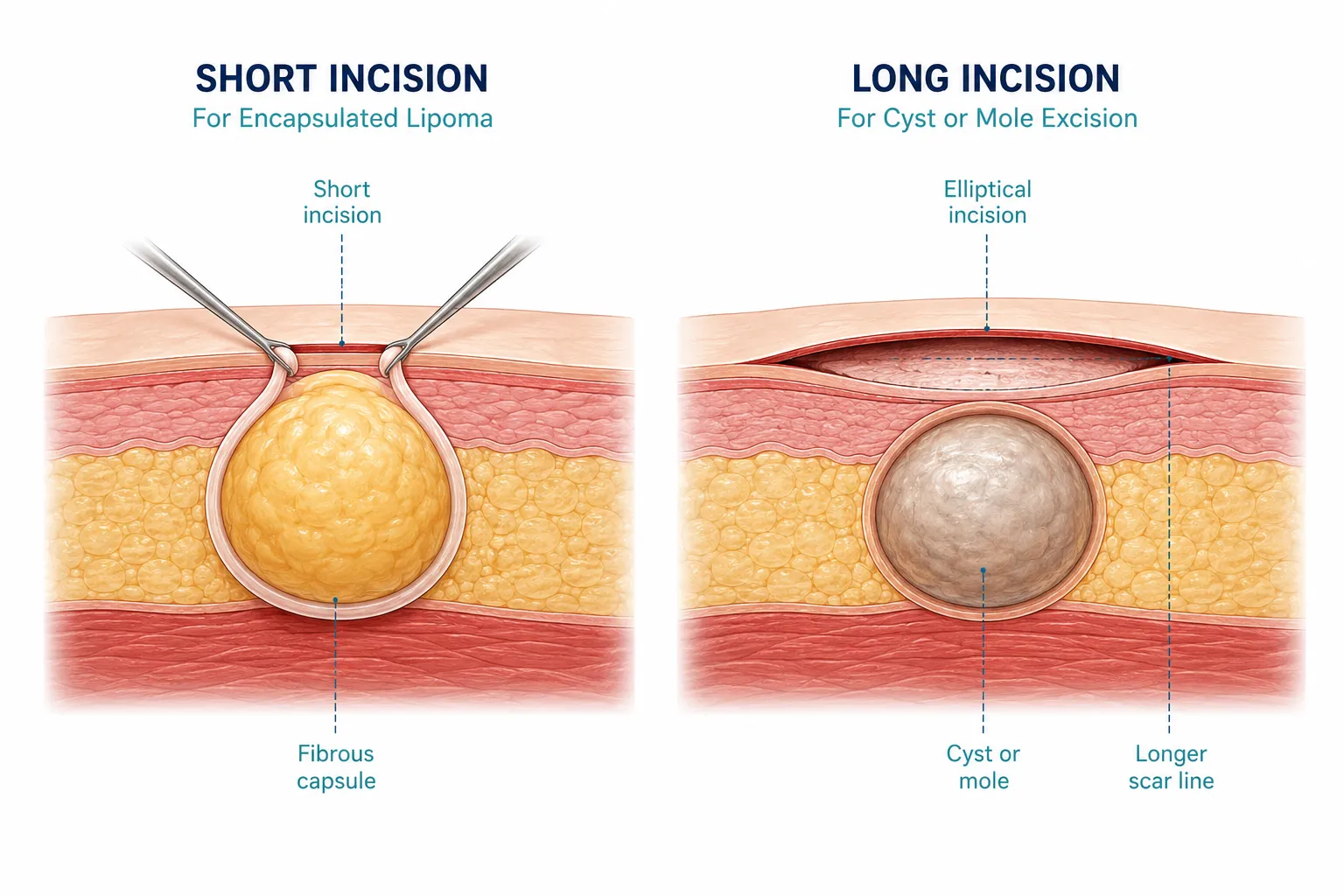
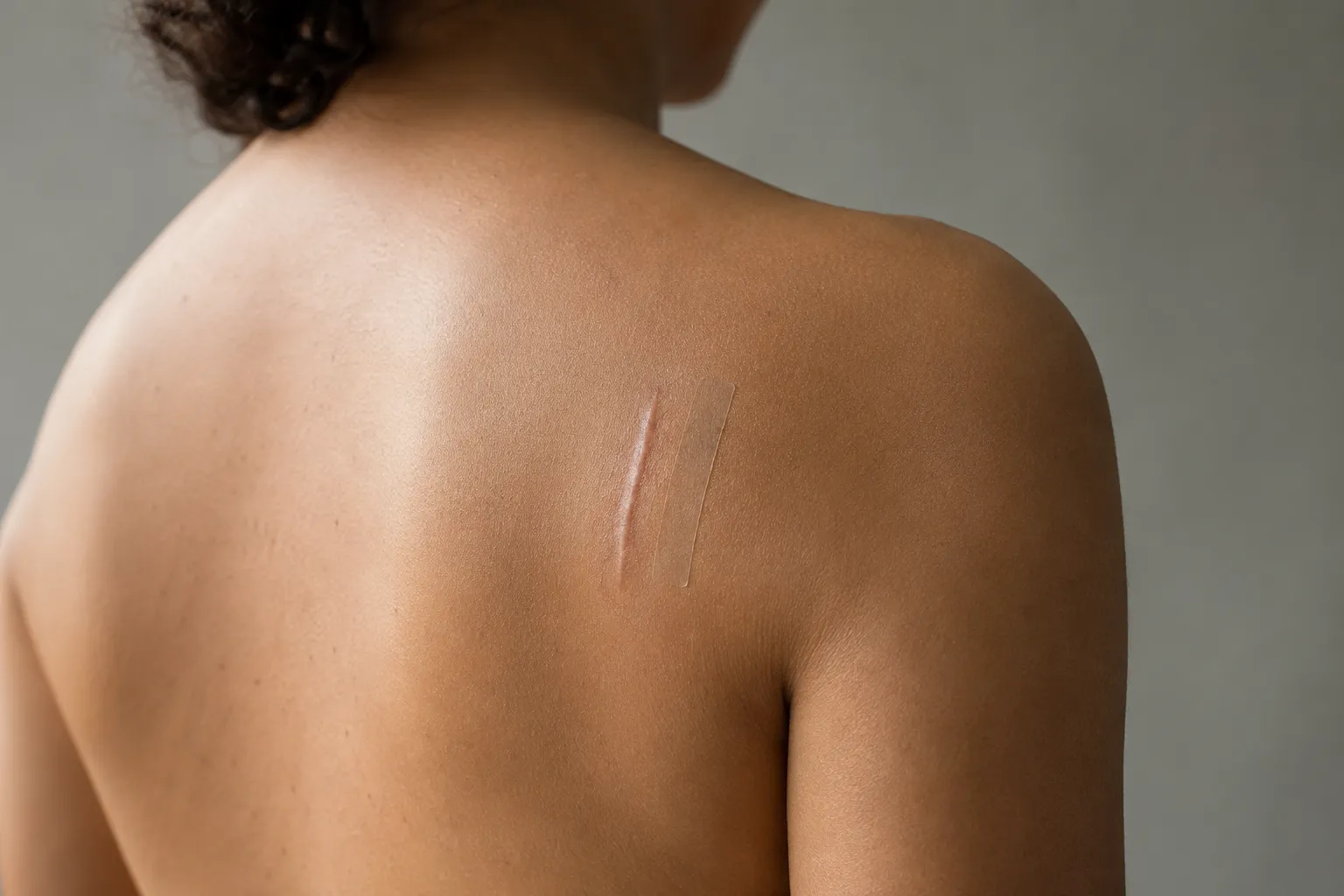
Usually a single straight line, placed along a natural skin crease or tension line where possible, and often shorter than the diameter of the lump. That last part surprises people.
A lipoma is an encapsulated fatty mass with a defined edge. Because it holds together, it can sometimes be freed from surrounding tissue and delivered through an incision smaller than its width, using segmental extraction or minimal-incision techniques. That is the opposite of mole removal or sebaceous cyst removal, where the skin lesion itself has to be cut out inside an ellipse. An ellipse forces a scar longer than the lesion.
The honest trade-off: a smaller incision means working through a narrower window, with more blunt dissection under the skin. That is not right for every lipoma.
A longer incision may be the better choice when the lipoma is:
Choose the technique that lets the surgeon see what they are doing. A slightly longer scar that heals cleanly beats a short scar over a haematoma.
Sometimes, yes. A shallow depression can remain where a sizeable mass of fat was taken out, and it is more noticeable over the shoulder, upper back, forehead and shin, where there is little soft tissue to redistribute. Most dents soften over three to twelve months as swelling settles and scar tissue fills part of the space. Closing the wound in layers rather than skin-only reduces how obvious the hollow becomes.
If the capsule came out intact, results are usually permanent. Recurrence at the same site after complete excision of a solitary subcutaneous lipoma is low, in the low single digits, and one published minimal-scar series reported recurrence of 0.8% across 122 procedures [1].
Two situations behave differently:
A new lipoma is not a recurrence. People who form multiple lipomas often develop new ones on the arms, back or thighs years later. That is the body doing the same thing again in a new place, not the removed lump returning.
Most of the time, what you are feeling is not lipoma. In the first weeks after excision, the cavity fills with swelling, blood-tinged fluid and firm healing tissue, which feels like a lump under the scar. It is usually firmer and less mobile than the original soft lipoma was. True residual lipoma is possible, particularly with lobulated or deep masses; if a soft, mobile lump is still clearly present after swelling has settled, it should be re-examined. You can read more about how lipomas are removed and assessed on the lipoma treatment page.
Taking out a fatty mass leaves a cavity. Surgeons call that dead space, and it is the reason lipoma excision has a fluid-related complication profile that mole and skin tag removal do not.
Haematoma is the most commonly reported complication after lipoma excision, with seroma next. Both are more likely after larger excisions, because more dissection creates more raw surface area and more empty space. Giant lipomas carry a higher seroma risk for exactly that reason.
Management is usually conservative: observation, a compression dressing, activity restriction and time. Small seromas typically reabsorb over one to three weeks. Larger or uncomfortable collections are sometimes drained with a needle, occasionally more than once. Surgeons reduce the risk during the procedure by closing in layers, obliterating dead space with sutures and applying a pressure dressing.
Contact the clinic if swelling grows quickly, the area becomes tense and increasingly painful, you see spreading redness or heat, fluid leaks through the incision, or you develop a fever. Do not wait for a scheduled visit. TMSC can be reached through the contact page or at (647) 614-1611. There is more detail on this in the guide to fluid collections after lipoma removal.
[EMBED: HEALING TIMELINE ELEMENT]
The wound closes in about two weeks. The scar and the contour keep changing for six to twelve months. Expect more early swelling and bruising than after a mole or cyst removal, because more tissue was mobilised.
)
First 24 hours. Local anaesthetic wears off in a few hours. Aching or throbbing is normal and usually manageable with simple analgesia. Keep the dressing dry and intact. Some pink staining of the dressing is expected.
Days 2 to 7. Peak swelling and bruising, often spreading downward with gravity. A back lipoma can bruise toward the flank; an arm lipoma can bruise toward the elbow. Pain typically drops noticeably after day three.
Days 7 to 14. Sutures are usually removed in this window, depending on the site and closure. The incision may look red and slightly raised. Fluid collections most often show up between weeks 1 and 3.
Weeks 3 to 8. This is the stage that worries people. The scar frequently looks worse now than at week two: pinker, firmer, sometimes slightly thickened as collagen remodels. That is normal maturation, not failure. Silicone gel or sheeting and sun protection are usually started once the wound is fully closed.
Months 3 to 6. Redness fades, the scar softens and flattens, and the surrounding contour smooths as residual swelling resolves. Numbness or odd sensation near the incision often improves in this period. Persistent burning or shooting pain deserves review; see the discussion of nerve-related pain after lipoma removal.
Months 6 to 12. Final appearance. The scar reaches its mature colour and texture, and any residual dent is what it is going to be. Judging your result before six months is judging an unfinished process.
Most people describe soreness rather than pain. The procedure itself is done under local anaesthetic, so you feel pressure and movement but not cutting. Discomfort is usually worst on days one to three, then improves steadily. Larger lipomas, lipomas over bone (shin, spine, forehead) and lipomas in areas that move constantly (shoulder, waistband, neck) tend to ache longer.
Size and depth matter more than anything else. A 2 cm lipoma on the forearm and a 9 cm lipoma on the back are different operations with different expected outcomes.
FactorWhy it changes the resultSize and depthBigger cavity means more swelling, more seroma risk and more chance of a contour dipSubcutaneous vs intramuscularIntramuscular lipomas need wider excision and recur more often [2]Body siteShoulders, chest and back are high-tension areas where scars widen more easilyPrevious surgery at the siteScar tissue blurs the capsule plane and makes complete removal harderSkin tone and keloid tendencyHigher risk of hypertrophic or keloid scarring; needs a plan up frontSmokingReduces wound blood supply, raising infection and healing-delay riskSun exposureUV on a young scar can cause lasting darkeningAftercareDressing care, activity limits, silicone and sun protection all measurably affect scar quality
Two technical points genuinely change outcomes: layered closure (so the skin is not carrying all the tension) and dead-space management (so the cavity does not fill with fluid).
Most lipoma excisions heal without incident, but complications happen and are easier to manage early.
Contact the clinic at any point if something feels wrong. Waiting for the next scheduled appointment is the most common avoidable mistake.
Imaging, usually ultrasound or MRI, is sensible before excision when the lump does not behave like a typical lipoma. This is routine surgical caution, not alarm.
Reasons to image first:
Rarer fatty tumours can look similar on the surface, and imaging clarifies depth and borders before a single incision is made. That also lets the surgeon plan the right margin the first time.
There is no size threshold that forces surgery. A small, soft, stable, painless lipoma can reasonably be monitored. Left alone, most lipomas simply stay put or enlarge slowly over years. The reasons to act are practical: it presses on a nerve, it catches under a bra strap or belt, it limits movement, it is growing, its diagnosis is uncertain, or its appearance bothers you. Larger lipomas are technically harder to remove, so waiting can mean a longer incision later.
Elective excision may be delayed or reconsidered for people with uncontrolled bleeding disorders or anticoagulation that cannot be safely adjusted, active skin infection at the site, poorly controlled diabetes, or an unclear diagnosis that should be imaged first. A history of keloids does not rule surgery out; it changes the plan and the counselling.
Surgical excision with removal of the capsule is the reference standard because it is the only approach that reliably takes the whole lesion and provides tissue for pathology. Liposuction-based and other non-surgical lipoma approaches can leave a smaller mark, but they may leave capsule behind, which raises the chance of regrowth, and they do not give the laboratory an intact specimen.
No. Attempting home removal risks serious bleeding, infection, injury to nerves or vessels, a far worse scar and an undiagnosed mass left in the body. There is no squeezing or draining a lipoma; it is solid fat inside a capsule, not fluid. The dangers of DIY lipoma extraction are worth reading before considering it.
Cost depends on the number of lipomas, their size, depth and location, and whether removal is considered medically necessary or cosmetic. Coverage under public or private plans depends on that medical-necessity assessment, which cannot be determined from a description over the phone. Current fees are listed on the TMSC pricing page, and a consultation is the right place to confirm what applies to your case.
[BEFORE AND AFTER GALLERY]
Photos are useful only if they are honest. Judge a gallery on the following:
Will lipoma removal leave a scar?
Yes. Any incision through the skin leaves a permanent mark. The realistic goal is a fine, flat, pale line, often shorter than the lump was wide. No surgeon can promise a scar-free result.
Will the lipoma grow back?
Rarely, if the capsule was completely removed. Recurrence after complete excision of a solitary subcutaneous lipoma is in the low single digits. Intramuscular and deep lipomas recur substantially more often [2].
Is lipoma removal painful?
The procedure is done under local anaesthetic, so you feel pressure rather than pain. Afterwards, expect soreness that peaks in the first two to three days and eases steadily.
How long is recovery after lipoma removal?
Normal daily activity usually resumes within a few days. Sutures typically come out in one to two weeks. Strenuous exercise is generally restricted for a few weeks, and the scar matures over six to twelve months.
Why is there still a lump or swelling weeks after surgery?
Most often it is swelling, healing tissue or a seroma filling the space the lipoma occupied. It usually feels firmer and less mobile than the original lump. If a soft, mobile lump persists after swelling settles, have it re-examined.
Can lipomas be removed without surgery?
Not reliably. Non-surgical methods may reduce bulk but can leave the capsule behind, which allows regrowth, and they do not provide tissue for pathology.
Is a lipoma cancer?
Lipomas are benign. Rarer fatty tumours can resemble them, which is why rapid growth, firmness, pain, deep location or size beyond roughly 5 cm should be imaged before removal.
Is the lipoma sent for pathology?
Removed tissue is normally sent for laboratory examination to confirm the diagnosis. This is standard practice, not a sign of concern.
Good lipoma removal results come down to three things: the whole capsule out, the dead space managed, and realistic patience through the weeks when the scar looks worse before it looks better. Judge the outcome at six to twelve months, and judge the contour as carefully as the scar line.
Next steps:
The Minor Surgery Center is staffed by board-certified plastic surgeons, with locations in North York/Toronto (2920 Dufferin St), Oakville, Vaughan, Mississauga and York Mills. No referral is needed for most procedures. To have a lump assessed, book a consultation or call (647) 614-1611.
[1] Minimal scar segmental extraction of lipomas: study of 122 consecutive procedures - https://pubmed.ncbi.nlm.nih.gov/15720097/
[2] Intramuscular lipoma: review of clinical features, imaging and surgical management - https://pmc.ncbi.nlm.nih.gov/articles/PMC4276111/