
Basal cell carcinoma (BCC) rarely spreads to other organs, but it does not stay still. Left alone, it keeps growing into nearby skin, and in advanced cases, into cartilage, nerves, or bone. It does not go away on its own, and the longer it sits, the bigger and more complicated the eventual treatment tends to be, especially on the face.
That answer matters because many people delay care for a small, painless bump that "doesn't look that bad." Waiting is the single biggest variable that changes outcome in basal cell carcinoma.
Yes, in the sense that it is cancer and will not stop on its own, but it is rarely life-threatening the way some other cancers are. The danger lies mainly in slow, local destruction of tissue rather than rapid spread through the body.
The American Academy of Dermatology (AAD) states that untreated BCC continues to grow and may extend into muscle and bone, wrap around nerves, or turn into a bleeding ulcer [1]. The National Cancer Institute (NCI) similarly describes BCC as slow-growing but locally destructive, noting that untreated tumors can cause "serious deforming damage," particularly when deep invasion prevents complete removal [2].
Common mistake: assuming a lesion is safe because it does not hurt. BCC is often painless well into its growth, which is exactly why people put off seeing a doctor.
BCC typically grows slowly, over months to years, but the rate varies by subtype and location, and growth accelerates the longer a lesion sits untreated. There is no single universal speed.
A 2025 study following 70 histologically confirmed BCC lesions in 55 patients awaiting surgery found a significant relationship between longer waiting time and greater tumor growth [3]. In that same group, 20% of patients eventually needed a more complex operation than originally planned, particularly for tumors on the head and neck [3]. Symptoms also increased with time: itching was reported by 39.4% of patients, crusting by 36.4%, and bleeding by 30.3% [3].
Nodular BCC tends to grow in a contained, dome-shaped manner. Superficial BCC often spreads outward across the skin surface rather than deep. Morpheaform (also called infiltrative) BCC grows in thin finger-like projections that are harder to see and harder to fully remove, which is why sources consistently describe it as more aggressive [1][4].
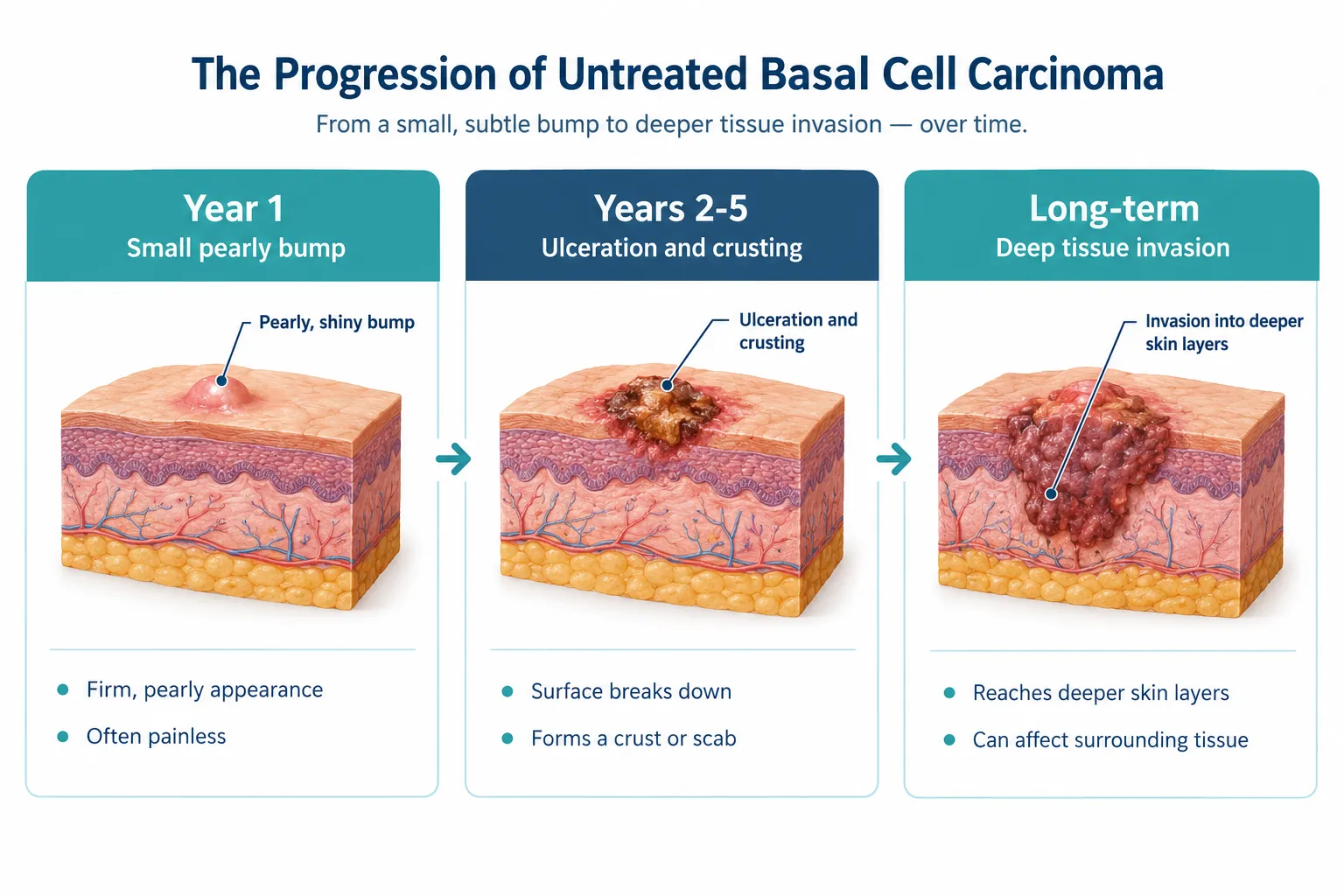
Over time, an untreated BCC generally moves through a recognizable pattern: slow surface growth, then surface breakdown and bleeding, then deeper invasion into structures below the skin. The exact timing varies by person, but the direction of change does not reverse on its own.
In the first year, a BCC is often a small, pearly or waxy bump, sometimes with visible tiny blood vessels. It may bleed after minor trauma, like shaving or toweling off, and then scab over. Because it often heals partially before bleeding again, people frequently mistake it for a recurring pimple or scab rather than a growing tumor, a pattern discussed further in skin cancer that looks like a pimple.
Basal cell carcinoma untreated for 2 years or longer commonly shows a central depression or open sore that will not heal, sometimes called a "rodent ulcer." The nickname comes from the gnawed, eroded appearance of the ulcer's edge, which historically resembled damage caused by a rodent's bite [1][5]. The surface can crust, bleed repeatedly, and become secondarily infected. A sore that keeps opening and scabbing for months is a reason for assessment, not reassurance that it is "just healing."
Left for years, BCC can invade cartilage, muscle, bone, and nerves, according to both the AAD and NCI [1][2]. On the nose, ear, eyelid, or scalp, areas with thin skin and tissue packed close to cartilage or bone, this can cause significant cosmetic and functional damage. Tumors near the eye can extend into periocular tissue and, in severe cases, threaten the eye itself or surrounding bone [6]. This is the realistic endpoint for neglected BCC, and it is largely preventable with earlier removal, as outlined in early stage basal cell carcinoma.
Timeline of neglectStage of neglectWhat typically happensWhat treatment may involveEarly (varies, often months)Small pearly bump, occasional bleedingSimple excision or curettage, small scarExtended (varies, often 1-2+ years)Larger lesion, crusting, repeated bleeding, possible ulceration [3]Wider excision or Mohs surgery, larger scarAdvanced (varies, long-term neglect)Invasion into cartilage, bone, nerves [1][2]Complex reconstructive surgery, radiation, or systemic medication [2][7]
Metastasis, spread to lymph nodes or distant organs, is extremely rare in basal cell carcinoma, and sources explain this is tied to its biology rather than luck. BCC grows from the basal layer of the skin and generally lacks the ability to break away and travel through blood or lymph vessels the way more aggressive cancers do [2][5].
This is why basal cell carcinoma does not typically metastasize: the tumor's growth pattern favors slow local invasion over the kind of cellular changes needed to spread through the body [2][5]. When metastatic BCC does occur, it is usually linked to very large, long-neglected, or repeatedly recurrent tumors [2].
If BCC did spread to internal organs, an uncommon scenario, treatment would move into systemic therapy territory, such as Hedgehog-pathway inhibitors (vismodegib, sonidegib) or, in select cases, the immunotherapy drug cemiplimab, which the FDA approved for metastatic BCC in February 2021 [7][8]. For a closer look at spread risk specifically, see does basal cell carcinoma spread.
No. Basal cell carcinoma cannot heal or resolve on its own, because it is made of cancerous cells that do not stop dividing without treatment. Temporary scabbing or partial healing is common and often misleading.
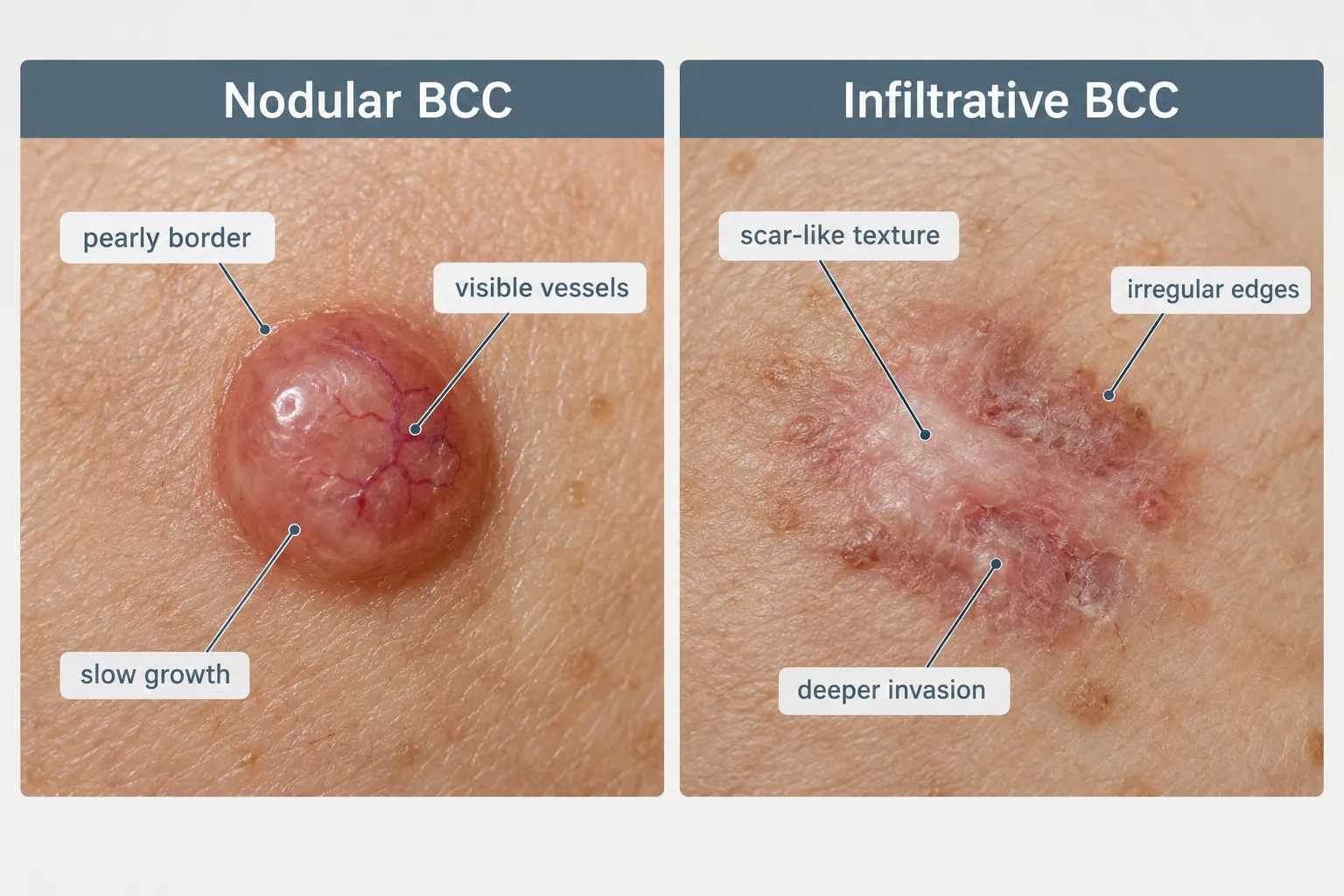
A BCC may scab, bleed, and then appear to "heal" over several weeks, only to break open again later. This cycle is a hallmark of the disease, not a sign of recovery [1][5]. There is no home remedy, cream, or supplement with evidence of curing BCC; topical prescription medications like imiquimod or 5-fluorouracil are legitimate treatments, but only under medical supervision for appropriate lesion types [2][7].
Location changes the stakes because thin-skinned areas near the eyes, nose, ears, and scalp have less tissue separating the tumor from critical structures. A BCC that would cause only a small scar on the back can threaten function and appearance in these zones.
People at highest risk for BCC generally include those with fair skin, significant lifetime sun exposure, a history of tanning bed use, older age, and a personal or family history of skin cancer [1][2]. For Ontario adults who spend summers outdoors or grew up with sunburns, these risk factors are common, not rare.
Yes, in general, waiting tends to increase both the extent of surgery and its cost, because a larger, deeper tumor needs more tissue removed and often more complex reconstruction. The 2025 cohort study found that 20% of patients required a more complex procedure than originally planned after a waiting period [3].
Early-stage BCC removed promptly often involves a straightforward excision with a small, predictable scar, covered in Ontario detail at skin cancer BCC/SCC removal cost in Ontario and what to expect after skin cancer excision on the face. A neglected tumor may require Mohs surgery, flap or graft reconstruction, or in advanced cases, radiation or medication, all larger undertakings than a simple excision caught early.
The main treatment options are surgical excision, Mohs micrographic surgery, curettage and electrodesiccation, topical medications, radiation, and, for advanced or metastatic disease, Hedgehog-pathway inhibitors or cemiplimab. The right choice depends on tumor size, subtype, and location [2][4][7].
TreatmentBest forClearance as reported by sourcesScarSurgical excisionMost localized BCCConsidered a cornerstone treatment [4]Linear, usually smallMohs micrographic surgeryHigh-risk, recurrent, or facial BCCFavored for high-risk features [4]Varies, often minimized by layer-by-layer removalCurettage & electrodesiccationLow-risk, superficial lesionsAlternative option in selected cases [2]Round, flatter scarImiquimod / 5-FU (topical)Select superficial BCCAlternative in selected cases [2]Minimal to noneRadiation therapyPatients unable to have surgeryAlternative in selected cases [2][4]None, may cause skin texture changeHedgehog inhibitors / cemiplimabLocally advanced or metastatic BCCStandard systemic options for advanced disease [7][8]Not applicable
For a deeper dive into subtype-specific choices, see basal cell carcinoma treatments and the current overview of advanced-case options in recent advances in treatment options for locally advanced basal cell carcinoma. Learn about recurrence risk after any of these treatments in can BCC come back after removal, and whether treated BCC is considered cured in is skin cancer curable.
The Minor Surgery Center, with clinics across the GTA in Toronto/North York, York Mills, Vaughan, Mississauga, and Oakville, performs OHIP-covered removal of BCC, SCC, and melanoma, with no referral required and a free consultation. Its surgical team is led by board-certified plastic and reconstructive surgeons Dr. Kunaal Jindal and Dr. Roberto Tutino. The clinic focuses on excision-based removal rather than Mohs, radiation, or medication-based therapies. Call (647) 614-1611 to book, or learn more at skin cancer screening in Toronto and conditions: skin cancer.
Yes. In Ontario, medically necessary removal of basal cell carcinoma is covered under OHIP when performed by a physician, and this applies whether the lesion is caught early or has progressed. Coverage does not require a dermatology referral at clinics that accept direct booking for skin cancer removal.
Cost concerns should never be the reason to delay care, a small early excision is also the simpler and less expensive path compared to delayed, more extensive surgery. More detail on what factors into pricing (for uninsured cosmetic add-ons, for instance) is covered in skin cancer BCC/SCC removal cost in Ontario.
See a doctor promptly if a skin spot shows any sign of being more than a minor irritation, waiting to "see if it goes away" is the most common mistake people make with BCC. Early symptoms are often subtle: a shiny bump, a flat scaly patch, or a small sore that keeps coming back.
See a doctor if a spot:
Example: a 50-year-old with a small, shiny bump near the hairline that bleeds slightly after combing hair, heals over a week, then reopens, this pattern over two or more cycles warrants an appointment, not continued observation. For a visual sense of early warning signs, see skin cancer that looks like a pimple and the broader overview in 4 types of skin cancer.
Can BCC go away on its own?
No. BCC does not resolve without treatment. It may scab and appear to heal temporarily, but the underlying cancerous tissue remains and continues to grow [1][5].
Is BCC a real cancer?
Yes. BCC is a true skin cancer arising from basal cells in the skin's outer layer. It behaves differently from more aggressive cancers because it rarely spreads, but it is still classified and treated as cancer [1][2].
Can BCC kill you?
Death from BCC is rare because it almost never metastasizes, but severe, long-neglected cases can cause serious local damage and, in very rare documented cases, metastatic disease that is harder to treat [1][2][8].
How long can you wait to remove BCC?
There is no safe waiting period; sources describe outcomes as worsening the longer treatment is delayed, with a 2025 study linking longer waiting time to larger tumors and more complex surgery [3]. Prompt evaluation after noticing a suspicious spot is the consistent recommendation [1].
Can BCC spread to other organs?
It is possible but rare. Metastasis is uncommon in BCC due to its growth biology, and when it does happen it is usually associated with very large or repeatedly recurrent tumors [2][7][8].
Is BCC removal covered by OHIP?
Yes, medically necessary BCC removal is covered under OHIP in Ontario, including at clinics that accept direct booking without a referral.
Basal cell carcinoma left untreated does not disappear, and it does not stay the same size. It grows locally, can ulcerate and bleed, and in advanced cases invades cartilage, bone, and nerves, particularly in high-risk zones like the nose, ears, and eyelids [1][2]. Metastasis remains rare because of how BCC's cells behave, but local destruction is well documented and preventable with earlier action [2][5].
The practical takeaway: get any spot that won't heal within about four weeks, bleeds repeatedly, or looks like a pearly or scar-like patch checked by a physician. Early removal generally means a smaller procedure, a smaller scar, and a simpler recovery, as detailed in basal cell carcinoma recovery: what to expect after removal. In Ontario, OHIP-covered assessment and removal is available without a referral, booking a consultation sooner rather than later is the single most effective step toward avoiding the long-term damage described above.