
Last updated: September 23, 2026
Skin cancer (BCC/SCC) removal cost in Ontario: what OHIP covers comes down to one simple rule: if a physician confirms or reasonably suspects a lesion is basal cell carcinoma (BCC), squamous cell carcinoma (SCC), or melanoma, OHIP pays for the assessment, biopsy, and surgical removal in full.[1][2][4] Patients with a valid OHIP card generally pay nothing out of pocket for medically necessary skin cancer surgery. The cost only shows up when a lesion turns out to be benign and was removed for cosmetic reasons, or when someone is not covered by OHIP at all.
The direct answer: OHIP covers the full cost of assessing, biopsying, and surgically removing basal cell carcinoma and squamous cell carcinoma when a physician determines the lesion is cancerous or strongly suspicious for cancer. There is no separate "skin cancer surgery fee" charged to the patient in this scenario.[1][2][4]
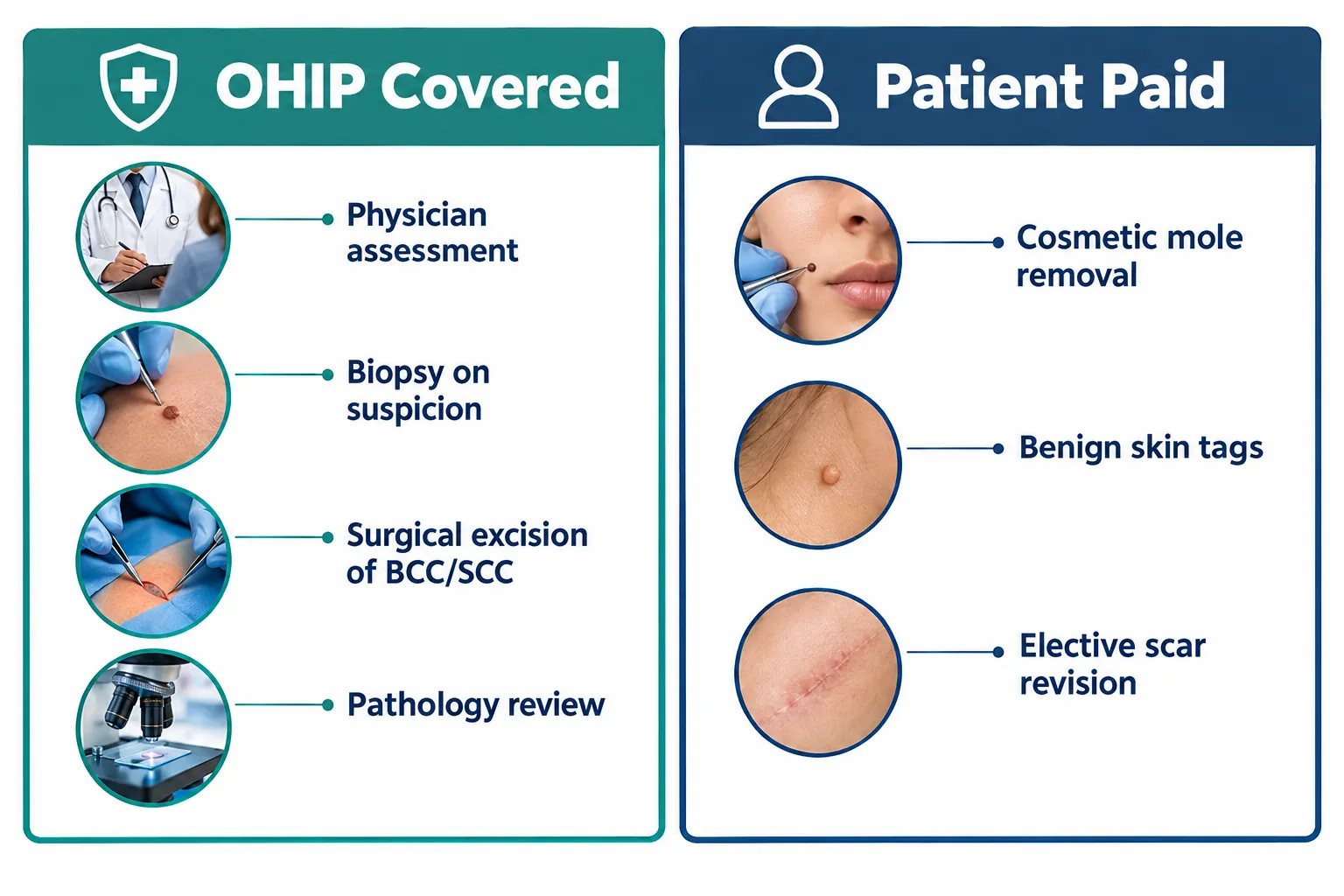
This coverage is not a special program. It falls under the general rule that OHIP pays for medically necessary physician and hospital services.[3] Skin cancer removal qualifies because leaving a malignant lesion untreated carries real health risk. That's different from a mole or skin tag that is removed purely because a patient does not like how it looks, which OHIP treats as elective and cosmetic.
What OHIP typically pays for once cancer is suspected or confirmed:
Several Ontario clinics that perform this work, including rapid-access minor surgery centers, describe the patient cost for OHIP-insured skin cancer excision as zero dollars, provided the patient holds a valid Ontario health card and the procedure is documented as medically necessary.[2][4][9] The Skin Cancer condition overview explains this distinction in more detail, including how clinics document medical necessity for billing purposes.
Decision rule: if your doctor writes "rule out BCC/SCC" or "clinically suspicious lesion" on the requisition, expect OHIP billing. If the note reads "cosmetic concern" or "patient request," expect a private invoice.
A common mistake is assuming that any dermatology visit is automatically OHIP-covered. Cosmetic consultations, laser treatments, and elective mole removal on normal-looking moles are billed separately even at the same clinic that treats skin cancer for free.[1][6]
Without OHIP, patients pay a private surgical fee that typically reflects the size and location of the lesion, the complexity of the closure, and whether pathology testing is billed separately. Exact private pricing varies by clinic and is not standardized the way OHIP fee codes are, so anyone paying privately should request a written quote before booking.
Who pays privately for BCC or SCC removal in Ontario:
For people who do have valid OHIP but are quoted a private fee, the smart move is to ask the clinic directly: "Is this lesion being billed to OHIP as a suspected skin cancer, or is this a cosmetic removal?" That single question resolves most confusion about cost. The Ohip Coverage Vs Private Pay guide breaks down exactly which procedures fall on each side of that line.
Edge case: a patient with an OHIP card but an expired or inactive health card number will be billed as a private patient until the card is renewed, even if the lesion is clearly cancerous. Renewing the health card before the appointment avoids this entirely.
Basal cell carcinoma (BCC) and squamous cell carcinoma (SCC) are both non-melanoma skin cancers that start in different layers of skin cells, and they behave differently enough that treatment urgency can vary. BCC grows slowly and almost never spreads beyond the skin; SCC grows faster and has a small but documented risk of spreading to lymph nodes or deeper tissue if left untreated.[4][10]
FeatureBasal Cell Carcinoma (BCC)Squamous Cell Carcinoma (SCC)Common appearancePearly bump, sometimes with visible blood vesselsScaly, crusty, or rough red patchGrowth speedSlow, often over months to yearsFaster, can change over weeksSpread riskVery lowLow but real, especially on lips, earsTypical locationFace, ears, neck (sun-exposed areas)Hands, scalp, lips, sun-damaged skinUsual treatmentSurgical excision, sometimes curettageSurgical excision, sometimes Mohs
Both types are covered by OHIP for diagnosis and removal once flagged as clinically suspicious.[2][4] The 4 Types Of Skin Cancer article covers BCC, SCC, melanoma, and Merkel cell carcinoma side by side if a broader comparison is useful. For a deeper look specifically at basal cell carcinoma, the Bcc Skin Cancer guide walks through warning signs in plain language.
Choose urgency accordingly: a lesion that looks like SCC (rough, crusty, tender, growing over weeks) generally warrants a faster appointment than one that looks like classic slow-growing BCC, though both should be assessed rather than watched indefinitely.
A walk-in clinic physician can examine a suspicious spot, order or perform a biopsy, and refer the patient onward, but most walk-in clinics do not perform the actual cancer excision on site. Whether a referral to a dermatologist or surgeon is required depends on the clinic: some rapid-access minor surgery centers accept direct bookings, while others require a referral from a family doctor or walk-in physician first.[2][9]
How this typically works in Ontario:
Common mistake: assuming a walk-in clinic visit alone counts as "getting it removed." In most cases, walk-in clinics diagnose and refer; the removal happens at a surgical clinic, hospital outpatient department, or dermatology office. Booking that second appointment promptly matters more than people realize, since delays between diagnosis and removal are one of the most common reasons small BCCs grow larger than they needed to. For readers comparing no-referral options, Best No Referral Walk In Dermatology Clinics In Toronto lists clinics that skip the referral step for initial assessment.[5]
Family doctors with minor surgery training can remove small, low-risk BCCs, especially on the trunk or limbs, but larger lesions, facial lesions near the eyes or nose, recurrent cancers, and most SCCs are typically referred to a general surgeon, dermatologist, or plastic surgeon. The deciding factors are lesion size, location, and whether it has come back after a previous removal.[4][10]
Practical guidance:
Under OHIP, the specialist consultation and the excision remain fully covered as long as the referral or direct booking is tied to a medically necessary skin cancer concern.[3][4]
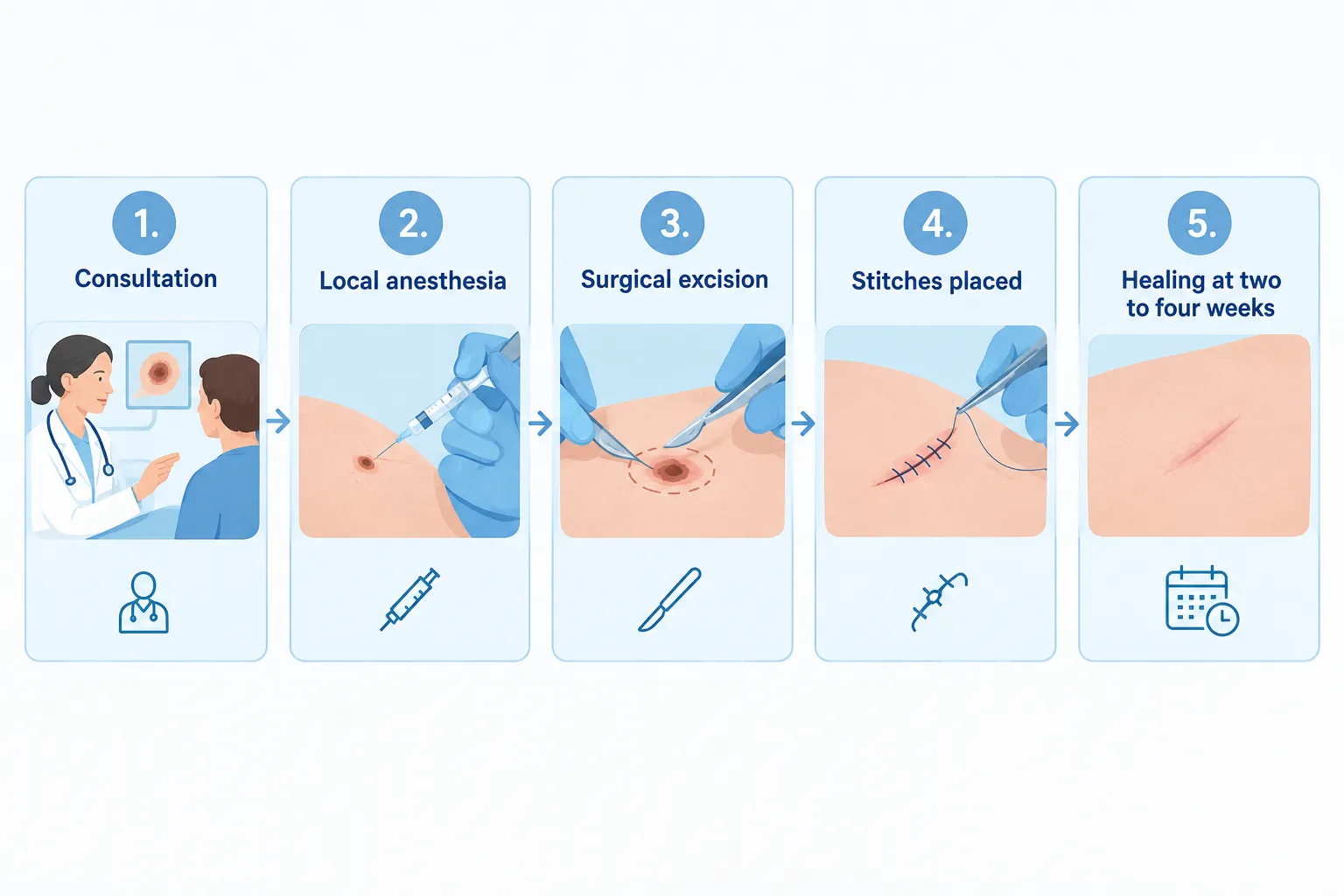
Most BCC excisions take between fifteen and forty-five minutes under local anesthetic, and patients go home the same day. Full healing usually takes two to four weeks, though the exact timeline depends on the lesion's size, location, and closure method.
What a typical BCC removal day looks like:
Recovery milestones patients can expect:
The Basal Cell Carcinoma Recovery What To Expect After Removal guide covers wound care, scar management, and warning signs of infection in more depth.
Decision rule: if a lesion sits on a cosmetically sensitive area like the nose tip or eyelid, ask specifically about the closure plan before surgery day, since a simple excision there may need a flap or graft that extends both the procedure time and the healing window.
Skin cancer removal is classified as medically necessary, not cosmetic, whenever a physician documents that the lesion is confirmed or clinically suspected to be cancerous. OHIP's coverage rules explicitly separate medically necessary care, which is insured, from cosmetic procedures, which are not.[3]
This distinction matters because the same physical action (cutting out a bump on the skin) can be billed two completely different ways:
A practical example: two patients each have a bump on their cheek. One's bump has been growing, bleeding occasionally, and looks pearly with visible small blood vessels; the doctor documents "clinically suspicious for BCC" and bills OHIP for the excision and pathology. The other patient's bump is a longstanding, unchanged skin tag they simply want gone; that removal is billed privately. Same body part, same basic procedure, very different cost because of medical necessity.
Common mistake: patients sometimes ask for a "cosmetic removal" of a spot that is actually medically suspicious, thinking it will be faster to book that way. This can delay proper biopsy and pathology tracking, so always describe symptoms (bleeding, growth, itching, changing shape) accurately rather than framing the request as purely cosmetic.
Left untreated, basal cell carcinoma continues to grow locally, gradually invading surrounding skin, and in advanced cases, underlying tissue such as cartilage, muscle, or bone, even though it rarely spreads to distant organs. The longer it goes untreated, the larger the eventual surgical defect and the more complex the repair.
Realistic consequences of delaying BCC treatment:
SCC carries a somewhat higher risk profile if ignored, since it is more likely than BCC to spread to lymph nodes, particularly on the lips, ears, and in patients with weakened immune systems.[4][10]
Edge case: some elderly or medically frail patients choose "watchful monitoring" with their physician's agreement rather than immediate surgery, when the surgical risk outweighs the cancer's slow growth. This is a documented medical decision, not simply avoidance, and should always involve a physician's assessment rather than a personal choice to skip care. Anyone noticing a changing spot should start with a proper assessment; the Skin Cancer Screening Toronto: Full Body Skin Exams & Mole Assessment page outlines what that first visit typically covers.
For medically necessary BCC/SCC removal, both private dermatology clinics and public hospital-affiliated surgical centers bill OHIP the same way, so the patient cost is zero either way; the real differences are wait time, convenience, and scheduling flexibility, not price.[1][4][9]
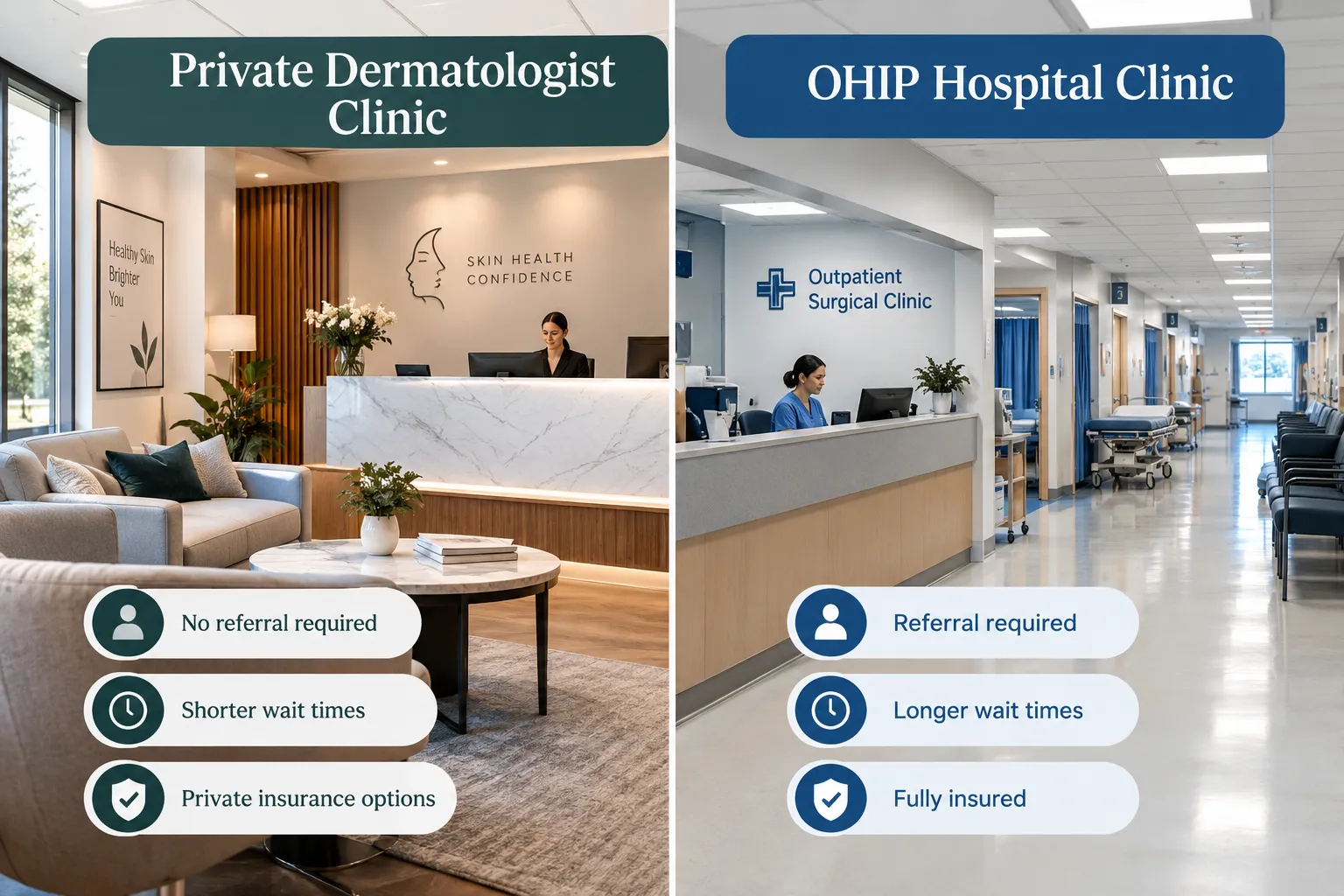
FactorPrivate Dermatologist/Minor Surgery ClinicPublic Hospital Outpatient ClinicOHIP billing for confirmed cancerYes, no patient fee[2][4]Yes, no patient fee[3]Typical wait for first appointmentOften shorter, especially at rapid-access clinicsCan be longer depending on regionReferral requirementVaries by clinic; some accept self-referral[2]Usually requires a referralSettingPrivate office, often same-day biopsy and excisionHospital surgical day unitBest forPatients wanting faster scheduling and one-stop assessmentPatients already connected to a hospital dermatology or surgery department
The word "private" in this context refers to the clinic's ownership structure, not to who pays. A private clinic can still bill 100 percent of a medically necessary BCC excision to OHIP.[4] Cost only enters the picture if someone chooses a private clinic specifically for a service OHIP does not cover, such as a cosmetic scar revision after healing.
Decision rule: choose a rapid-access minor surgery or skin cancer clinic if the priority is getting seen and treated quickly without waiting for a long hospital queue. Choose the hospital route if there is already an existing referral in the system or if the case is complex enough to need a multidisciplinary hospital team. Clinics such as those covered in the Best Skin Cancer Clinic Toronto guide detail typical wait times and booking processes across the city.
Mohs micrographic surgery is available in Ontario at select referral centers, and OHIP covers it for medically appropriate cases, typically high-risk BCC or SCC on the face, ears, or other cosmetically and functionally sensitive areas.[4] Mohs is not the default treatment for every skin cancer; it is reserved for cases where preserving healthy tissue and confirming clear margins in real time matters most.
When Mohs is usually chosen over standard excision:
Standard excision remains the more common approach for BCC/SCC on the trunk, arms, and legs, since it is faster and produces equally good outcomes in lower-risk locations. Both approaches are OHIP-insured when medically indicated; the choice comes down to lesion location and risk, not cost.[4]
Common mistake: patients sometimes request Mohs surgery by name because they've read it has better cosmetic outcomes, without realizing that a simple excision on a low-risk body area gives an equivalent result with less appointment time. The treating physician, not the patient, determines medical suitability for Mohs.
Anyone previously diagnosed with BCC should get a full skin check roughly every six to twelve months, since having one non-melanoma skin cancer meaningfully raises the odds of developing another, either at the same site or elsewhere on the body.[4][10] The exact interval depends on skin type, sun exposure history, and how many prior lesions someone has had.
Follow-up frequency guide:
Common mistakes people make with early skin cancer diagnosis:
For a broader screening baseline, a Full Body Skin Exam Toronto | Skin Cancer Screening covers areas patients often miss checking themselves, such as the scalp, back, and between the toes.
When a BCC or SCC excision is billed to OHIP, the core medical components are included at no direct cost to the patient: consultation, biopsy, the excision itself, standard closure, and pathology.[2][4] Extra costs, when they exist, almost always relate to elective add-ons rather than the cancer treatment itself.
What's typically included under OHIP for confirmed or suspected skin cancer:
What's typically extra, billed privately, or not standard:
Quick example: a patient has a confirmed BCC removed on the shoulder (OHIP-covered) and, at the same visit, asks the surgeon to also remove two unrelated skin tags on the neck for appearance reasons. The BCC excision is billed to OHIP; the skin tags are billed as a separate private cosmetic service. This kind of mixed visit is common and is not a billing error, it reflects two different categories of care in one appointment. Anyone unsure what a specific clinic charges for the non-covered portion should ask for an itemized estimate before the procedure, similar to the cost breakdowns discussed in the Cyst Removal Cost In Ontario guide, which covers the same OHIP-versus-private split for a different minor surgery category.
Does OHIP cover skin cancer removal in Ontario?
Yes. OHIP covers the assessment, biopsy, and surgical removal of confirmed or clinically suspected BCC, SCC, and melanoma, with no direct surgical fee for OHIP-insured patients.[2][3][4]
How much does BCC removal cost without OHIP in Ontario?
Cost varies by clinic and lesion complexity since there is no fixed public price list for private-pay excisions; patients without active OHIP coverage should request a written quote before booking.[1]
Do I need a referral to see a dermatologist for skin cancer removal under OHIP?
Sometimes. Some rapid-access minor surgery clinics accept self-referred patients, while other OHIP-funded surgical centers require a referral from a family doctor or walk-in physician first.[2][9]
Can a walk-in clinic remove skin cancer?
Usually not directly. Walk-in physicians typically assess and biopsy a suspicious lesion, then refer the patient to a clinic or surgeon equipped to perform the excision.[5]
What's the difference between BCC and SCC?
BCC grows slowly and rarely spreads; SCC grows faster and has a small but real risk of spreading to lymph nodes, particularly on the lips and ears.[4][10]
Is Mohs surgery covered by OHIP in Ontario?
Yes, when medically appropriate, generally for high-risk BCC or SCC on the face or other sensitive areas, at select referral centers.[4]
What happens if basal cell carcinoma is left untreated?
It continues growing locally, potentially invading deeper tissue and requiring larger, more complex surgery later, even though distant spread is rare.[4]
How often should someone with a history of BCC get skin checks?
Roughly every six to twelve months, often more frequently in the first year after removal, since a prior BCC raises the risk of developing another skin cancer.[4][10]
Is removing a suspicious mole considered cosmetic or medical under OHIP?
It depends entirely on documentation. If a physician notes clinical suspicion of cancer, it's medical and OHIP-covered; if it's removed purely for appearance with no clinical concern, it's cosmetic and privately billed.[3]
Can my family doctor remove my BCC, or do I need a specialist?
Family doctors with minor surgery training can often remove small, low-risk BCCs on the trunk or limbs; facial lesions, recurrences, and SCCs are typically referred to a specialist.[4][10]
The core fact worth remembering is straightforward: skin cancer (BCC/SCC) removal cost in Ontario, when OHIP covers the case, is zero dollars for the patient, because biopsy, excision, and pathology for confirmed or clinically suspected cancer fall under medically necessary care.[2][3][4] Cost only enters the conversation when a lesion is benign and removed for cosmetic reasons, or when someone lacks active OHIP coverage.
Practical next steps:
Anyone still unsure where to start can review the Skin Cancer overview for a plain-language summary of warning signs and next steps before booking an assessment.
[1] Ohip Coverage Vs Private Pay - https://www.theminorsurgerycenter.com/blog/ohip-coverage-vs-private-pay
[2] Skin Cancer Treatment - https://rapidaccessminorsurgery.com/skin-cancer-treatment/
[3] What Ohip Covers - https://www.ontario.ca/page/what-ohip-covers
[4] Best Skin Cancer Clinic Toronto - https://www.theminorsurgerycenter.com/blog/best-skin-cancer-clinic-toronto
[5] Best No Referral Walk In Dermatology Clinics In Toronto - https://www.theminorsurgerycenter.com/blog/best-no-referral-walk-in-dermatology-clinics-in-toronto
[6] Are Dermatologists Covered By Ohip Heres What You Need To Know - https://facetdermatology.com/blogs/news/are-dermatologists-covered-by-ohip-heres-what-you-need-to-know
[7] Ohip - https://hellosafe.ca/en/health-insurance/ontario/ohip
[8] Coverage Details - https://uhip.ca/uhip-services/coverage-details/
[9] Ohip Funded Care - https://thecooperclinic.com/ohip-funded-care/
[10] Skin Cancer Clinic Mississauga - https://www.torontominorsurgery.com/skin-cancer-clinic-mississauga