
Last updated: September 30, 2026
Yes, basal cell carcinoma (BCC) can come back after removal, and it can also show up as a brand-new tumor elsewhere on the skin. Recurrence rates range from about 1% with Mohs micrographic surgery to over 10% with standard excision at 5 years, depending on the treatment method and the tumor's original risk features.[2] Regular follow-up exams catch most recurrences early, when they are still easy to treat.
Basal cell carcinoma is the most common form of skin cancer, starting in the basal cells at the bottom of the skin's outer layer, and it is typically removed through surgery, scraping, freezing, radiation, or topical medication depending on size, location, and subtype.[2] It rarely spreads to distant organs, but it can grow deep and wide locally if left untreated or incompletely treated.
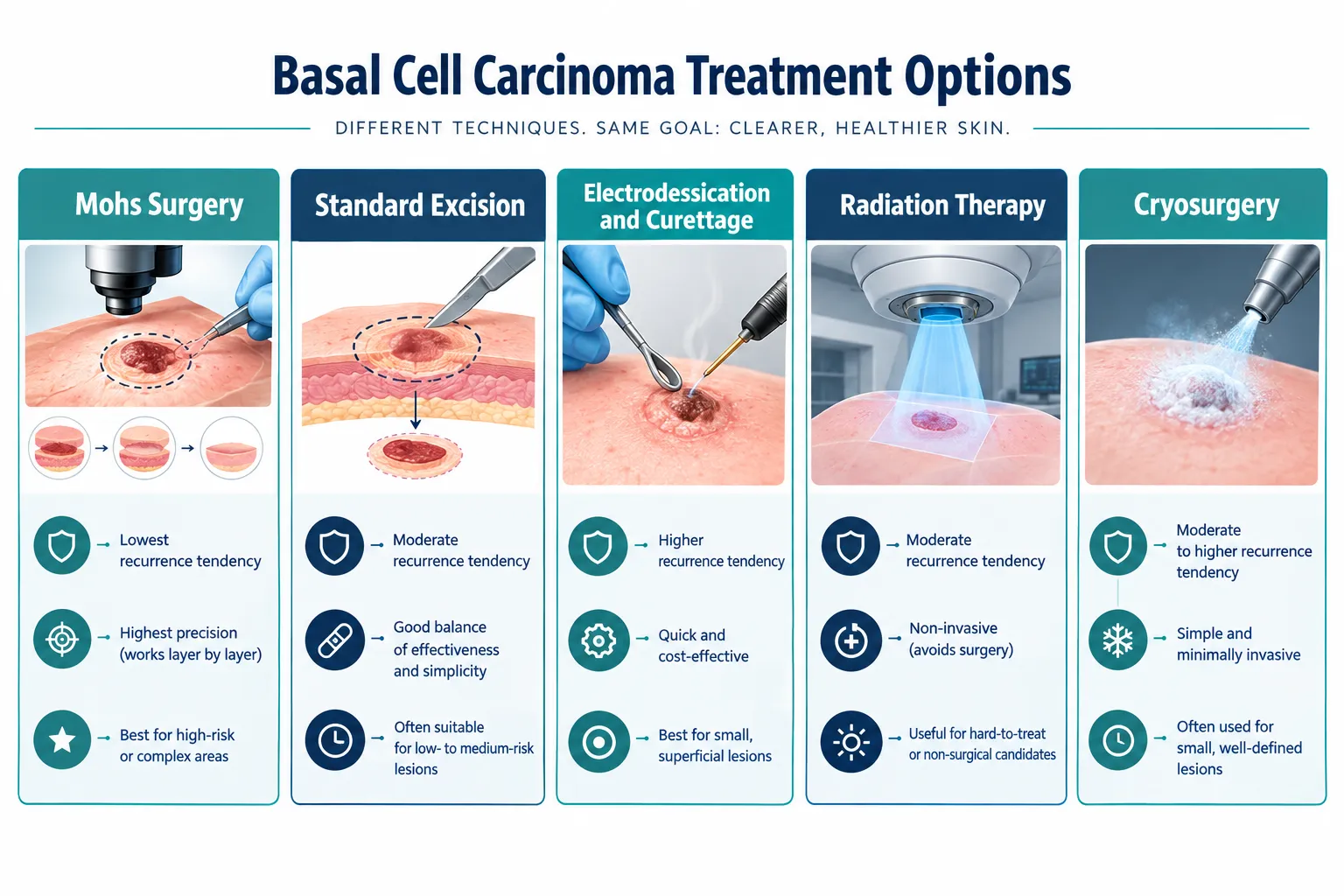
Treatment choice depends on the tumor's size, location, growth pattern (histologic subtype), and whether it is a first-time (primary) or recurrent tumor. Common removal methods include:
A tumor that was treated by any of these methods can still return. That is the central question this article answers: can BCC come back after removal, and if so, how do patients and doctors watch for it? For a deeper look at what recovery looks like right after treatment, see this guide on basal cell carcinoma recovery and what to expect after removal.
Choose Mohs surgery if: the BCC is on the face, ears, nose, or another cosmetically or functionally sensitive area, or if it is a recurrent tumor, the margin control significantly lowers the re-treatment risk.[12]
BCC recurrence rates vary widely by treatment method, generally ranging from about 1% to 17% within 5 years. Mohs surgery has the lowest recurrence rate, while topical treatments and destructive methods like curettage or photodynamic therapy tend to have higher rates, especially for nodular subtypes.[1][2]
A 2025-2026 StatPearls review reports these 5-year recurrence rates for primary BCC:[2]
Treatment Method5-Year Recurrence RateMohs micrographic surgeryAbout 1%Standard surgical excision10.1%Electrodessication and curettage7.7%Radiation therapy8.7%Cryosurgery7.5%
A large 2026 cohort study with up to 8 years of follow-up found that for nodular BCC, standard surgical excision had the lowest cumulative recurrence rate at 16.5% over 8 years, compared with higher rates for curettage, photodynamic therapy (PDT), and cryotherapy.[1] For superficial BCC, standard excision and curettage performed similarly (both around 16.3% at 8 years), while PDT showed the highest recurrence rate for both subtypes.[1]
For context on how recurrence compares across treatment types more broadly, a 2021 American Academy of Family Physicians review reports 5-year recurrence rates of 3.2% for Mohs versus 5.2% for standard excision, and around 17.5% at 5 years for topical imiquimod, which may still be an acceptable option for carefully selected, low-risk superficial lesions.[14][15]
Common mistake: Assuming all BCC treatments carry the same risk. A patient treated with curettage for a nodular BCC on the nose faces a meaningfully higher recurrence risk than one treated with Mohs surgery in the same location, location and subtype change which method is appropriate.
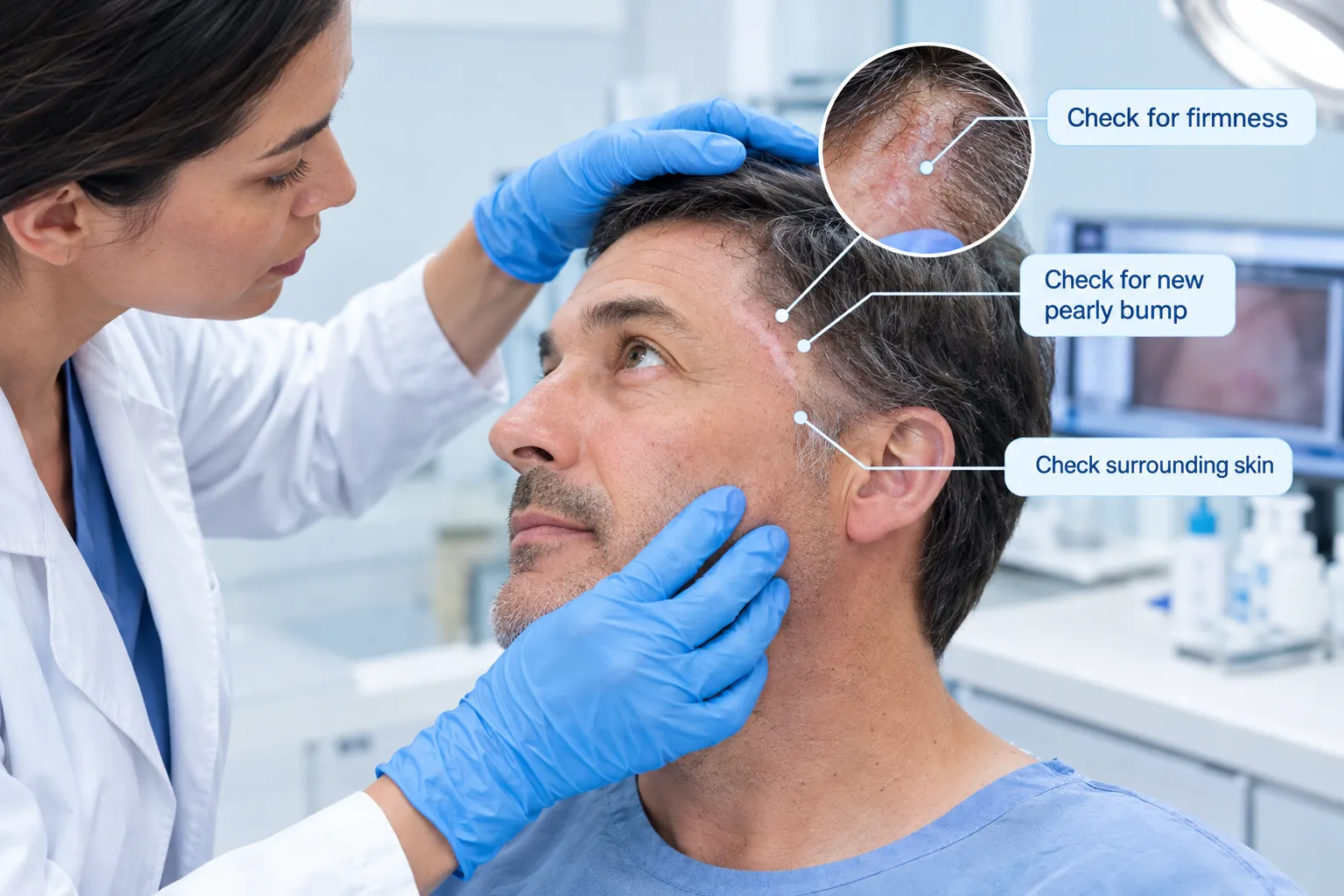
The most reliable sign of BCC recurrence is a new bump, sore, or area of irritation appearing in or around a previous treatment scar, especially if it does not heal within a few weeks. Watch for changes in the texture, color, or shape of the scar itself.
Signs worth reporting to a doctor include:
Edge case: Sometimes recurrence grows beneath the scar rather than on its surface, meaning the skin can look normal while a firm nodule is palpable underneath. This is one reason doctors physically palpate treated sites during follow-up, not just look at them.
Quick example: A patient treated for a nodular BCC on the cheek two years earlier notices the scar has become slightly raised and shiny at one edge. It does not hurt and has not changed color, but it has grown over the past six weeks. This pattern, slow, painless growth in a previously treated area, is a classic recurrence red flag and warrants prompt evaluation.
Yes, BCC most commonly recurs at or very near the original treatment site, because leftover microscopic cancer cells at the tumor's edges are usually the cause. Recurrence can happen anywhere from a few months to many years after treatment, though most cases appear within the first 3 to 5 years.
According to the National Cancer Institute's PDQ (updated February 2026), the timeline for BCC recurrence breaks down as follows:[9]
A separate recurrence-rate analysis similarly reports that 3-year follow-up detects about 66% of relapses, and 75% of recurrences occur within 5 years.[6] This means a 5-year follow-up window catches most, but not all, recurrences. A meaningful minority show up later, which is a key reason many dermatologists now recommend indefinite annual skin checks rather than "graduating" from surveillance after 5 years.[6][9]
Decision rule: If a scar or treated area changes in any way, even years after treatment, schedule an evaluation rather than waiting for a routine annual visit. Early detection of recurrence almost always means a simpler, less invasive second treatment.
Incomplete excision is the single strongest predictor of BCC recurrence, but tumor location, size, subtype, and patient factors all play a role. A tumor with clear, wide margins on a low-risk site carries a very different outlook than one with narrow margins on the nose or ear.
Key risk factors for recurrence include:
Common mistake: Assuming a "successful" surgery day means zero risk. Pathology results confirming clear margins lower the risk substantially, but they do not eliminate it, a small percentage of confirmed clear-margin excisions still recur, which is why follow-up remains necessary even after good news from pathology.
BCC recurrence is generally discussed in different terms than melanoma because BCC almost never spreads to distant organs, while melanoma's danger lies primarily in its ability to metastasize. Direct recurrence-rate comparisons between the two are less useful than understanding that each cancer behaves differently.
Here is how the two compare:
FactorBasal Cell CarcinomaMelanomaLocal recurrence after treatmentCommon, 1-17% depending on method[1][2]Less common with adequate marginsRisk of distant spreadVery lowSignificant, especially if diagnosed latePrimary concern with recurrenceLocal tissue damage, repeat surgerySpread to lymph nodes or organsNew tumor risk after first diagnosisHigh, 30-50% develop another BCC within 5 years[2][4]Elevated, but tracked differentlyTypical follow-up focusLocal recurrence and new keratinocyte cancersRegional lymph nodes, systemic surveillance
In short, BCC recurs locally at rates that can rival or exceed some melanoma local recurrence figures, but melanoma's follow-up protocols weigh more heavily toward catching spread rather than local regrowth. Neither comparison should be used to downplay either cancer, both require consistent monitoring, just with different priorities.
Doctors check for BCC recurrence primarily through visual inspection and physical palpation of the treated site and surrounding skin during scheduled follow-up visits, sometimes supplemented by dermoscopy or biopsy if something looks suspicious. A full-body skin exam is standard at each visit, not just a look at the treated scar.
Typical components of a BCC follow-up check include:
StatPearls (updated September 2026) recommends full-skin examinations every 6-12 months for the first 5 years after treatment of a low-risk BCC, then annually thereafter.[2] Patients with multiple tumors, high-risk histology, high-risk locations such as the nose, ear, or periocular area, or immunosuppression need at least annual, and often more frequent, surveillance for 3-5 years or longer.[12]
European guidance reflects a similar, risk-stratified approach. The 2023 S2k guideline for BCC (published November 2024, updated through 2026) recommends an exam at 6 months for isolated, low-risk, surgically treated BCC, followed by yearly visits, while multiple BCCs, high-risk features, or locally advanced disease call for visits every 3 months initially, potentially easing to annual visits after more than 2 years without new tumors or recurrence.[13]
If a suspicious change turns up on self-exam between visits, waiting for the next scheduled appointment is not advisable. For guidance on evaluating a new or changing skin lesion, this skin cancer clinic resource in Etobicoke covering assessment, biopsy, and removal outlines what an evaluation visit typically involves.
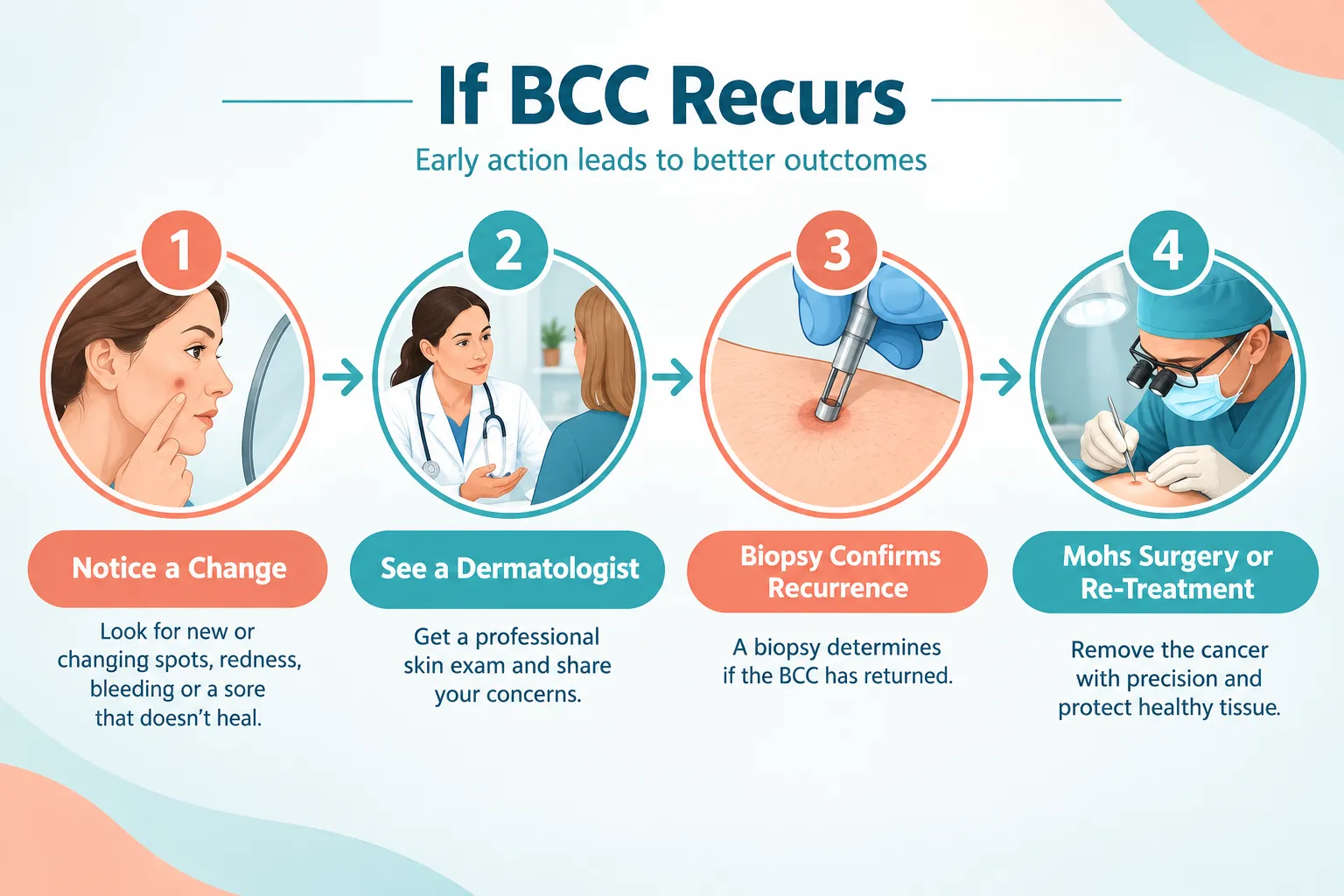
If a BCC recurs, the first step is prompt evaluation by a dermatologist or skin cancer specialist, who will usually confirm the diagnosis with a biopsy before recommending treatment, often a margin-controlled surgical approach like Mohs surgery. Waiting or self-monitoring a suspected recurrence is not recommended, since delayed treatment allows the tumor more time to grow into deeper tissue.
Steps to take if recurrence is suspected:
A study of previously recurrent non-melanoma skin cancers found 5-year re-recurrence rates as high as 15.4% for BCC overall, with recurrent tumors showing a 5.1% 5-year recurrence rate compared with 3.4% for primary tumors.[11] This elevated risk is exactly why guidelines recommend treating recurrent and high-risk tumors with margin-controlled surgery and intensifying follow-up afterward.[11][12]
Quick example: A patient whose BCC recurred on the temple after standard excision is switched to Mohs surgery for re-treatment and placed on a 3-month follow-up schedule for the first two years, rather than the standard 6-12 month interval used for a low-risk primary tumor.
There is no guaranteed way to prevent BCC recurrence, but choosing the right treatment method upfront, confirming clear surgical margins, practicing strict sun protection, and keeping every follow-up appointment substantially lower the risk. Prevention is really about stacking several risk-reducing habits rather than relying on one single step.
Practical steps that reduce recurrence and new-tumor risk:
The American Cancer Society's August 2026 update advises monthly self-skin exams after BCC treatment, with clinician visits every 6-12 months, and more frequent visits for those at higher risk or with multiple prior skin cancers.[5] The American Academy of Dermatology's September 26, 2026 patient resource reinforces this, stressing that keeping every dermatology appointment matters, with the exact frequency depending on treatment type, how early the cancer was caught, and individual risk factors.[8]
Decision rule: If a tumor sits in a high-risk location (nose, ear, eyelid, lip) or has an aggressive subtype on pathology, choose Mohs surgery over standard excision or destructive methods whenever it is available, the long-term recurrence data strongly favor it.[12]
Recurring BCC is not inherently more life-threatening than a first-time tumor, since BCC still rarely spreads to distant organs even after recurrence. It is, however, generally harder to treat, because recurrent tumors often grow along scar tissue in irregular patterns that are difficult to see or map with standard imaging, and they carry a higher risk of recurring yet again.[11]
Recurrence versus a new (second) primary BCC, what's the difference:
Both are common outcomes for people with a BCC history, and both require the same basic response: prompt evaluation and treatment. But they carry different implications. Recurrence may prompt a doctor to reconsider whether the original treatment method was aggressive enough, while a new primary BCC is treated as evidence of general skin cancer susceptibility tied to sun damage, skin type, and genetics.
This distinction matters for long-term outlook. StatPearls estimates that 30-50% of people with a BCC history develop another BCC within 5 years, a separate, new tumor, not a recurrence of the original.[2] Medscape cites a meta-analysis showing a roughly 44% cumulative 3-year risk of developing a second BCC after an index tumor.[4] The Merck Manual's 2026 update reports that about 40% of patients with a history of keratinocyte cancer (which includes BCC) develop another keratinocyte cancer within 5 years.[10] Classic clinical reviews confirm the same pattern: a prior BCC diagnosis strongly increases the risk of developing additional BCCs over a lifetime.[7]
Common mistake: Treating a clean pathology report as the end of the skin cancer story. Even a perfectly treated, fully cleared BCC does not reduce a patient's underlying tendency to develop new skin cancers, ongoing surveillance addresses this separate but related risk.
For patients managing multiple moles, cysts, or skin lesions alongside a BCC history, understanding how moles can behave after removal or reviewing options like suspicious mole biopsy and pathology testing can help clarify when a new spot needs professional evaluation versus routine monitoring.
Yes, follow-up appointments are considered a standard part of BCC care, not an optional extra, because they catch both local recurrence and new BCCs while they are still small and easy to treat. Skipping follow-up significantly raises the odds that a recurrence or new tumor will be caught later, when it requires more extensive treatment.
General follow-up framework based on current guidance:
Risk LevelRecommended Follow-UpLow-risk, isolated, fully cleared BCCExam at 6 months, then annually[13]Standard risk (per StatPearls)Full-skin exam every 6-12 months for 5 years, then annually[2]Multiple BCCs, high-risk histology, or high-risk siteEvery 3 months initially, easing to annual after 2+ years clear[13]Immunosuppressed or prior recurrenceAt least annual, often more frequent, for 3-5+ years[11][12]
Follow-up is not only about watching the treated site. The National Cancer Institute's PDQ and other 2026 references stress that follow-up visits also exist to catch new primary skin cancers and manage the effects of long-term sun damage, meaning thorough full-body skin exams and ongoing sun-protection counseling should happen at every visit, not just a glance at the old scar.[9][10]
Recent authoritative reviews increasingly frame BCC as a chronic, relapsing condition for many patients rather than a one-time problem that gets fully resolved after treatment.[2][9][12] This is why experts now favor lifelong, risk-adjusted follow-up over a fixed cutoff, since a meaningful share of recurrences and many new BCCs appear beyond the traditional 5-year surveillance window.[6][9][10]
Common mistake: Stopping follow-up after 5 years because "the risk window has passed." About 18% of recurrences appear after year 5, and new BCC risk does not disappear on a timer, it persists as long as sun-damaged skin and genetic risk factors remain.[9]
Anyone unsure where to get an evaluation or biopsy locally can review options such as a skin cancer removal clinic in York Mills or compare leading basal cell carcinoma removal clinics in Toronto before booking a follow-up or second-opinion visit.
Can BCC come back after removal even with clear margins?
Yes, though the risk is much lower. Clear margins on pathology significantly reduce recurrence risk, but a small percentage of fully cleared excisions still recur, which is why follow-up exams continue even after good pathology results.[3][12]
How soon can BCC recur after treatment?
Recurrence can appear within months, though about half of all recurrences show up within 2 years and most within 5 years.[9] A smaller share, roughly 18%, appear later than 5 years out.[9]
Does BCC recurrence mean the cancer has spread?
No. Recurrence means cancer cells regrew at or near the original site, it does not automatically mean the cancer has spread to lymph nodes or organs, which remains rare for BCC even after recurrence.[11]
Is Mohs surgery better than standard excision for preventing recurrence?
Yes, for high-risk and recurrent tumors. Mohs surgery has shown roughly 1% recurrence at 5 years compared with about 10% for standard excision, and its advantage persists at 10 years for both primary and recurrent BCC.[2][12]
What does a recurring BCC look like?
It often appears as a new pearly bump, a sore that will not heal, or a scaly patch forming in or near an old treatment scar. Firmness felt under the scar, even without a visible change, can also signal recurrence.
How many follow-up visits will I need after BCC treatment?
Most low-risk patients need exams every 6-12 months for the first 5 years, then annually after that.[2] Higher-risk patients may need visits every 3 months initially.[13]
Can a new BCC appear even if my original one never came back?
Yes, and this is common. About 30-50% of people with a BCC history develop a separate new BCC within 5 years, unrelated to the original tumor's treatment outcome.[2][4]
Should I worry more about recurrence or a brand-new BCC?
Both deserve attention. Recurrence signals the original tumor was not fully cleared, while a new BCC reflects ongoing skin cancer risk from sun damage or genetics, both are caught through the same routine follow-up exams.
Does recurrent BCC need more aggressive treatment?
Usually yes. Recurrent tumors carry a higher re-recurrence risk, so doctors typically recommend margin-controlled surgery like Mohs rather than less precise methods for re-treatment.[11]
Can sunscreen alone prevent BCC recurrence?
Sunscreen reduces overall UV-driven skin cancer risk but cannot fully prevent recurrence of a tumor with residual cells left after treatment. It works alongside, not instead of, proper treatment and follow-up.
Basal cell carcinoma can come back after removal, whether as a true local recurrence at the treated site or as a separate new tumor elsewhere on the skin. The odds of recurrence depend heavily on the treatment method chosen, the tumor's original risk features, and how closely margins were controlled during removal, ranging from about 1% with Mohs surgery to over 10% with standard excision at 5 years.[2] Most recurrences show up within the first 5 years, but a meaningful share appear later, which is why lifelong surveillance makes more sense than a fixed follow-up cutoff.[6][9]
The practical takeaway is straightforward: keep every scheduled follow-up appointment, perform monthly self-checks of treated areas and the rest of the skin, report any new or changing spot promptly rather than waiting, and discuss with a dermatologist whether a higher-risk tumor warrants Mohs surgery over a less precise removal method. For anyone currently facing a new diagnosis, a prior recurrence, or simply trying to understand their long-term outlook, scheduling a consultation with a skin cancer specialist is the clearest next step toward catching any future changes early and keeping treatment as simple as possible.
[1] Pmc13347380 - https://pmc.ncbi.nlm.nih.gov/articles/PMC13347380/
[2] Nbk482439 - https://www.ncbi.nlm.nih.gov/books/NBK482439/
[3] Pmc3135095 - https://pmc.ncbi.nlm.nih.gov/articles/PMC3135095/
[4] 276624 Overview - https://emedicine.medscape.com/article/276624-overview
[5] After Treatment - https://www.cancer.org/cancer/types/basal-cell-carcinoma/after-treatment.html
[6] Pmc5312180 - https://pmc.ncbi.nlm.nih.gov/articles/PMC5312180/
[7] Pmc214105 - https://pmc.ncbi.nlm.nih.gov/articles/PMC214105/
[8] Outcome Life After Treatment - https://www.aad.org/public/diseases/skin-cancer/basal-cell-carcinoma/outcome-life-after-treatment
[9] Skin Treatment Pdq - https://www.cancer.gov/types/skin/hp/skin-treatment-pdq
[10] Basal Cell Carcinoma - https://www.merckmanuals.com/en-ca/professional/oncology/cancers-of-the-skin/basal-cell-carcinoma