

Last updated: September 23, 2026
A lipoma on the arm is a soft, slow-growing lump made of fat cells that sits just under the skin. Most are painless, movable, and completely harmless, and many people leave them alone for years without any problem. Doctors typically remove an arm lipoma only if it grows quickly, causes pain, limits arm movement, or bothers the person cosmetically. Surgical excision under local anesthesia is the standard cure, with a very low recurrence rate when the lump is fully removed.[3][4][8]
A lipoma is a benign tumor made of mature fat cells that grows in the layer of fat just beneath the skin. On the arm, lipomas most often show up on the upper arm or shoulder area, where there is more subcutaneous fat, though they can appear anywhere along the limb.[3][11][12]
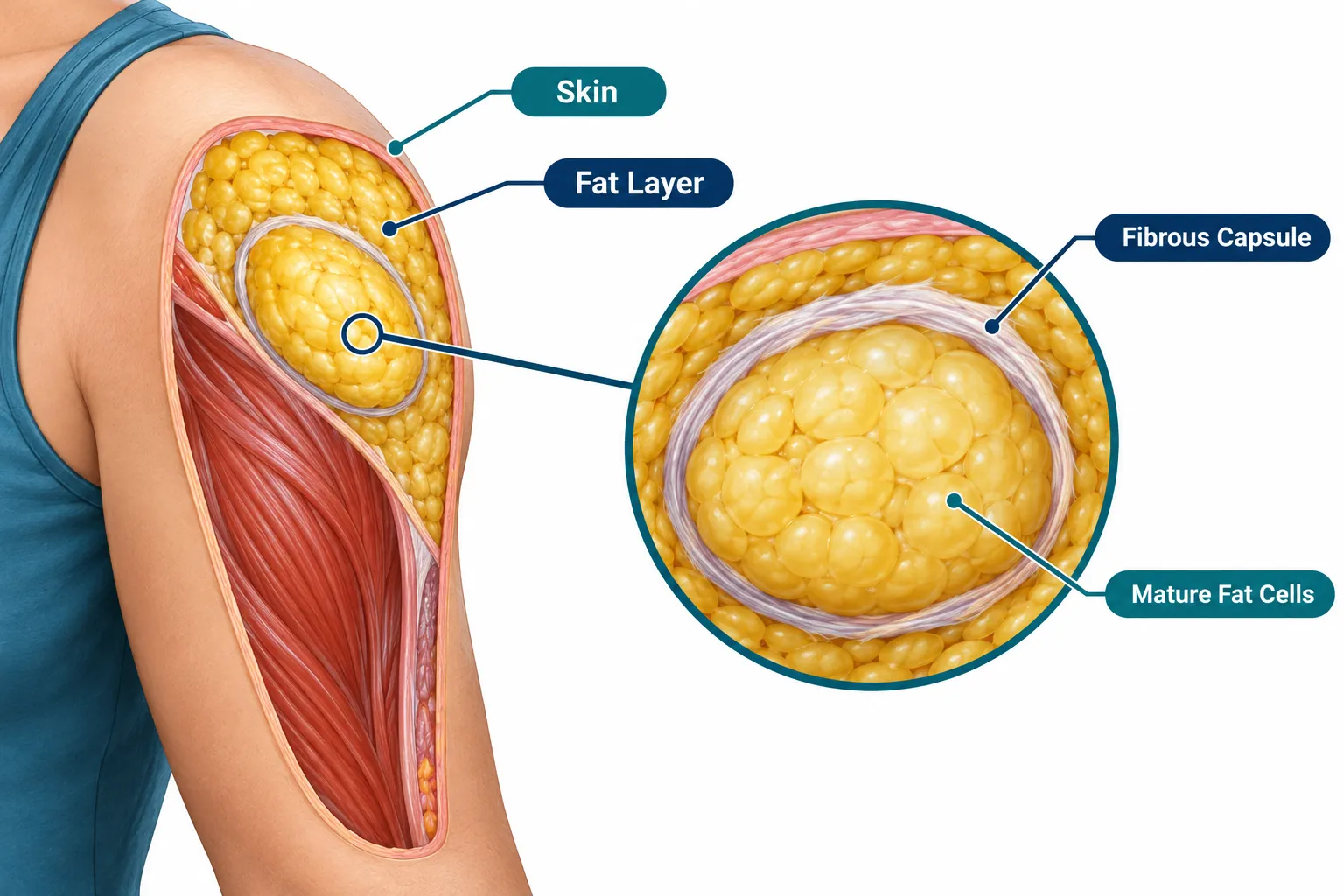
Lipomas form when fat cells cluster together and multiply inside a thin fibrous capsule. Doctors don't fully know why this clustering happens in one spot rather than spreading evenly through the body's fat, but the result is a distinct, encapsulated lump rather than general weight gain. This is why losing weight rarely shrinks an existing lipoma. It sits in its own separate pocket of tissue.
Key features that define a typical lipoma on the arm include:
Lipomas are among the most common soft tissue growths in adults, typically appearing between the ages of 40 and 60, and they occur more often on the trunk and upper limbs than anywhere else on the body.[3][11][12] A lipoma on the arm that has been present and unchanged for years, with no pain and no rapid growth, fits the classic, low-concern presentation that most primary care doctors are comfortable simply monitoring.
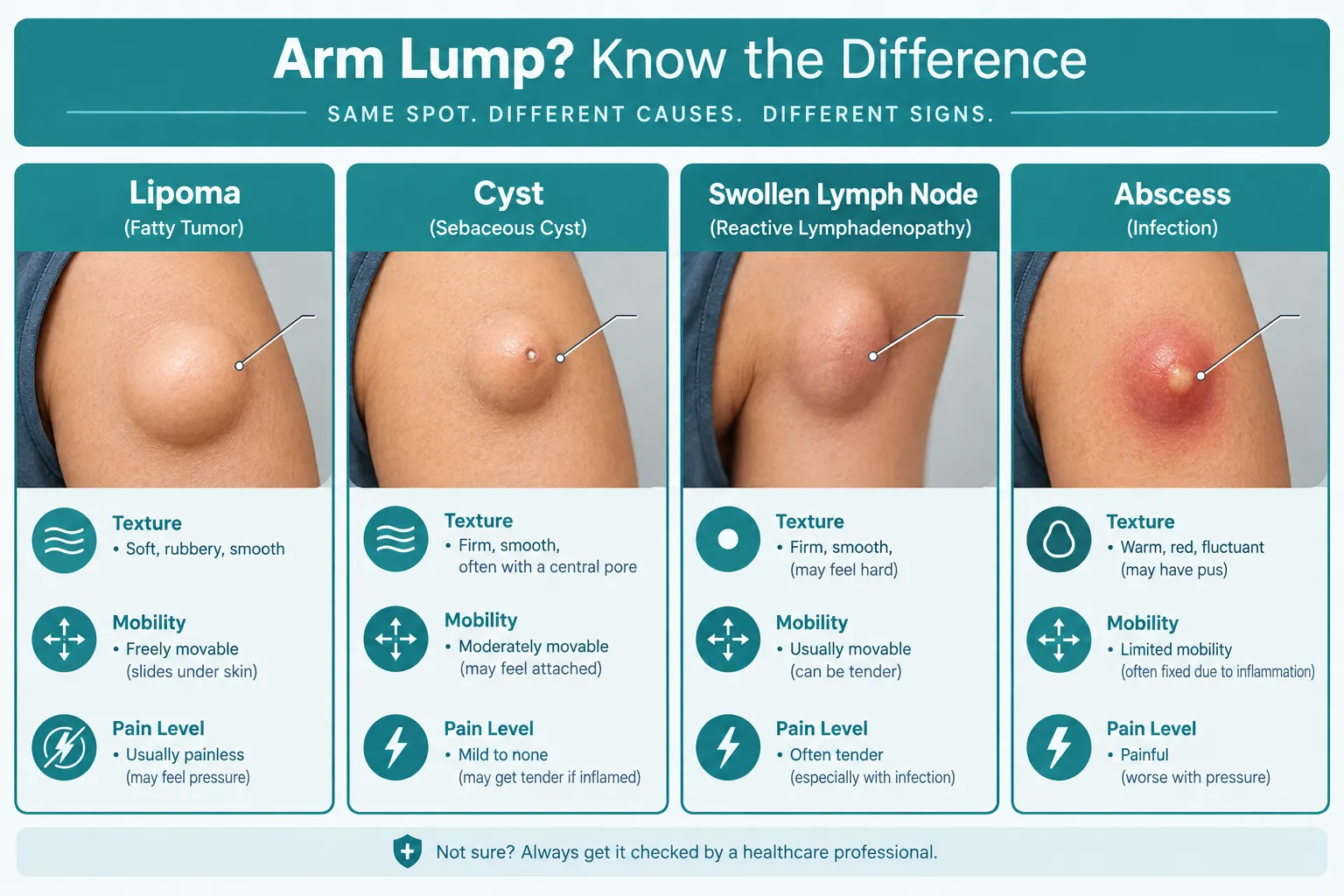
A lipoma feels soft, moves easily under the skin, and grows slowly without pain, while other lumps such as cysts, swollen lymph nodes, or muscle knots tend to feel firmer, fixed in place, or tender. The only way to confirm a lump is truly a lipoma is a physical exam by a clinician, sometimes backed up by ultrasound or a biopsy.
A lipoma is fat tissue growing in a capsule under the skin, while a cyst is a fluid- or keratin-filled sac that often has a small visible central opening called a punctum. Both can look similar at first glance, but a doctor can usually tell them apart by feel and by checking for that central pore.
FeatureLipomaCystTextureSoft, doughy, rubberyFirmer, sometimes fluctuantCentral pore (punctum)AbsentOften presentMobility under skinMoves freelyMay feel more attached to skinRisk of infection or drainageVery lowCan become inflamed or drain fluidGrowth speedSlow, over months to yearsCan appear or enlarge more suddenly
Other lookalikes worth knowing about on the arm include:
Decision rule: if the lump is soft, painless, mobile, and has been stable for months, it is very likely a simple lipoma. If it is tender, fixed, has a visible pore, or is growing quickly, get it examined rather than guessing. A useful resource for sorting out lookalike lumps is this guide on differentiating lipomas from other soft tissue masses, which walks through the exam findings doctors use to tell them apart.
A common mistake is assuming any painless lump is automatically a lipoma. Painless is a good sign, but it is not a diagnosis on its own; a clinical exam (and imaging when needed) is what actually confirms it.
Arm lipomas are almost always benign, and the chance that a typical lipoma turns into cancer is extremely low. The fatty tumor that does carry cancer risk is called a liposarcoma, and it is a distinct, much rarer condition that tends to behave differently from a normal lipoma from the start.
Features that separate a low-risk lipoma from a lesion that needs closer scrutiny:
UK cancer pathway guidance recommends MRI imaging and referral to a sarcoma service when a fatty arm mass is large, deep, growing quickly, or shows suspicious features on ultrasound, since some of these lesions turn out to be atypical lipomatous tumors or well-differentiated liposarcomas rather than ordinary lipomas.[9] For extremity tumors that do turn out to be atypical, research comparing narrower (marginal) versus wider surgical margins has found no significant difference in recurrence-free survival between the two approaches, which supports function-preserving surgery combined with regular MRI follow-up rather than more extensive, disfiguring resection.[2][4]
A soft, mobile, slow-growing lump on the arm is reassuring. A firm, fixed, fast-growing, or deep lump is not something to self-diagnose.
For a deeper look at how doctors distinguish a harmless lipoma from a lesion that needs oncology input, see this explainer on whether a lipoma can turn into cancer.
Edge case: painful lipomas are sometimes a variant called an angiolipoma, which contains extra blood vessels. These are still benign but often warrant removal simply for symptom relief. A full breakdown is available in this guide to angiolipoma and painful lipoma treatment.
Lipomas tend to run in families and become more common with age, but there is no single confirmed cause that explains why one person develops them and another doesn't. Genetics, age, and certain inherited conditions play a bigger role than diet or lifestyle alone.
Known and suspected contributing factors include:
A common question is whether diet or exercise can prevent or shrink lipomas. Because a lipoma is a separate, encapsulated growth rather than ordinary body fat, standard weight loss strategies don't reliably reduce it. This guide on whether exercise or diet can shrink lipomas explains why the fat inside a lipoma behaves differently from the fat your body burns for energy.
Decision rule: if lipomas are appearing in multiple family members or across many body sites at once, mention this to a doctor. That pattern is more consistent with an inherited lipomatosis syndrome than with random, isolated growths.
Yes, having more than one lipoma on the same arm is common and does not automatically signal a serious problem. Many people develop two or three small lipomas in the same general area over time, especially as they get older.
That said, a few patterns are worth flagging to a doctor:
Quick example: someone in their 50s who notices a second, smaller lump form near an existing long-standing lipoma on the forearm, with no pain and no rapid change, is describing a very ordinary pattern that usually just needs routine monitoring, not urgent workup.
Lipomas almost never disappear without treatment. They are made of stable, encapsulated fat tissue, and unlike a cyst or abscess, there is no fluid to drain or infection to resolve, so the body does not reabsorb them.
A few clarifications people often get wrong:
Common mistake: waiting for a lipoma to shrink on its own before deciding whether to treat it. Since spontaneous resolution is not a realistic expectation, the better approach is to decide based on whether the lump is symptomatic or bothersome, not on hoping it will vanish.
If a lump attributed to a "lipoma" does shrink and disappear within days to weeks, it was likely a cyst, swelling, or hematoma rather than a true lipoma, and that change in itself is a reason to get the original diagnosis re-checked.
A lipoma on the arm that keeps growing should be evaluated by a doctor, ideally with a physical exam and possibly imaging, rather than watched indefinitely. Continued growth doesn't automatically mean cancer, but it changes the risk calculation enough to warrant a professional look.
Steps to take if an arm lipoma is enlarging:
Edge case: a lipoma that was stable for years and then suddenly starts growing after an injury to the same arm should still be checked, since post-traumatic changes in a longstanding lump are not typical lipoma behavior and deserve a fresh look rather than an assumption that it's "just the same lipoma changing."
Yes, a lipoma on the arm can be removed, and surgical excision is the standard, most reliable way to eliminate it for good. Removal is typically recommended when the lipoma is painful, growing, limiting movement, or cosmetically bothersome, rather than for every lipoma automatically.[3][4][11]
Main treatment paths for an arm lipoma include:
Choosing between a dermatologist and a general or minor surgery specialist for excision depends on the lipoma's size, depth, and location relative to nerves. This comparison of a dermatologist versus a general surgeon for lipoma removal breaks down which specialist typically handles which cases.
Primary care dermatology guidance is clear that excision should only be performed by practitioners trained in skin surgery who understand the arm's local anatomy and know how to close the surgical space properly to prevent fluid buildup or a poor scar.[13] The Merck Manual and current StatPearls guidance both confirm that complete removal of the lipoma along with its capsule remains the standard definitive treatment, and that a cosmetically thoughtful incision placement matters on a visible site like the arm.[3][12]
Decision rule: choose observation if the lipoma is small, soft, painless, and stable. Choose excision if it's painful, enlarging, limiting arm motion, or simply unwanted for cosmetic reasons. There is no medical requirement to remove every lipoma, but there's also no reason to avoid removal if it's genuinely bothering you.
Non-surgical treatment for an arm lipoma mainly means steroid injections for partial shrinkage, since no medication or cream currently eliminates a lipoma completely. Newer injection-based and energy-based therapies are being studied, but they remain investigational rather than standard care.
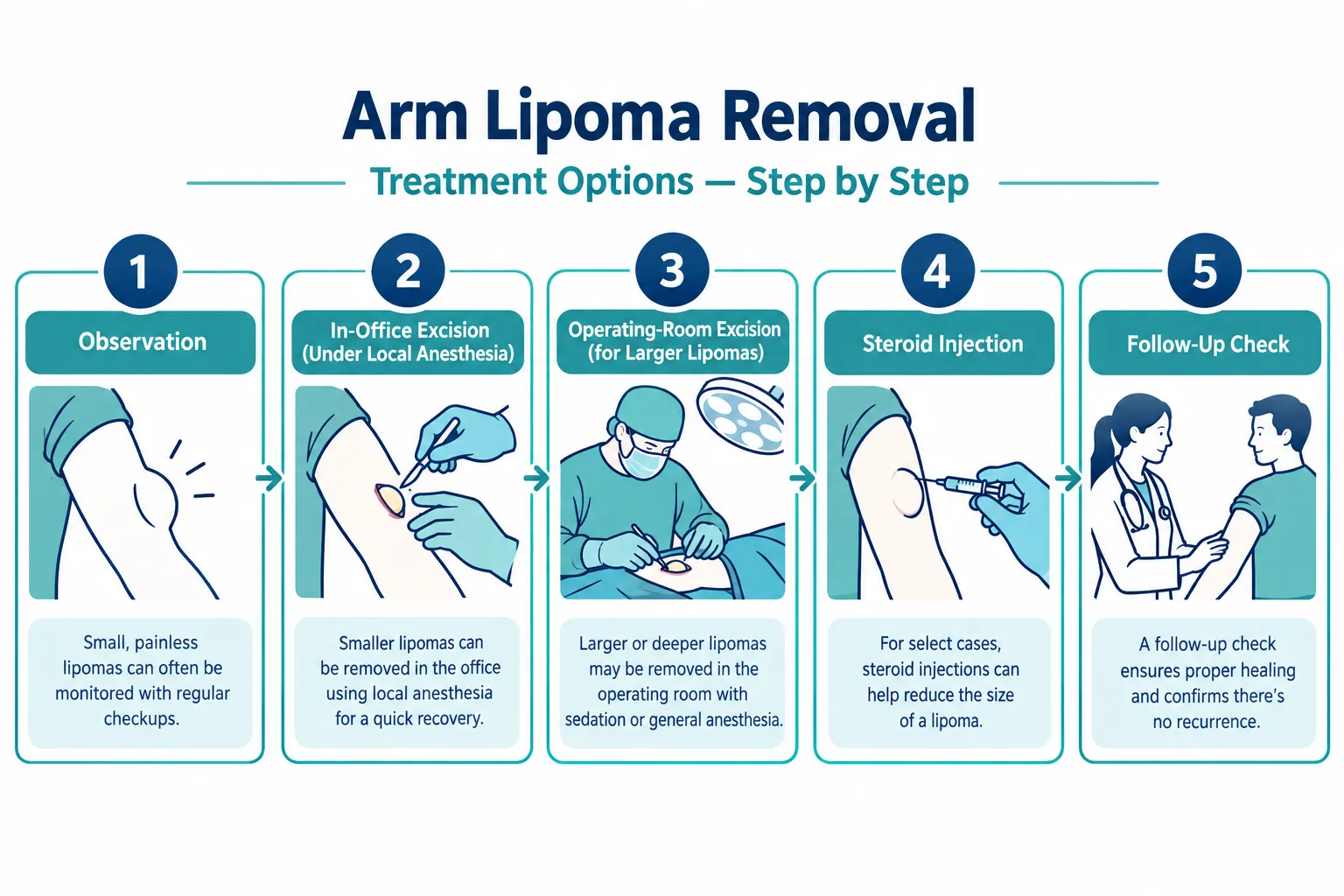
Options currently available or being researched:
Creams and topical products marketed for "dissolving" lipomas are not medically supported, since a lipoma sits beneath the skin's surface and topical ingredients cannot reach or break down that fat pocket. A detailed look at this claim is available in this article on whether a lipoma can be removed without surgery using creams.
Common mistake and real danger: attempting to squeeze, cut, or otherwise remove a lipoma at home. Because a lipoma has a fibrous capsule and sits near nerves and blood vessels, DIY attempts risk infection, bleeding, incomplete removal, and scarring far worse than a professional excision would leave. This guide on the real dangers of DIY lipoma removal covers exactly what can go wrong.
Choose non-surgical treatment if: the lipoma is small, you want partial size reduction without a scar, and you understand it likely won't fully disappear. Choose surgical excision if: you want the lipoma gone completely and are comfortable with a small, well-placed incision.
Lipoma removal costs vary widely based on the lipoma's size, depth, location, whether it's done in-office under local anesthesia or in an operating room, and regional pricing differences, so there is no single universal price. In-office excision of a small, superficial lipoma is generally far less costly than operating-room removal of a large or deep lesion.
Factors that most influence the final cost:
For readers comparing providers in specific regions, resources like this overview of lipoma clinics in Toronto with cost and technique comparisons or clinic-specific pages for areas such as Mississauga, Woodbridge and Vaughan, Whitby, York Mills, Etobicoke, and Toronto's broader minor surgery center can give a clearer local picture of what to expect.
Practical tip: ask any clinic for a written quote that specifies whether it includes the initial consultation, the procedure itself, local anesthesia, and pathology review, since some quotes list only the base procedure fee.
Recovery from arm lipoma removal is generally quick for small, superficial lipomas, with most people resuming light daily activities within a few days and full healing over a couple of weeks. Larger excisions or operating-room procedures naturally take somewhat longer to heal.
Typical recovery pattern:
Possible complications, while uncommon with proper technique, can include infection, fluid collection under the skin (seroma), bruising, or a less-than-ideal scar. This detailed rundown of complications from lipoma removal explains what these look like and how they're managed if they occur.
Recurrence after complete surgical excision is low: one 2026 clinical summary cites a recurrence risk of roughly 0.8 percent when the capsule is fully removed, making surgery close to a permanent solution for most people.[4][8]
Decision rule: choose in-office excision recovery expectations (days to light activity) if the lipoma is small and superficial. Expect a longer, more cautious recovery timeline if the lipoma was large, deep, or removed under sedation in an operating room.
Lipoma removal scars on the arm are usually a thin line that fades significantly over several months to a year, and how noticeable it stays depends on incision size, surgical technique, skin type, and aftercare. A well-placed, well-closed incision on the arm often becomes quite subtle over time.
Factors that affect final scar appearance:
Seeing real before-and-after examples is often the best way to set realistic expectations. This resource showing before and after photos of lipoma removal illustrates how much scars typically fade over time on different body areas.
Quick example: a 3 cm lipoma removed in-office through a well-placed incision commonly leaves a scar under 3 to 4 cm that, after a year, appears as a thin, pale line easily mistaken for a minor old scratch.
See a doctor about an arm lipoma if it grows quickly, becomes painful, feels hard or fixed rather than soft and mobile, sits deep under the muscle, or exceeds roughly 5 centimeters. These features shift the situation from "watch and wait" to "get it evaluated."[4][9]
Checklist for when evaluation is warranted:
Common mistake: assuming that because a lump is painless, it never needs a doctor's opinion. Painless is reassuring, but a first-time evaluation to confirm the diagnosis is still worthwhile, especially for a new lump that hasn't been checked before.
If any of the checklist items apply, the next reasonable step is a visit to a primary care doctor, dermatologist, or minor surgery clinic for an exam and, if needed, imaging referral.
A lipoma on the arm is, in the overwhelming majority of cases, a soft, harmless, slow-growing fatty lump that doesn't require urgent action. It rarely turns cancerous, it won't disappear on its own, and it can be safely observed if it's small, painless, and stable. Removal becomes the right call once a lipoma starts growing, causing pain, limiting arm movement, or simply bothering you enough to want it gone, and surgical excision remains the most reliable way to eliminate it for good, with a very low chance of it coming back.
Next steps worth taking:
Getting an accurate diagnosis early gives the most options and the best outcome, whether that means simple reassurance or a straightforward, well-planned removal.
Is a lipoma on the arm always benign?
Almost always. Standard lipomas are benign fatty growths, and malignant transformation is extremely rare; the rare cancerous version, liposarcoma, tends to look and behave differently from the start.[3][11][12]
Can a lipoma on the arm be a sign of something serious?
Usually not, but a lump that is large, deep, fast-growing, firm, or painful should be checked, since these features can occasionally indicate an atypical lipomatous tumor rather than a simple lipoma.[9]
Does removing an arm lipoma leave a big scar?
Not typically. Scar size generally matches incision length, and careful closure technique on the arm usually results in a thin scar that fades substantially within a year.[13]
Will my arm lipoma come back after surgery?
Recurrence is uncommon when the lipoma and its full capsule are removed, with one clinical summary citing a recurrence rate of about 0.8 percent.[4][8]
Can I just leave a lipoma on my arm alone?
Yes, if it's small, soft, painless, and stable in size, observation without treatment is a medically reasonable choice.[3][4]
Do creams or supplements shrink lipomas?
No. There's no credible evidence that topical creams dissolve a lipoma, since the growth sits beneath the skin's surface, out of reach of topical ingredients.
How painful is lipoma removal surgery?
Most in-office excisions are done under local anesthesia, so the area is numbed during the procedure, with mild soreness for a few days afterward as it heals.
Are there truly non-surgical treatments for arm lipomas?
Steroid injections can shrink a lipoma partially, and newer options like deoxycholic acid injections and focused ultrasound are being studied, but none currently offer a guaranteed, complete non-surgical cure.[1][2][7][8]
Why do I have more than one lipoma on the same arm?
Multiple lipomas in one area are common as people age and are usually still benign; widespread or rapidly appearing lipomas can point to an inherited lipomatosis condition worth mentioning to a doctor.
Should a dermatologist or a surgeon remove my arm lipoma?
It depends on the lipoma's size, depth, and location near nerves; dermatologists commonly handle smaller, superficial lipomas, while general or minor surgery specialists often manage larger or deeper ones.
[1] What Are The New Treatments For Lipomas - https://biologyinsights.com/what-are-the-new-treatments-for-lipomas/
[2] Evolving Of Lipomatous Neoplasms - https://www.theminorsurgerycenter.com/blog/evolving-of-lipomatous-neoplasms
[3] Lipomas - https://www.merckmanuals.com/professional/dermatologic-disorders/benign-skin-tumors-growths-and-vascular-lesions/lipomas
[4] Lipoma - https://www.orthoinfo.org/diseases--conditions/lipoma
[7] Trials - https://www.cancerindex.io/cancer/lipoma/trials
[8] Can A Lipoma Turn Into Cancer - https://www.theminorsurgerycenter.com/blog/can-a-lipoma-turn-into-cancer
[9] Lipoma Pathway - https://www.swagcanceralliance.nhs.uk/wp-content/uploads/2020/10/Lipoma-pathway.pptx
[10] Lipoma - https://clinicaltrials.gg/conditions/lipoma
[11] Can Lipomas Turn Into Cancer - https://www.theminorsurgerycenter.com/blog/can-lipomas-turn-into-cancer
[12] Differentiating Lipomas From Other Soft Tissue Masses - https://www.theminorsurgerycenter.com/blog/differentiating-lipomas-from-other-soft-tissue-masses
[13] Dermatologist Or A General Surgeon For Lipoma Removal - https://www.theminorsurgerycenter.com/blog/dermatologist-or-a-general-surgeon-for-lipoma-removal
[15] Angiolipoma Painful Lipoma Treatment A Complete - https://www.theminorsurgerycenter.com/blog/angiolipoma-painful-lipoma-treatment-a-complete