
Last updated: August 19, 2026
OHIP rarely covers lipoma removal in Ontario. Coverage only applies when a doctor documents medical necessity, such as significant pain, restricted movement, nerve compression, or uncertainty about whether the lump is cancerous. Lipoma removal requested purely for appearance is classified as cosmetic and is billed privately, typically ranging from a few hundred to over a thousand dollars depending on size and location [1][3].
A lipoma is a soft, slow-growing lump made of fatty tissue that sits just under the skin. Most people seek removal either because the lump bothers them cosmetically, because it has started to hurt or press on a nerve, or because they want to confirm it isn't something more serious [7].
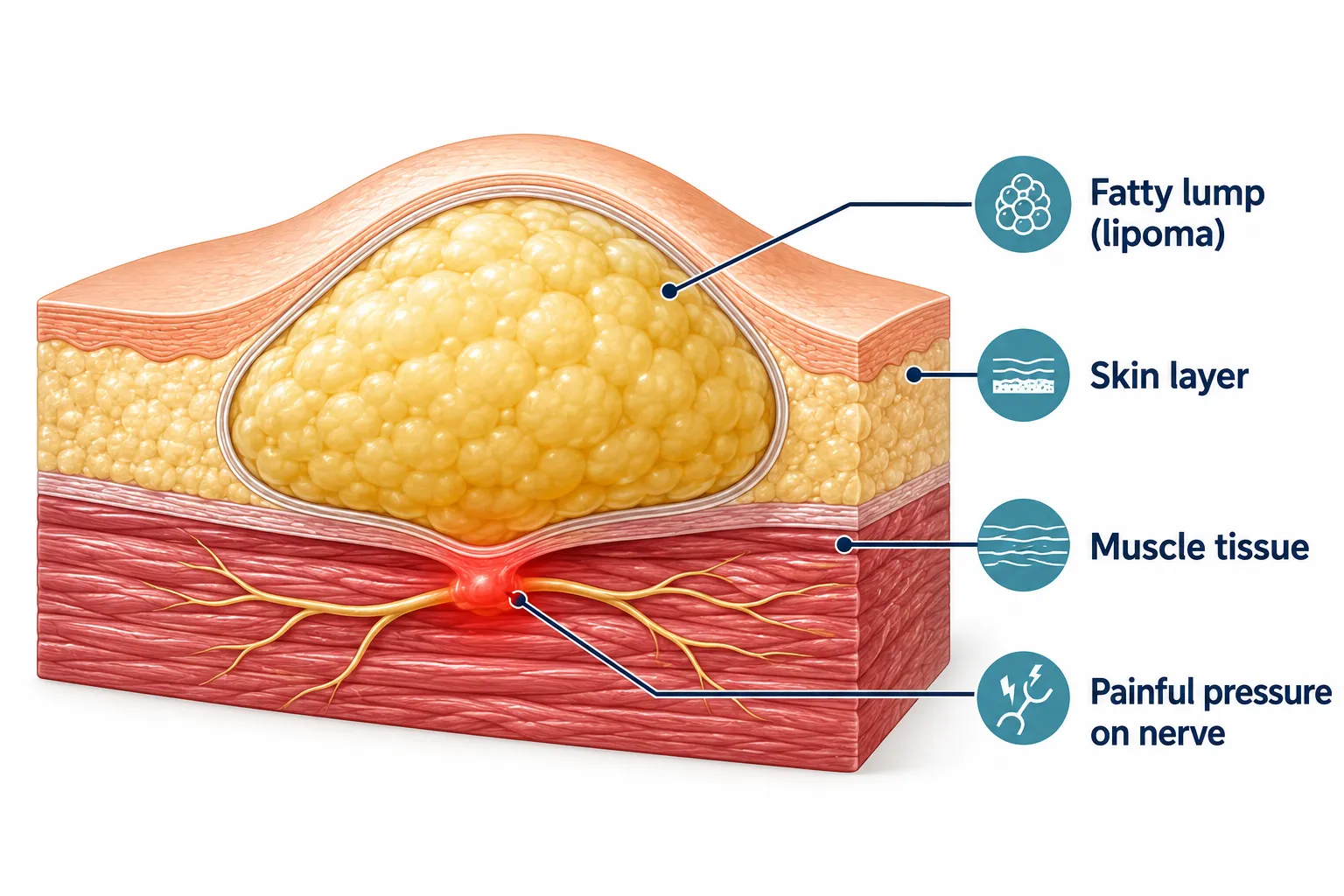
Lipomas are the most common type of soft-tissue tumor, and the vast majority are completely benign. They tend to show up on the trunk, arms, shoulders, neck, and thighs, though they can appear almost anywhere fat tissue exists, including the face and forehead. A lipoma usually feels rubbery, moves slightly when pressed, and grows very slowly over months or years.
People typically ask about removal for one of these reasons:
Understanding which of these categories applies matters enormously in Ontario, because it directly determines whether OHIP will pay for the procedure. A lump removed strictly for looks is treated very differently from one removed because it is pressing on a nerve. For a deeper look at how lipomas compare to more concerning growths, see this guide on lipoma versus liposarcoma symptoms and this comparison of lipoma versus lymphoma.
In most cases, no. OHIP does not cover lipoma removal surgery in Ontario when the lump is small, painless, and removed for appearance alone, because the Ministry of Health classifies this as an unessential, cosmetic procedure [1]. Coverage is possible, but only when a physician can document a clear medical reason for the surgery.
Ontario's public health insurance system was built to pay for medically necessary care, not elective or appearance-driven procedures. The Schedule of Benefits for Physician Services, maintained by the Ministry of Health, spells out which services are insured and under what conditions [3]. Dermatology and minor surgery billing codes distinguish between medically necessary excisions and those performed for cosmetic reasons [2][9].
As of 2026, billing codes related to lipoma excision, including updates made in April 2026 covering smaller lipomas and those on the face or neck, confirm that OHIP does pay physicians when the excision meets medical-necessity criteria [6]. The core principle from the Schedule of Benefits, however, remains unchanged: a benign fatty lump that causes no functional problem is not an insured service, regardless of where on the body it sits [3].
Pull quote: "The general rule in Ontario is simple: if a lipoma isn't causing a documented medical problem, OHIP treats its removal as cosmetic, and cosmetic procedures are not insured services." [1]
Clinical guidance circulating among Ontario minor-surgery providers in 2025 and 2026 echoes this: OHIP "almost never" pays for lipoma removal, with only narrow exceptions carved out for pain, nerve involvement, or diagnostic uncertainty [5][7]. This is consistent with how OHIP treats other benign skin and soft-tissue growths, such as most moles, cysts, and skin tags, which are also considered cosmetic unless they show worrying features. For context on how this plays out with a related growth type, see this explanation of whether mole removal is covered by OHIP [8].
Decision rule: Choose to pursue the OHIP pathway if a doctor can point to a specific functional or diagnostic reason for removal. Choose the private-pay pathway if the lipoma is stable, painless, and the main concern is appearance or convenience.
Lipoma removal in Ontario without OHIP coverage typically costs between roughly $300 and $1,500 or more per lipoma, depending on size, location, complexity, and whether the procedure happens at a private clinic or through a plastic surgeon [4]. Larger lipomas, those on the face, or those requiring more extensive closure tend to cost more.
Private minor-surgery clinics in Ontario generally price lipoma removal based on a few factors:
FactorHow it affects costSize of the lipomaLarger lumps require bigger incisions and more suturing timeLocation on the bodyFacial or neck lipomas often cost more due to precision and cosmetic closure needsNumber of lipomasMultiple lipomas removed in one visit may have a bundled rateDepth and complexityDeeper lipomas near muscle or nerves take longer and cost moreClinic typePrivate minor-surgery clinics are often more predictable in pricing than hospital-based cosmetic surgery
Because pricing varies clinic to clinic, it's worth getting a written quote before booking. For a detailed regional breakdown, see this Toronto lipoma removal cost guide for 2026 and this general overview of lipoma removal costs. A shorter primer is also available at how much does lipoma removal cost.
Common mistake: Assuming a quote for one lipoma automatically covers a second or third lump. Many clinics price per lesion, so multiple lipomas usually mean multiple charges, even during the same visit.
Quick example: A patient with a single 2 cm lipoma on the forearm, removed at a private Ontario clinic purely for cosmetic reasons, might pay a flat fee covering the consultation, local anesthesia, excision, and follow-up. A patient with a larger lipoma on the back, or one requiring pathology testing to rule out liposarcoma, would likely pay more due to added lab and surgical time.
OHIP will only consider covering lipoma removal when a physician documents medical necessity, meaning the lump causes pain, nerve compression, restricted movement, rapid or unusual growth, or diagnostic uncertainty about whether it might be cancerous. Meeting one or more of these criteria does not guarantee approval, but it is required before OHIP will pay anything toward the procedure [1][3].
The criteria generally fall into these categories:
If none of these apply, the removal is classified as cosmetic, and OHIP will not pay, regardless of how much the lipoma bothers the patient emotionally or how large it has become. This is consistent with how OHIP treats most benign skin lesions across dermatology billing more broadly [2][9][10].
Common reasons OHIP denies or excludes coverage:
Decision rule: If a family doctor can write in the chart that the lipoma causes pain, limits movement, or raises diagnostic concern, there is a real chance of OHIP coverage. If the only complaint is "I don't like how it looks," plan for private payment instead.
Yes, pain and mobility issues are among the strongest grounds for OHIP coverage, but the physician must clearly document how the lipoma is causing these problems. A lump that simply "feels a bit sore sometimes" is less likely to qualify than one causing consistent, functionally limiting pain confirmed on physical exam.
Angiolipomas, a subtype containing small blood vessels, are more likely to be genuinely painful than standard lipomas. If a lipoma sits over or near a joint, tendon sheath, or major nerve pathway (such as near the elbow, wrist, or shoulder), restricted movement becomes a more credible clinical finding. For more detail on painful subtypes, see this guide on angiolipoma and painful lipoma treatment.
What strengthens a pain- or mobility-based claim:
Edge case: A lipoma on the back of the thigh can become genuinely uncomfortable during prolonged sitting, which some patients successfully document as a functional problem. Details on this presentation are covered in this article on lipomas on the thigh. A lump near the sacrum with nerve-like symptoms is discussed in this piece on episacral lipomas.
Common mistake: Waiting until the pain becomes severe before mentioning it to a doctor. Early, consistent documentation of symptoms creates a stronger paper trail if a coverage decision is ever questioned or appealed.
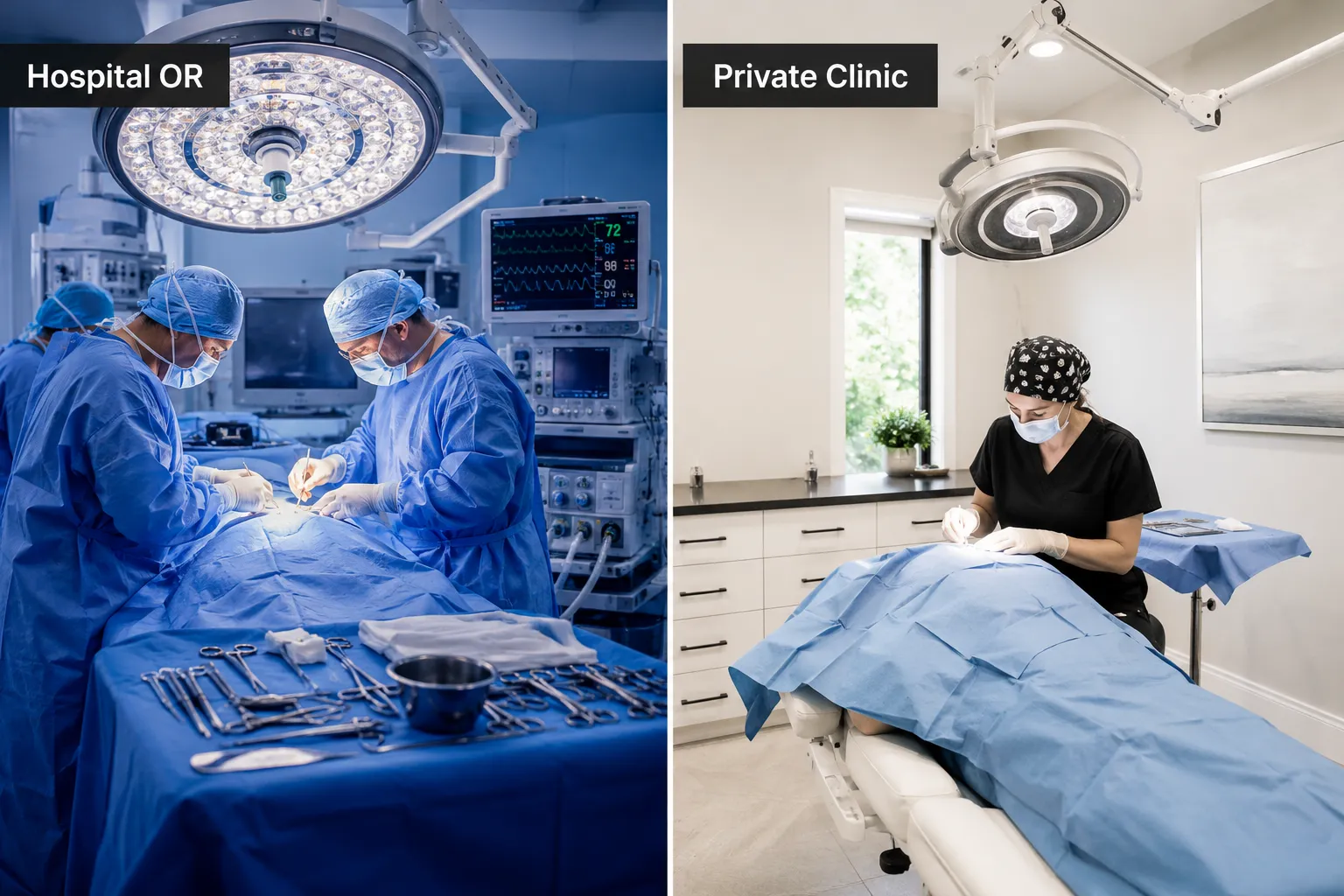
The main difference is cost, wait time, and setting: hospital-based removal follows the OHIP-funded referral pathway with no direct patient cost but longer waits, while private clinic removal is typically self-pay with faster scheduling and a more predictable, streamlined experience. Both settings can perform the same basic excision technique for a straightforward lipoma.
FactorHospital / OHIP PathwayPrivate ClinicCost to patientFree if approved as medically necessaryPaid out of pocket, flat feeWait timeWeeks to months for referral and surgical bookingOften days to a few weeksReferral neededYes, usually from a family doctorOften not required, or minimal paperworkSettingHospital operating room or outpatient surgical clinicDedicated minor-surgery clinicAnesthesiaLocal, sometimes general for complex casesAlmost always local anesthesiaBest forCases with clear pain, nerve involvement, or cancer concernCosmetic removal, faster timelines, smaller lipomas
Private minor-surgery clinics in Ontario, including locations across the Greater Toronto Area and surrounding regions, focus specifically on lump and lesion removal using local anesthesia in an outpatient setting. This model tends to suit patients who don't meet OHIP's medical-necessity bar but still want the lipoma gone without waiting on a hospital referral system. Regional examples include clinics serving Oakville, Woodbridge and Vaughan, and Mississauga.
Decision rule: Choose the hospital/OHIP pathway if there's a documented medical reason and the patient is willing to wait for a specialist appointment. Choose a private clinic if the priority is speed, convenience, or the case is cosmetic and won't qualify for OHIP anyway.
For a sense of how long the actual excision itself takes once booked, see this breakdown of how long lipoma removal surgery takes.
Wait times for OHIP-covered lipoma removal typically range from several weeks to a few months, depending on referral processing, specialist availability, and regional surgical capacity. There is no fixed province-wide standard wait time published specifically for lipoma excision, so timelines vary by community and by how urgent the physician marks the referral.
The general sequence looks like this:
Rural and smaller-population areas sometimes have shorter specialist wait times but fewer surgical slots, while larger urban centers may have faster referral turnaround but busier surgical schedules. Cases with clear functional urgency (nerve compression, rapid growth, cancer suspicion) tend to get prioritized ahead of stable, low-concern lipomas.
Quick example: A patient with a painless lipoma that doesn't meet OHIP criteria and instead books at a private clinic can often have the lump removed within one to three weeks of their first phone call, compared to a multi-month timeline through the referral-based public system.
Common mistake: Assuming the referral alone guarantees quick treatment. A referral only starts the process; actual surgical booking is a separate step that depends on specialist and facility availability.
No. OHIP does not cover lipoma removal requested for cosmetic reasons, meaning appearance alone is not a valid basis for public funding, no matter how visible or bothersome the lump feels to the patient. This mirrors how OHIP treats other benign skin conditions across dermatology [1][2][9].
The Schedule of Benefits distinguishes between insured services (medically necessary) and uninsured services (cosmetic or elective) [3]. A lipoma on the forehead that a patient finds embarrassing but that causes no pain, no nerve issue, and no functional limitation falls squarely into the cosmetic category. This is true even for highly visible locations like the face. For more on facial presentations specifically, see this guide on facial lipomas, causes, removal options, and minimizing scarring and this piece on lipomas on the forehead.
Some patients try to reframe a cosmetic request as a medical one by emphasizing "psychological distress" or "self-consciousness." While real, this framing rarely meets OHIP's bar, because the Schedule of Benefits focuses on physical function and diagnosis, not emotional impact, when defining medical necessity [3].
Edge case: If a facial lipoma grows quickly or changes texture, a doctor may order removal partly for diagnostic reasons (ruling out something more serious). In that scenario, OHIP may cover the excision even though the lump is on a cosmetically sensitive area, because the driving reason is diagnostic, not aesthetic.
Decision rule: If the honest answer to "why do you want this removed" is "I don't like how it looks," plan for private payment. If the honest answer includes pain, function, or a doctor's concern about the diagnosis, there's a real chance OHIP applies.
Yes, in nearly all cases, patients need a referral from a family doctor or nurse practitioner before OHIP will consider covering lipoma removal by a specialist. The referral documents the initial assessment and justifies why a surgical consultation is medically warranted.
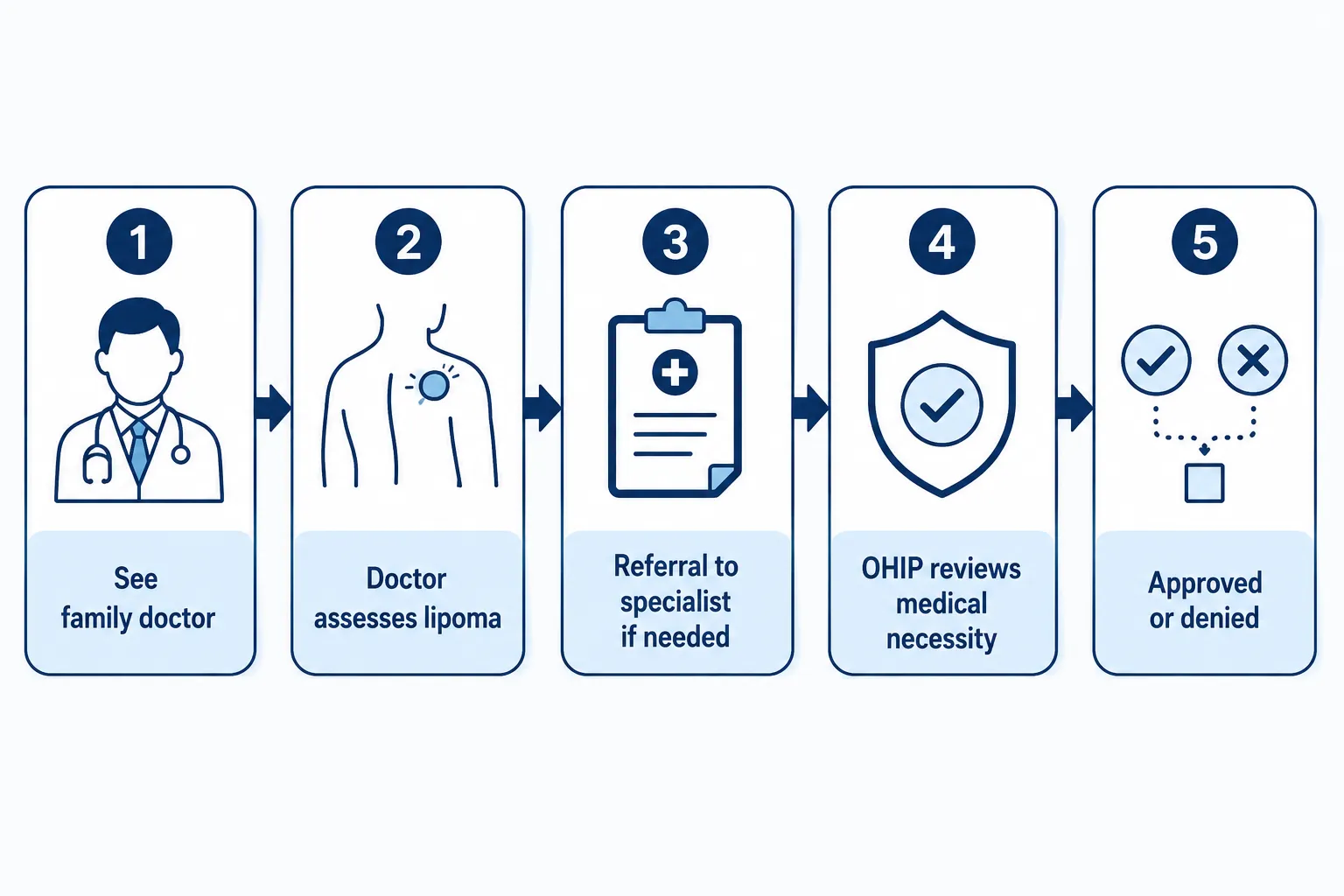
The OHIP-funded pathway generally requires:
Without a documented referral and a clear medical reason on file, most surgical or dermatology practices will simply treat the request as a private, self-pay cosmetic procedure. Patients without a family doctor can sometimes get a referral through a walk-in clinic, though continuity of documentation is harder without an ongoing patient-doctor relationship.
Common mistake: Going directly to a private cosmetic clinic and expecting it to bill OHIP afterward. Private minor-surgery clinics generally do not process OHIP claims for lipoma removal, because most requests they receive are cosmetic by nature. If OHIP coverage is genuinely the goal, the referral route through a family doctor is the correct starting point.
There is no separate "application form" for lipoma removal coverage; instead, coverage is determined case by case through the standard referral and physician-billing process. The family doctor's documentation and the specialist's assessment together decide whether the excision qualifies as an insured service.
Step-by-step process:
There's no online OHIP portal where patients submit their own lipoma-removal request; the decision flows through the treating physician's clinical judgment and billing codes tied to the Schedule of Benefits [3][6].
Quick example: A patient whose lipoma has grown from 2 cm to 5 cm over six months, with new tingling in the fingers, should mention both the growth rate and the nerve symptom specifically during the family doctor visit. That combination of documented findings is far more likely to support an OHIP-covered referral than a general statement like "I want this looked at."
If OHIP denies coverage, the patient can request more documentation from their doctor, seek a second opinion from another physician or specialist, or choose to pay privately at a minor-surgery clinic. There is no dedicated appeals tribunal specifically for cosmetic-classification denials the way there is for some other health coverage decisions, so the practical options are limited but real.
Reasonable next steps after a denial:
Common mistake: Assuming a denial is final and unappealable through any means. While there's no guaranteed reversal process, doctors can resubmit referrals with stronger documentation, and specialists can reassess if symptoms change or worsen.
Edge case: Some patients discover mid-way through a private cosmetic consultation that their lipoma actually shows atypical features warranting a pathology check. In that scenario, the private clinic may recommend returning to the family doctor for an OHIP-eligible referral instead of proceeding privately, since diagnostic uncertainty can shift a case into medically necessary territory.
No, non-surgical alternatives to lipoma excision, such as steroid injections or liposuction techniques, are generally not covered by OHIP either, since they fall under the same cosmetic or elective classification as surgical removal when there's no documented medical necessity [7]. The delivery method doesn't change the underlying coverage rule.
Non-surgical options patients sometimes consider include:
Because none of these alternatives meaningfully change the medical-necessity calculation, patients hoping for OHIP coverage still need to establish a documented physical reason for treatment, regardless of which removal method is eventually chosen.
Decision rule: Choose watchful waiting if the lipoma is small, stable, and not bothersome. Choose a private procedure (surgical or liposuction-assisted) if the goal is removal without meeting OHIP's medical-necessity bar. Pursue the referral pathway only if there's a genuine, documentable medical reason.
If a lipoma recurs after removal, the first step is a follow-up exam with the treating physician to confirm it's truly the same growth returning rather than a new lipoma, and to reassess whether repeat removal would qualify for OHIP coverage under the same medical-necessity criteria. Recurrence itself doesn't automatically make future removal covered.
Why lipomas sometimes come back:
What to do about recurrence:
Common mistake: Assuming that because the first removal was private-pay, all future removals must also be private-pay. Each case is assessed on its own current symptoms, so a recurrence causing genuine pain could potentially open the door to OHIP coverage even if the original lump didn't qualify.
For visual reference on what lipomas and their variations typically look like, this visual guide to lipoma pictures can help patients compare their own presentation, and this article on when to seek medical advice for lumps under the skin covers warning signs worth flagging to a doctor.
For most patients, the honest answer to "is lipoma removal covered by OHIP in Ontario" is no, unless a clear medical reason is documented. Use this checklist to figure out which category applies before booking any procedure.
Likely OHIP-eligible if:
Likely private-pay if:
Decision rule in one line: Choose the OHIP pathway only when pain, function, or diagnostic uncertainty is real and documented; choose the private pathway for everything else, including most facial and purely cosmetic cases.
Does OHIP cover lipoma removal if it's painful?
OHIP may cover lipoma removal when a doctor documents genuine, ongoing pain linked directly to the lipoma. Coverage isn't automatic just because a patient reports discomfort; it depends on clinical findings supporting a medical reason.
Is lipoma removal ever considered an emergency under OHIP?
Rarely. Most lipomas are slow-growing and benign, so removal is not usually urgent. An exception would be a rapidly growing or unusual-feeling lump where a doctor wants tissue removed quickly to rule out cancer.
Can a walk-in clinic doctor refer me for OHIP-covered lipoma removal?
Yes, a walk-in clinic physician can write a referral to a specialist if they identify a medical reason for removal. Continuity of care is easier with a regular family doctor, but a walk-in referral can still start the process.
Does OHIP cover lipoma removal on the face?
Facial location alone does not create OHIP eligibility. Facial lipomas are assessed under the same medical-necessity rules as lipomas anywhere else on the body, meaning pain, function, or diagnostic concern must be documented for coverage.
How much does private lipoma removal cost compared to waiting for OHIP?
Private removal in Ontario generally costs a few hundred to over a thousand dollars per lipoma but can often be scheduled within one to three weeks. The OHIP referral pathway is free once approved but can take weeks to months from first doctor visit to surgery date.
Will OHIP cover removal if the lipoma is growing quickly?
Rapid or unusual growth is one of the stronger reasons OHIP may approve coverage, since it raises the possibility of a different diagnosis needing pathology confirmation. A doctor should examine any lipoma that changes size or texture quickly.
Can I get a lipoma removed privately and then bill OHIP afterward?
No. OHIP does not reimburse patients after the fact for privately paid cosmetic procedures. Coverage decisions are made before or during the referral process, not retroactively.
Do multiple lipomas increase the chance of OHIP coverage?
Not automatically. Each lipoma is generally assessed on its own symptoms and impact. Having several lipomas doesn't by itself meet the medical-necessity bar unless one or more are causing documented pain or functional problems.
Is a pathology test on a removed lipoma covered by OHIP?
When a lipoma is removed as part of an OHIP-covered, medically necessary procedure, related pathology testing to confirm the diagnosis is typically covered as part of the insured service. When the removal itself is a private cosmetic procedure, associated lab testing may be billed separately by the clinic.
What's the difference between OHIP coverage and private insurance coverage for lipoma removal?
OHIP is Ontario's public health plan and only covers medically necessary excisions under the Schedule of Benefits. Private extended health insurance plans sometimes cover a portion of cosmetic or elective procedures depending on the individual policy, so it's worth checking directly with the insurer separately from any OHIP determination.
The straightforward answer to "Is lipoma removal covered by OHIP in Ontario?" is that coverage is the exception, not the rule. OHIP pays for lipoma excision only when a physician documents a real medical reason, such as pain, nerve involvement, restricted movement, or diagnostic uncertainty about cancer. Purely cosmetic removal, no matter how bothersome the lump feels, falls outside the Schedule of Benefits and becomes a private, self-pay procedure [1][3].
For patients weighing their options, the practical path forward looks like this:
Patients in the Greater Toronto Area and surrounding regions who decide to pursue private removal can compare options through resources like this comparison of Toronto lipoma clinics, costs, and techniques, which lays out surgeon experience and pricing side by side to help with an informed decision.
[1] Which Cosmetic Procedures Are Covered By Ohip - https://snhhealthcare.com/which-cosmetic-procedures-are-covered-by-ohip.html
[2] Are Dermatologists Covered By Ohip Heres What You Need To Know - https://facetdermatology.com/en-us/blogs/news/are-dermatologists-covered-by-ohip-heres-what-you-need-to-know
[3] Ohip Schedule Benefits And Fees - https://www.ontario.ca/page/ohip-schedule-benefits-and-fees
[4] Lipoma Removal Cost In Toronto 2026 Price Guide - https://www.theminorsurgerycenter.com/blog/lipoma-removal-cost-in-toronto-2026-price-guide
[5] Faqs - https://www.minorsurgery.ca/faqs/
[6] Z097 - https://snapbill.ca/billing-codes/Z097
[7] Lipoma Removal How To Diagnose Treat - https://www.minorsurgery.ca/blog/lipoma-removal-how-to-diagnose-treat/
[8] Is Mole Removal Covered By Ohip - https://themomloft.com/is-mole-removal-covered-by-ohip/
[9] Dermatologists - https://hellosafe.ca/en/health-insurance/ontario/ohip/dermatologists
[10] Dermatology Treatments Are Covered By Ohip 2f8c49141861 - https://medium.com/@nirmalraj16/dermatology-treatments-are-covered-by-ohip-2f8c49141861