

Last updated: May 27, 2026
Quick Answer: A lipoma on the thigh is a benign, slow-growing fatty tumor that can sit either just beneath the skin (superficial) or deep within the muscle tissue (intramuscular). Most thigh lipomas are harmless and don't require removal. However, deep lipomas, rapidly growing lumps, painful masses, or any growth that limits movement should be evaluated promptly by a surgeon. Surgical excision remains the only proven, permanent treatment.
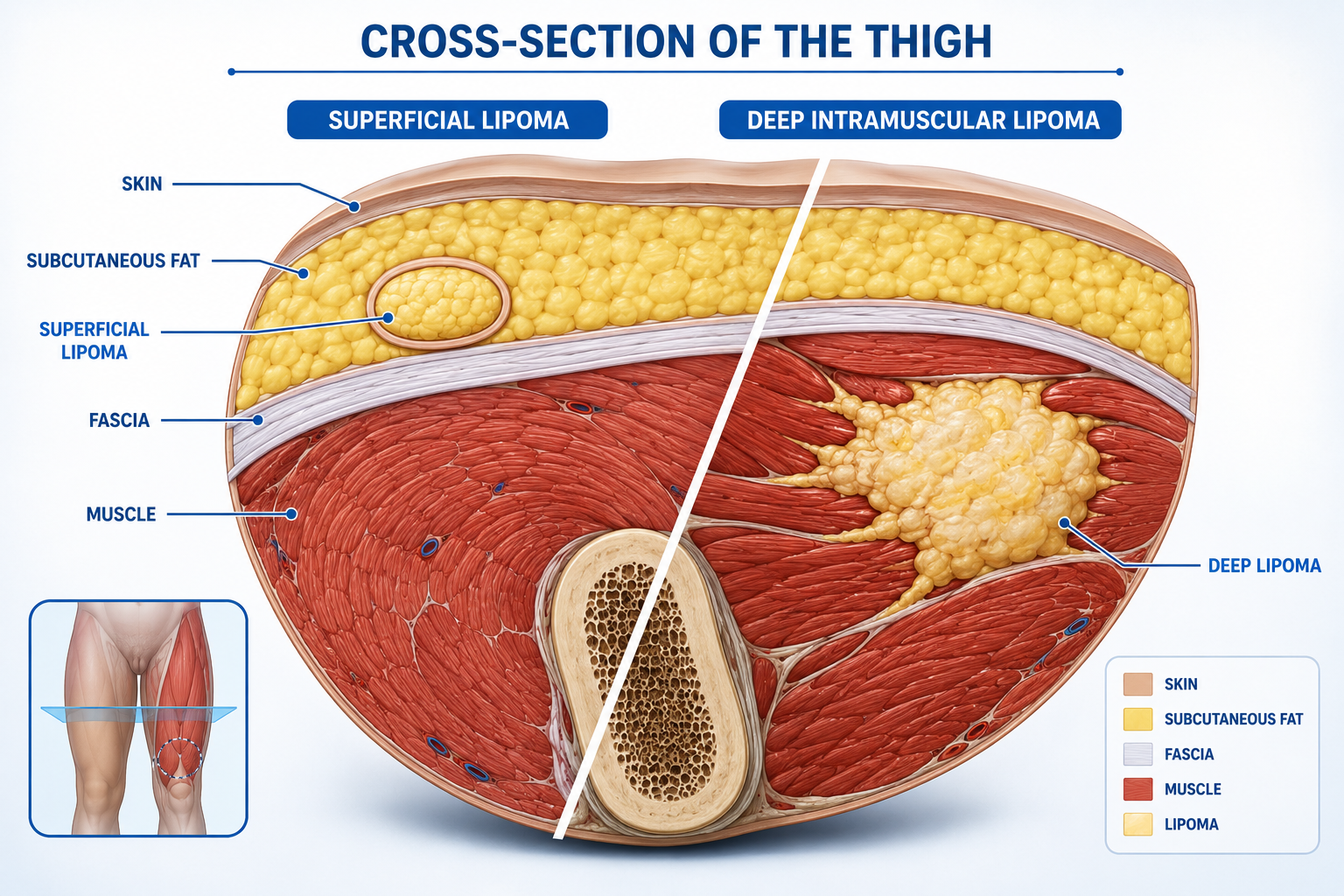
A lipoma is a non-cancerous overgrowth of fat cells that clusters into a soft, encapsulated mass beneath the skin. They're the most common soft-tissue tumors in adults, with an estimated prevalence of roughly 1 in 100 people according to data cited in dermatology literature (StatPearls, 2023).
Lipomas form when a group of fat cells multiplies abnormally and becomes enclosed in a thin fibrous capsule. The exact trigger isn't fully understood, but contributing factors include:
Lipomas on the thigh are particularly common because the thigh has a large volume of subcutaneous fat and muscle mass. They can appear on the inner thigh, outer thigh, or anterior (front) thigh, and range from the size of a pea to larger than a golf ball.
💡 Key distinction: A lipoma is not a cyst. A cyst has a fluid-filled sac and a distinct wall; a lipoma is solid fat. Differentiating lipomas from other soft-tissue masses requires clinical examination and sometimes imaging.
The location of a lipoma relative to the fascia (the tough connective tissue layer that wraps around muscle) determines whether it's superficial or deep. This distinction matters enormously for treatment planning and for ruling out more serious diagnoses.
A superficial lipoma sits above the fascia, within the subcutaneous fat layer just beneath the skin. It typically:
A deep lipoma sits within or beneath the muscle, below the fascia. It typically:
The fascia test: Ask a surgeon or physician to press the lump while you contract the muscle. A superficial lipoma moves freely regardless of muscle tension. A deep intramuscular lipoma becomes less mobile or harder when the muscle contracts — because it's embedded within the muscle fibers.
For any thigh lipoma that feels firm, is larger than 5 cm, grows quickly, or doesn't move freely, ultrasound or MRI is essential before any treatment decision. MRI in particular can show the lipoma's depth, relationship to surrounding structures, and internal characteristics that help distinguish a benign lipoma from a liposarcoma (a rare malignant fatty tumor).
⚠️ Common mistake: Many people assume any soft lump is automatically a benign lipoma. Deep thigh lumps that feel firm or tethered should always be imaged before being dismissed.
For a deeper look at how depth affects diagnosis and treatment, see this guide on deep-seated soft tissue masses and how they differ from surface lesions.
For the vast majority of people, a lipoma on the thigh is entirely benign and poses no health risk beyond cosmetic concern or mild discomfort. That said, "benign" doesn't always mean "ignore it."
Reasons a thigh lipoma is generally safe:
Reasons a thigh lipoma warrants medical attention:
The 5 cm rule: Many orthopedic and soft-tissue oncology guidelines treat any soft-tissue mass larger than 5 cm, or any mass located deep to the fascia, as suspicious until proven otherwise. This doesn't mean it's cancer — it means it needs proper imaging and specialist evaluation.
Ordinary lipomas almost never become cancerous. The risk of malignant transformation in a typical superficial lipoma is considered extremely low — most soft-tissue oncologists describe it as negligible in standard clinical literature.
However, there's an important nuance: liposarcoma (a malignant fatty tumor) can look and feel like a deep lipoma, especially in early stages. The concern isn't that a lipoma "turns into" cancer — it's that what appears to be a deep thigh lipoma might actually be a liposarcoma from the start.
Key distinguishing features that raise concern for liposarcoma:
FeatureBenign LipomaPossible LiposarcomaGrowth rateSlow (years)Faster (weeks to months)ConsistencySoft, doughyFirm, rubbery, or hardMobilityFreely moveableFixed or poorly mobileSizeUsually under 5 cmOften over 5 cmLocationSuperficial (above fascia)Deep (below fascia)PainUsually painlessMay be painful
For a thorough breakdown of this topic, see can a lipoma turn into cancer — which covers the distinction between benign lipomas and liposarcoma in detail.
💡 Bottom line: If a thigh lump is deep, large, firm, or growing, don't self-diagnose. Get imaging. The stakes are too high to guess.
No — most thigh lipomas don't require removal. A small, stable, painless superficial lipoma that has been confirmed benign by a physician can be safely monitored without any intervention.
Removal is recommended when:
Removal is generally not urgent when:
Decision rule: Choose monitoring if the lipoma is superficial, under 5 cm, painless, and confirmed by a physician. Choose removal if it's deep, growing, painful, or causing functional problems — or if you simply don't want to live with it.
For a comprehensive overview of lipoma removal options across the Toronto and GTA area, see lipoma removal in Toronto, Vaughan, Mississauga and Oakville.
The decision to remove a lipoma on the thigh — deep vs. superficial, when to remove — depends on a clear set of clinical criteria, not just patient preference or anxiety.
Here's a practical decision framework:
⚠️ Edge case: Patients with familial lipomatosis often develop multiple lipomas simultaneously. In these cases, removing multiple lipomas in one visit is often possible and more cost-efficient.
Most lipoma removal procedures cause minimal pain during the procedure itself, because local anesthesia is used. Post-operative discomfort is usually mild to moderate and manageable with over-the-counter pain relief.
Surgical excision (most common):
Liposuction-assisted removal:
Laser lipolysis (1444 nm Nd:YAG):
For deep thigh lipomas, surgical excision is almost always the recommended approach because the entire capsule must be removed to prevent recurrence. Leaving capsule tissue behind is the most common cause of lipoma regrowth.
In Canada, lipoma removal is generally not covered by provincial health insurance (OHIP or equivalent) when the procedure is considered cosmetic. When removal is medically necessary — for example, due to nerve compression or rapid growth — coverage may apply, but approval is not guaranteed.
Typical out-of-pocket cost estimates in Canada (2026):
Lipoma Size/TypeEstimated Cost Range (CAD)Small superficial (under 2 cm)$500 – $900Medium superficial (2–5 cm)$900 – $1,800Large superficial (over 5 cm)$1,500 – $2,500Deep intramuscular (any size)$2,000 – $4,000+
These are estimates based on typical clinic pricing in Ontario as of 2026. Costs vary by clinic, surgeon, anesthesia requirements, and geographic location. Always request an itemized quote.
Factors that increase cost:
For specific pricing information, see Minor Surgery Center treatment pricing.
For most superficial, stable, confirmed-benign lipomas, watchful waiting carries minimal risk. The main risks of leaving a thigh lipoma untreated are:
The key risk of inaction is not malignant transformation of the lipoma itself — it's missing a diagnosis that looks like a lipoma but isn't.
Thigh lipomas can develop in anyone, but certain groups are at higher risk. Adults between 40 and 60 years old are most commonly affected. Men and women develop lipomas at roughly equal rates, though some studies suggest a slight male predominance for intramuscular lipomas.
Higher-risk groups:
💡 Note: Having one lipoma doesn't mean more will follow. However, if multiple lipomas appear simultaneously or in a short period, a physician should evaluate for an underlying syndromic cause.
No clinical evidence supports the idea that diet or exercise can shrink or eliminate an existing lipoma. A lipoma is an encapsulated, autonomous cluster of fat cells — it doesn't respond to caloric deficit the way normal body fat does.
When someone loses weight, normal adipose tissue shrinks. A lipoma's encapsulated fat cells are largely isolated from this process. The lipoma may appear slightly smaller relative to surrounding tissue as overall body fat decreases, but the mass itself doesn't dissolve.
What about popular home remedies?
What exercise and diet can do:
⚠️ Common mistake: Trying to "squeeze out" or manually compress a lipoma is ineffective and can cause bruising, inflammation, or, in rare cases, trigger an infection. Never attempt DIY lipoma removal — the risks far outweigh any perceived benefit, especially for deep thigh lipomas near major nerves and vessels.
Surgery is the only treatment with a proven, durable cure rate for lipomas. That said, several alternatives exist for patients who want to avoid traditional open excision.
1. Steroid injection (intralesional corticosteroid)
2. Liposuction-assisted removal
3. Laser lipolysis (1444 nm Nd:YAG)
4. Watchful waiting
Choose this optionIf…Open surgical excisionLipoma is deep, large, or causing symptomsLiposuction-assisted removalLipoma is soft, superficial, and under 5 cmSteroid injectionPatient wants size reduction without surgery; lipoma is smallLaser lipolysisPatient wants minimal scarring; lipoma is superficialWatchful waitingLipoma is confirmed benign, small, stable, and asymptomatic
For patients in the Greater Toronto Area, the Minor Surgery Center in Mississauga and Torontooffer multiple removal options tailored to lipoma depth and size.
Several avoidable errors can delay diagnosis, complicate treatment, or lead to unnecessary anxiety.
Mistake 1: Assuming every soft lump is a benign lipoma
Not every soft-tissue mass on the thigh is a lipoma. Cysts, hematomas, ganglion cysts, and — rarely — liposarcomas can all mimic a lipoma. Never self-diagnose.
Mistake 2: Ignoring a deep thigh lump because it doesn't hurt
Liposarcomas are often painless in early stages. Pain is not a reliable indicator of malignancy. Deep, large, or rapidly growing lumps need imaging regardless of pain level.
Mistake 3: Attempting home removal
Squeezing, lancing, or trying to "pop" a lipoma is ineffective and dangerous. The thigh contains the femoral nerve and femoral artery — structures that can be seriously damaged by amateur attempts at extraction.
Mistake 4: Choosing a provider based on price alone
Lipoma removal requires proper technique to remove the entire capsule. Incomplete removal leads to recurrence. Choose a board-certified surgeon with specific experience in soft-tissue excision.
Mistake 5: Delaying evaluation of a growing lump
A lipoma that grows noticeably over weeks or months is not behaving like a typical lipoma. Rapid growth is a red flag that warrants urgent imaging and specialist referral.
Mistake 6: Skipping post-operative follow-up
After removal, pathology results confirm the diagnosis. Skipping follow-up means missing the confirmation that the mass was benign — and missing any early signs of recurrence.
Q: How do I know if my thigh lipoma needs medical attention right away?
Seek prompt evaluation if the lump grows rapidly (over weeks), becomes painful, feels hard or fixed, is larger than 5 cm, or causes numbness, tingling, or weakness in the leg. These features can indicate a more serious lesion.
Q: Can a thigh lipoma go away on its own?
No. Lipomas do not resolve spontaneously. They may remain stable for years, but they will not disappear without treatment. Some may grow slowly over time.
Q: Is a thigh lipoma the same as a cyst?
No. A lipoma is a solid mass of fat cells. A cyst is a fluid-filled sac with a distinct wall. They require different treatments and have different recurrence profiles.
Q: How long does lipoma removal surgery take?
A straightforward superficial thigh lipoma excision typically takes 20–45 minutes under local anesthesia. A large or deep intramuscular lipoma may take 1–2 hours or longer under general anesthesia.
Q: Will my lipoma come back after removal?
Recurrence is uncommon when the entire capsule is removed during excision. Incomplete removal — more likely with liposuction-assisted techniques — increases recurrence risk. Ask your surgeon about their technique and recurrence rate.
Q: Is lipoma removal covered by OHIP in Ontario?
Generally, no — not for cosmetic reasons. If the lipoma is causing documented functional impairment (nerve compression, restricted movement, rapid growth), a physician may submit for coverage, but approval varies. Always confirm with your surgeon and insurer beforehand.
Q: Can I exercise after lipoma removal from my thigh?
Light activity (walking) is usually permitted within a few days. Return to full exercise, running, or heavy leg training typically takes 2–6 weeks depending on the depth and size of the lipoma and the type of procedure performed.
Q: What type of doctor removes thigh lipomas?
General surgeons, plastic surgeons, and orthopedic surgeons all perform lipoma removal. For deep intramuscular thigh lipomas, an orthopedic surgeon or a surgeon with soft-tissue oncology experience is preferable. See dermatologist or general surgeon for lipoma removal for guidance on choosing the right specialist.
Q: Can a thigh lipoma affect walking or sports performance?
Yes, if it's large or deep enough. Intramuscular lipomas can cause a dull ache during exercise, reduced range of motion, or a feeling of pressure or fullness in the thigh. These are valid functional reasons to pursue removal.
Q: Is there a minimum size for lipoma removal?
No. Even a small lipoma can be removed if it's causing symptoms, growing, or causing significant cosmetic concern. Size is one factor in the decision, not the only one.
Q: What happens if a thigh lipoma is left untreated for years?
Most stable, superficial lipomas can be safely monitored indefinitely. The main risks of long-term inaction are: gradual enlargement (making future removal more complex), missing a misdiagnosed lesion, or developing nerve/vessel compression if the lipoma grows near critical structures.
Q: How do I find a qualified lipoma removal surgeon in the GTA?
Look for board-certified surgeons (FRCSC designation in Canada) with documented experience in soft-tissue excision. The Minor Surgery Center has performed over 10,000 procedures across Toronto, Vaughan, Mississauga, and Oakville.
Understanding the distinction between a deep and superficial lipoma on the thigh — and knowing when to remove it — comes down to a few clear principles:
If a thigh lump is causing concern — whether it's pain, growth, or simply the uncertainty of not knowing what it is — the most practical step is a consultation with a board-certified surgeon who specializes in soft-tissue procedures. Early evaluation is always better than delayed action.