

Last updated: October 28, 2026
No. Basal cell carcinoma (BCC) and squamous cell carcinoma (SCC) start in different skin cells than melanoma, so one cannot biologically turn into the other. But having BCC or SCC is linked to a higher chance of developing another skin cancer later, including melanoma, which is why follow-up skin checks matter even after a successful treatment.
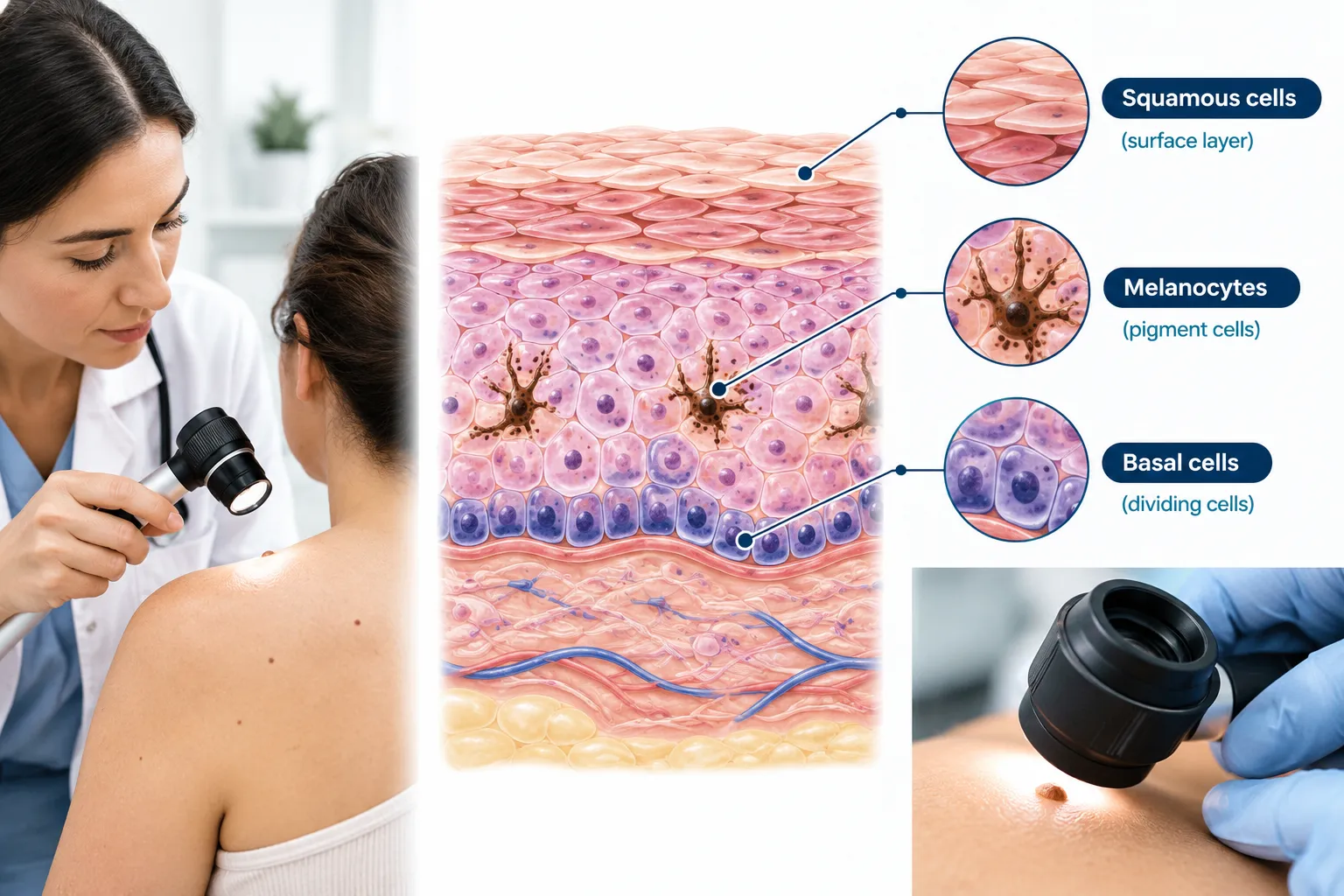
The short answer is no, for both BCC and SCC. These are called keratinocyte carcinomas because they start in keratinocytes, the skin's main structural cells, while melanoma starts in melanocytes, the pigment-producing cells [1]. A cancer that begins in one cell type does not convert into a cancer of a different cell type, that would require the tumor to change its biological lineage, which is not how these cancers behave [2].
What does happen, and what confuses people, is that a patient can be diagnosed with BCC and later develop an entirely separate, new melanoma somewhere on their skin. That is not transformation. It's a second, independent cancer, often explained by shared risk factors like years of sun exposure.
No, BCC and SCC start in different skin cells from melanoma, so one cannot turn into the other. However, having BCC or SCC is associated with a higher risk of developing another skin cancer, including melanoma, over time. That's why ongoing skin checks after any skin cancer diagnosis remain important, regardless of which type you had.
No published evidence supports basal cell carcinoma converting into melanoma. BCC arises from basal cells in the deepest layer of the epidermis, while melanoma arises from melanocytes, two different cell lineages with separate genetic drivers [1][2].
A September 2026 case report sometimes cited as suggesting a link actually argues against transformation. Researchers described a 70-year-old man with a 20-centimeter pigmented abdominal tumor that, on biopsy, showed areas of BCC in one spot and malignant melanoma 1.5 centimeters away [3]. Lab testing (immunohistochemistry) showed the BCC cells were positive for a marker called BerEP4, while the melanoma cells were positive for a separate marker called MelanA, two distinct cell signatures in the same tumor [3].
The authors concluded this was a collision tumor: two separate cancers that happened to grow next to each other, not one cancer changing into the other [3]. They specifically stated that direct transformation was not supported by their findings [3]. This case is a reminder that rare, unusual lesions need careful, multi-site biopsy review, not a diagnosis of BCC-to-melanoma conversion.
No. SCC, like BCC, is a keratinocyte carcinoma and does not convert into melanoma, because it originates from a different cell type than melanocytes [1]. SCC does have its own concerning behavior pattern, though, which is sometimes mistaken for "turning into" something worse.
SCC can keep recurring locally, especially if it was not fully removed, if it's on a high-risk site like the ear or lip, or if it is a thicker, poorly differentiated tumor. This recurrence is the same cancer type regrowing, not a new cancer type forming. For readers tracking this specifically, the SCC recurrence and follow-up schedule guide breaks down why SCC tends to come back and what follow-up looks like.
It is also worth separating SCC from its precursor. Actinic keratosis (a rough, scaly patch caused by sun damage) can progress to SCC over time, this is a real, documented pathway within the same keratinocyte lineage, explained further in actinic keratosis to SCC: understanding pre-cancerous lesions. That is different from SCC becoming melanoma, which does not happen.
Skin cancers are classified by the cell they start in, and each cell type has its own job and its own genetic vulnerabilities. Understanding this explains, in plain terms, why cross-over between cancer types does not occur.
Basal cells sit at the bottom of the epidermis and constantly divide to replace skin cells that wear off the surface. Basal cell carcinoma, or what's basal cell cancer in plain terms, is a cancer of these cells, usually caused by cumulative sun exposure, and it typically grows slowly with rare spread beyond the skin [2]. Learn more in the basal cell carcinoma condition overview.
Squamous cells are flatter cells that sit above the basal layer and form the outer, protective part of the skin. What's squamous cell cancer? It is a cancer of these cells, often starting from a precancerous actinic keratosis, and it carries a higher chance than BCC of growing into deeper tissue if left untreated [1]. See the squamous cell carcinoma condition page for details.
Melanocytes are scattered among basal cells and produce melanin, the pigment that gives skin its color and protects it from UV damage. Melanoma begins when melanocytes mutate and grow uncontrollably, and because melanocytes already have pathways built for mobility (pigment transport), melanoma spreads more readily than BCC or SCC once it invades deeper layers [2].
Yes, having a history of BCC or SCC is associated with a higher likelihood of being diagnosed with another skin cancer later, including melanoma. This does not mean one caused the other; it means the same risk factors, cumulative UV exposure, fair skin, age, raise the odds of multiple, separate skin cancers over a lifetime.
The National Cancer Institute and American Cancer Society both group BCC and SCC as keratinocyte carcinomas and track them separately from melanoma in national statistics, but patients who have had one skin cancer are generally advised to continue regular full-body skin checks because of this elevated background risk [1][4]. Cancer Facts and Figures reporting from the American Cancer Society tracks keratinocyte carcinomas and melanoma as distinct disease categories with different staging and treatment pathways [4].
Common mistake: assuming that because BCC is "less serious," a new mole or dark spot after a BCC diagnosis can be ignored. Is basal cell carcinoma less serious than melanoma? In terms of typical spread and mortality, yes, BCC rarely metastasizes, while melanoma is more likely to spread if untreated [2]. But that doesn't lower melanoma risk after a BCC diagnosis; it just means the cancers behave differently once they exist.
Pigmented basal cell carcinoma is a BCC variant that contains melanin, giving it a brown, black, or blue-black color instead of the typical pearly pink appearance. This pigmentation is why pigmented basal cell carcinoma vs melanoma is such a common point of confusion for patients and even on casual visual inspection.
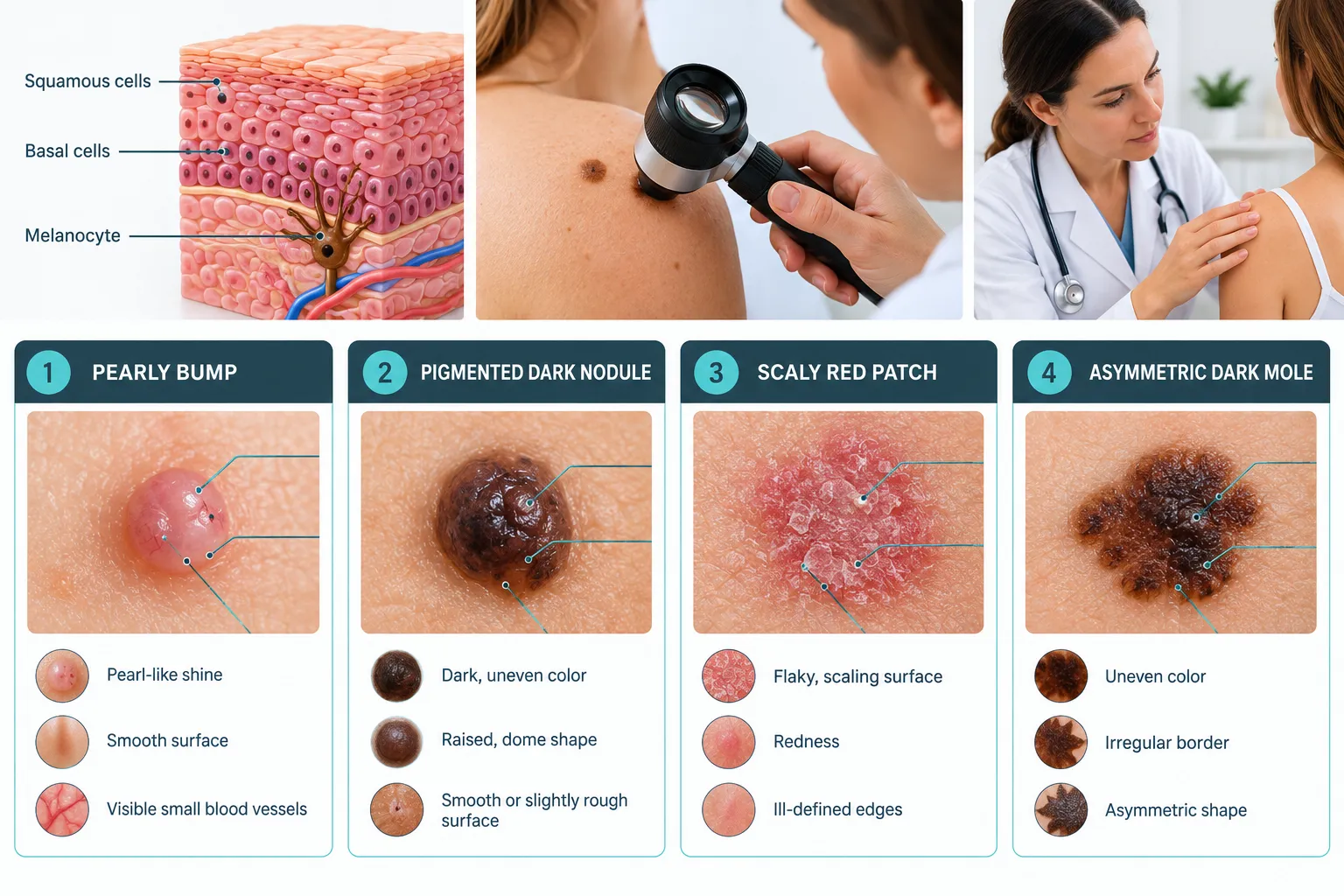
Despite the dark color, a pigmented BCC is still, at the cellular level, a basal cell cancer, the pigment comes from melanocytes caught up within the tumor, not from the BCC cells turning into melanocytes [2]. Only a biopsy can reliably tell pigmented BCC apart from melanoma, since both can appear as a dark, irregular, slowly changing spot. For a deeper visual and clinical comparison, see pigmented BCC vs melanoma.
Decision rule: if a dark spot is new, growing, bleeding, or has irregular borders, get it checked regardless of whether you assume it's "just BCC." Pathology, not appearance, makes the diagnosis.
Yes, it is possible to have BCC and melanoma together, either as two separate tumors in different locations or, rarely, as a collision tumor where both cancers occupy the same site. This is well documented in case reports, including the 2026 case already discussed [3].
Earlier medical literature uses terms like "collision," "colonization," and "combination" to describe BCC and melanoma found together in one lesion [5]. These terms describe physical proximity, not one cancer converting into the other. A review of collision tumors notes that this distinction matters clinically: the melanoma portion may behave aggressively and metastasize even if the BCC portion stays slow-growing, so treating the whole lesion as "just BCC" risks underestimating the real danger [3].
Edge case: if a BCC diagnosis doesn't match how aggressively a tumor is behaving, for example, unexplained lung nodules or rapid growth, doctors may re-biopsy a different part of the lesion. In the 2026 case, a lung biopsy actually found melanoma first, which led doctors to re-examine the skin tumor and find both cancer types present [3].
FeatureBasal Cell CarcinomaSquamous Cell CarcinomaMelanomaCell of originBasal cells (epidermis base) [2]Squamous (keratinocyte) cells [1]Melanocytes (pigment cells) [2]Typical lookPearly bump, sometimes pigmented [2]Scaly, red, growing patch or sore [1]Asymmetric, changing dark spot (ABCDE) [1]Spread riskRare metastasis [2]Higher than BCC if untreated [1]More likely to spread if untreated [2]Typical treatmentSurgical excision or Mohs [2]Surgical excision or Mohs [1]Wide excision, possibly lymph node evaluation [1]
For a broader primer on all four main skin cancer types, see 4 types of skin cancer and the general skin cancer conditions overview.
Recommendations vary by source, but all agree that ongoing skin checks are necessary after any keratinocyte carcinoma diagnosis. No single universal schedule exists, so ranges differ by organization and by individual risk factors.
SourceGeneral guidance rangeNCI/PDQ skin cancer screening summaryRegular clinical skin exams after a prior skin cancer diagnosis; frequency individualized by risk [6]American Cancer SocietyOngoing follow-up visits and self-exams recommended after BCC treatment [2]
Because recurrence risk and timelines differ between BCC and SCC, dedicated guides cover each: can BCC come back after removal, SCC recurrence and follow-up schedule, and melanoma recurrence.
Check your skin for:
Sun protection is the single most consistent, evidence-based strategy for lowering the risk of new BCC, SCC, and melanoma diagnoses. This applies whether you've had zero skin cancers or several.
Who is most at risk for basal cell carcinoma? Fair-skinned individuals, those with significant lifetime sun exposure, older adults, and people with a personal or family history of skin cancer face higher odds [2]. What causes basal cell carcinoma to develop is primarily cumulative UV exposure damaging basal cell DNA over years [2].
Yes, treatment is recommended for both BCC and SCC even though BCC rarely spreads, because untreated tumors keep growing locally and can damage surrounding tissue, nerves, or structures like the eyes, nose, or ears. Does basal cell carcinoma spread to other parts of my body? It can in rare cases, but local tissue invasion is the far more common concern [2]. Treatment options for basal cell carcinoma include surgical excision, Mohs micrographic surgery, curettage and electrodesiccation, and topical or radiation therapy for select cases, outlined in BCC treatments and early-stage basal cell carcinoma.
Survival rates for BCC are generally favorable because metastasis is rare, though exact figures depend on tumor size, location, and how early it's treated [2]. BCC can also come back after treatment, particularly with incomplete removal or high-risk tumor features, more detail is available in can BCC come back after removal.
If you've been diagnosed with BCC or SCC in the Greater Toronto Area, The Minor Surgery Center operates five clinics, Toronto/North York, York Mills, Vaughan, Mississauga, and Oakville, where board-certified plastic and reconstructive surgeons, co-founded by Dr. Kunaal Jindal and Dr. Roberto Tutino, perform OHIP-covered BCC, SCC, and melanoma removal with no referral required. A free consultation is available by calling (647) 614-1611. Related screening information is available at skin cancer screening in Toronto.
Can BCC turn into melanoma?
No. BCC starts in basal cells and melanoma starts in melanocytes; one cell type does not convert into the other [1][2].
Can SCC turn into melanoma?
No. SCC and melanoma arise from different skin cell types, so SCC cannot become melanoma [1].
Does having BCC mean I'll get melanoma?
No, but a history of BCC is linked to a higher chance of developing another skin cancer over time, including melanoma, which is why ongoing skin checks matter [1][4].
Which skin cancer is the most dangerous?
Melanoma is generally considered the most dangerous because it is more likely to spread if untreated, compared to BCC and SCC, which more commonly stay localized [2].
Can BCC and melanoma look alike?
Yes. Pigmented BCC can appear dark and irregular, resembling melanoma, which is why biopsy and pathology review are needed to tell them apart [2].
How often should I get my skin checked after BCC?
Sources agree ongoing follow-up is needed, but exact frequency is individualized based on risk factors and prior tumor characteristics rather than a single fixed schedule [2][6].
BCC, SCC, and melanoma are three distinct cancers rooted in three distinct cell types, and no credible evidence shows one converting into another, even the most relevant 2026 case report describing BCC and melanoma in a single tumor concluded it was a collision of two separate cancers, not transformation [3]. What does connect these cancers is shared risk: sun exposure and skin type raise the odds of developing any of them, sometimes more than once.
The practical takeaway is simple. Keep up with skin self-exams, protect your skin from UV exposure, and don't skip follow-up visits after a BCC or SCC diagnosis, since catching a new or changing spot early remains the most reliable way to manage risk. If you notice a new growth, a changing mole, or a sore that won't heal, have it evaluated promptly rather than guessing based on appearance alone.