
Last updated: September 30, 2026
Squamous cell carcinoma (SCC) recurrence rates depend heavily on the original tumor's risk features, with most recurrences showing up within the first two to three years after treatment. A well-built SCC recurrence and follow-up schedule typically means visits every three to six months for high-risk cases during the first two to five years, shifting to annual skin checks after that, though some patients need surveillance indefinitely. The right interval for any individual depends on tumor size, depth, location, and immune status, not a single fixed rule.
SCC recurrence rates vary from under 5 percent for small, low-risk tumors treated with clear margins to well over 15 to 20 percent for high-risk tumors, depending on tumor features and treatment method [2][9]. There is no single "SCC recurrence rate" number that applies to every patient, because risk depends on the tumor itself, not just the diagnosis.
Several factors shape the number dermatologists quote for an individual:
Decision rule: If a pathology report lists the tumor as "high-risk" based on size, depth, differentiation, or nerve involvement, expect closer monitoring and a real possibility of recurrence in the 10 to 20 percent range over several years. If the tumor was small, superficial, and completely excised, the risk is much lower, often under 5 percent [2][9].
A common mistake is assuming a clean excision report means zero future risk. Clear margins lower risk but do not eliminate it, which is exactly why a follow-up schedule still matters even after a "clean" surgery.
Most SCC recurrences happen within two to three years of initial treatment, though a smaller number surface later, which is why five-year surveillance windows remain standard [1][3]. Yes, SCC can recur in the exact same location where it was originally removed, and this is actually the most common pattern of recurrence.
Timing pattern: Studies and clinical guidance consistently point to the first 24 to 36 months as the highest-risk window for local recurrence [1][3]. After that, the risk curve flattens but never reaches zero, which explains why long-term monitoring continues even for patients who are years out from treatment.
Same-spot recurrence happens when cancer cells were left behind at the microscopic level, even if the visible tumor appeared fully removed. This can occur because:
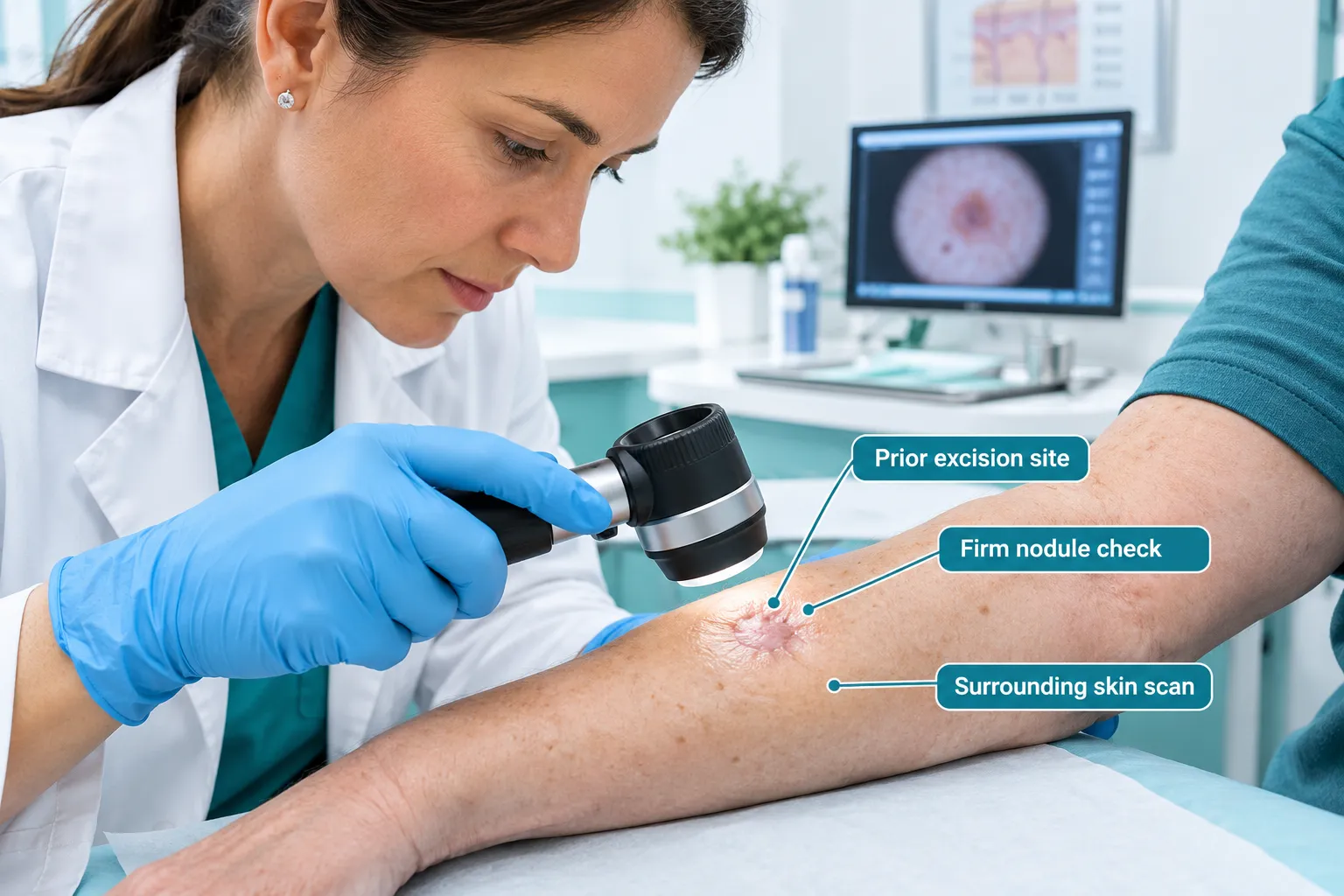
Example: A patient with a 1.5 cm SCC on the forearm, treated with standard excision and clear margins, has a lower same-spot recurrence risk than a patient with a 2.5 cm poorly differentiated SCC on the ear treated the same way. Location and tumor biology matter as much as the procedure itself.
Edge case: recurrence can sometimes appear years later, beyond the typical three-year window, particularly in immunosuppressed patients or those with a history of multiple skin cancers. This is one reason some clinicians extend surveillance well past five years for higher-risk individuals [3][9].
Certain tumor and patient characteristics substantially raise the odds of SCC recurrence, and yes, some people are clearly more prone to recurrence than others based on documented risk factors [4][9]. Tumor biology, treatment completeness, and patient immune status are the three biggest drivers.
Tumor-related risk factors:
Patient-related risk factors:
Choose closer follow-up if: the tumor had any high-risk pathology feature, the patient is immunosuppressed, or this is a second or third SCC in the same general skin region. Precursor lesions matter too, and understanding how ordinary sun damage evolves into SCC is covered in this overview of actinic keratosis progressing to SCC.
Common mistake: treating all SCC diagnoses the same. A small, well-differentiated SCC on the trunk in a healthy 45-year-old carries a very different recurrence profile than a 3 cm poorly differentiated tumor on the ear in a 70-year-old transplant recipient, even though both are technically "squamous cell carcinoma."
SCC recurrence means cancer returns at or very near the original treatment site because some cancer cells survived the first treatment, while a new (second primary) skin cancer is a separate tumor that develops elsewhere on sun-damaged skin [2][7]. Both matter clinically, but they point to different underlying problems.
FeatureRecurrenceNew Primary SCCLocationSame site or immediate margin of prior treatmentDifferent area, often on other sun-exposed skinCauseResidual cancer cells not fully removedNew mutation in separately sun-damaged skinTimingOften within 2-3 years of treatmentCan occur any time, including years apartRisk implicationSignals possible incomplete excision or aggressive biologyReflects general skin cancer risk, not treatment failureManagementMay require wider re-excision, Mohs, or imagingTreated as an independent new cancer
Patients who had one SCC are also at meaningfully higher risk of developing additional keratinocyte cancers (both SCC and basal cell carcinoma) elsewhere on the body, separate from any recurrence at the original site [3]. This is why full-body skin checks matter even when the treated area looks fine. If you are unclear on how SCC differs biologically from other common skin cancers, this comparison of BCC vs SCC breaks down the distinctions clearly.
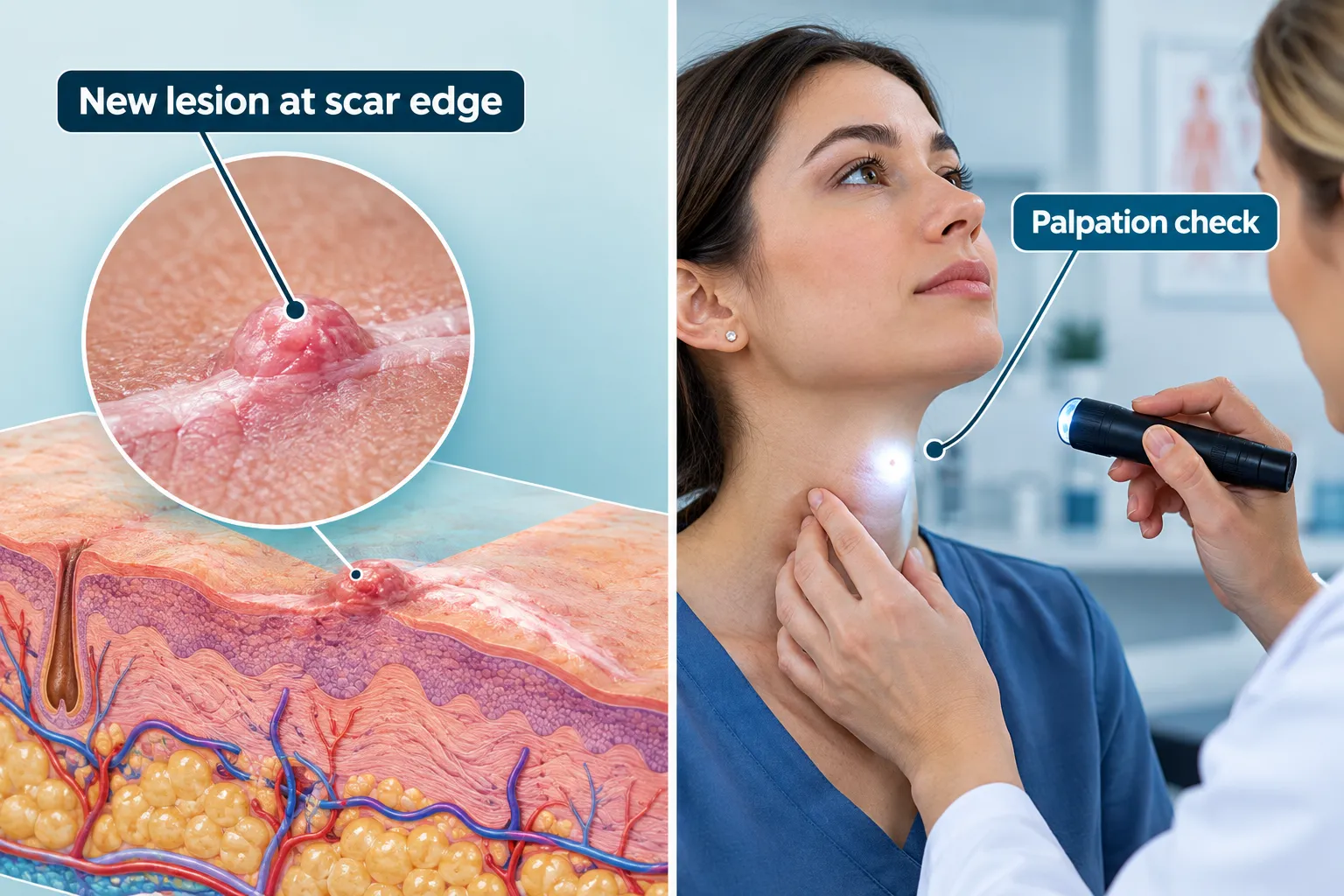
Decision rule: A new lesion right at the edge of an old scar should be treated with suspicion of recurrence and biopsied promptly. A new lesion on an entirely different body part, especially in a patient with a history of sun damage, is more likely a separate primary tumor but still needs prompt evaluation.
The most reliable signs of SCC recurrence are a new bump, sore, or area of firmness at or near the original treatment scar, along with any new swelling in nearby lymph nodes [7]. These signs deserve prompt evaluation rather than a wait-and-see approach.
Watch for:
Example: A patient treated for SCC on the temple notices a small, firm nodule developing at the edge of the surgical scar eight months later. Even though it is painless, this pattern (new growth near a prior SCC site) warrants a same-week dermatology visit rather than waiting for the next scheduled checkup.
Edge case: some recurrences are subtle and look like nothing more than a thickened or slightly scaly patch, which is easy to dismiss as normal scar healing. Anyone unsure whether a scar change is normal healing or something concerning should get it looked at rather than guess, and a structured skin lesion assessment can clarify quickly whether further action is needed.
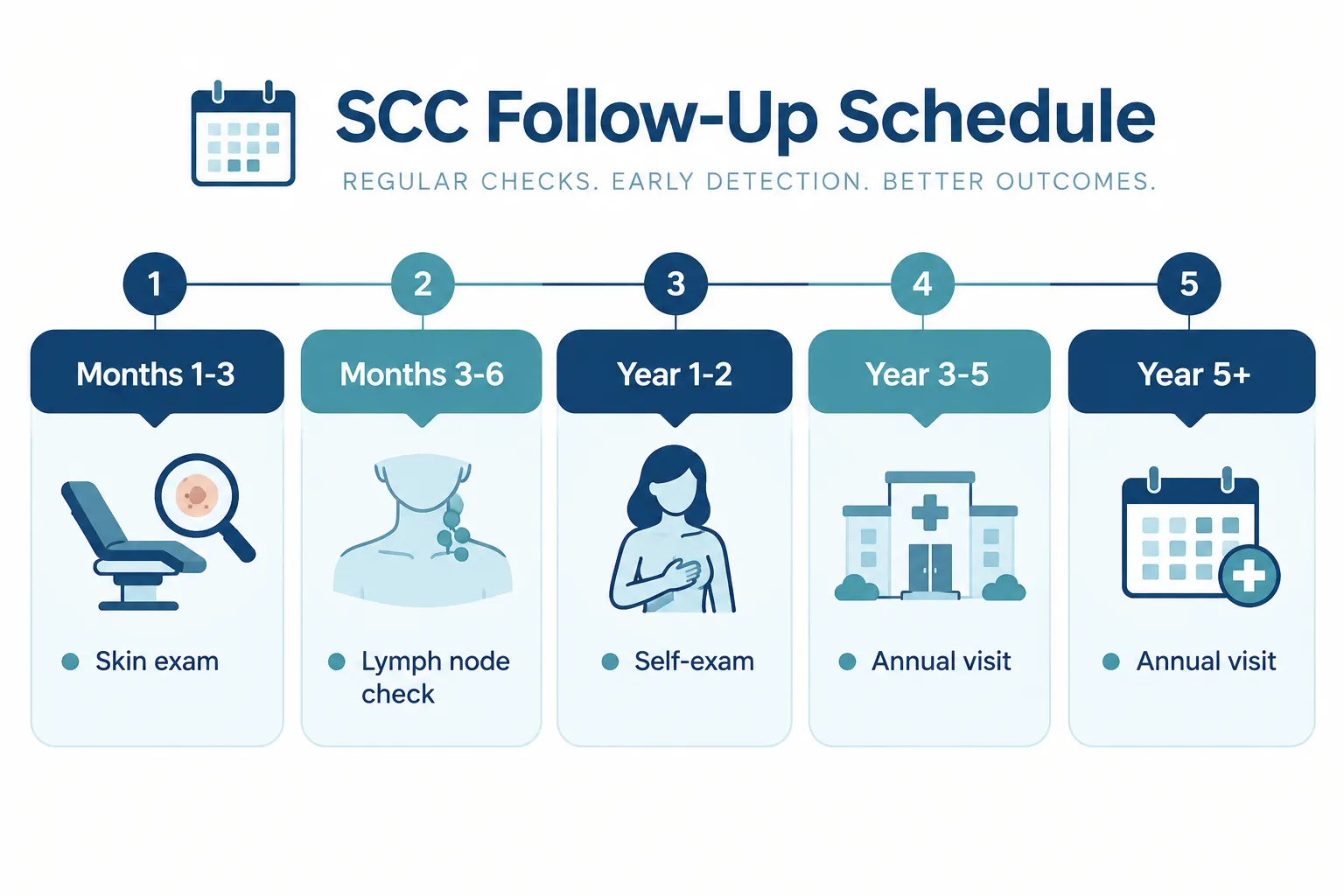
Dermatologists generally recommend an SCC recurrence and follow-up schedule of visits every three to six months for the first two to five years after treatment for high-risk tumors, shifting to annual visits afterward, while low-risk tumors may only need checks every six to twelve months [1][10]. The exact interval depends on the tumor's original risk category.
Guideline bodies broadly agree on a risk-adapted approach, though specific intervals vary slightly by region and guideline source [4][10]. Here is a general pattern reflected across major guidance:
Risk LevelYears 1-2Years 3-5Beyond Year 5Low-risk SCCEvery 6-12 monthsAnnuallyAnnual skin self-exam, periodic clinic visitHigh-risk SCCEvery 3-6 monthsEvery 6 monthsAnnually, often long-termVery high-risk (perineural invasion, nodal history, immunosuppressed)Every 1-3 months, may include regional imagingEvery 3-6 months, imaging as indicatedEvery 6-12 months, indefinitely
This pattern broadly mirrors guidance from the American Cancer Society [1], Alberta Health Services' clinical cancer guide [10], and European S3-level recommendations for risk-adapted surveillance [4]. For patients with head and neck SCC or nodal involvement, some specialty guidelines incorporate periodic imaging alongside clinical exams, particularly in the first two to three years [5].
What a typical follow-up visit includes:
A thorough full body skin exam forms the backbone of most follow-up visits, since it catches both local recurrence and unrelated new lesions in one appointment. Choose the high-risk schedule if the original tumor had any of the risk features listed earlier in this guide; choose the low-risk schedule only if pathology clearly documented a small, well-differentiated tumor with clear margins and no nerve involvement.
Common mistake: spacing out visits too early because the treatment site "looks fine." Most recurrences are caught precisely because a scheduled visit happened on time, not because the patient noticed something first.
Many patients with high-risk SCC or a history of multiple skin cancers need ongoing follow-up indefinitely, while those with a single low-risk tumor may be able to transition to standard annual skin checks after about five years [1][10]. Whether follow-up continues forever depends on ongoing risk, not a fixed calendar cutoff.
Factors that typically extend follow-up long-term:
Patients with a single, small, low-risk SCC that was fully excised with clear margins often can step down to routine annual skin screening once past the five-year mark, similar to general population skin cancer screening recommendations [1][2]. That said, UK-based guidance has specifically moved toward minimizing unnecessary follow-up for genuinely low-risk disease, recognizing that indefinite frequent visits offer limited added benefit for this group [2].
Decision rule: Continue indefinite structured follow-up if any high-risk feature was present or if immunosuppression is ongoing. Step down to general annual screening if the tumor was clearly low-risk and five years have passed without recurrence or new high-risk lesions.
Working with a consistent provider makes this transition easier to manage. Patients without an established dermatology relationship can use a resource like finding a dermatologist in Toronto to set up ongoing care rather than letting follow-up lapse by default.
SCC recurrence is detected early through a combination of scheduled clinical exams, dermoscopy of the treatment site, patient self-checks between visits, and imaging for select high-risk cases [5][7]. Early detection depends on consistent habits, not a single test.
Clinical detection methods:
Patient self-monitoring between visits:
Dermoscopy in particular has become a standard part of high-quality follow-up because it can flag structural changes at a stage well before a lesion becomes obviously visible or symptomatic. A dedicated dermoscopy skin check adds this layer of detail to a routine visual exam.
Edge case: in patients with extensive scarring, prior radiation, or grafted skin, visual inspection alone can miss subtle changes, making dermoscopy or even biopsy of any suspicious texture change more important than in patients with simpler healing.
SCC most commonly recurs on the skin at or near the original site, but high-risk tumors can spread internally to regional lymph nodes and, less often, to distant organs such as the lungs [3][9]. Internal spread is far less common than local skin recurrence but carries more serious implications when it happens.
Local (skin) recurrence is by far the most frequent pattern and is what most follow-up schedules are built to catch early [2][7].
Regional spread involves nearby lymph nodes and is more likely with:
Distant metastasis is uncommon for SCC overall but does occur in a subset of high-risk cases, particularly when regional lymph nodes are already involved or the tumor was neglected before treatment [3][9]. This is the main reason very high-risk patients sometimes have imaging built into their follow-up schedule rather than relying on physical exam alone [5].
Example: A patient with a 3 cm, poorly differentiated SCC on the scalp with documented perineural invasion is a candidate for nodal ultrasound or CT imaging as part of follow-up, whereas a patient with a 0.8 cm well-differentiated SCC on the back typically does not need imaging at all.
If SCC recurs, prompt re-biopsy and re-evaluation by a dermatologist or surgical specialist is the immediate next step, and recurrence does not automatically mean a worse long-term prognosis, though it usually calls for more aggressive treatment and closer future monitoring [9]. The response matters more than the recurrence itself.
Steps if recurrence is suspected or confirmed:
On prognosis: Recurrence signals that the initial treatment did not fully eliminate the cancer, but with prompt re-treatment, many patients still achieve good long-term outcomes. The bigger prognostic concern is delayed detection or delayed treatment of the recurrence, not the recurrence itself [9]. Tumors caught early at the recurrence stage, before nodal or distant spread, generally carry a far better outlook than those allowed to progress unchecked.
Common mistake: assuming a recurrence means the original treatment "failed" in a way that predicts poor outcomes overall. In most cases, recurrence simply means the treatment plan needs to be more aggressive the second time, often with wider margins, Mohs surgery, or added imaging surveillance.
Low-risk and high-risk SCC follow-up plans differ mainly in visit frequency, use of imaging, and how long structured surveillance continues [1][4][10]. Matching the plan to the correct risk category prevents both over-testing and under-monitoring.
Quick Reference: Choosing the Right Follow-up Intensity
Related reading on general screening approaches, including how clinics structure comprehensive checks, is available through skin cancer screening services, which cover both new lesion detection and post-treatment monitoring in one visit.
What is the SCC recurrence rate after treatment?
Recurrence rates range from under 5 percent for small, low-risk tumors with clear margins to 15 percent or higher for high-risk tumors with deep invasion, poor differentiation, or perineural spread [2][9].
How often should I get checked after SCC removal?
Most patients need visits every three to six months for the first two to five years if the tumor was high-risk, or every six to twelve months if it was low-risk, shifting to annual visits afterward [1][10].
Can SCC recur in the same spot?
Yes. Same-site recurrence is the most common recurrence pattern and usually reflects residual cancer cells left behind at the microscopic level after initial treatment [2].
How long after SCC treatment can it recur?
Most recurrences appear within two to three years of treatment, though later recurrences can occur, especially in immunosuppressed patients or those with high-risk tumor features [1][3].
What's the difference between SCC recurrence and a new skin cancer?
Recurrence happens at or near the original treatment site from surviving cancer cells, while a new primary SCC is a separate tumor forming elsewhere on sun-damaged skin [2][7].
What are the signs that SCC is coming back?
Key signs include a new bump or firmness at the treatment scar, a sore that won't heal, changes in scar texture, and swollen lymph nodes nearby [7].
Do I need dermatology follow-ups forever after SCC?
Not always. Low-risk, single-tumor patients can often step down to annual screening after about five years, while high-risk or immunosuppressed patients typically need indefinite structured follow-up [1][10].
Can SCC recur internally, or just on the skin?
Local skin recurrence is most common, but high-risk SCC can spread to regional lymph nodes and, less often, to distant organs like the lungs [3][9].
What should I do if SCC recurs?
Get the area biopsied promptly, expect a wider excision or Mohs surgery, discuss lymph node evaluation if high-risk features are present, and plan for closer follow-up going forward [2][4][9].
Does SCC recurrence mean a worse prognosis?
Not automatically. Prompt re-treatment of a recurrence generally leads to good outcomes; the bigger risk factor is delayed detection or delayed treatment, not the recurrence itself [9].
An effective SCC recurrence and follow-up schedule is built around one core idea: match the intensity of monitoring to the actual risk of the original tumor. Low-risk SCC calls for a lighter schedule that eventually tapers to annual screening, while high-risk features, nodal history, or immunosuppression justify closer, sometimes indefinite, surveillance with exams every few months and imaging when clinically indicated.
The most useful next steps for anyone treated for SCC are straightforward. Confirm the tumor's risk classification with the treating clinician, agree on a specific follow-up interval rather than a vague "come back if you notice anything" plan, learn the concrete warning signs at the treatment site, and keep every scheduled visit even when the area looks completely normal. Recurrence caught early through a structured schedule is almost always more manageable than recurrence discovered late through symptoms alone.
[1] After Treatment - https://www.cancer.org/cancer/types/squamous-cell-carcinoma-of-the-skin/after-treatment.html
[2] Histological Clearance And Recurrence Of Keratinocyte Cancers - https://dermnetnz.org/topics/histological-clearance-and-recurrence-of-keratinocyte-cancers
[3] Pmc11394133 - https://pmc.ncbi.nlm.nih.gov/articles/PMC11394133/
[4] Nxj9mlsws46ejpdve1s1955a Guideline Part Ii Treatment - https://www.guidelines.edf.one/uploads/attachments/nxj9mlsws46ejpdve1s1955a-guideline-part-ii-treatment.pdf
[5] S00405 026 10024 2 - https://link.springer.com/content/pdf/10.1007/s00405-026-10024-2.pdf?error=cookies_not_supported&code=612e6382-e378-478c-b804-cc90112fb5dd
[6] 1346 8138 - https://onlinelibrary.wiley.com/doi/full/10.1111/1346-8138.70104
[7] Signs Of Recurrence - https://skincancer.net/types-signs/signs-of-recurrence
[8] 1346 8138 - https://onlinelibrary.wiley.com/doi/10.1111/1346-8138.70104
[9] Mdpi - https://www.mdpi.com/2072-6694/16/17/2960
[10] If Hp Cancer Guide Cu013 Scc - https://www.albertahealthservices.ca/assets/info/hp/cancer/if-hp-cancer-guide-cu013-scc.pdf