Last updated: September 1, 2026
A soft little flap of skin on your neck that catches on a shirt collar is usually nothing. The problem is the word "usually." A skin tag, a stalked mole, a wart and an early basal cell carcinoma can all start as a small bump that a reasonable person would ignore for two years. That's the real question behind most searches for skin tag removal in York Mills: not how to get rid of it, but whether it's safe to get rid of it without knowing what it is.
Quick Answer
Skin tag removal in York Mills is a minor in-office procedure. The lesion is numbed with local anaesthetic, removed by snip excision, cautery or surgical excision, and covered with a small dressing. Most single lesions take under 15 minutes, and several can often be handled in the same visit. The York Mills clinic at 85 Scarsdale Rd, Unit 101, North York (647-614-1611) sees patients without a referral, and consultation plus treatment often happen on the same day when it's clinically appropriate. One rule matters more than any other: if you aren't certain a growth is a skin tag, have it assessed before anything is used to destroy it.
Key Takeaways
- A skin tag (acrochordon) is a benign, soft, skin-coloured growth on a narrow stalk, most often in areas that rub, neck, armpits, eyelids, groin, under the breasts.
- Removal is quick. After local anaesthetic, a small tag is typically removed in a few minutes; a longer visit usually means multiple lesions or a lesion needing stitches.
- Freezing and laser destroy the tissue, so nothing can be sent to pathology. If the diagnosis is uncertain, excision that preserves the specimen is the safer choice.
- Home kits, bands and string are a poor bet on any lesion you haven't had identified. Reported problems include pain, infection, scarring and poor cosmetic results [6][8].
- OHIP does not cover removal done purely for appearance. Removal can be handled differently when a lesion is suspicious, bleeding, repeatedly irritated or interfering with function, confirm at the consultation.
- A properly removed skin tag doesn't grow back in that spot. New ones can appear nearby, because the friction and the personal tendency behind them haven't changed.
- No referral is needed at the York Mills location, which is just south of York Mills Road east of Leslie, minutes from the DVP, and reachable by TTC from York Mills station on Line 1.
Is It Actually a Skin Tag? How Benign Skin Lesions Are Told Apart
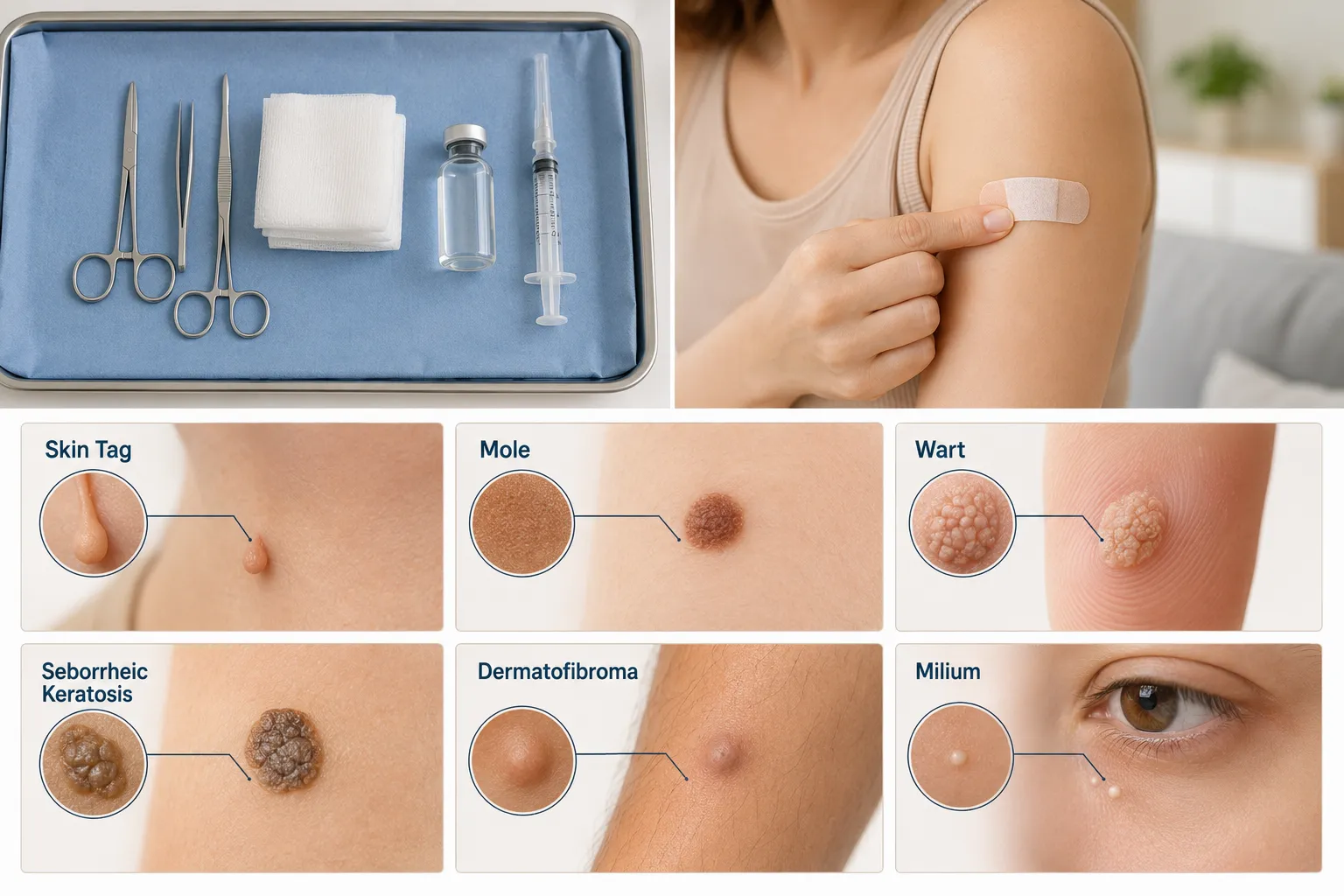
Clinicians separate these lesions by four things: shape, texture, how it's attached to the skin, and where on the body it sits. A skin tag is soft, moves freely, and hangs from a thin stalk. Almost everything else on the list below is either flat, firm, rough, or anchored into the skin, and that difference is usually visible within seconds of looking at it with good light and a dermatoscope.
Is It Actually a Skin Tag? How Benign Skin Lesions Are Told Apart
What a clinician is really checking is whether anything about the lesion breaks the pattern. Colour that isn't uniform. A border that fades irregularly into normal skin. A firm base that doesn't move when the skin does. A surface that has broken down and won't heal. Any one of those moves the lesion out of the "just take it off" category and into "look at it properly first."
- Lesion / What it looks like / How it feels / Typical locations / Assessment before removal?
- Skin tag (acrochordon)
- What it looks like: Small flap, skin-coloured or slightly darker, hangs on a narrow stalk
- How it feels: Soft, floppy, moves easily; painless unless caught
- Typical locations: Neck, eyelids, armpits, groin, under breasts, waistband line
- Assessment before removal?: Brief look is enough in most cases
- Mole (nevus)
- What it looks like: Flat or raised, usually evenly brown or tan, round or oval
- How it feels: Firmer than a tag; sits in the skin, not on a stalk
- Typical locations: Anywhere, often sun-exposed areas
- Assessment before removal?: Yes, should be examined, and often sent to pathology
- Wart (viral)
- What it looks like: Rough, grainy, sometimes with tiny dark dots; can cluster
- How it feels: Hard and dry; tender if pressed on a weight-bearing spot
- Typical locations: Hands, fingers, feet, knees; sometimes neck and face
- Assessment before removal?: Yes, treatment differs; warts are contagious and spread
- Seborrheic keratosis
- What it looks like: Waxy, "stuck-on" tan to dark brown patch or plaque
- How it feels: Slightly greasy or crumbly surface; well anchored
- Typical locations: Chest, back, temples, face; more common with age
- Assessment before removal?: Yes, dark ones can mimic pigmented cancers
- Dermatofibroma
- What it looks like: Small firm nodule, pink to brown, may dimple when pinched
- How it feels: Hard, button-like, fixed within the skin
- Typical locations: Lower legs, arms
- Assessment before removal?: Yes, confirm before any removal
- Epidermoid cyst
- What it looks like: Round lump under the skin, sometimes with a central pore
- How it feels: Rubbery, mobile, deeper than a tag; can become sore
- Typical locations: Back, chest, scalp, behind ears, neck
- Assessment before removal?: Yes, the whole sac must come out or it refills
- Milium
- What it looks like: Tiny firm white or yellowish dome, 1-2 mm
- How it feels: Hard, immobile, doesn't squeeze out like a pimple
- Typical locations: Under eyes, cheeks, eyelids
- Assessment before removal?: Usually straightforward, but eyelid skin needs care
- Early basal cell carcinoma
- What it looks like: Pearly or translucent bump, fine visible vessels, may scab and re-scab
- How it feels: Firm, slowly enlarging, bleeds with minor contact
- Typical locations: Nose, cheeks, ears, forehead, upper chest, back
- Assessment before removal?: Always, needs biopsy-confirmed diagnosis and proper margins
Decision rule: if the growth is soft, dangles, and looks the same as three others in the same crease, it behaves like a skin tag. If it's firm, flat, pigmented, rough, bleeding, or the only one of its kind, treat that as a lesion needing assessment, not a cosmetic nuisance. Pigmented lesions in particular belong in the same conversation as a proper mole assessment and removal in York Mills, not a two-minute cosmetic zap.
A common mistake worth naming: patients often assume a lesion that has been there "for years" must be benign. Long-standing lesions usually are. But basal cell carcinomas also grow slowly, sometimes over years, and the ones that get missed are usually the ones dismissed as an old blemish.
What Causes Skin Tags, and Why Some People Get Many
Skin tags form where skin repeatedly rubs against skin or fabric. Friction is the main driver, which is why they cluster in folds and along clothing lines. Some people are simply more prone to them, and that tendency often runs in families.
Factors that commonly line up with having several tags:
- Friction and skin-on-skin contact, neck, armpits, groin, under the breasts, along a collar, bra strap or waistband.
- Age, tags become more common from the thirties onward.
- Higher body weight, which increases the number and depth of skin folds.
- Pregnancy, likely through hormonal changes and weight gain; tags that appear in pregnancy sometimes shrink afterward.
- Insulin resistance and metabolic factors. Multiple skin tags are associated with insulin resistance in the dermatology literature, particularly alongside darkened velvety skin in the folds (acanthosis nigricans).
That last point needs care. An association is not a diagnosis. Having skin tags does not mean you have diabetes, and removing them changes nothing about your metabolic health. If you have many tags appearing quickly plus other reasons for concern, that's a conversation for your family doctor, not a reason to panic.
Location changes the removal plan more than most people expect. Eyelid tags sit millimetres from the lash line and the eye itself, so technique and control matter; tags on the face and eyelids are handled differently from a tag on the back of the neck. Groin, underarm and under-breast tags sit in warm, moist, mobile skin, which affects both healing and dressing choices, and removal in sensitive areas generally calls for a gentler approach and clearer aftercare.
When a Skin Lesion Needs a Doctor Rather Than a Drugstore Kit
Any lesion that is changing, bleeding, painful, firm, fixed or refusing to heal should be examined in person before anything is done to it. So should any new growth appearing after age 40, and any pigmented lesion you can't confidently match to the tags you already have.
Red flags worth an appointment rather than a wait-and-see:
- Growing, or changing shape or colour over weeks to months
- Bleeding, oozing or crusting without being knocked or scratched
- Itching, tenderness or a burning feeling in one specific spot
- Firm, hard, or fixed to deeper tissue rather than moving with the skin
- A sore or scab that heals and then breaks down again
- Asymmetry, an irregular or blurred border, or more than one colour within it
- A single lesion that looks different from everything else on your body
- Any new lesion appearing on sun-exposed skin after 40
Separately, some people warrant extra caution regardless of how ordinary the lesion looks:
- On blood thinners (including ASA, clopidogrel, warfarin, DOACs), bleeding control changes the plan; never let a lesion be tied off or cut at home
- Diabetes, especially with slower healing or reduced sensation
- Keloid-prone or hypertrophic-scar-prone skin, particularly on the chest, shoulders and earlobes
- Immunosuppressed patients (transplant medication, biologics, chemotherapy), higher infection risk and higher skin cancer risk
- Pregnancy, removal is often deferred unless the lesion is symptomatic or concerning
If there's genuine doubt about what a lesion is, the right sequence is assessment first, removal second, and pathology when indicated. Reversing that order is how diagnoses get lost.
Nothing in this article can tell you your lesion is harmless. If a growth on your skin has any of the features above, book an in-person look, a lesion with concerning features may need a skin cancer assessment and excision rather than a cosmetic procedure, and it's better to find that out at the start.
Removal Methods Compared: Snip Excision, Cautery, Cryotherapy, Laser and Surgical Excision
There are five methods in common clinical use for small benign lesions, and they aren't interchangeable. Toronto-area dermatology practices describe laser, electrosurgery, excision, cryotherapy and radiofrequency cautery as standard options, generally after local numbing [8][14][7]. The choice depends on lesion size, exactly where it sits, your skin type, and whether the tissue needs to be preserved for a lab.
- Method / How it works / Best suited for / Typical healing time / Scarring risk / Tissue to pathology?
- Snip excision
- How it works: Fine surgical scissors cut the stalk at skin level after numbing
- Best suited for: Classic stalked skin tags on neck, armpits, eyelids, groin
- Typical healing time: Usually 5-10 days for the surface
- Scarring risk: Low
- Tissue to pathology?: Yes, specimen is intact
- Electrosurgery / RF cautery
- How it works: High-frequency current removes the lesion and seals small vessels
- Best suited for: Small tags, multiple tags, sites that bleed easily; often no stitches [14]
- Typical healing time: Usually 7-14 days
- Scarring risk: Low to moderate
- Tissue to pathology?: Limited, tissue is partly destroyed
- Cryotherapy (liquid nitrogen)
- How it works: Freezing damages the lesion so it sloughs off over days [7]
- Best suited for: Small tags away from the eye; some warts and keratoses
- Typical healing time: Usually 1-3 weeks, sometimes with blistering
- Scarring risk: Low scarring, but real risk of light or dark pigment change
- Tissue to pathology?: No
- Laser (e.g. CO₂)
- How it works: Focused light vaporises the lesion tissue [14]
- Best suited for: Confidently benign small lesions where cosmetic finish is the priority
- Typical healing time: Usually 1-2 weeks
- Scarring risk: Low, though redness can persist for weeks
- Tissue to pathology?: No
- Surgical excision with closure
- How it works: Lesion is cut out with a margin of normal skin and closed with sutures
- Best suited for: Larger or broad-based lesions, cysts, lipomas, anything suspicious
- Typical healing time: Sutures out or dissolved in 7-14 days; scar matures over months
- Scarring risk: A line scar is expected
- Tissue to pathology?: Yes, full specimen
How the choice actually gets made: a soft stalked tag on the neck is a snip-and-cautery job and takes seconds once numb. Twelve tiny tags in an armpit favour cautery, because it handles volume with minimal bleeding. A broad-based, pigmented or firm lesion goes to excision so the specimen survives. And if the lesion turns out to be a cyst or a lipoma rather than a tag, the plan changes completely, a cyst has a sac that must be removed whole, and a fatty lump under the skin is a different operation again. Healing figures above are typical ranges, not promises; individual healing varies with site, skin type and general health.
Why the Method Matters When the Diagnosis Is Not Certain
Freezing and laser destroy the lesion, so there is nothing left to send to a pathology lab. That single fact should drive the decision whenever the diagnosis isn't clear. If a lesion might be something other than a skin tag, the safer route is an excision that keeps the tissue intact.
Consider what happens in the bad version. A pearly bump on the temple is assumed to be a tag and is frozen off. It looks gone. Nine months later a firm scab appears in the same place, and now the lesion is larger and no one has a baseline diagnosis. Nothing about that path is recoverable, the original tissue is gone.
Choose a method that preserves tissue if: the lesion is pigmented, firm, has a broad base, has bled on its own, is changing, has any irregular border, or is the only lesion of its type on your body. Devices are fine for lesions a clinician has confidently identified. They're a poor fit for uncertainty, which is the main reason a surgical clinic with pathology access handles ambiguous lesions differently from a cosmetic device suite.
Edge case worth knowing: a dark, flat, "tag-like" lesion in a skin fold is often a small seborrheic keratosis rather than an acrochordon, and dark lesions deserve a closer look before anything is destroyed. If you've been reading about flat black skin tags and what they can actually be, that's the reason the distinction gets emphasised.
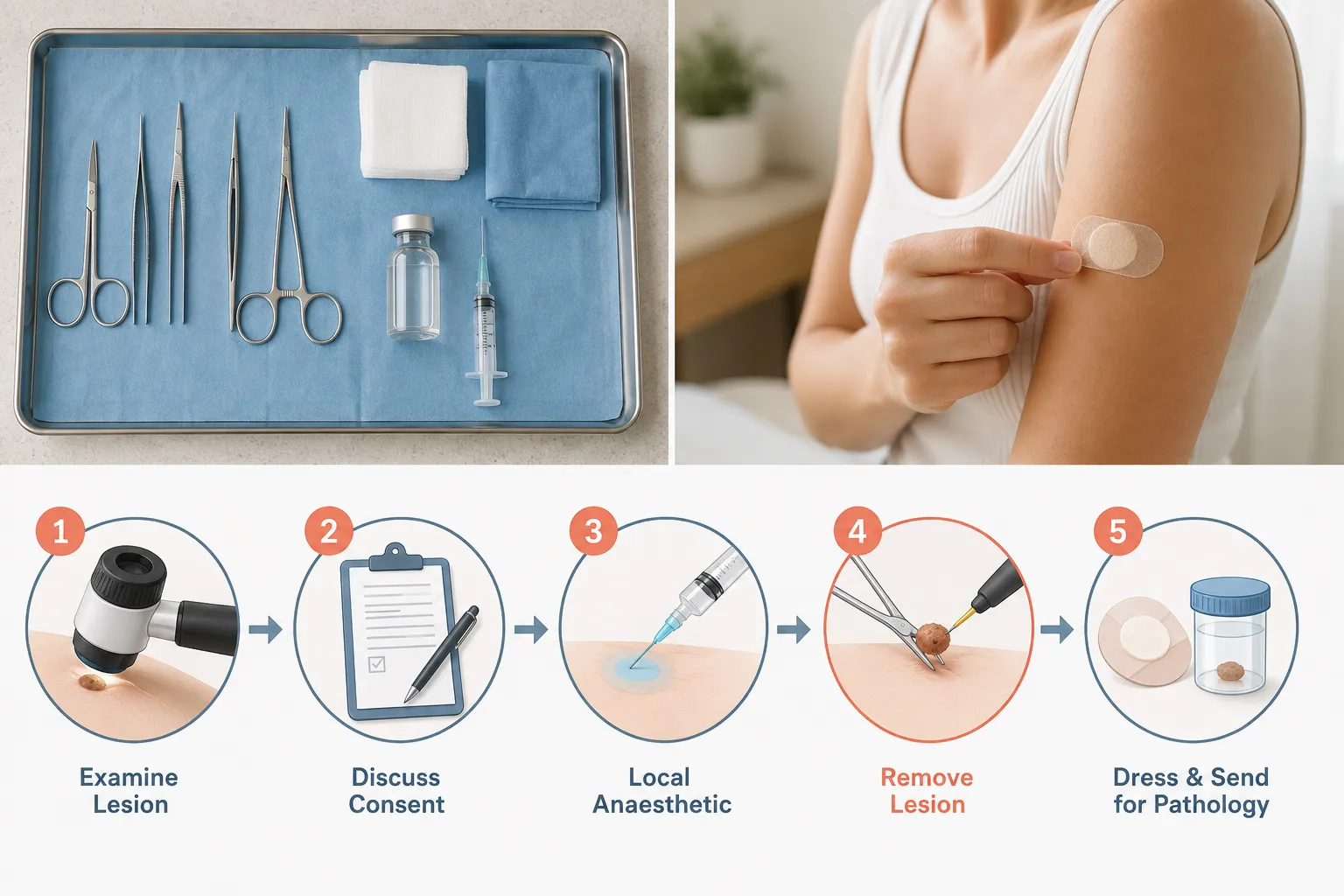
What the Appointment Actually Looks Like, Step by Step
A single-lesion visit typically runs 20 to 40 minutes door to door, with only a few minutes of that being the removal itself. Most of the time goes to assessment, consent and the dressing.
What the Appointment Actually Looks Like, Step by Step
- Assessment. The clinician looks at the lesion and, importantly, at the rest of your skin. Pigmented or unclear lesions are examined with a dermatoscope, a magnifier with polarised light that shows structures the naked eye can't.
- Discussion and consent. What the lesion most likely is, which method suits it, what the site will look like afterward, expected scarring, and whether tissue will be sent to pathology. Ask questions here, this is the part patients later wish they'd used.
- Cleaning and local anaesthetic. The skin is cleaned and a small amount of local anaesthetic is injected. The pinch and sting last a few seconds. Numbness follows within a minute or two.
- Removal. Snip, cautery or excision, depending on the plan. A small stalked tag takes seconds. An excision with careful closure takes longer, particularly on the face.
- Closure and dressing. Small sites are cauterised or left to heal on their own under a dressing. Larger excisions are closed with sutures, dissolvable or removable depending on site and depth.
- Pathology, if indicated. The specimen goes to a lab. Results typically come back within one to three weeks and are communicated to you along with next steps if anything further is needed.
Multiple lesions are commonly handled in the same appointment, which is why patients with a scatter of tags along a collar line don't need repeat visits. If you're weighing several lesions at once, listing them in advance helps, the same principle applies to preparing questions before a skin lesion or skin cancer consultation.
Recovery, Aftercare and What the Site Looks Like Week by Week
Small skin tag sites usually close over within about 5 to 10 days, and sutured excisions take a bit longer. Aftercare is simple: keep the site clean, keep it covered while it's raw, and keep it out of the sun for months, not weeks.
Day 0 to 2. Expect mild soreness as the anaesthetic wears off, and a spot of blood on the dressing. Keep the dressing dry for the first 24 hours unless you're told otherwise. Plain acetaminophen is usually enough if anything is needed.
First week. Clean gently with mild soap and water, pat dry, re-cover as directed. A thin scab or pink base is normal. Short showers are fine after the first day; avoid soaking, swimming and hot tubs until the surface has closed. Don't pick the scab, picking is one of the most common causes of a worse final mark.
Weeks 2 to 6. The scab is off and a pink or slightly raised patch remains. Removable sutures usually come out at 7 to 14 days depending on the site; dissolvable ones break down over a few weeks. This is when daily sunscreen on the site starts to matter most.
Months 3 to 12. Pink fades toward your normal skin tone. Most small-lesion sites become hard to find. Excision scars soften and flatten over 6 to 12 months, which is why judging a scar at week three is unfair to it.
Call the clinic if you see spreading redness, increasing pain after day two or three, yellow discharge, a bad smell, fever, or bleeding that doesn't stop with 10 minutes of firm pressure. Those are the ones worth a phone call rather than a wait.
Scarring expectations by method and body area
- Snip excision and cautery on the neck, armpit or groin: usually a faint flat mark or nothing visible.
- Cryotherapy: low scarring risk, but a lighter or darker patch can persist, and it is more noticeable on medium and deeper skin tones.
- Eyelids: thin, forgiving skin that generally heals with an excellent cosmetic result, but the margin for error is small.
- Chest, upper back and shoulders: the highest-tension areas on the body, and the most likely to produce a wide or raised scar. Keloid-prone skin needs that discussed in advance.
- Face: technique and closure matter most here, which is where a surgical rather than cosmetic approach earns its keep.
Sun protection is not cosmetic advice. A fresh scar exposed to UV can darken permanently, so a hat, clothing or SPF 30+ over the site for six to twelve months genuinely changes the outcome. For a fuller picture of typical stages, this walkthrough of how a small removal scar looks at one week, one month and six months is a realistic reference point.
At-Home Skin Tag Removal: Kits, Bands, Freezing Sprays and String
Home removal works by strangling the blood supply (bands, string) or by chemically or cryogenically damaging tissue (acid drops, drugstore freezing sprays). It sometimes works. It also fails in specific, predictable ways, and dermatology practices in Toronto explicitly advise against self-removal after seeing scarring, infection, significant pain and poor cosmetic results [6][8].
The common failure modes:
- Partial removal. The visible part comes off, the base stays, and the lesion regrows, often looking more irregular than before.
- Infection. Non-sterile scissors, nail clippers, thread and unwashed hands on a raw wound in a moist skin fold.
- Pigment change. Freezing sprays sold for warts aren't dose-controlled for a soft tag; a permanent pale or dark patch is a real outcome, especially on deeper skin tones.
- Bleeding. Tags have a blood supply. On blood thinners, bleeding can be much harder to stop than expected.
- Scarring in a spot that had nothing but a small flap of skin before.
- The serious one: destroying a lesion that was never a skin tag. If a growth was an early skin cancer, home treatment removes the surface and the opportunity to diagnose it, while whatever is underneath continues quietly.
There's also the question of site. Anything on an eyelid, near the eye, in the genital area, or around the anus should never be self-treated, those areas have anatomy and differential diagnoses that make DIY a bad trade. If you've already been down this road and want the honest version, the write-ups on what actually happens with DIY skin tag removal and on home methods generally are worth reading before you buy a kit.
Bottom line for home methods: they're a gamble on a lesion you haven't had identified, in exchange for saving one short appointment.
Is Skin Tag or Skin Lesion Removal Covered by OHIP in Ontario?
In Ontario, removal performed purely to improve appearance is not an insured service. Removal is handled differently when there's a medical reason, a lesion that is suspicious for cancer, bleeding, repeatedly irritated or inflamed, infected, or interfering with function such as vision, glasses, clothing or hygiene.
Three practical points patients often miss:
- The assessment and the removal can be treated separately. A clinician can be seeing you for a medically indicated skin lesion assessment while the removal itself is a private-pay cosmetic procedure. These are two different questions.
- Private insurance and health spending accounts sometimes apply to cosmetic removals, particularly through employer HSAs. Many extended health plans do not cover cosmetic procedures at all. Ask your insurer before your appointment, not after.
- Don't assume either way. Coverage depends on the specific clinical findings on the day, not on how the lesion looked in a photo. Confirm at the consultation, and ask what happens to the cost if the plan changes mid-visit.
The same logic applies across lesion types, and the overlap between medical necessity and appearance comes up constantly with pigmented lesions, the explanation of when mole removal is and isn't covered by OHIP covers that boundary in more detail.
What Removal Costs Around York Mills and What Drives the Price
Private-pay skin tag removal in the Toronto and North York area is priced per lesion, and the spread between providers is wide. Aggregated Ontario listings from 2026 show single-tag fees in roughly the CA$100 range at surgical and dermatology clinics, with reduced fees for each additional tag in the same visit, while high-volume cosmetic operators advertise far lower per-lesion pricing [9][10][13]. Lesions on the eyelids or those requiring local anaesthetic generally sit at the higher end [9].
What actually moves the number:
- How many lesions you're having removed, additional tags in the same visit almost always cost less each
- Size and base width, a 2 mm stalked tag and an 8 mm broad-based lesion are different procedures
- Location, eyelids, face and genital skin take longer and demand more care
- Method, snip and cautery cost less than an excision with layered closure
- Whether pathology is required, lab processing is a separate cost
- Closure, sutures, and a follow-up visit to remove them, add to the total
Treat any figure you read online, including the ranges above, as a ballpark rather than a quote. The exact number comes from the consultation, once someone has looked at the lesion and decided what it needs. For a fuller breakdown of what drives Ontario pricing, this guide to skin tag removal costs in Ontario, OHIP coverage and private pay goes deeper than a price range can.
One caution about the cheapest end of the market: very low per-lesion pricing usually reflects a high-volume cosmetic model with a device, not a surgical assessment with pathology access. That's fine for lesions someone qualified has already identified. It's the wrong setting for a lesion nobody has diagnosed.
Getting It Done Near York Mills: Access, Referrals and Same-Day Treatment
The York Mills location of The Minor Surgery Center is at 85 Scarsdale Rd, Unit 101, North York, ON M3B 2R2, phone 647-614-1611, open weekdays roughly 9:00 a.m. to 4:00 p.m. It opened in July 2026. No referral is required, and consultation and removal are often completed in the same visit when that's clinically appropriate [4][15].
Getting there:
- By car: just south of York Mills Road, east of Leslie, minutes from the Don Valley Parkway via the York Mills Road exit. On-site parking.
- By TTC: reachable from York Mills station on Line 1, then eastbound service along York Mills Road; the Scarsdale Road pocket sits a short distance south.
- Booking: by phone or online. Practical details for the York Mills clinic location and hours are listed on the clinic page.
Who does the work matters as much as where. The group staffs a mix of GP dermatologists, who assess skin lesions and handle dermoscopy and diagnosis, and plastic surgeons, who take on excisions and anything requiring careful closure. That combination is the reason a lesion on an eyelid, a nose or the front of the neck can be assessed and removed in one place: the diagnostic question and the cosmetic-closure question get answered by people trained for each. Other locations in the same group operate in North York (2920 Dufferin St), Vaughan, Mississauga and Oakville, so if a different site is closer to work, the North York mole, cyst and skin tag removal clinic is an alternative.
Same-day removal, honestly framed. One-visit treatment is common for straightforward benign lesions. It's not automatic. Removal may be deferred if a lesion needs a biopsy first, if your medications need reviewing, if the lesion is inflamed or infected, or if it's larger than expected and warrants a properly booked surgical slot. Mention blood thinners, diabetes, previous keloids, pregnancy and known allergies to local anaesthetic when you book, those change scheduling.
Access without a referral is one of the reasons wait times differ from the hospital route; the piece on getting minor skin surgery in Toronto without a referral explains that pathway.
Do Skin Tags Grow Back After Removal?
A skin tag that has been fully removed does not return at that spot. New tags can appear nearby, sometimes within months, because the friction, the body habitus and the personal tendency that produced the first one haven't changed. Regrowth and recurrence are different things.
Cysts are the genuine exception. If the sac wall of an epidermoid cyst is left behind, the cyst refills and returns to the same spot, which is why cyst removal aims to take out the whole sac rather than drain it. If a lump you thought was a tag keeps coming back in the identical location, that's a reason to have it reassessed rather than removed again the same way.
What actually reduces new tags:
- Reduce rubbing: looser collars, well-fitted bras, seamless underarm fabrics, moisture-wicking clothing in summer
- Keep folds dry, a light powder or a barrier product where skin meets skin
- Manage weight and metabolic health with your family doctor where relevant
- Have batches removed together rather than one at a time; it's less disruptive and usually costs less per lesion
If your concern is a pigmented lesion rather than a tag, the question of return is different again, and whether moles grow back after removal depends on the technique used.
Areas Served Near York Mills
The Scarsdale Road location is a short drive for patients in Hoggs Hollow, the Bridle Path, Banbury, Don Mills and Bayview Village, and it's convenient from Lawrence Park, Leaside, Graydon Hall, Parkwoods and Willowdale. Patients coming from further along the DVP or from wider North York generally find the York Mills Road exit the simplest approach. Anyone travelling from the west end or from Peel and Halton may find one of the group's other locations closer.
Frequently Asked Questions
Does skin tag removal hurt? The removal itself shouldn't hurt, because the area is numbed with local anaesthetic first. What you feel is a brief pinch and sting from the freezing, lasting a few seconds. Mild soreness for a day or two afterward is normal and usually manageable with plain acetaminophen.
How long does the appointment take? Typically 20 to 40 minutes in total for one or two lesions, with only a few minutes of that being the actual removal. Multiple lesions or an excision with sutures take longer. The assessment and consent discussion account for most of the visit.
Can I drive myself home? Yes, in almost all cases. Local anaesthetic numbs a small patch of skin and does not affect alertness or reaction time. Sedation isn't used for routine skin tag removal.
Do I need a referral for skin tag removal in York Mills? No. Patients can book directly at the York Mills clinic without a family doctor's referral. Bring a list of your medications, especially blood thinners, and mention any allergy to local anaesthetic.
Can several skin tags be removed at once? Usually yes. Removing a cluster in one visit is standard, and additional lesions typically cost less per lesion than the first. How many can be done safely in a session depends on their size, location and how much local anaesthetic is appropriate.
Will skin tag removal leave a scar? Small stalked tags removed by snip excision or cautery usually heal with a faint flat mark or nothing visible. Larger excisions leave a line scar that fades over 6 to 12 months. Chest, shoulder and upper back sites carry the highest risk of a raised or widened scar, and keloid-prone skin should be flagged before the procedure.
How soon can I exercise or swim after removal? Light activity is generally fine within a day or two. Heavy sweating, swimming pools, hot tubs and lakes should wait until the surface is fully closed, commonly one to two weeks, and longer for sutured excisions. Follow the specific timeline you're given, since it depends on the site.
Can a skin tag be cancerous? True skin tags are benign. The risk isn't that a tag turns cancerous, it's that a lesion assumed to be a tag was actually something else, such as an early basal cell carcinoma or an unusual mole. That's why anything firm, pigmented, bleeding or changing should be examined, and why destroying an unidentified lesion is a bad idea [6][8].
Is skin tag removal safe during pregnancy? Elective cosmetic removal is usually deferred until after delivery, partly because pregnancy-related tags sometimes shrink on their own. A lesion that is bleeding, painful, infected or suspicious should still be assessed during pregnancy, and the plan discussed with your obstetrical care provider.
What if it grows back? A fully removed skin tag doesn't return at the same spot. A new tag nearby is common, since friction and personal tendency haven't changed. A lump that keeps returning in the exact same place is more suggestive of a cyst or another lesion type and should be reassessed rather than treated the same way again.
The Bottom Line
The removal is the easy part. Whether you're dealing with a skin tag, a mole, a cyst or something that needs a pathology report is the part worth getting right, and it's the part a drugstore kit can't answer. If it's soft, dangling, and identical to three others in the same crease, it's probably behaving like a skin tag. If it's firm, pigmented, bleeding, changing, or the only one of its kind, have someone look at it before anything destroys it.
A practical next step: call 647-614-1611 or book online for the York Mills clinic at 85 Scarsdale Rd, Unit 101, North York, ON M3B 2R2, weekdays 9 a.m. to 4 p.m. No referral is needed, and straightforward lesions are often assessed and removed in the same visit.
This article is general information and not a substitute for medical advice. No one can diagnose a lesion from a description or a photo online. For a specific lesion, see a physician in person.
References
[1] Skin Lesion Removal - https://www.dermapure.com/en/locations/toronto/don-mills/skin-lesion-removal/ [2] Private Aesthetic Dermatology Service - https://www.dermapure.com/en/locations/toronto/don-mills/private-aesthetic-dermatology-service/ [3] Private Aesthetic Dermatology Service - https://www.dermapure.com/en/locations/toronto/private-aesthetic-dermatology-service/ [4] Best Mole Check Clinics In Toronto - https://www.theminorsurgerycenter.com/best-mole-check-clinics-in-toronto [5] Skin Tags Removal Toronto - https://www.nelllaser.com/skin-tags-removal-toronto/ [6] Skin Tags - https://torontodermatologycentre.com/skin-tags/ [7] Skin Tags - https://dermatelieronavenue.com/skin-tags/ [8] Removal Of Benign Growths - https://torontodermatologycentre.com/removal-of-benign-growths/ [9] Skin Tag Removal - https://www.whatclinic.com/dermatology/canada/ontario/skin-tag-removal [10] Tag Mole Removal - https://www.soniacosmetic.com/tag-mole-removal




.avif)
%20(600%20x%20600%20px)%20(2).avif)
.avif)
%20(8).avif)
%20(7).avif)

.png)