
Last updated: June 24, 2026
Quick Answer: Skin cancer on the face is the most common location for skin cancer to develop because facial skin receives more cumulative sun exposure than almost any other body part. The three main types are basal cell carcinoma, squamous cell carcinoma, and melanoma. Most cases are treatable when caught early, but delayed treatment on the face carries real risks to both function and appearance.
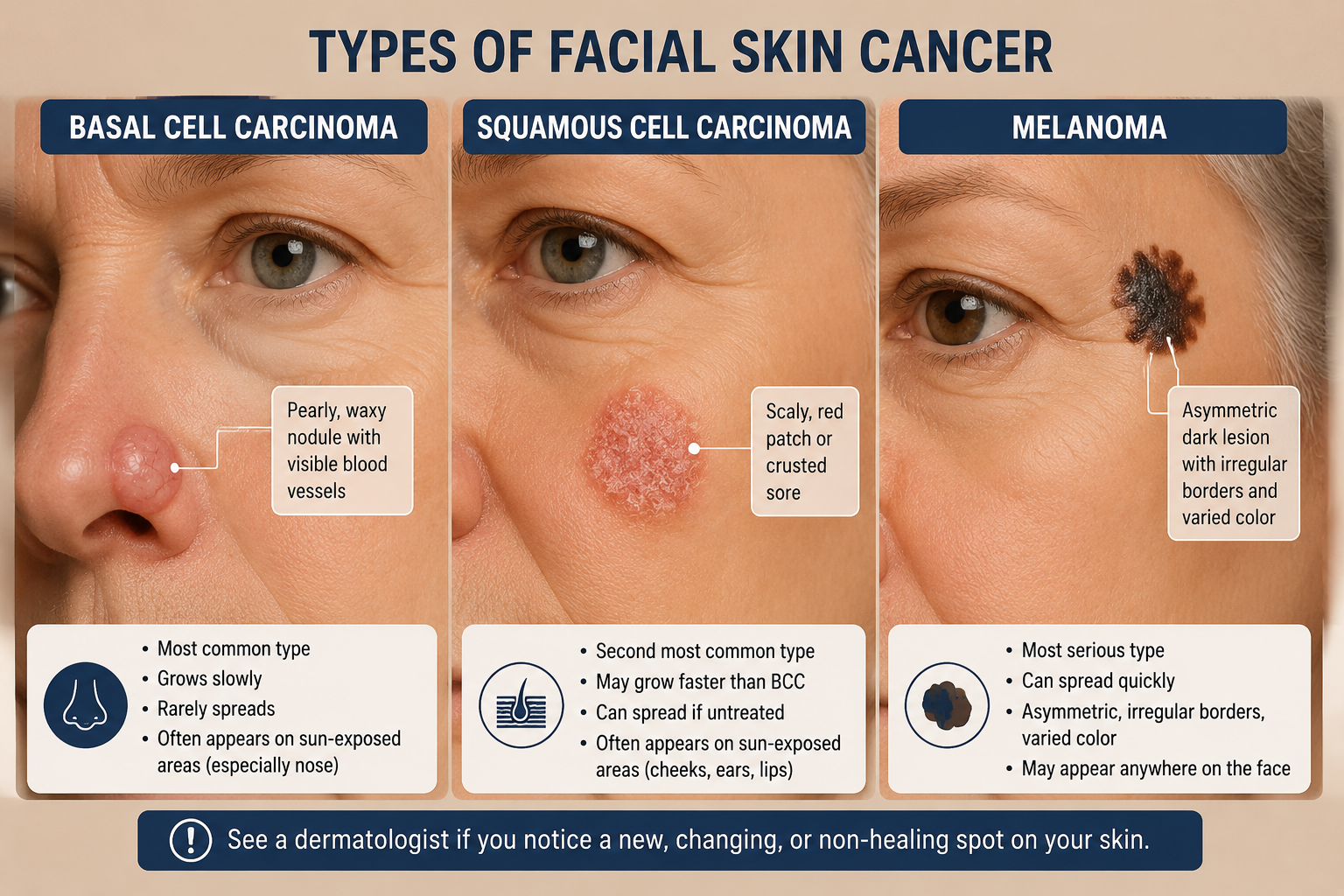
Skin cancer on the face does not always look dramatic. Many early lesions are subtle, and people frequently dismiss them as a pimple, scar, or age spot for months before seeking evaluation.
The appearance varies significantly by type:
Basal Cell Carcinoma (BCC)
Squamous Cell Carcinoma (SCC)
Melanoma
Use the ABCDE rule as a quick self-check:
For visual reference, the early stages of skin cancer pictures guide provides helpful photo comparisons of early lesions.
Common mistake: Many people assume skin cancer must be dark or raised. BCC, the most common type, is often pale, shiny, and flat. If a spot on your face hasn't healed in four to six weeks, get it checked.
Melanoma and basal cell carcinoma are both common on the face but behave very differently. BCC grows slowly, rarely spreads to other organs, and is almost always curable with surgery. Melanoma can spread to lymph nodes and distant organs even when the primary lesion is small, making early detection critical.
FeatureBasal Cell CarcinomaSquamous Cell CarcinomaMelanomaAppearancePearly bump, flat scarRed scaly patch, firm noduleAsymmetric dark or multicolored spotGrowth speedSlowModerateVariable; can be rapidSpread riskVery lowLow to moderateHigh if untreatedCommon face sitesNose, cheeks, foreheadLips, ears, templesCheeks, nose, anywhereCure rate (early)Excellent (>95%)Very good (>90%)Good if stage I/IITreatment priorityWeeks to monthsPrompt (weeks)Urgent
For a deeper look at early BCC specifically, see this guide on early stage basal cell carcinoma.
Yes, skin cancer can and does develop exclusively on the face, and the face is actually the single most common location for both BCC and SCC. This is because the face accumulates decades of UV radiation exposure, even in people who are careful about sunscreen on other parts of the body.
That said, skin cancer can appear anywhere on the body, including areas never exposed to the sun. Melanoma, in particular, can develop on the scalp, inside the mouth, under nails, and on the soles of the feet. The face being affected does not rule out lesions elsewhere, which is why full-body skin exams matter.
Who is most at risk for facial skin cancer:
Understanding your Fitzpatrick skin type can help assess your baseline risk level.
Recurrent facial skin cancer is common and usually comes down to cumulative UV damage that occurred years or decades earlier. The face has received more lifetime sun exposure than most body parts, and that damage to DNA in skin cells does not disappear after one successful treatment.
Key reasons for recurrence:
People who have had one skin cancer have a significantly elevated risk of developing another within five years. Regular dermatology follow-up, typically every six to twelve months, is standard of care after any facial skin cancer diagnosis.
Diagnosis of skin cancer on the face requires a skin biopsy. A dermatologist or surgeon removes a small sample of the suspicious lesion and sends it to a pathologist for microscopic analysis. Visual inspection alone, even by an experienced clinician, cannot confirm a diagnosis.
Diagnostic steps:
In Ontario, clinics like The Minor Surgery Center's skin cancer clinic offer rapid access with no referral required, which is important because wait times for publicly funded dermatology appointments can stretch to many months.
For those in the Greater Toronto Area, this resource on skin biopsy and skin cancer screening in Mississauga covers what to expect from the process.
Facial skin cancer is not inherently more aggressive biologically, but its location creates unique challenges. The face contains critical structures, including the eyelids, nose, lips, and ears, where even a small tumor can be difficult to remove completely without affecting function or appearance.
Why the face adds complexity:
Melanoma on the face near the eye or on the lip carries specific concerns. For detailed information about one high-stakes scenario, see this resource on face stage 4 melanoma.
The good news: because facial lesions are visible, they tend to be caught earlier than cancers on the back or scalp. Early-stage facial BCC and SCC have cure rates above 90 to 95%.

Treatment for skin cancer on the face depends on the cancer type, size, location, depth, and the patient's overall health. Most cases are treated surgically, but non-surgical options exist for superficial or early-stage lesions.
Surgical options:
Non-surgical options:
Systemic therapies for advanced disease:
Recent advances have expanded options for patients whose cancer cannot be fully removed surgically:
For patients in Ontario seeking surgical evaluation, reviewing the best skin cancer screening and treatment clinics in Toronto can help identify appropriate providers.
Treatment timelines vary by cancer type and treatment method. Most patients can expect the active treatment phase to last one day to several weeks, with recovery extending over weeks to months depending on the extent of surgery.
Typical timelines:
TreatmentProcedure DurationRecoveryTotal TimelineMohs surgery (small lesion)2-4 hours (same day)2-6 weeks1-2 monthsStandard excision30-60 minutes1-3 weeks4-8 weeksRadiation (multiple sessions)3-6 weeks of sessions4-8 weeks post-treatment3-4 monthsTopical therapy (imiquimod)Applied at home dailySkin reaction 4-8 weeks6-12 weeksImmunotherapy (advanced cases)Infusions every 3-6 weeksOngoingMonths to years
From first biopsy to completed treatment, most straightforward facial skin cancer cases resolve within six to twelve weeks. Complex reconstructions after large Mohs defects may require staged procedures over several months.
Scarring after facial skin cancer treatment is a real concern, and the extent depends on the size of the lesion, the treatment method, and individual healing factors. Mohs surgery, despite being the most thorough approach, is also the most tissue-conserving, which generally produces better cosmetic outcomes than wide excision.
What to expect during recovery:
Factors that affect scarring:
People prone to keloid scarring should discuss this with their surgeon before the procedure. For background on scar risk factors, this guide on keloid-prone skin is a useful reference.
Reconstruction options after large facial excisions include local skin flaps, skin grafts, and, in some cases, staged repairs. A board-certified plastic surgeon with experience in facial reconstruction is the ideal provider for complex cases.
In Canada, skin cancer treatment is generally covered under provincial health insurance when performed in a publicly funded setting, though wait times can be long. Private clinic options exist for faster access, with costs varying by procedure type.
General cost ranges (private pay in Canada, 2026 estimates):
In the United States, costs are substantially higher without insurance. Mohs surgery can range from $1,000 to $4,000 USD or more per procedure, and reconstruction adds further expense.
Factors that affect cost:
For Ontario residents seeking no-referral access, the Minor Surgery Center's skin cancer clinic offers transparent pricing and rapid booking.
For diagnosis and initial evaluation, a dermatologist is the appropriate first step. For treatment, particularly surgical removal on the face, a dermatologic surgeon, Mohs surgeon, or board-certified plastic surgeon with skin cancer experience is often the best choice.
Decision guide:
Many clinics offer integrated care where dermatology and surgery are coordinated. The Minor Surgery Center FAQ addresses common questions about which specialist to see and what to expect from the process.
Untreated skin cancer on the face will not resolve on its own. The consequences depend on the cancer type, but all three major types worsen with delayed treatment.
BCC without treatment: Grows slowly but steadily, eventually invading deeper tissues including cartilage and bone. On the nose or ear, this can cause significant structural destruction. While BCC rarely spreads to distant organs, locally advanced BCC can become very difficult to treat and may require extensive surgery or radiation.
SCC without treatment: Carries a meaningful risk of spreading to regional lymph nodes (estimated at 2 to 5% for typical facial SCC, higher for lesions on the lip or ear). Once regional spread occurs, treatment becomes significantly more complex and prognosis worsens.
Melanoma without treatment: The most serious consequence of delay. Melanoma thickness at diagnosis is the single strongest predictor of outcome. A thin melanoma (less than 1mm) carries a five-year survival rate above 95%. A thick or metastatic melanoma has substantially lower survival rates.
Bottom line: There is no safe "watch and wait" period for a confirmed or suspected skin cancer on the face. Earlier treatment means smaller surgery, less scarring, and better outcomes.
For more detail on what happens as skin cancer progresses, see this complete guide to cancer progression.
Most skin cancer on the face is preventable, and sunscreen is the single most evidence-supported tool for reducing risk. Broad-spectrum sunscreen with SPF 30 or higher, applied daily to the face, reduces cumulative UV damage that drives BCC, SCC, and melanoma development [7].
Effective prevention strategies:
Sunscreen is not a perfect shield, but consistent daily use over years meaningfully reduces the probability of developing facial skin cancer. People who start using sunscreen daily in their 20s or 30s accumulate far less UV damage by the time they reach the highest-risk decades.
Diet and overall skin health also play a supporting role. For background on how nutrition intersects with skin health, this article on diet and skin health offers practical guidance.
Does skin cancer on the face hurt?
Most early-stage facial skin cancers are painless. Some lesions, particularly SCC, may cause tenderness, itching, or a burning sensation. Pain is not a reliable indicator of whether a lesion is cancerous or benign. For more detail, see this article on whether skin cancer hurts.
How fast does skin cancer on the face grow?
BCC typically grows very slowly, sometimes over years. SCC grows more quickly, over weeks to months. Melanoma growth rate is highly variable; some lesions change rapidly over weeks while others evolve slowly. Any lesion that has changed noticeably in four to six weeks warrants evaluation.
Can skin cancer on the face spread to the brain?
Melanoma has the highest potential to metastasize to distant organs, including the brain, liver, and lungs. BCC almost never spreads beyond the local site. SCC can spread to regional lymph nodes and, rarely, to distant organs. This is why melanoma requires more aggressive staging and follow-up.
Is a dark spot on my lip skin cancer?
A dark spot on the lip can be melanoma, SCC, a benign lentigo, or other conditions. Any new or changing dark spot on the lip should be evaluated by a dermatologist. See this resource on melanoma dark spot on lip for more information.
Can I treat skin cancer on my face at home?
No home remedy or over-the-counter product can reliably treat confirmed skin cancer. Topical imiquimod and 5-FU are prescription medications used by clinicians for specific superficial lesions under medical supervision. Attempting to treat a facial skin cancer at home risks allowing the cancer to grow deeper while masking surface changes.
How do I know if a spot on my face is cancerous without a biopsy?
You cannot confirm skin cancer without a biopsy. Dermatoscopy can increase clinical suspicion, but pathology is the only definitive test. If a lesion concerns you, book an appointment for evaluation rather than waiting.
Will Mohs surgery leave a big scar on my face?
Mohs surgery is specifically designed to remove the minimum amount of tissue necessary, which minimizes scarring compared to wider excisions. Most patients are satisfied with cosmetic outcomes, especially when reconstruction is performed by an experienced surgeon. Scar appearance continues to improve for up to eighteen months post-procedure.
Can children get skin cancer on the face?
Skin cancer in children is rare but not impossible. Melanoma does occur in adolescents, and conditions like xeroderma pigmentosum dramatically increase childhood skin cancer risk. Any unusual or changing lesion on a child's face should be evaluated by a pediatric dermatologist.
How often should I get my face checked for skin cancer after treatment?
After a confirmed facial skin cancer, most dermatologists recommend follow-up every three to six months for the first two years, then annually. The schedule is adjusted based on cancer type, risk factors, and whether additional lesions have appeared.
Is one bad sunburn enough to cause facial skin cancer?
A single severe sunburn, particularly blistering sunburns in childhood or adolescence, does increase lifetime skin cancer risk. However, cumulative UV exposure over decades is the primary driver. This is why protection matters at every age, not just after a significant burn.
Skin cancer on the face is common, visible, and in most cases, highly treatable when caught early. The face's constant sun exposure makes it the most frequent site for basal cell carcinoma, squamous cell carcinoma, and melanoma, but that same visibility means lesions are more likely to be noticed and evaluated before they advance.
Actionable next steps:
Early action is the single most effective thing anyone can do to improve outcomes for facial skin cancer.
[1] Skin Cancer Facts - https://www.skincancer.org/skin-cancer-information/skin-cancer-facts/
[2] Key Statistics for Basal and Squamous Cell Skin Cancers - https://www.cancer.org/cancer/types/basal-and-squamous-cell-skin-cancer/about/key-statistics.html
[3] Phio Pharmaceuticals Announces Positive Pathology Results Final Maximum Dose Cohort - https://www.nasdaq.com/press-release/phio-pharmaceuticals-announces-positive-pathology-results-final-maximum-dose-cohort
[4] Regeneron Announces Approval of Cemiplimab-rwlc for Adjuvant Treatment of Cutaneous Squamous Cell Carcinoma - https://aimatskincancer.org/press-releases/regeneron-announces-approval-of-cemiplimab-rwlc-for-adjuvant-treatment-of-cutaneous-squamous-cell-carcinoma-with-a-high-risk-of-recurrence-after-surgery-and-radiation/
[5] Immunotherapy Pembrolizumab Skin Cancer Treatment UCLA Study - https://newsroom.ucla.edu/stories/immunotherapy-pembrolizumab-skin-cancer-treatment-ucla-study
[6] Early Immunotherapy Shows Promising Results in Advanced Basal Cell Carcinoma - https://www.hopkinsmedicine.org/news/newsroom/news-releases/2025/11/early-immunotherapy-shows-promising-results-in-advanced-basal-cell-carcinoma
[7] What to Know About Skin Cancer - https://time.com/7300863/what-to-know-about-skin-cancer/
[8] Five Things to Know If You've Been Diagnosed with Skin Cancer on Your Face - https://www.mskcc.org/news/five-things-know-if-you-ve-been-diagnosed-skin-cancer-your-face