
Last updated: October 28, 2026
Most skin biopsy sites heal in about one to three weeks depending on the technique used and where the biopsy was taken, though deeper or sutured wounds can take longer [1][2]. The best approach is simple: keep the area clean, apply petroleum jelly, and cover it with a bandage rather than letting it dry into a scab [1]. Watch for spreading redness, pus, fever, or pain that worsens instead of improves, and call your doctor if any of these appear [1][3].
A shave biopsy, which only removes a thin surface layer of skin, often closes within one to two weeks [4]. A punch or excisional biopsy, which goes deeper and may need stitches, can take several weeks to heal fully, with the visible wound reaching 90% closure in roughly 7-10 days and complete surface healing taking longer [1][5].

Location matters as much as technique. The AAD and Mayo Clinic both note that biopsies on the lower legs and feet heal more slowly than those on the face, arms, or trunk, sometimes taking well beyond the typical 7-10 day window [1][3]. Age, circulation, diabetes, and smoking also slow healing, though exact added time varies by person and isn't quantified in a single standard figure.
Scar color and texture continue to change for much longer than the wound itself. Mayo Clinic states the final scar color may not settle for one to two years [3]. If you want a broader look at how biopsy methods differ, see this guide to skin biopsy types.
Skin biopsy healing moves through four overlapping stages: initial inflammation, tissue rebuilding (granulation), surface closure (epithelialization), and long-term scar remodeling [2][3]. Understanding each stage helps you tell normal healing from a problem.
Expect mild oozing, tenderness, swelling, bruising, and pink or red skin around the wound edge. This is the body's inflammatory response, and it's considered normal as long as it doesn't keep getting worse [1][3]. If bleeding starts, apply firm, uninterrupted pressure with clean gauze for a full 20 minutes before checking again [1].
Avoid bumping or stretching the area, and use a wrapped ice pack if your clinician approves it to reduce swelling [3].
New pink or red tissue (granulation tissue) fills in the wound bed as the body rebuilds. For many smaller biopsies, the surface is largely closed by around day 7-10, though this depends on biopsy depth and location [1]. Itching is common during this stage as nerve endings and skin cells regenerate.
The surface finishes closing over (epithelialization). Shave biopsies typically wrap up within one to three weeks total, while punch and excisional sites, especially ones with stitches, often need several weeks before the wound is fully sealed [1][4][5]. Some redness or firmness under the skin can persist even after the surface looks closed.
The scar continues to remodel for months after the wound closes, and its final color may not be set for one to two years [3]. During this window, sun protection and gentle scar care make the biggest difference in how the scar eventually looks. For a related, step-by-step look at this process, see mole removal healing stages explained.
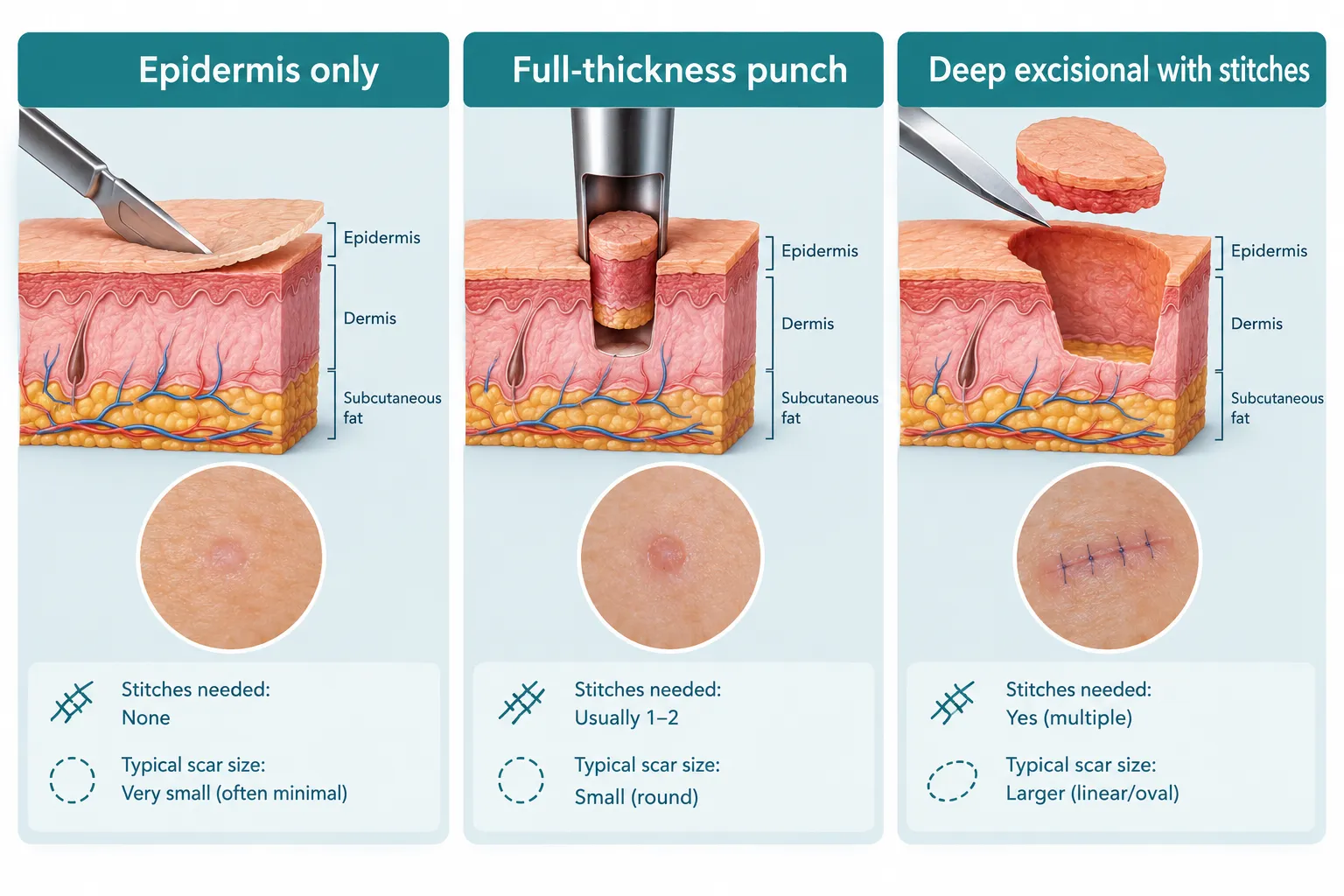
Yes. The three main biopsy types differ in depth, closure method, and typical healing time, which directly affects scar risk [1][2][5].
Biopsy typeDepthStitchesTypical healingScarShaveEpidermis/upper dermisUsually none1-2 weeks [4]Flat or slightly indentedPunchFull thickness, small round coreOften yesSeveral weeks [1][5]Small round scarExcisionalFull thickness, wider marginYesSeveral weeks [1][2]Linear scar
Choose to ask your clinician which type applies if you're unsure; the biopsy method is usually chosen based on the lesion's appearance and location rather than patient preference. For a related procedure, see what to expect after skin cancer excision on the face.
Daily cleansing, petroleum jelly, and a protective bandage are the core of skin biopsy aftercare recommended by the AAD [1]. This moist, covered approach heals wounds faster and with less visible scarring than letting a wound dry out and scab over.
Wash the site gently once or twice daily with mild soap and water, pat dry, then apply a thin layer of petroleum jelly from a squeeze tube [1]. Mayo Clinic also recommends twice-daily cleaning for many biopsy sites, continuing until the wound heals or stitches come out [3].
Topical antibiotic ointment is not generally necessary for an uncomplicated biopsy. AAD dermatologists Stephen Stone, MD, and Mona Gohara, MD, note that allergic or irritant skin reactions to antibiotic ointments can be more of a concern than infection itself [1].
Keep the wound covered with an adhesive bandage or sterile gauze and tape. Covering it, rather than exposing it to air, supports faster, cleaner healing [1]. Instructions do vary: Mayo Clinic suggests covering for 2-3 days for many biopsy types, while some NHS leaflets recommend leaving the first dressing untouched for 24-48 hours [3][6][7]. Follow the specific instructions given at your visit, since they reflect your biopsy's depth and location.
Showering is usually fine the day after a biopsy, but keep the site from soaking and pat it dry afterward rather than rubbing. Avoid swimming, hot tubs, and baths until the wound is closed, since prolonged soaking can soften the healing tissue and raise infection risk.
Skip heavy exercise, stretching, or activities that strain the biopsy site for several days, particularly if stitches are involved, since tension on the wound edges can widen the eventual scar. Light walking is generally fine.
Stitch-removal timing depends mostly on location: typically around 5-7 days for facial sites and 10-14 days for the trunk or limbs, though exact timing varies by tension and clinician judgment [2]. Facial skin heals faster and scars less with early stitch removal, while thicker-skinned areas like the back need longer support.
Some stitches are absorbable and don't need removal at all. If you're not sure which type you have, ask before leaving your appointment, and don't try to remove stitches yourself.
Call your doctor if:
These warning signs align with general wound-care guidance from AAD and NCBI resources on skin healing and infection risk [1][3].
Normal healing involves mild redness, tenderness, and warmth near the wound that gradually improves day by day. Infection is suggested by redness that spreads outward, increasing (not decreasing) pain, pus, a foul odor, or fever [1][3].
Normal: pink edges, light itching, small amount of clear or slightly blood-tinged fluid, mild swelling that peaks in the first couple of days then fades.
Not normal: redness expanding beyond the original wound margin, yellow or green drainage, a wound that feels hot, increasing swelling after day 3-4, or any fever. If in doubt, a same-day call to the clinic that performed the biopsy is the safest move, it's rarely wasted effort and sometimes catches a problem early. For a closer look at distinguishing normal change from concern, see what does normal healing look like after mole removal.
Almost every skin biopsy leaves some mark, ranging from a barely visible flat spot to a small linear scar, because the skin's surface has been intentionally broken [2][3]. The exact appearance depends on biopsy type, body location, your skin's healing tendencies, and aftercare.
Shave biopsy scars tend to be flat or slightly sunken. Punch biopsy scars are usually small and round. Excisional biopsy scars are linear and can be longer, especially if a wider margin was removed. Scars on the chest, shoulders, and upper back tend to be more visible and are more prone to thickening (hypertrophic or keloid scarring) than scars on the face.
Darker skin tones carry a higher risk of post-inflammatory hyperpigmentation (temporary darkening) or, less often, keloid scarring, and may take longer to see the scar settle to its final color [3]. This doesn't mean a worse outcome long-term, just a longer visible fading process.
Silicone gel or sheeting, consistent sun protection, and avoiding tension on the healing wound are the main evidence-supported steps for reducing scar visibility [3]. None of these erase a scar completely, but they can make it flatter, paler, and less noticeable.
For a deeper product comparison, see best scar care after mole removal: silicone vs vitamin E vs petroleum jelly, and for persistent or raised scars, scar revision may be worth discussing with a surgeon.
Biopsy result timing depends on lab volume, pathology complexity, and the clinic's reporting process, and varies across Ontario. Rather than guess a number here, see the dedicated breakdown in how long does it take to get biopsy results in Ontario for current, specific timelines.
The Minor Surgery Center operates five clinics across the GTA, Toronto/North York, York Mills, Vaughan, Mississauga, and Oakville, where board-certified plastic and reconstructive surgeons, including co-founders Dr. Kunaal Jindal and Dr. Roberto Tutino, assess and remove suspicious lesions with tissue sent for pathology. BCC, SCC, and melanoma treatment are OHIP-covered, no referral is needed, and consultations are free. For a suspicious mole, you can learn more at mole biopsy Toronto: suspicious mole testing, pathology and removal or call (647) 614-1611.
How long does a punch biopsy take to heal?
A punch biopsy often takes several weeks to heal fully, longer than a shave biopsy, because it removes a full-thickness core of skin and frequently requires stitches [1][2][5]. Facial sites generally heal faster than trunk or limb sites.
Should I keep my biopsy covered?
Yes, in most cases. The AAD recommends keeping the wound covered with a bandage and petroleum jelly rather than exposing it to air, since moist, covered wounds tend to heal faster with less scarring [1].
Can I shower after a skin biopsy?
Showering is typically fine the next day, but avoid soaking the area, pat it dry gently, and skip baths, hot tubs, and swimming until the wound has closed.
Is it normal for a biopsy site to be red?
Mild redness right at the wound edge is a normal part of early healing. Redness that spreads outward, worsens, or comes with fever or pus suggests infection and needs medical attention [1][3].
Will my biopsy leave a scar?
Almost every biopsy leaves some mark, since the skin's surface is intentionally broken. The size and visibility depend on biopsy type, location, and aftercare, and it may take one to two years for the scar's final color to settle [3].
When will I get my biopsy results?
Timing varies by clinic and lab, so check the specific Ontario guide linked above for current ranges rather than a single estimate.
Skin biopsy healing moves through predictable stages: inflammation in the first few days, tissue rebuilding over the following one to two weeks, surface closure by one to three weeks for most wounds, and scar remodeling that continues for months to a couple of years [1][3]. Keeping the wound clean, moist with petroleum jelly, and covered gives the best chance of a flat, pale scar. Watch for spreading redness, pus, fever, or bleeding that won't stop, and call your clinic promptly if any appear. If a biopsy comes back showing a lesion needing removal, a board-certified surgical team can guide you through the next steps, the clinics listed above offer free consultations and OHIP-covered treatment for skin cancer diagnoses.