
Last updated: November 10, 2026
This article is educational only and not medical advice. Pregnant readers should talk to their obstetric care provider before any treatment decision.
A fast-growing red bump that bleeds when touched is unsettling, especially during pregnancy when hormones seem to explain everything and nothing. If a search for "pyogenic granuloma pregnancy bleeding removal cost" brought you here, this guide walks through what the lesion is, why it bleeds so easily, how to manage it while pregnant, and what removal in Ontario actually involves, cost and OHIP included.
A pyogenic granuloma is a benign, fast-growing red bump made of tangled blood vessels that bleeds easily when bumped or rubbed. It's common during pregnancy, especially on the gums, and many pregnancy-related lesions shrink after delivery [1]. Firm, steady pressure stops most bleeding episodes. Removal, usually shave excision with cautery or full surgical excision, with the tissue sent for pathology, is the standard long-term treatment [2][3].
A pyogenic granuloma (also called lobular capillary hemangioma) is a benign overgrowth of small blood vessels that forms a soft, red or purplish bump, often within days to weeks [2][4]. Despite the name, it is not caused by pus-forming infection and it is not a true granuloma in the medical sense, it's a vascular growth [4].
Typical features:
For a broader comparison with a similar-looking but different vascular bump, see cherry angiomas vs. pyogenic granulomas.
The exact trigger isn't fully understood, but several factors are consistently linked to these lesions. Minor skin injury, certain medications, and hormonal changes during pregnancy are the most commonly cited associations [2][4].
Pregnancy-associated pyogenic granulomas are common enough to have their own names: granuloma gravidarum, pregnancy tumor, or epulis gravidarum [4]. DermNet notes they occur in roughly 5% of pregnancies [4], usually on the gums, where rising hormone levels and local irritation combine to trigger rapid vascular growth.
Yes. A pregnancy epulis (also called granuloma gravidarum) is simply a pyogenic granuloma that develops on the gums during pregnancy [4]. The biology is identical; the name just reflects the location and the hormonal trigger.
Often, yes. Cleveland Clinic notes that pregnancy-associated lesions may disappear after delivery as hormone levels return to pre-pregnancy baselines [1]. Because of this, many providers favor watching and waiting rather than treating right away, especially for small, non-bleeding gum lesions [5].
Sometimes, but it depends on symptoms. A 2026 oral-surgery case report notes that pregnancy-associated oral lesions are often managed expectantly, with surgery reserved for uncontrolled heavy bleeding, significant pain, or interference with chewing [6]. A 2022 review on dermatologic procedures in pregnancy similarly treats a friable, bleeding pyogenic granuloma as a lesion that may need prompt management rather than automatic postponement, generally favoring the second trimester for elective timing when treatment is needed, while allowing urgent care at other times under medical supervision [7]. Lidocaine, with or without diluted epinephrine, is considered a preferred local anesthetic choice in pregnancy; a cited cohort of 210 pregnant dental patients receiving lidocaine found no statistically significant difference in adverse fetal outcomes compared with controls [7]. Timing should always be discussed with an obstetric care provider and the treating surgeon.
These lesions are built almost entirely from small, fragile blood vessels packed close to the surface, so even light friction can tear them open [2][4]. Unlike a scrape on regular skin, there's very little supporting tissue to limit the bleeding, which is why these bumps seem to "bleed out of nowhere."
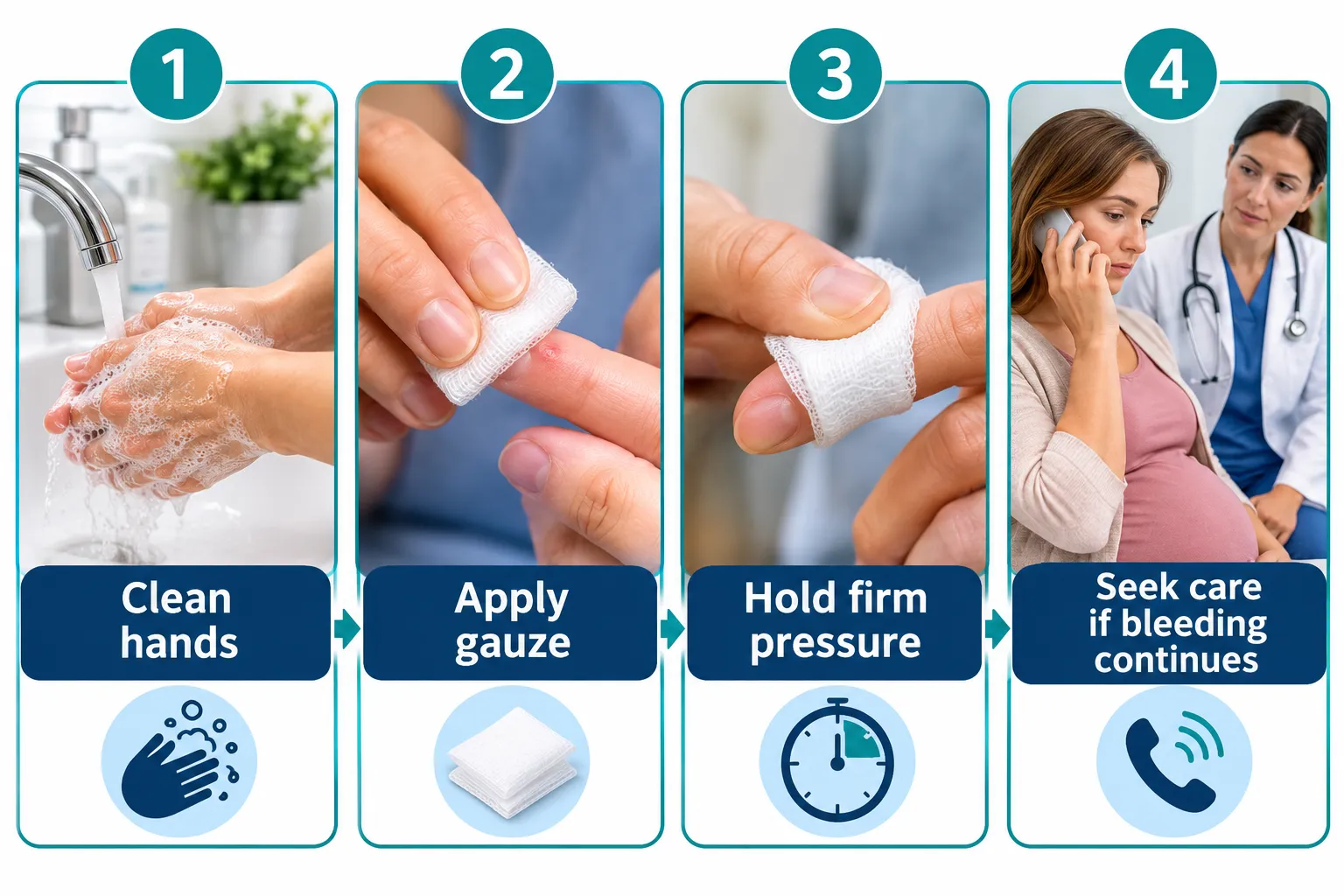
🩸 How to stop the bleeding
Pyogenic granulomas can appear almost anywhere skin or mucous membrane exists, but some spots are far more common than others.
A pyogenic granuloma on the finger is one of the more common presentations outside pregnancy, and it's often mistaken for a stubborn wart or an infected cut because it keeps reopening.
A fast-growing bleeding bump deserves a careful look because a few serious conditions can mimic a pyogenic granuloma. Amelanotic melanoma, a melanoma without the usual dark pigment, can look very similar: pink, red, and fast-growing see the guide to amelanotic melanoma. This is a major reason pathology review matters after removal.
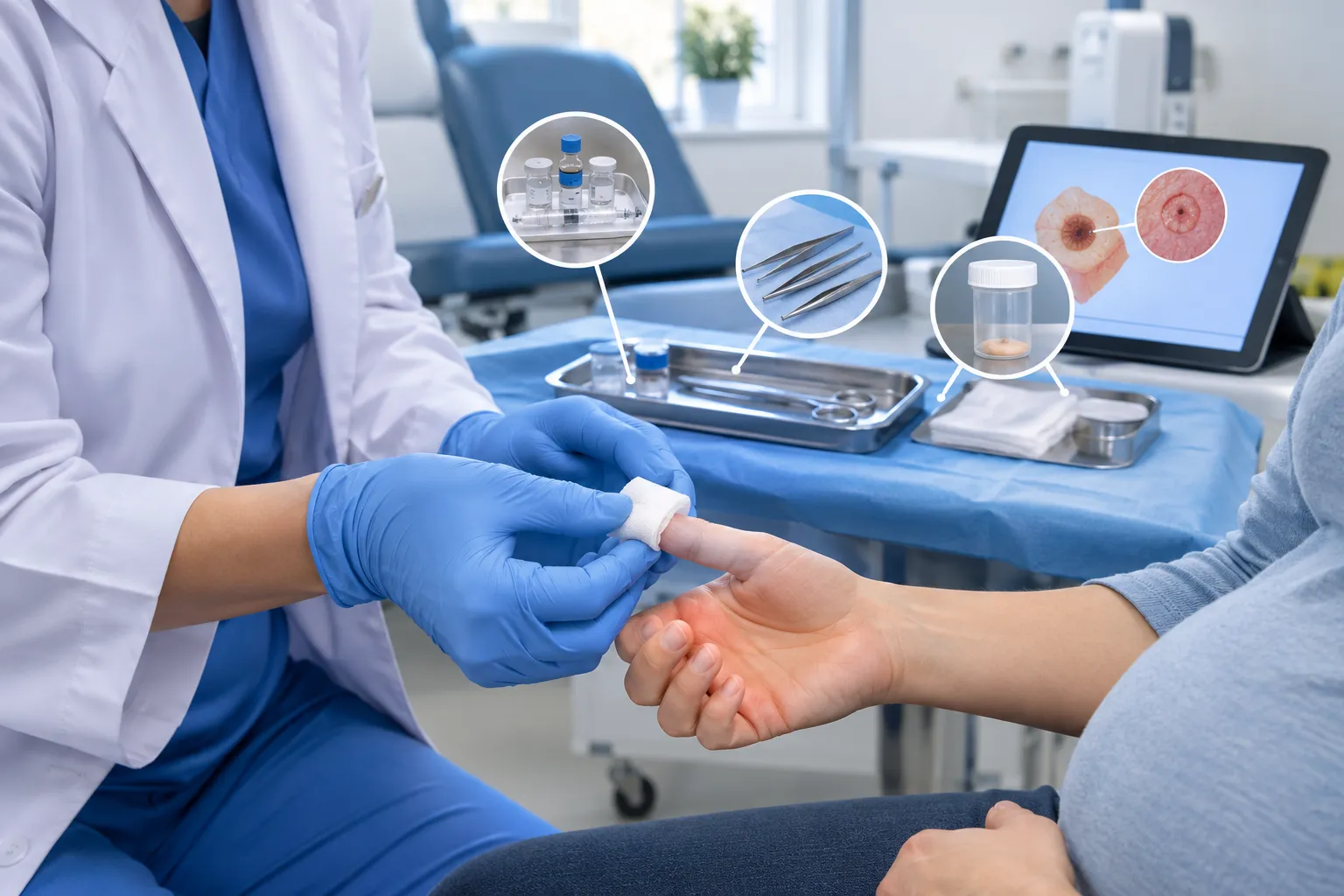
Removal is typically done under local anesthetic in an outpatient setting, and the method chosen affects both scarring and the chance the lesion returns [2][3].
The lesion is shaved flush with the skin, then the base is cauterized to control bleeding and destroy remaining vessels. This method is often chosen for cosmetic reasons but carries a higher reported recurrence risk than full excision [2][3].
The lesion is cut out completely, including a margin of surrounding tissue, then closed with sutures. StatPearls identifies complete excision as preferable when preventing recurrence and confirming the diagnosis are priorities [2].
Cryotherapy, curettage, pulsed-dye laser, and topical or chemical approaches like silver nitrate are described in the literature as alternatives, each with different recurrence and scarring profiles [1][3]. Availability varies by provider and setting.
MethodHow it worksRecurrence (per sources)ScarringPathology possibleFull surgical excisionCuts out lesion with margin, sutured closedLower [2]Linear scarYesShave excision + cauteryShaves lesion flush, cauterizes baseHigher [2][3]Flatter, often minorYesLaser / cryotherapy / curettageDestroys or removes tissue without full excisionVariable [1][3]Minimal to moderateLimited/none in some methods
TMSC's board-certified plastic and reconstructive surgeons, co-founders Dr. Kunaal Jindal and Dr. Roberto Tutino, treat pyogenic granuloma under local anesthetic as an outpatient procedure, with patients going home the same day; learn more on the pyogenic granuloma condition page or the related blog overview.
Sending excised tissue to a pathology lab confirms the diagnosis and rules out look-alike conditions, including amelanotic melanoma, which can resemble a pyogenic granuloma on examination alone [1]. CMS coding guidance notes that pathology is commonly billed as a separate service from the removal procedure itself, which matters when estimating total costs [coding note]. For more on what happens after a lesion is removed, see what happens to tissue after removal.
Yes, recurrence is possible, and the method used affects the odds. StatPearls notes there is no universally accepted standard treatment because clinical trial data is limited, and shave excision or curettage with cautery, while often preferred cosmetically, carries a higher recurrence risk than complete excision [2]. The American Academy of Ophthalmology's EyeWiki similarly notes increased recurrence when lesions are treated during pregnancy versus postpartum, likely tied to ongoing hormonal influence [eyewiki].
⚠️ See a doctor if:
There is no single published price for pyogenic granuloma removal in Ontario, and costs vary by method, location, and whether the lesion is treated as medically necessary or cosmetic. OHIP coverage generally depends on medical necessity, for example, active bleeding or diagnostic uncertainty, rather than purely cosmetic concerns; exact eligibility should be confirmed at consultation.
For general background on how public versus private minor-surgery coverage works in Ontario, see OHIP vs. private clinic for minor surgery. TMSC offers free consultations with no referral needed, across five GTA locations: Toronto/North York, York Mills, Vaughan, Mississauga, and Oakville. See our clinics for addresses and to book.
See a doctor promptly if a red, bleeding bump is growing fast, won't stop bleeding with pressure, looks irregular or dark, or keeps coming back after treatment. Pregnant patients with a suspected gum epulis should also loop in their dentist or oral surgeon, since oral lesions are managed differently from skin lesions. If pregnancy and skin-lesion removal timing both apply to you, this guide on mole removal during pregnancy covers similar timing considerations.
Is a pyogenic granuloma dangerous?
It's benign and not cancerous, but it bleeds easily and can look similar to more serious lesions like amelanotic melanoma, which is why diagnosis and sometimes pathology matter [1][2].
Is pregnancy epulis the same as pyogenic granuloma?
Yes. Pregnancy epulis, granuloma gravidarum, and pregnancy tumor are all names for a pyogenic granuloma that develops on the gums during pregnancy [4].
Will a pyogenic granuloma go away after pregnancy?
Often, yes. Many pregnancy-associated lesions shrink or disappear after delivery as hormone levels drop [1].
How do I stop a pyogenic granuloma from bleeding?
Apply firm, continuous pressure with clean gauze for several minutes without checking. Seek urgent care if bleeding doesn't stop [1].
Can a pyogenic granuloma come back after removal?
Yes. Recurrence is more likely after shave excision or curettage than after full surgical excision [2][3].
Is pyogenic granuloma removal covered by OHIP?
It depends on medical necessity, such as bleeding or diagnostic uncertainty, versus purely cosmetic removal. Coverage should be confirmed at consultation.
A pyogenic granuloma is rarely an emergency, but a bleeding bump that keeps coming back is reasonable grounds to get it checked and, often, removed. Pregnant readers should talk through timing with their obstetric care provider, since many gum lesions settle down after delivery. For removal under local anesthetic with pathology available, book a free consultation at The Minor Surgery Center, no referral needed. Call (647) 614-1611 or book online at any of the five GTA locations.