
Cysts can be uncomfortable, frustrating, and cosmetically concerning. Many people search for natural remedies to dissolve cysts because they want to avoid surgery, reduce swelling, or manage the lump at home.
The important truth is this: most natural remedies cannot fully dissolve or remove a true cyst, especially if the cyst has a capsule or sac under the skin. Some home care methods may help reduce irritation, swelling, tenderness, or drainage, but they usually do not remove the cyst lining. If the cyst wall remains, the cyst can come back.
This guide explains what natural remedies may help, which ones are overhyped, what to avoid, and when professional cyst treatment is the safer option.
If you are unsure what type of bump you have, it may help to review our guide to 17 types of cysts or learn more about sebaceous cyst removal.
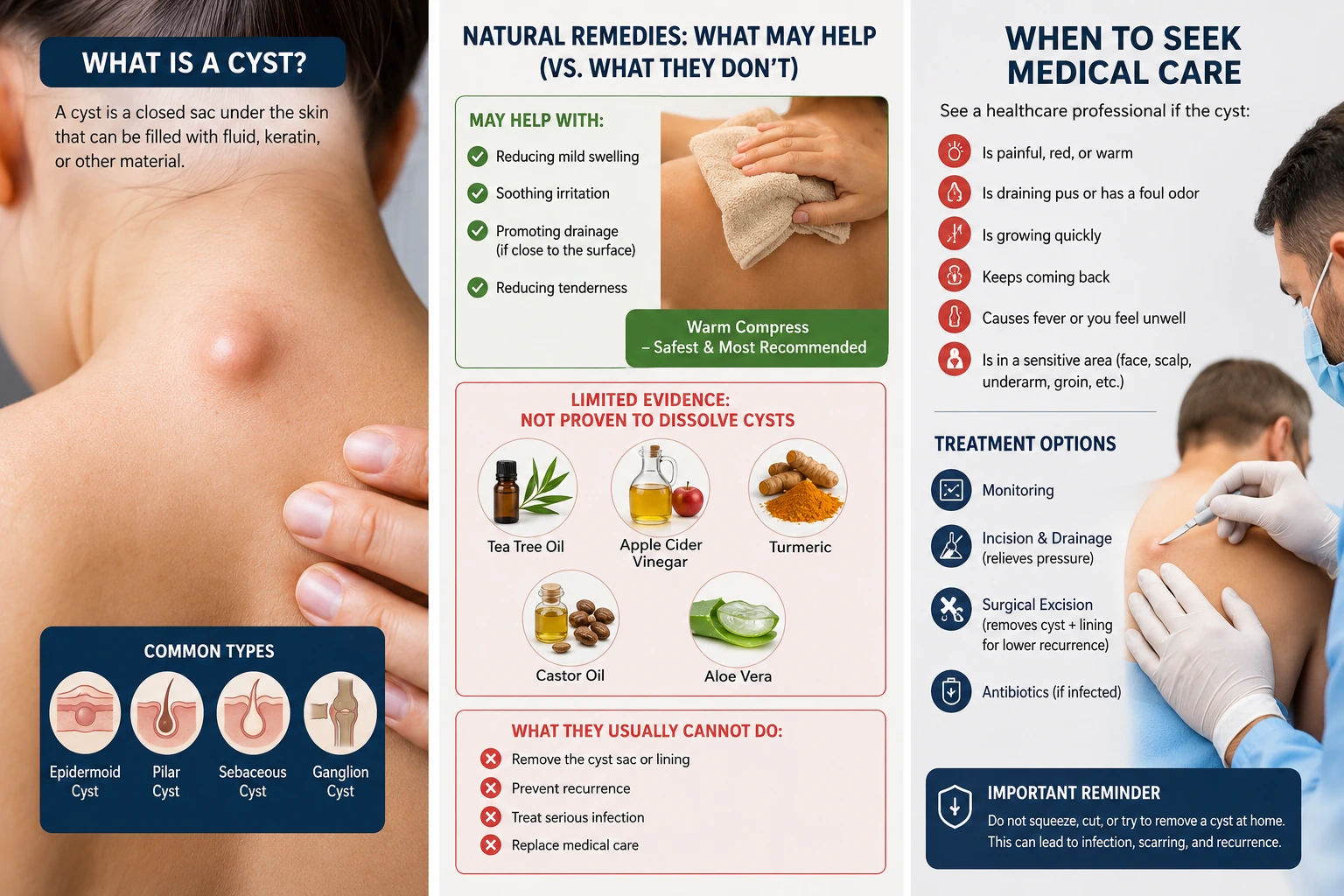
Natural remedies do not reliably dissolve cysts. A warm compress may help reduce discomfort and encourage drainage in some superficial cysts, but it will not remove the cyst wall. Tea tree oil, apple cider vinegar, turmeric, castor oil, and aloe vera may soothe the skin for some people, but they can also irritate the area and should not replace medical care. If a cyst is painful, infected, growing, recurring, or bothersome, professional evaluation is the safer option.
A cyst is a closed sac or pocket of tissue that can be filled with fluid, keratin, semi-solid material, pus, or other substances. Cysts can form under the skin or inside the body.
This article focuses mainly on skin cysts, especially epidermoid, pilar, and commonly called “sebaceous” cysts.
Common cyst types include:
For a broader breakdown, see our full guide to 17 types of cysts.
Many people use the term “sebaceous cyst” for any lump under the skin. In many cases, what they are describing is actually an epidermoid cyst or pilar cyst.
Epidermoid cysts often appear on the face, neck, back, chest, or trunk. They usually form when skin cells and keratin become trapped under the skin.
They may feel:
You can learn more about this type of cyst in our guide to epidermoid cyst removal surgery.
Pilar cysts commonly appear on the scalp. They often feel firm, smooth, and round. They can run in families and may become noticeable when brushing hair, washing the scalp, or getting a haircut.
Helpful related guides:
True sebaceous cysts are less common than the term suggests. Many “sebaceous cysts” are actually epidermoid or pilar cysts.
Still, patients often search for sebaceous cyst treatment because that is the common phrase used to describe a lump under the skin. If you are looking for treatment options, visit our page on sebaceous cyst removal.
Cysts can form for different reasons depending on the type.
Common causes and triggers include:
Some cysts form randomly and cannot be fully prevented.
For most true skin cysts, natural remedies do not dissolve the cyst completely.
The reason is simple: many cysts have a capsule, lining, or sac. Even if the swelling goes down or the cyst drains, the lining can remain under the skin. If the lining remains, the cyst can refill.
Natural remedies may help:
Natural remedies usually cannot:
If your main concern is recurrence, read our guide on why cyst sac removal matters.
Warm compresses are one of the most reasonable at-home options for a mild, uncomplicated skin cyst.
A warm compress may help:
Use this approach:
Stop warm compresses and seek medical care if:
If the cyst is already infected, review our guide to infected cysts.
Tea tree oil is often promoted online for cysts because it has antibacterial and anti-inflammatory properties. However, there is limited evidence that it can dissolve or remove a cyst.
Tea tree oil may help some people with:
Tea tree oil will not reliably:
Tea tree oil can cause irritation or allergic reactions, especially if used undiluted.
If used at all:
For many people, a warm compress is a safer first step than essential oils.
Apple cider vinegar is one of the most common home remedies people search for, but it is also one of the more irritating options.
Some people claim apple cider vinegar can “dry out” or “dissolve” cysts. There is not strong evidence that it removes the cyst sac or cures true skin cysts.
Apple cider vinegar is acidic and may cause:
This is especially risky on sensitive skin, broken skin, facial skin, genital skin, or inflamed cysts.
Do not use strong or undiluted apple cider vinegar on cysts. If the cyst is painful, red, warm, draining, or growing, do not try to treat it with vinegar. Seek medical care instead.
Epsom salt soaks are sometimes used for comfort. They may feel soothing and may help with general relaxation, but they do not dissolve cysts.
An Epsom salt soak may be reasonable for:
Avoid Epsom salt soaks if:
Epsom salt should be viewed as comfort care, not a cyst cure.
Turmeric contains curcumin, a compound known for anti-inflammatory properties. Some people use turmeric paste on cysts or take turmeric supplements for general inflammation support.
However, turmeric does not reliably remove skin cysts.
Turmeric may help:
Turmeric is unlikely to:
Turmeric can:
Do not apply turmeric paste to open, draining, or infected cysts.
Castor oil is commonly used as a moisturizing and soothing oil. Some people apply it to cysts to reduce discomfort or soften the skin.
Castor oil may help:
Castor oil is not proven to:
Castor oil can be greasy and may clog pores in some people. Avoid using it on open, draining, infected, or acne-prone areas if it worsens breakouts.
Aloe vera is gentle for many people and may help soothe irritated skin around a cyst.
Aloe vera may help:
Aloe vera does not usually:
Use pure aloe vera when possible and avoid products with fragrance, alcohol, or harsh additives.
Stop using it if the skin becomes more red, itchy, or irritated.
Honey is sometimes promoted for wound care and antibacterial support. Medical-grade honey is used in some clinical wound settings, but grocery-store honey is not the same as sterile medical-grade honey.
For intact cysts, honey is not proven to dissolve the cyst.
Avoid applying honey to:
If a cyst is open or draining, it is safer to have it assessed by a medical professional.
Many remedies are popular online but are not reliable for cyst removal.
Lavender, eucalyptus, oregano, peppermint, and other essential oils are sometimes promoted for cysts.
The issue is that they can irritate the skin and are not proven to remove cysts.
Avoid applying strong essential oils to:
Homeopathic remedies are sometimes promoted for cysts, but there is no strong clinical evidence that they remove cyst walls or cure cysts.
They should not replace medical care for:
Detox teas, cleanses, and extreme diets do not dissolve cysts.
They may also cause problems such as:
A balanced diet can support general skin health, but it is not a cyst removal treatment.
This is one of the biggest mistakes.
Do not:
Trying to remove a cyst yourself can cause:
If you are comparing drainage versus full removal, read our guide on cyst removal vs cyst drainage and our breakdown of drainage vs full excision recurrence risk.
Diet and lifestyle can support general skin health, but they usually do not dissolve an existing cyst.
Supportive habits include:
Diet cannot reliably:
If cysts are linked with acne, ingrown hairs, or chronic inflammation, improving skin care and underlying triggers may reduce flare-ups, but it should not be presented as a guaranteed cure.
The right approach depends on the type of cyst, symptoms, location, and whether it keeps coming back.
Before trying any home care, ask:
If the answer is yes to any of these, professional evaluation is safer.
Natural care may be reasonable when:
A warm compress and gentle hygiene are usually the safest options.
You should seek medical care if the cyst:
For related warning signs, see our guide to infected cysts.
Professional treatment depends on whether the cyst is inflamed, infected, painful, or simply bothersome.
Some small, painless cysts do not need immediate treatment. A provider may recommend watching it if it is not causing symptoms.
Incision and drainage may be used when a cyst is painful, swollen, or infected.
This can relieve pressure, but it may not prevent recurrence if the cyst wall remains.
Learn more here: cyst removal vs cyst drainage.
A provider may use a steroid injection to reduce inflammation in selected cysts. This does not remove the cyst, but it may calm swelling.
Antibiotics may be needed if there is a true bacterial infection. Not every inflamed cyst is infected, so assessment matters.
Surgical excision removes the cyst and its lining. This is usually the best option when the goal is to reduce recurrence.
For more detail, read:
At The Minor Surgery Center, patients can be assessed for cysts and other skin lesions. The right treatment depends on the cyst type, size, location, symptoms, recurrence history, and cosmetic goals.
Our team can help determine whether your cyst is best managed with monitoring, drainage, or removal.
You can learn more about sebaceous cyst removal, review pricing, or contact us to ask about next steps.
Most cyst removal procedures are done with local anesthetic. That means the area is numbed before treatment.
Patients may feel:
You should not feel sharp pain during a properly numbed procedure.
For timing details, see how long cyst removal surgery takes.
Healing depends on the cyst size, location, removal method, incision size, and your body’s healing response.
In general, healing may involve:
For more detail, read our guide to cyst removal recovery time.
Cyst removal cost depends on the cyst size, location, complexity, number of cysts, and whether pathology or additional care is needed.
Helpful internal resources:
Yes. Many skin lumps can resemble cysts.
A cyst can be confused with:
Helpful comparison guides:
If a lump is changing quickly, painful, bleeding, irregular, or unusual, do not assume it is a simple cyst.
Not every cyst can be prevented, but some habits may reduce irritation and flare-ups.
Helpful steps include:
Choose skincare products labeled:
This may reduce blocked pores and acne-related cysts.
If you get cyst-like bumps from acne or ingrown hairs, prevention may include:
Cysts can become irritated by friction from:
If a cyst keeps getting irritated, professional removal may be worth discussing.
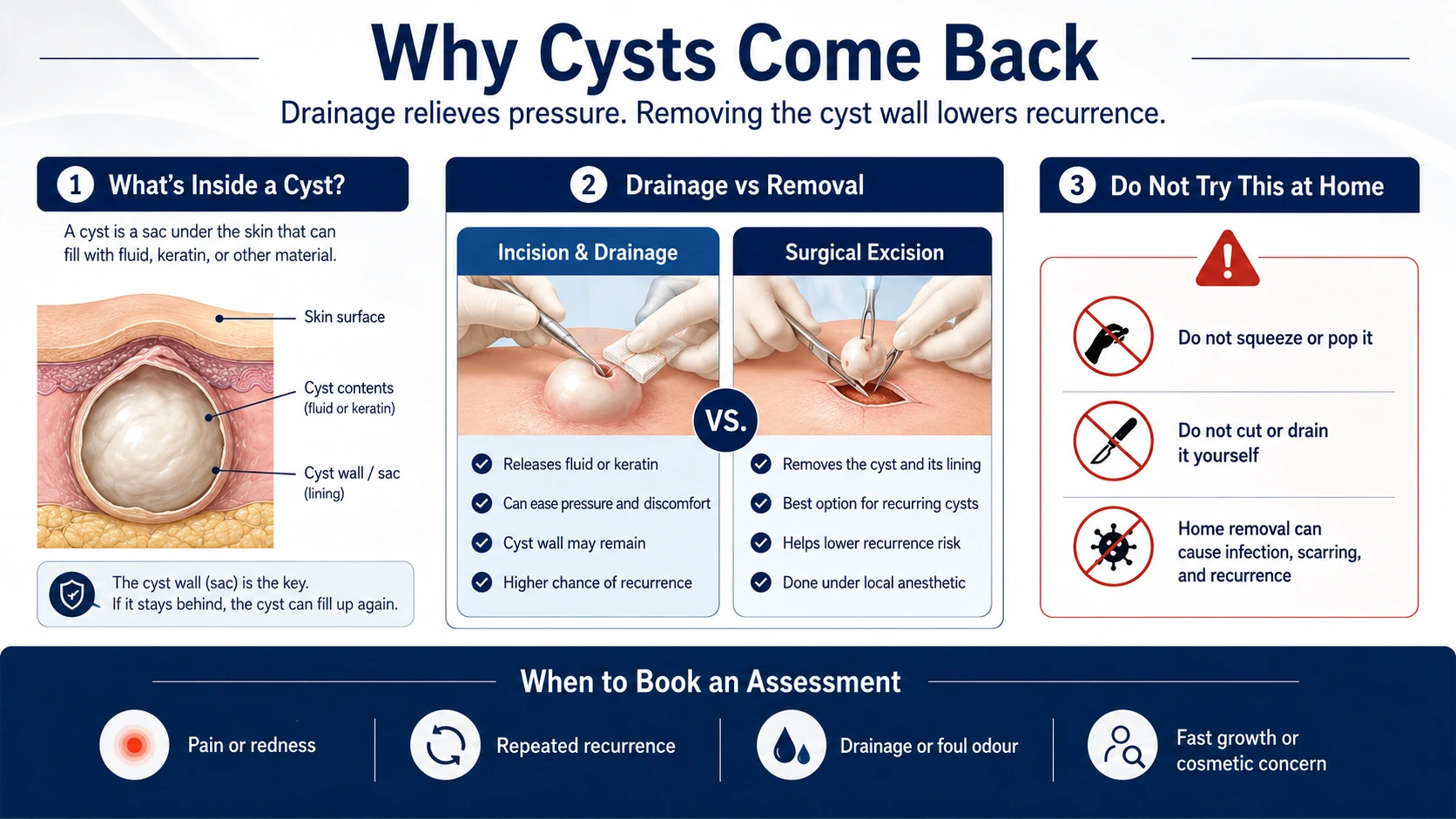
Natural remedies usually cannot completely dissolve a true cyst because many cysts have a lining or capsule under the skin. Warm compresses may help reduce discomfort or encourage drainage, but complete and lasting removal often requires removing the cyst wall.
A warm compress is generally the safest home option for a mild, uncomplicated skin cyst. It may reduce tenderness and help the cyst drain naturally. Avoid squeezing, cutting, or applying harsh substances.
Apple cider vinegar is not proven to remove cysts and can irritate or burn the skin. It should not be used on open, inflamed, draining, or sensitive areas.
Tea tree oil does not reliably dissolve cysts. It may have antibacterial and anti-inflammatory properties, but it can also cause irritation or allergic reactions. It should not be used on open or infected cysts.
Castor oil may moisturize the skin and soothe mild irritation, but it is not proven to remove cysts or prevent recurrence.
Turmeric may help with general inflammation, but it is not proven to remove the cyst sac or cure an infected cyst. It may also stain skin and clothing.
Some cysts may shrink or calm down, but many persist unless treated. Even if a cyst drains, it can return if the cyst wall remains.
A cyst often comes back when the cyst lining or sac remains under the skin. Drainage can relieve pressure, but full excision is usually needed to reduce recurrence risk.
No. Popping a cyst can cause infection, scarring, inflammation, and recurrence. It can also make future removal more difficult.
A ruptured cyst can cause swelling, redness, tenderness, drainage, and inflammation. If there is increasing pain, pus, warmth, spreading redness, or fever, seek medical care.
See a doctor if the cyst is painful, infected, growing quickly, recurring, bleeding, changing, or located in a sensitive area. You should also seek care if you are unsure whether the lump is actually a cyst.
No. Drainage releases the cyst contents, but it may leave the cyst wall behind. Cyst removal usually means removing the cyst and its lining, which lowers the chance of recurrence.
Diet cannot reliably dissolve an existing cyst. A healthy diet may support skin health and healing, but it should not replace medical assessment for painful, infected, or recurring cysts.
No. Detox teas and cleanses are not proven to dissolve cysts and may cause side effects. Hydration and balanced nutrition are better for general health.
For a recurring skin cyst, complete surgical excision is often the most effective option because it removes the cyst lining. A provider can confirm whether removal is appropriate.
Natural remedies may help calm mild cyst symptoms, but they should not be oversold as a way to dissolve cysts. Warm compresses, gentle hygiene, and avoiding irritation may help manage discomfort, but they do not reliably remove the cyst wall.
If a cyst is persistent, painful, infected, growing, or keeps coming back, professional evaluation is the safer and more effective path.
The Minor Surgery Center offers cyst assessment and treatment options across multiple GTA clinic locations, including:
You can learn more about sebaceous cyst removal, review pricing, or contact our team to discuss next steps.