
Last updated: August 19, 2026
Mole on nose removal typically costs between $150 and $1,200 depending on the method, whether a dermatologist or plastic surgeon performs it, and if the mole needs biopsy testing. Shave excision leaves the smallest, flattest scar for raised moles, while surgical excision is safer for moles with irregular features. Most nose moles heal within 2 to 6 weeks, though full scar fading can take several months to a year.
The main methods for mole on nose removal are shave excision, punch or round excision, full surgical excision with stitches, and laser or cryotherapy for very select cases. Which one a provider chooses depends on whether the mole is flat or raised, whether it looks typical or atypical, and how much tissue needs testing.
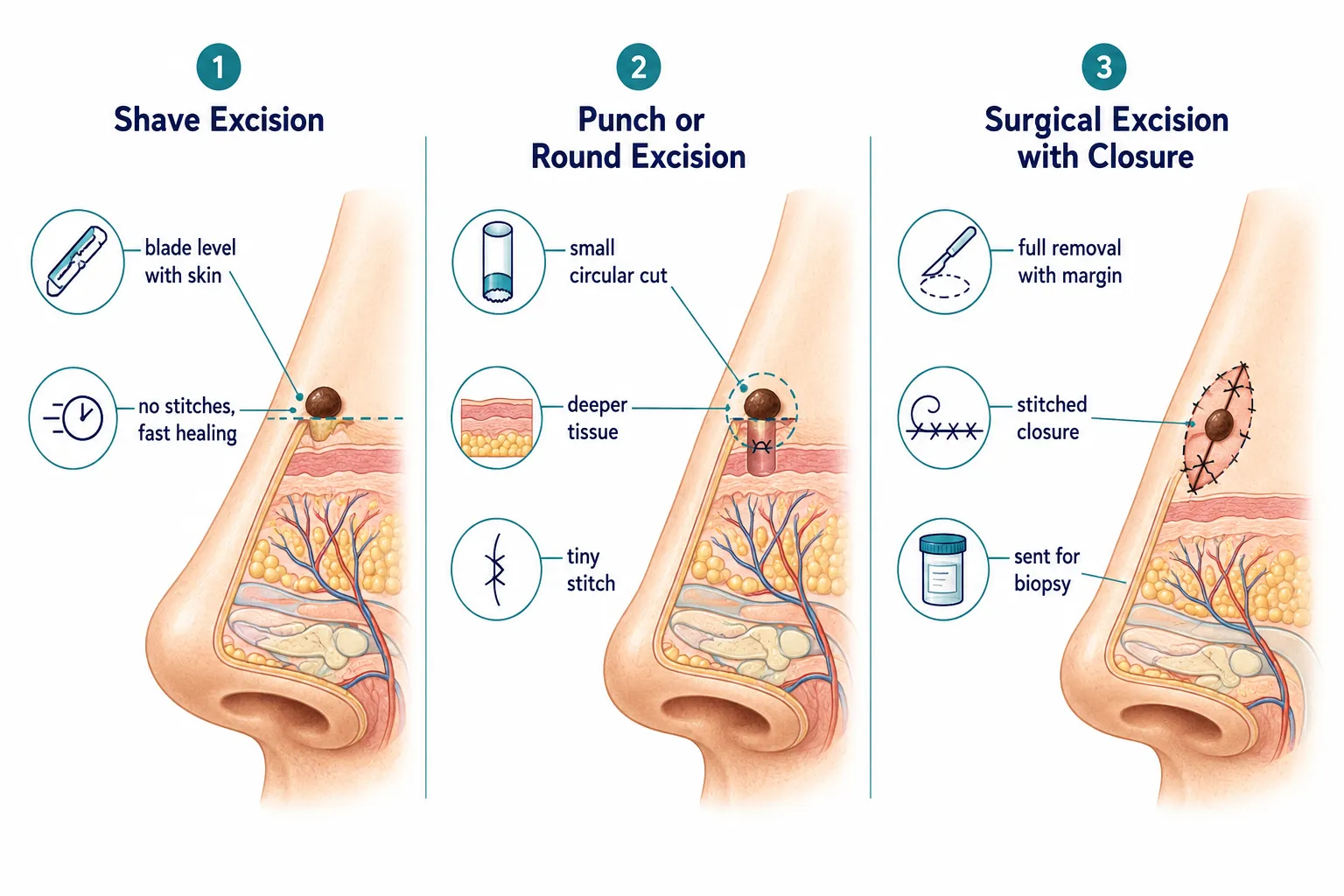
Clinical guidance published by the Primary Care Dermatology Society and reviewed clinical inquiries both point to the same pattern: benign, clearly raised nose moles with no worrying features respond well to shave excision or a small round/punch excision performed by an experienced dermatologist or facial plastic surgeon.[4][6][7] These techniques remove the raised portion of the mole while leaving enough of a specimen for the lab to confirm it is benign.
Here is a breakdown of common approaches:
Decision rule: choose shave or punch excision if the mole is raised, has been previously checked and confirmed benign, and the goal is mainly cosmetic. Choose full surgical excision if there is any uncertainty about the mole's nature, a family history of skin cancer, or if the mole has changed recently.
A common mistake is assuming every nose mole can be lasered off in one quick session. Many nose moles sit deeper than they appear, and lasering without a tissue sample means there is no way to confirm afterward that the mole was not something more serious.
Laser mole removal vaporizes the pigmented tissue using targeted light, while surgical removal (shave or excision) physically cuts the mole out and preserves a specimen for pathology testing. On the nose, surgical methods are generally favored for anything but the most superficial, previously confirmed benign spots.
The key difference is what happens to the tissue. Laser treatment destroys the mole cells in place, so there is nothing left to send to a lab. Surgical shave or excision removes an intact piece of tissue that a pathologist can examine under a microscope. This matters more on the nose than almost anywhere else on the body, because nasal skin lesions can be harder to evaluate visually and any atypical mole needs histologic confirmation before anyone can call it safe.[4][10]
Research on laser mole removal has generally studied smaller, well-selected lesions and still notes limitations around confirming what was actually removed.[2] Because of this, most dermatology guidance treats laser as a secondary option for facial pigmented lesions rather than a first-line choice, especially compared with shave excision, which recent evidence highlights as a minimally invasive method with high patient satisfaction for appropriate benign moles.[6]
FeatureLaser RemovalSurgical Shave/ExcisionTissue sent for biopsyNoYesBest forVery superficial pigment, previously confirmed benignRaised moles, any mole with uncertain featuresScarring risk on noseCan cause pigment changes or texture irregularityFlat, thin scar when done wellNumber of sessionsOften multipleUsually oneSuitability for atypical molesNot recommendedRecommended
Choose laser if: a dermatologist has already confirmed the spot is a flat, benign pigmented mark (not a true raised nevus) and the patient specifically wants to avoid any cutting.
Choose surgical removal if: the mole is raised, has any irregular color or border, or has never been formally evaluated by a physician.
Mole on nose removal generally costs more than removal on the arms, back, or legs because of the precision required and the higher likelihood that a specialist performs the procedure. Published clinic fee schedules suggest typical costs can range from around $150 for a simple shave excision to $1,200 or more for surgical excision performed by a facial specialist, particularly when biopsy and pathology fees are included.[1][5][8][9]
These figures are general estimates drawn from published clinic pricing pages and should be confirmed directly with a provider, since exact costs vary by region, clinic, and complexity.
MethodEstimated Cost Range (USD/CAD)What Drives the PriceShave excision$150,$400Size, single vs multiple moles, clinic typePunch/round excision with stitches$250,$600Suture removal visit, local anesthesiaSurgical excision with pathology$400,$1,200+Specialist fee, lab/pathology cost, facial locationFollow-up scar treatmentVariable, separate feeSilicone products, laser resurfacing if desired
Financing programs such as CareCredit are sometimes used by patients for cosmetic mole removal where insurance does not apply.[5] For a more detailed, up-to-date regional breakdown, see this guide on mole removal costs in 2025 and this Toronto-specific mole removal cost guide. Patients who want a personalized number before booking a consultation can also use the free mole removal cost estimator tool.
Common mistake: comparing a quoted price for trunk or limb mole removal to a nose quote and assuming they should match. Nose procedures often take longer per mole and may require a more experienced provider, which affects the fee.
Insurance typically covers mole removal on the nose only when the mole is medically suspicious or symptomatic, not when the goal is purely cosmetic. A mole that is flat, stable, and being removed just to improve appearance is usually billed as a cosmetic, out-of-pocket procedure.
Medical necessity generally applies when a mole shows features consistent with possible skin cancer, has been bleeding, is repeatedly irritated by glasses or rubbing, or has changed in size, shape, or color. In these cases, a physician documents the clinical concern, and removal is billed as a diagnostic or therapeutic procedure rather than cosmetic.[5][9]
Practical steps to check coverage:
Edge case: a mole that started as a cosmetic complaint but turns out to have atypical features on biopsy may retroactively qualify for reimbursement in some insurance systems, depending on the payer's rules, so keeping the pathology report is worthwhile.
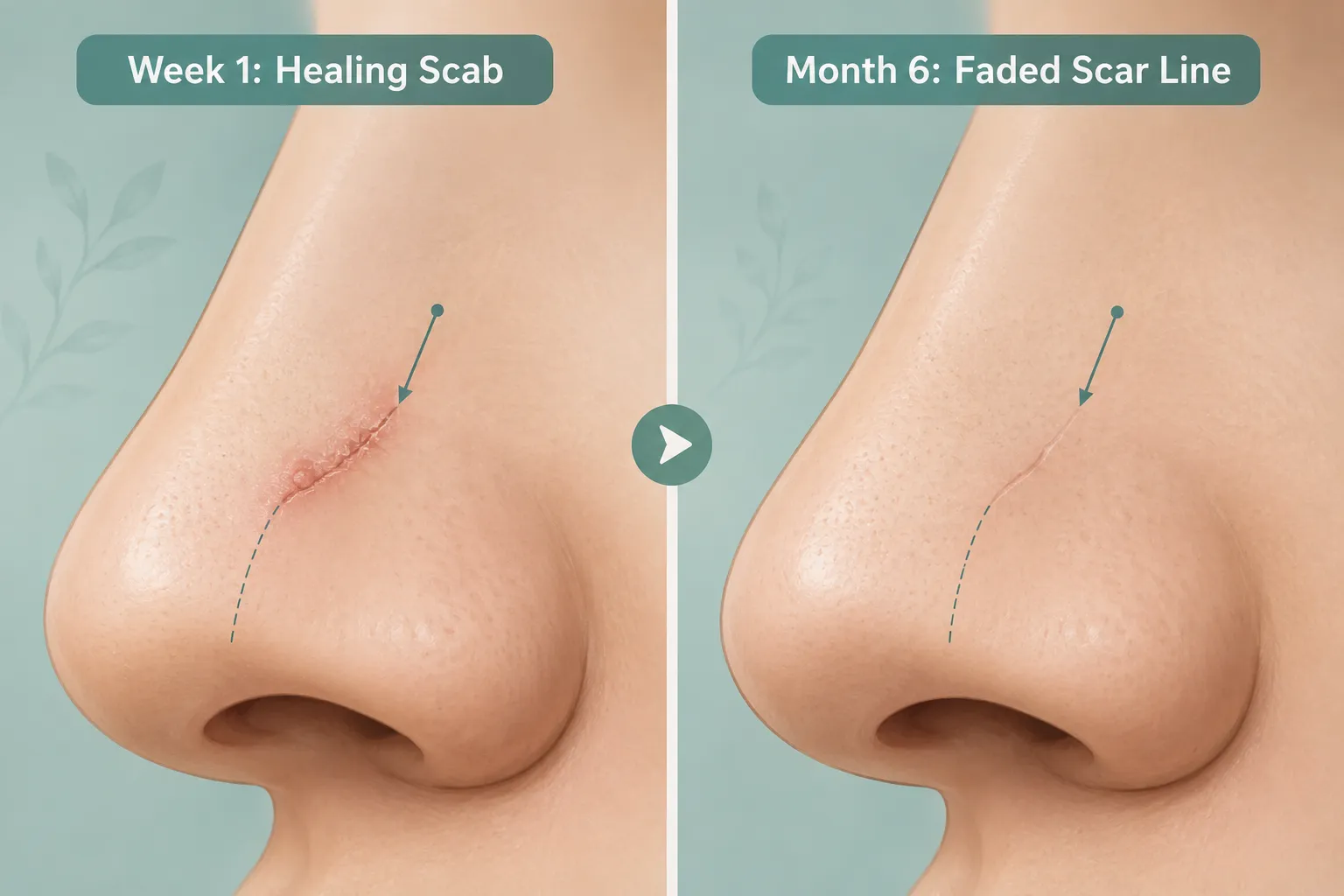
Yes, any method of mole on nose removal leaves some mark on the skin, but the size and visibility depend heavily on the technique used and how the skin heals. Shave excision on a raised mole typically leaves a flatter, less noticeable scar than a full surgical excision with stitches, though excision may be unavoidable for safety reasons in certain moles.
Nasal skin is thin, oil-gland-rich, and highly visible, which makes scarring on the nose a common concern.[6][7] A shave excision that removes only the raised portion of a mole tends to heal into a small, flat, pale mark that blends with surrounding skin texture over several months. A full excision with sutures creates a linear scar that is usually thin if closed carefully but is somewhat longer than the original mole width because of the tissue margin removed.
Factors that influence how visible a nose mole scar ends up being:
"The trade-off on the nose is almost always between a smaller cosmetic scar and complete diagnostic certainty. A slightly larger, well-closed excision scar is preferable to an incomplete or ambiguous shave when a mole's nature is uncertain."
Decision rule: if cosmetic appearance is the top priority and the mole is confirmed benign, ask specifically about shave excision. If there's any diagnostic doubt, accept that a small excision scar is the safer trade-off.
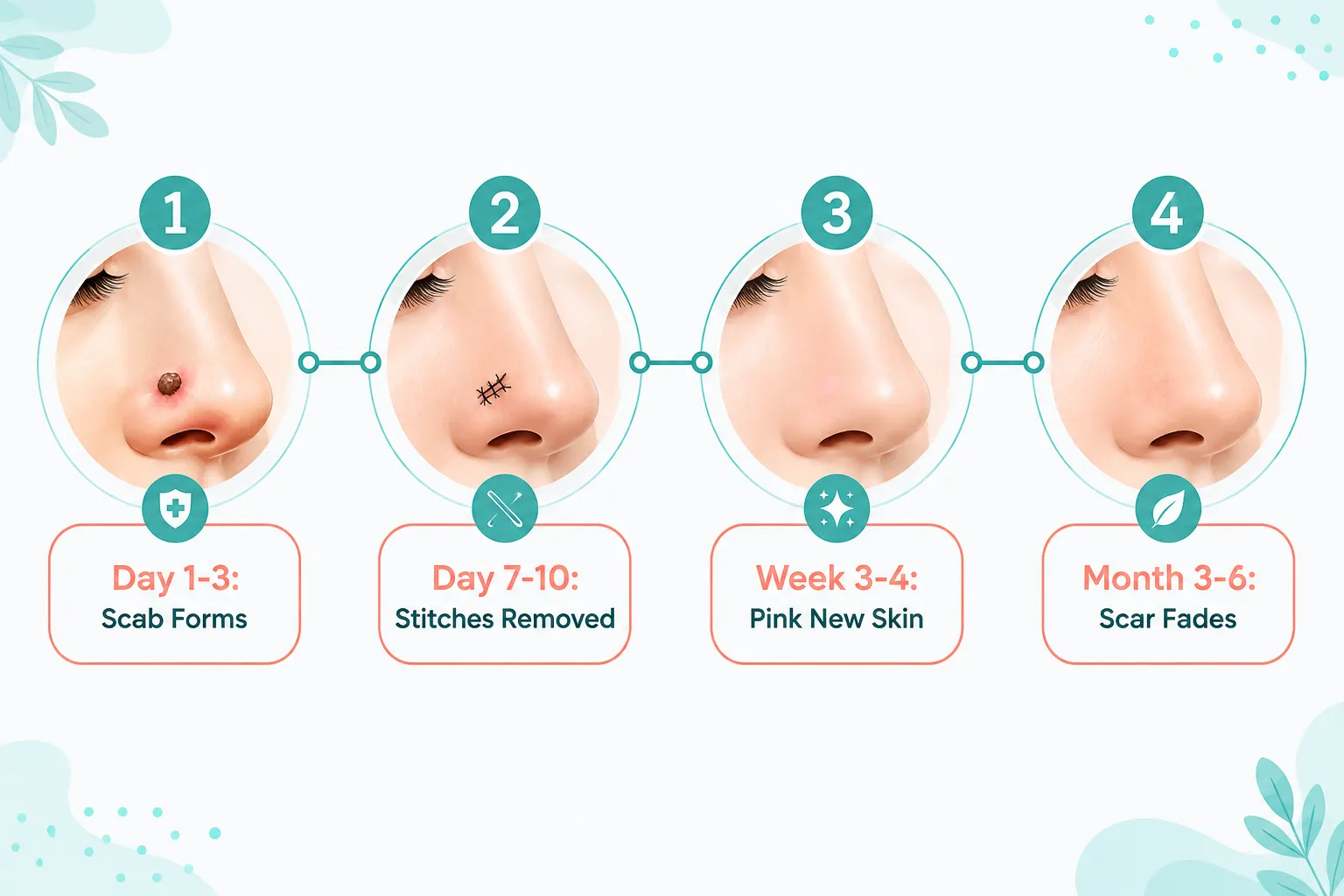
Most nose mole removal sites form a scab within the first few days, heal on the surface within 2 to 4 weeks, and continue fading in color and texture for 3 to 12 months. Recovery time depends on the method used: shave excisions generally heal faster than surgical excisions with stitches.
A general healing timeline looks like this:
For a broader look at healing patterns across different mole locations, see this guide on how long mole removal takes to heal. Related aftercare questions, such as when it is safe to shower or exercise again, are addressed in guides on showering after mole removal and exercising after mole removal.
Common mistake: picking off the scab early because it looks "ready." This is one of the most frequent causes of a worse scar, since premature scab removal can pull at healing tissue underneath.
Removing a mole from your nose at home is not recommended. Over-the-counter creams, mole removal pens, and DIY cutting or freezing kits cannot distinguish a benign mole from a cancerous lesion, and they carry real risks of infection, permanent scarring, and delayed cancer diagnosis.[10]
Facial skin, and nasal skin specifically, has a rich blood supply and sits close to cartilage. Attempting to cut or burn off a mole without sterile technique and proper depth control can lead to:
Some over-the-counter products marketed for mole removal claim to dissolve or lift moles using acids or freezing agents. Independent reviews of these products generally find limited evidence they work as advertised, and dermatology sources caution against self-treatment of any pigmented lesion.[10] For readers curious about the mole removal cream and pen category specifically, see the deeper reviews on whether mole removal creams work and whether mole removal pens work.
Edge case: a small skin tag near the nose that has already been confirmed by a doctor as a skin tag, not a mole, may be a lower-risk candidate for simple at-home methods, but this distinction should always come from a professional exam first, not self-diagnosis.
Decision rule: if there is any doubt about whether a growth is a mole, skin tag, or something else, book a professional evaluation before attempting any home method. The cost of a consult is far lower than the cost of treating a missed skin cancer.
A mole on the nose should be checked by a doctor if it has changed size, shape, or color, developed irregular or blurred borders, started bleeding or crusting without injury, become itchy or tender, or simply looks different from other moles on the body. New moles appearing after age 30, or any mole a person is unsure about, also warrant a professional look.
Dermatology references describe the classic warning signs using the "ABCDE" framework: Asymmetry, Border irregularity, Color variation, Diameter greater than roughly 6mm, and Evolution (any change over time).[10] These signs do not guarantee cancer, but they are the standard trigger for a professional exam rather than a wait-and-see approach.
Can a mole on your nose be cancerous?
Yes, moles anywhere on the body, including the nose, can become or start as skin cancer, most seriously melanoma, though many nose moles are entirely benign intradermal or compound nevi.[3][10] Because the nose is frequently sun-exposed and cosmetically prominent, atypical changes are often noticed early, which is actually an advantage for catching problems while they are still highly treatable.
Clinical guidance on intradermal melanocytic lesions generally recommends that any mole with atypical features be biopsied or excised with margins rather than shaved, specifically to allow full histologic assessment.[3][4] If a biopsy is performed, understanding the results matters just as much as the removal itself; this guide on reading a pathology report after mole removal explains common terminology in plain language.
Quick example: a longstanding, symmetric, brown, dome-shaped mole on the nose that hasn't changed in years fits the low-risk profile and is often removed cosmetically via shave excision. A mole that recently darkened on one side and started bleeding fits the high-risk profile and should be excised with margins and sent for pathology, not shaved cosmetically.
Picking, scratching, or repeatedly irritating a mole on the nose can cause bleeding, scabbing, localized infection, and inflammation that sometimes mimics the warning signs of a changing or cancerous mole, which can complicate diagnosis. Chronic irritation, such as from glasses frames or frequent touching, is also a recognized reason some patients seek removal even when the mole itself is benign.[10]
Repeated trauma to a mole does not turn a benign mole malignant, but it can make it harder for both patients and doctors to tell whether a change is due to irritation or to true biologic change. This is one reason doctors often ask patients to stop touching or attempting to remove a mole themselves and instead come in for an exam.
Risks of picking or scratching a nose mole include:
Common mistake: assuming that if scratching didn't hurt or bleed much, the mole is "fine." Painless changes are actually the more concerning pattern in melanoma, since early melanoma is frequently painless.
A nose mole needs to be removed if it shows any warning signs of atypical change, causes recurring symptoms like bleeding or irritation from clothing or glasses, or if a patient wants it removed for personal cosmetic reasons and a doctor confirms it is safe to do so. There is no single universal rule; the decision blends medical risk and personal preference.
Use this simple framework:
Patients who are unsure whether a mole falls into the medical or cosmetic category benefit from a professional mole check first. Resources such as how to check a mole at home and comparisons of flat versus raised moles and skin cancer risk can help patients understand what they are looking at before booking an appointment, though they are not a substitute for an in-person exam.
Decision rule: if a mole has been stable for years, is symmetric, and has no reported symptoms, cosmetic removal by shave or small excision is generally low risk. If any of those conditions are not met, medical evaluation should come first.
The best provider for mole on nose removal is a board-certified dermatologist or facial plastic surgeon with specific experience performing shave and excisional procedures on nasal skin, since this area requires more precision than mole removal on the trunk or limbs. Experience with facial anatomy directly affects both scarring outcomes and diagnostic accuracy.
What to look for when choosing a provider:
Patients in Ontario researching local options can review clinic-specific guides, including details on mole removal in Oakville, costs, methods, and what to expect and broader options for suspicious mole testing, biopsy, and removal. For patients who are not yet sure whether their mole needs removal at all, a dedicated mole check clinic can provide a lower-commitment first step.
Edge case: a patient with several atypical-looking moles across the body, not just on the nose, may benefit more from a full-body mole mapping service before targeting the nose lesion specifically, since a broader skin check can reveal patterns a single-mole exam would miss.
Mole on nose removal is a routine procedure when handled by an experienced provider, but the nose's thin skin and cosmetic visibility make method choice and provider experience more important than on almost any other body part. Shave or small excision works well for confirmed benign, raised moles, while full surgical excision remains the safer choice whenever a mole's nature is uncertain.
Before booking a procedure:
Is mole removal on the nose painful?
Most patients report only mild discomfort during the procedure because local anesthetic numbs the area first; some tenderness during healing is normal but significant pain is not expected. More detail is available in this guide on whether mole removal hurts.
Can a mole grow back after it's removed from the nose?
Superficial shave excisions occasionally leave pigment cells behind that can regrow a faint mark, while full excision with margins is less likely to regrow. This topic is covered in depth in this article on whether moles grow back after removal.
How small can a nose mole scar be made?
Scar size depends on the mole's original size and the method used; shave excision on a small raised mole often heals into a barely visible mark, while a larger or atypical mole requiring full excision leaves a proportionally larger, thin linear scar.
Does a nose mole always need a biopsy?
Not always. A long-standing, symmetric, unchanged mole may be removed cosmetically without automatic biopsy, though many providers still send tissue for testing as a precaution, especially on the face.
What's the difference between a mole and a skin tag on the nose?
A mole is a cluster of pigment-producing cells that can be flat or raised, while a skin tag is a small soft flap of skin tissue; the two require different evaluation and removal techniques, so a professional exam should confirm which one is present.
Can I get a tattoo over a nose mole removal scar later?
Tattooing over a healed scar is a cosmetic option some patients consider, though the nose's thin skin and visibility make this a decision worth discussing with both a dermatologist and an experienced tattoo artist; more general considerations are discussed in this piece on tattooing over a removal scar.
How soon can I wear glasses or a mask after nose mole removal?
Most providers recommend avoiding direct pressure on the healing site for at least the first week or two, and patients should ask their specific provider for individualized guidance based on the removal method used.
Is laser removal ever the right choice for a nose mole?
Laser removal can be appropriate for very superficial, previously confirmed benign pigmented spots, but it is generally not recommended for raised moles or any mole without prior professional evaluation, since no tissue sample is preserved for testing.[2][6]
[1] Services Miscellaneous Fees - https://rutlandskin.com/services-miscellaneous-fees/
[2] pubmed.ncbi.nlm.nih.gov - https://pubmed.ncbi.nlm.nih.gov/17163925/
[3] What Is The Recommended Management For An Intradermal Melanocytic - https://www.droracle.ai/articles/192366/what-is-the-recommended-management-for-an-intradermal-melanocytic
[4] What Is The Best Way To Remove A Melanocytic - https://www.droracle.ai/articles/417105/what-is-the-best-way-to-remove-a-melanocytic
[5] Mole Removal - https://www.carecredit.com/well-u/health-wellness/mole-removal/
[6] 5609jfp Clinicalinquiries1 - https://cdn.mdedge.com/files/s3fs-public/Document/September-2017/5609JFP_ClinicalInquiries1.pdf
[7] Moles - https://www.pcds.org.uk/clinical-guidance/moles
[8] Treatment Prices - https://drfareeha.com/treatment-prices/
[9] Your Guide To Mole Removal Costs From A Skin Expert - https://plasticsurgerygroupnewjersey.com/your-guide-to-mole-removal-costs-from-a-skin-expert/
[10] Nevi Moles - https://www.merckmanuals.com/professional/dermatologic-disorders/benign-skin-tumors-growths-and-vascular-lesions/nevi-moles