
Last updated: October 14, 2026
Merkel cell carcinoma is a rare but aggressive neuroendocrine carcinoma of the skin that most often appears as a fast-growing, firm, painless, shiny pink, red, or purple bump on sun-exposed skin in older adults. It can spread to nearby lymph nodes early in its course, so a new bump that grows noticeably over a few weeks needs prompt medical assessment rather than a wait-and-watch approach.
This article provides general health information for a Canadian audience and is not a substitute for medical advice from a qualified clinician.
Merkel cell carcinoma is a rare, aggressive skin cancer that develops from abnormal neuroendocrine cells in the skin, which is why it is also known as neuroendocrine carcinoma of the skin. It behaves differently from more common skin cancers because it tends to grow quickly and has a higher tendency to spread to lymph nodes and distant organs.
The tumour forms in the deeper layer of the skin and often grows larger within weeks rather than months. Because it starts in neuroendocrine-type cells rather than pigment-producing cells, it does not typically look like a mole and is frequently mistaken for a cyst, insect bite, or harmless lump until it keeps enlarging.
Merkel cell carcinoma is considered one of the rarer forms of skin cancer, far less common than basal cell carcinoma or squamous cell carcinoma. Anyone noticing an unusual, rapidly growing bump should still have it checked, since rarity does not reduce the importance of early assessment when a lesion is changing quickly.
For general context on how this condition fits among other skin cancers, see the overview of 4 types of skin cancer.
Merkel cell carcinoma often appears as a firm, dome-shaped bump that is pink, red, or purple, grows quickly, and usually does not hurt. Clinicians sometimes use the AEIOU criteria as a memory aid for features commonly seen in this cancer, though the criteria alone cannot confirm a diagnosis.
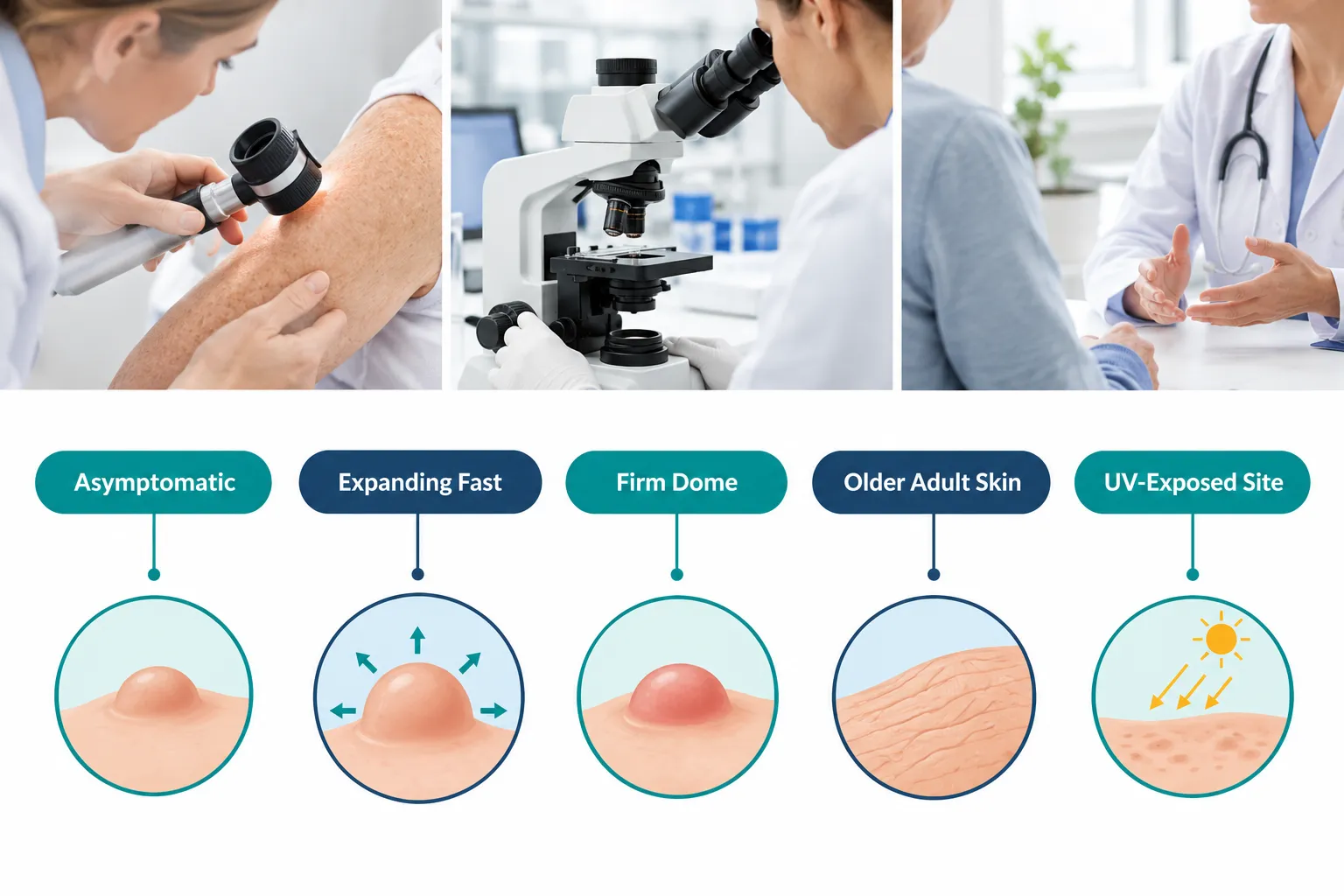
The AEIOU criteria stand for:
A bump does not need to meet all five criteria to be worth checking. Anyone uncertain about what this looks like in practice can review real examples in the pictures of Merkel cell carcinoma guide. Because many other skin conditions can look similar, including cellular dermatofibroma, a visual comparison is not a substitute for a clinical assessment and biopsy.
Merkel cell carcinoma mainly affects older adults with significant lifetime sun exposure, and risk is notably higher in people with weakened immune systems. Infection with the Merkel cell polyomavirus is found in a large share of tumours and is considered a key contributing cause in many cases.
Recognized risk factors include:
The Merkel cell polyomavirus is a virus that many people carry without any symptoms, but in a subset of cases it integrates into skin cells in a way that is linked to the development of Merkel cell carcinoma. Not everyone who carries the virus develops cancer, and the exact combination of factors that leads to tumour formation is still an active area of cancer research.
Merkel cell carcinoma differs from the more common skin cancers mainly in how rare it is, how quickly it grows, and how readily it can spread to lymph nodes. The table below gives a general comparison to help put the condition in context.
FeatureMerkel Cell CarcinomaBasal Cell CarcinomaSquamous Cell CarcinomaMelanomaHow commonRareMost common skin cancerSecond most commonLess common than BCC/SCCTypical lookFirm, painless, pink/red/purple bumpPearly bump or sore that won't healScaly, crusted patch or bumpOften pigmented, but can be amelanoticGrowth speedFast, weeks to a few monthsSlow, months to yearsModerateVariable, can be fastSpread riskHigh relative to sizeLowModerateHigh if deep or advancedTypical treatmentSurgery, radiation, immunotherapySurgery, topical therapySurgery, sometimes radiationSurgery, immunotherapy, targeted therapy
A key distinction from melanoma is that Merkel cell carcinoma is not a pigment-cell cancer, so it rarely looks brown or black. For more detail on how a non-pigmented, fast-growing bump is evaluated against pigment-cell skin cancers, see the pages on amelanotic melanoma and nodular melanoma. For the difference between the two most common non-melanoma skin cancers, see BCC vs SCC: what's the difference.
Merkel cell carcinoma is diagnosed with a skin biopsy that is examined under a microscope and confirmed with specialized staining, since it can be hard to tell apart from other skin lumps by appearance alone. Once confirmed, further tests are usually done to check whether the cancer has spread.
The diagnostic process generally includes:
A minor surgery clinic can perform the initial assessment and biopsy of a suspicious bump without requiring a prior referral, then refer the person to oncology specialists if the biopsy confirms Merkel cell carcinoma. The Minor Surgery Center assesses and biopsies suspicious skin lesions without a referral, with OHIP coverage for skin cancer care; details are available on the skin lesion assessment page and the skin cancer conditions page.
Merkel cell carcinoma is staged from early, localized disease through to advanced disease that has spread to distant organs, and staging directly determines which treatments are recommended. Staging considers tumour size, whether lymph nodes are involved, and whether the cancer has spread beyond the regional lymph nodes.
In general terms:
Staging is typically confirmed through the combination of biopsy results, sentinel lymph node biopsy findings, and imaging, and it is set by a multidisciplinary cancer team rather than a single provider.
Merkel cell carcinoma treatment usually combines surgery to remove the tumour, radiation therapy to reduce the chance of local or regional recurrence, and, for more advanced disease, immunotherapy with checkpoint inhibitors. The right combination depends on the stage, the person's overall health, and input from a full cancer care team.
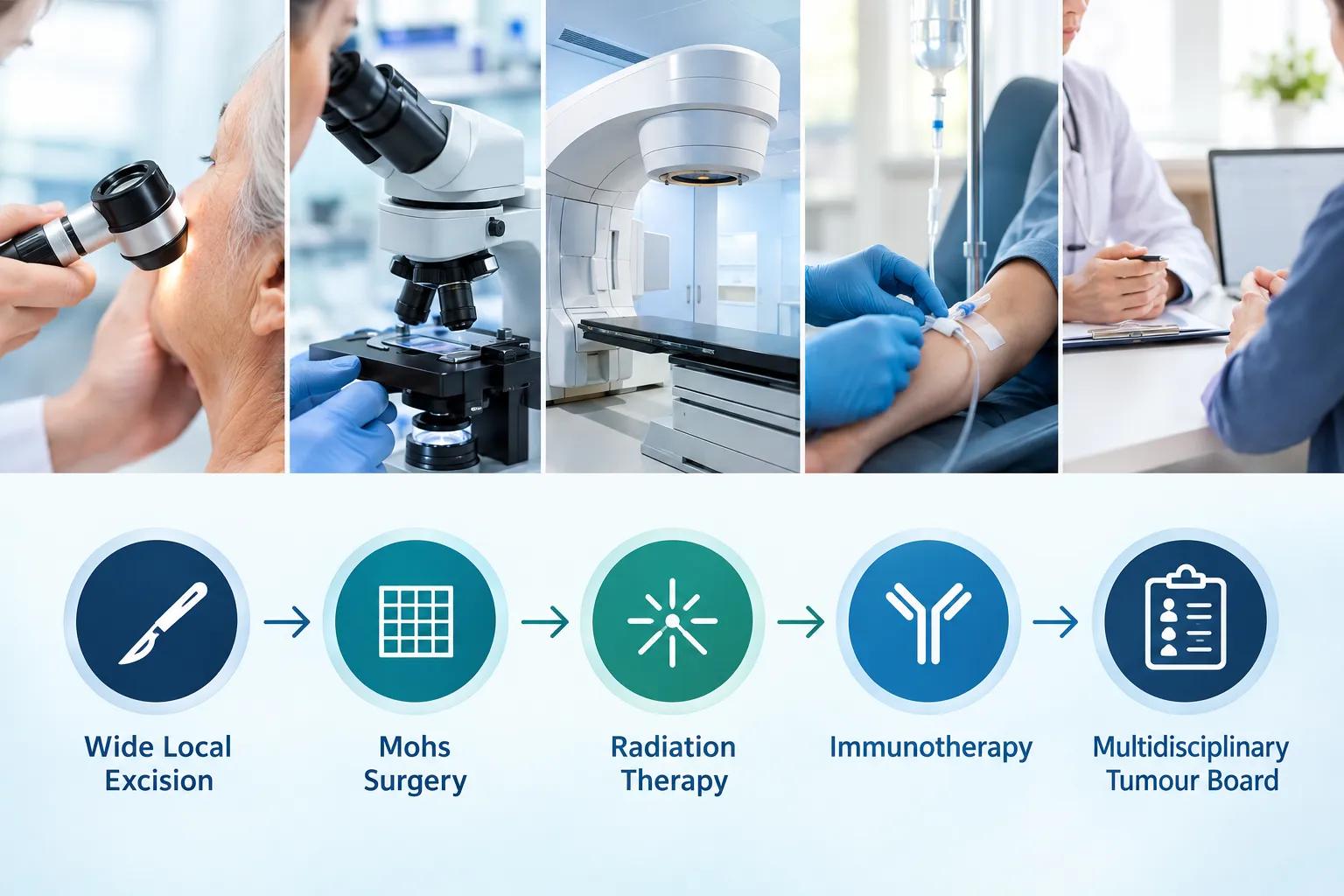
Surgery. Wide local excision removes the tumour along with a margin of healthy-looking skin to reduce the chance that cancer cells are left behind. Mohs surgery, which removes and examines tissue layer by layer, may be used in certain locations, particularly on the face, where sparing healthy tissue matters.
Radiation therapy. Radiation is frequently used after surgery to lower the risk of the cancer returning in the same area or in nearby lymph nodes, since Merkel cell carcinoma tends to be sensitive to radiation.
Immunotherapy. For regional or metastatic Merkel cell carcinoma, checkpoint inhibitors such as avelumab and pembrolizumab are now standard options, and pembrolizumab received FDA approval for recurrent, locally advanced, or metastatic Merkel cell carcinoma in adult and pediatric patients [5]. Active research is expanding how immunotherapy is used at earlier stages:
Decision rule: localized disease without lymph node involvement is generally managed with surgery plus radiation, while regional or distant disease usually adds immunotherapy to the treatment plan. A multidisciplinary cancer team, not a single clinic, determines this plan based on staging results.
The outlook for Merkel cell carcinoma depends heavily on how early it is caught, with localized disease generally carrying a better outlook than disease that has reached lymph nodes or distant organs. Because specific survival figures vary by stage, age, and immune status, they are best discussed directly with the treating oncology team rather than applied generally.
Merkel cell carcinoma can be cured, particularly when found and treated while still localized to the skin. Recurrence is a recognized risk after treatment, which is why long-term follow-up with regular skin and lymph node checks is a standard part of post-treatment care. The ongoing development of immunotherapy options, including newly approved and trial-based combinations, has expanded treatment choices for people whose cancer returns or spreads [5][8].
A new skin bump should be checked by a clinician if it grows noticeably over a few weeks, feels firm, looks shiny or discoloured, or appears without pain in someone over 50, especially with a history of significant sun exposure or a weakened immune system. Waiting to see if a fast-growing bump goes away on its own is not advisable given how quickly Merkel cell carcinoma can progress.
Common mistake: assuming a painless bump is automatically harmless. Pain is not a reliable warning sign for this cancer, and the absence of pain is part of why many cases are initially mistaken for cysts or bites.
Edge case: a bump that temporarily shrinks or changes colour after minor trauma should still be assessed if it was growing beforehand, since skin cancers can bleed or crust without resolving the underlying growth.
A minor surgery clinic can assess and biopsy a suspicious bump directly, without needing a referral first, and coordinate onward care if cancer is confirmed.
Quick checklist before an appointment:
Is Merkel cell carcinoma always fatal? No. Merkel cell carcinoma can be cured, especially when diagnosed early while still localized to the skin, though outcomes vary based on stage and individual health factors.
Does Merkel cell carcinoma hurt? Usually not. One of the defining features in the AEIOU criteria is that the bump is typically asymptomatic and painless, which is part of why it is often mistaken for something harmless.
How fast does Merkel cell carcinoma grow? It tends to grow quickly, often becoming noticeably larger within weeks rather than months, which sets it apart from slower-growing skin cancers like basal cell carcinoma.
Can a biopsy be done without a referral in Ontario? Yes, a minor surgery clinic can assess and biopsy a suspicious skin lesion without requiring a referral, and OHIP covers medically necessary skin cancer assessment and care.
Is Merkel cell carcinoma related to a virus? Yes, the Merkel cell polyomavirus is found in a large proportion of tumours and is considered a significant contributing factor, though not everyone who carries the virus develops cancer.
What specialists are involved in treating Merkel cell carcinoma? Treatment is coordinated by a multidisciplinary cancer team that typically includes a surgeon, dermatologist, radiation oncologist, and medical oncologist, who together determine the surgery, radiation, and immunotherapy plan based on stage.
Merkel cell carcinoma is rare, but its tendency to grow fast and spread early makes prompt evaluation of any new, firm, painless, rapidly enlarging bump worthwhile, especially for adults over 50 with significant sun exposure or a weakened immune system. Diagnosis depends on a skin biopsy, often followed by a sentinel lymph node biopsy and imaging, and treatment is built around surgery, radiation therapy, and, for more advanced disease, immunotherapy with checkpoint inhibitors such as avelumab and pembrolizumab, guided by a multidisciplinary cancer team.
Anyone who notices a new, rapidly growing skin bump should not wait for it to resolve on its own. A minor surgery clinic can assess and biopsy a suspicious lesion without a referral, with OHIP coverage for skin cancer care, and arrange appropriate follow-up if the result points to Merkel cell carcinoma or another skin cancer.
<!DOCTYPE html>
A - Bump is painless (Asymptomatic)
E - Growing fast over weeks (Expanding)
I - Weakened immune system (Immune suppression)
O - Age over 50 (Older adult)
U - On sun-exposed skin (UV-exposed site)
Select features to see a summary.
This tool is not a diagnosis. Any suspicious bump should be assessed by a clinician regardless of how many boxes are checked.
[1] Merkel Cell Carcinoma - https://clinicaltrials.ucsf.edu/merkel-cell-carcinoma [2] 18 148 - https://www.dana-farber.org/clinical-trials/18-148 [3] 19 712 - https://www.dana-farber.org/clinical-trials/19-712 [4] Neoadjuvant Lenvatinib Plus Pembrolizumab In Merkel Cell Carcinoma An Investigator Initiated Open Label Phase Ii Trial - https://merkelcell.org/news-and-publications/2026/neoadjuvant-lenvatinib-plus-pembrolizumab-in-merkel-cell-carcinoma-an-investigator-initiated-open-label-phase-ii-trial/ [5] Fda Approves Mercks Keytruda Pembrolizumab For The Treatment Of Adult And Pediatric Patients With Recurrent Locally Advanced Or Metastatic Merkel Cell Carcinoma A Rare Form Of Skin C - https://www.merck.com/news/fda-approves-mercks-keytruda-pembrolizumab-for-the-treatment-of-adult-and-pediatric-patients-with-recurrent-locally-advanced-or-metastatic-merkel-cell-carcinoma-a-rare-form-of-skin-c/ [6] Nct07387198 - https://clinicaltrials.gov/study/NCT07387198 [7] Clinical Trials Merkel Cell Carcinoma - https://www.mskcc.org/cancer-care/types/merkel-cell-carcinoma/clinical-trials-merkel-cell-carcinoma [8] Treatment - https://www.cancer.gov/research/participate/clinical-trials/disease/merkel-cell/treatment [9] Merkel Cell Carcinoma - https://www.mayo.edu/research/clinical-trials/diseases-conditions/merkel-cell-carcinoma [10] Trial Details - https://clinicaltrials.merckgroup.com/en/trial-details/?id=100070-003