

Last updated: August 19, 2026
A lipoma is a soft, slow-growing lump of fat cells that sits just under the skin, feels rubbery, and rarely hurts. A swollen lymph node is a firmer, bean-shaped gland that usually appears near the neck, armpit, or groin, often shows up quickly alongside an infection or illness, and can feel tender to the touch. The clearest way to tell Lipoma vs Lymph Node: How to Tell the Difference apart is to check location, texture, mobility, and how fast the lump appeared, but a doctor's exam or imaging is the only way to be certain.
A lipoma is a benign tumor made of fat cells that grows in the layer of tissue just beneath the skin, while a swollen lymph node is a normal part of the immune system that enlarges temporarily to fight infection or inflammation [1]. The two have completely different biological origins even though both can show up as a lump you can feel with your hand.
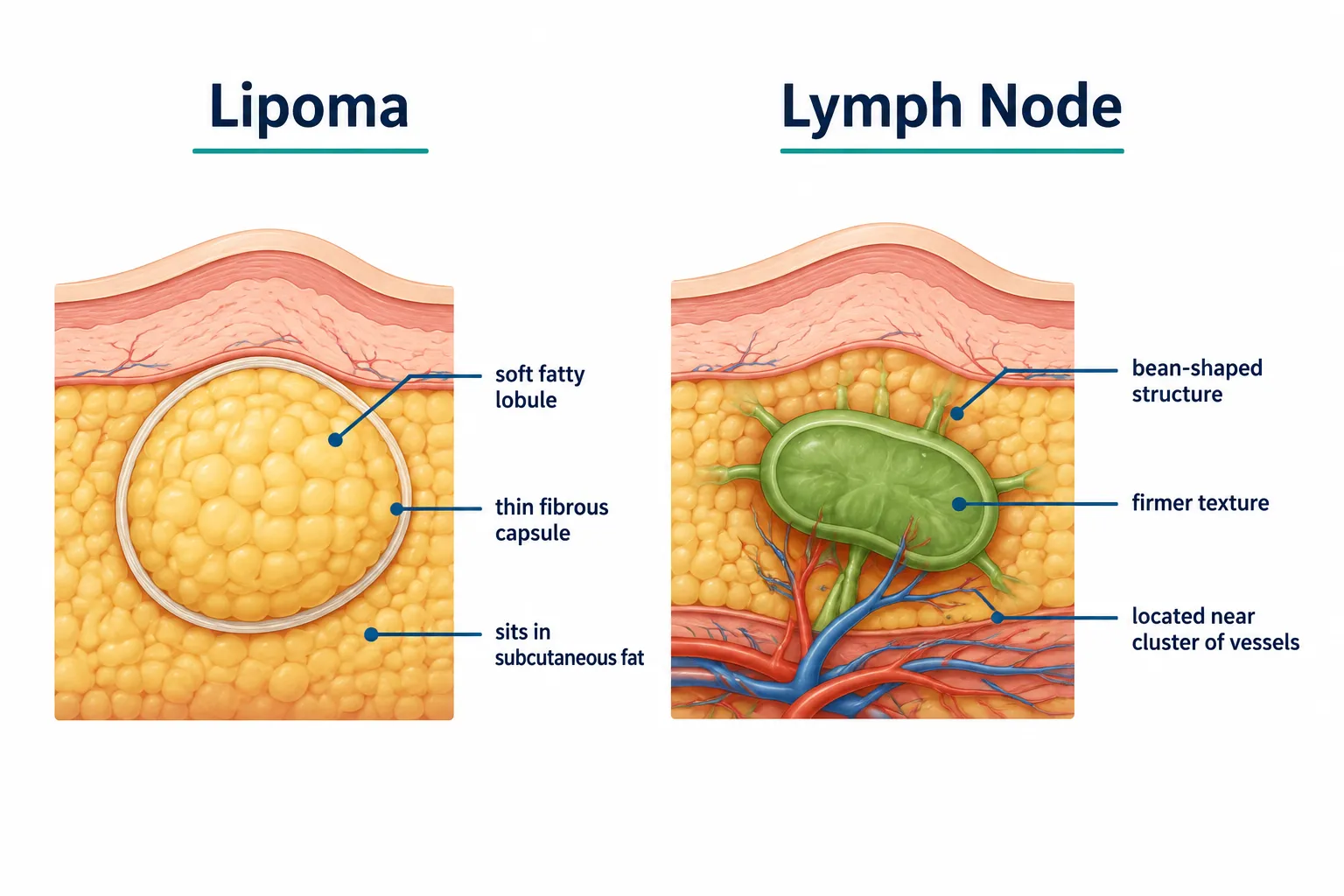
Lymph nodes are small, bean-shaped structures scattered throughout the body, in the neck, under the arms, behind the knees, and in the groin. They filter lymph fluid and trap bacteria, viruses, and abnormal cells. When the immune system ramps up activity, nodes swell, sometimes to the size of a grape or larger [3]. A lipoma has nothing to do with the immune system. It's an overgrowth of mature fat cells enclosed in a thin capsule, and it tends to stay the same size for long stretches or grow very gradually [9].
Decision rule: If the lump sits directly over a known lymph node region (jaw line, armpit, groin crease) and appeared within the last one to two weeks, often alongside a cold, sore throat, or skin infection, think lymph node first. If it's been present for months, sits somewhere without major lymph node clusters (like the back, forearm, or thigh), and never hurts, think lipoma first. For a deeper look at how lipomas differ from lymphoma-related swelling, see this comparison of lipoma vs lymphoma.
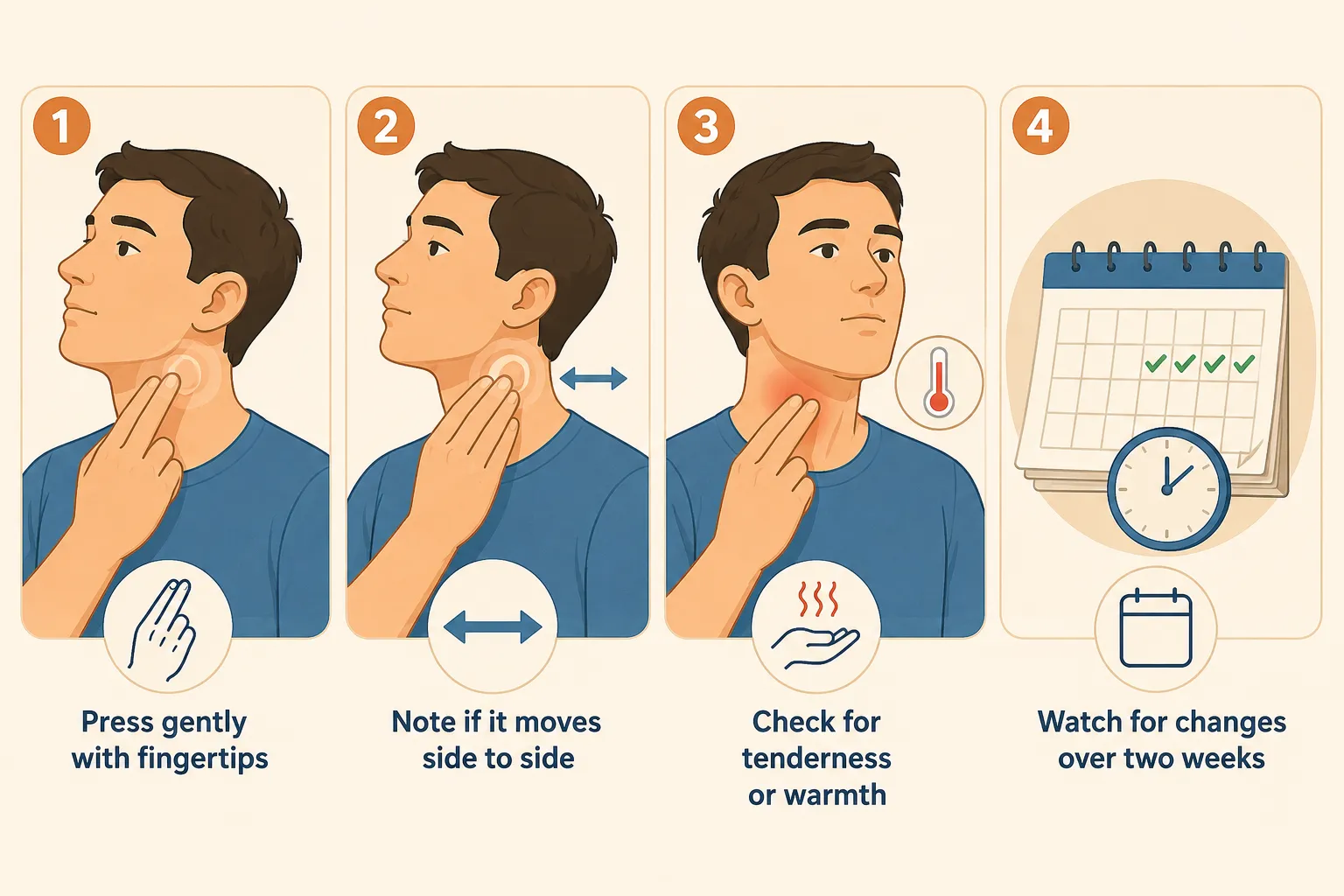
The fastest bedside check is the "push test": gently press two fingers on either side of the lump and see how it responds. A lipoma slides and squishes like a small water balloon under the skin, while a lymph node feels denser, rounder, and more like a firm pea or bean that doesn't compress as easily [6].
Here's a side-by-side comparison of the physical traits clinicians look for during an exam:
FeatureLipomaSwollen Lymph NodeTextureSoft, doughy, rubberyFirm, rubbery to hardShapeRound or oval, lobulatedBean-shaped, ovalMobilitySlides freely under skinLess mobile, may feel tetheredSkin colorNormal skin over the lumpNormal, sometimes red if infectedOnsetGradual over months/yearsSudden over daysTendernessUsually painlessOften tender when infection is activeCommon locationTrunk, arms, shoulders, thighsNeck, armpit, groin
Common mistake: People assume any lump that "moves" must be safe and any lump that's "stuck" must be dangerous. Mobility is a useful clue, not a diagnosis. Some lipomas sit deeper and feel less mobile, and some reactive lymph nodes stay fairly mobile early on. Combine texture, location, and history rather than relying on one sign alone. For a visual reference of what lipomas typically look and feel like, this lipoma photo guide can help set expectations before a clinical visit.
Yes, lipomas typically move freely under a fingertip because they sit in a loose pocket of fatty tissue with no strong attachment to deeper structures. Lymph nodes can also shift slightly, but they tend to feel more anchored, especially when swollen from infection [8].
When examining a lipoma, gentle lateral pressure usually lets the lump glide a few millimeters before it meets resistance from its thin fibrous capsule. This "slippery" quality is one of the more reliable signs pointing away from a lymph node or a solid tumor. A lymph node, by contrast, is anchored by small blood vessels and connective tissue, so it moves less and springs back into position quickly.
Edge case: A lipoma sitting close to muscle fascia (a subfascial lipoma) can feel firmer and less mobile than a typical fatty lump, which sometimes leads to confusion with a fixed lymph node or another solid mass. This is one reason clinicians rely on more than mobility alone, and why imaging becomes useful when the exam findings feel ambiguous.
Most lipomas measure between 1 and 3 centimeters when first noticed, though they can slowly grow to 5 centimeters or larger if left alone for years. Normal lymph nodes are usually smaller than 1 centimeter, and a node is generally considered enlarged once it exceeds about 1 to 1.5 centimeters, depending on its location [10].
Size alone is a useful screening clue, but the speed of size change matters just as much:
Quick example: A neck lump that appeared over a weekend, feels tender, and shrank noticeably after a week of antibiotics for a throat infection fits the classic pattern of a reactive lymph node, not a lipoma.
Yes, it's possible for a lipoma and an enlarged lymph node to occur in the same general region, particularly in the neck, armpit, or groin where both fat tissue and lymph node clusters are present. This overlap is exactly why location alone can't confirm a diagnosis [3].
The armpit is a good example. It contains a dense network of lymph nodes as well as plenty of subcutaneous fat, so a lump there could reasonably be a lipoma, a reactive node, or even a cyst. Recent patient-facing imaging guidance on armpit lumps recommends ultrasound specifically because clinical exam alone struggles to separate these three possibilities with confidence [3].
Decision rule: If a lump sits in an area rich in lymph nodes (armpit, groin, sides of the neck) and you're unsure whether it's fatty tissue or a gland, don't rely on touch alone, request an ultrasound. If the lump sits in an area with few or no lymph nodes (mid-back, forearm, outer thigh), a lipoma becomes statistically far more likely from the start. Learn more about self-checking technique in this guide on how to check your lymph nodes.
Lipoma symptoms are usually limited to the presence of a painless lump, sometimes with mild pressure if it sits near a nerve; lymph node symptoms often include tenderness, warmth, redness, fever, or other signs of illness happening at the same time [1]. The accompanying symptoms are often more telling than the lump itself.
Watch for these symptom patterns:
More consistent with a lipoma:
More consistent with a swollen lymph node:
Common mistake: Assuming a painless lump is automatically harmless. Painless doesn't equal benign, some concerning lymph node changes, including those linked to lymphoma, are painless in early stages [2][5]. This is a key reason clinical exams and imaging still matter even when a lump doesn't hurt. For more detail on when a lump under the skin needs medical attention rather than reassurance, see this breakdown of lipoma or cancer signs to watch for.
See a doctor if a lump under the skin grows quickly, feels hard or fixed in place, is larger than 2 centimeters, doesn't go away within four to six weeks, or comes with fever, night sweats, or unexplained weight loss. These are the same warning signs clinicians use during a head and neck mass assessment [10].
A practical checklist for deciding whether to book an appointment:
If the answer to two or more of these is "yes," schedule a clinical exam. Edge case: even a soft, mobile lump that fits the classic lipoma pattern should be reassessed if it suddenly changes texture, becomes painful, or grows faster than it previously did, a stable lipoma changing behavior is one of the few situations where "typical" lipoma features stop being reassuring on their own [9].
Most lipomas are painless, though a subtype called an angiolipoma can be tender due to extra blood vessels within the fatty tissue, and larger lipomas can ache if they press on nearby nerves [16]. Swollen lymph nodes, in contrast, are frequently tender because the swelling itself involves inflammation.
Pain patterns worth noting:
Decision rule: Pain plus recent illness points to a lymph node reacting normally. Pain without any recent illness, especially in a long-standing lump, is worth having checked. No pain at all doesn't rule out either condition, so it shouldn't be the only factor guiding the decision to see a doctor. This guide on whether lipomas are painful covers the exceptions in more depth.
Lipomas grow slowly, often taking years to go from barely noticeable to a few centimeters wide, while swollen lymph nodes typically enlarge within days in response to an active infection and then shrink back down over one to a few weeks once the infection resolves [1][3].
This difference in timeline is one of the more reliable ways to separate the two without imaging:
Quick example: Someone notices a soft lump on their forearm that's been "always there" for the past three years and has barely changed size, this timeline strongly favors a lipoma. Someone else develops a tender lump in the armpit two days after a cut on their hand gets infected, this timeline strongly favors a reactive lymph node.
Lipomas form when fat cells cluster abnormally under the skin, often with a genetic or familial component, while lymph nodes swell as a direct response to infection, inflammation, or in less common cases, an underlying blood or immune system condition [1][9].
Causes linked to lipoma formation:
Causes linked to lymph node swelling:
Common mistake: Blaming a new lipoma on a recent bump or injury. While minor trauma has been anecdotally associated with some lipomas, most appear with no clear trigger, and there's no strong evidence that everyday bumps cause them to form. For background on how lipomas develop and progress over time, see this overview of lipoma disease explained and this look at how lipomatous neoplasms evolve.
Yes, lipomas can be removed surgically, but removal is elective in most cases rather than medically necessary. Doctors typically only recommend removal when the lipoma is painful, growing quickly, restricting movement, affecting appearance in a visible area, or when the diagnosis needs confirming through pathology [9].
Reasons people choose removal:
Reasons people choose to leave a lipoma alone:
Removal is typically done under local anesthesia as an outpatient procedure. For a full breakdown of what the surgery involves and how long it takes, this guide on how long lipoma removal surgery takes is a useful next step, along with details on lipoma removal costs for anyone weighing the decision.
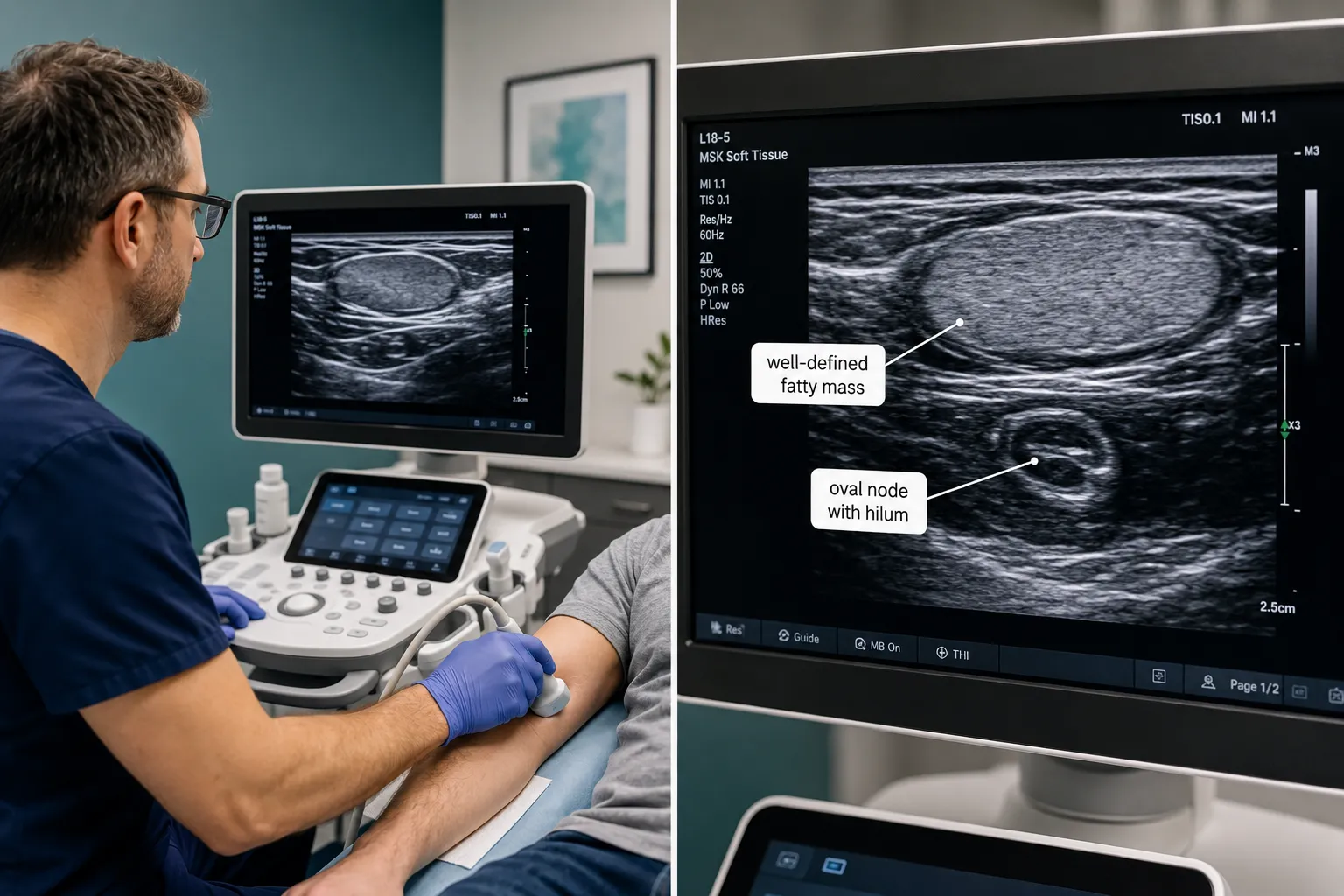
Doctors start with a physical exam, checking size, texture, mobility, and tenderness, but ultrasound is the most common next step because it can clearly distinguish fatty tissue from lymphoid tissue without radiation [3][7]. MRI and biopsy are reserved for cases where ultrasound findings are unclear or the lump has atypical features.
Physical exam: Useful as a first step and often enough for classic, longstanding, soft, mobile lumps. Limited by the fact that texture and mobility can overlap between conditions, especially in fat-rich areas like the armpit [3][6].
Ultrasound: Shows a lipoma as a well-defined, homogeneous fatty mass, usually without much internal blood flow. A normal or reactive lymph node typically shows an oval shape with a visible central "hilum" and characteristic blood flow pattern. Updated soft-tissue mass protocols from 2026 emphasize using ultrasound as the first-line imaging tool precisely because it reliably separates these fat-based and node-based patterns in a single, quick scan [7].
MRI: Used less often for a straightforward external lump, but valuable when a lesion sits deeper, is unusually large, or needs more detailed characterization. Breast MRI research has specifically highlighted how fat-signal lesions differ from lymph node signal patterns on advanced imaging, reinforcing that fat-containing masses and lymphoid tissue behave distinctly across multiple imaging modalities [4].
Biopsy: The definitive step when imaging is inconclusive, when a node is hard and fixed, or when systemic symptoms (fever, weight loss, night sweats) accompany the lump. Radiologic and clinical experts agree that in ambiguous cases, tissue sampling, not repeated observation, is what actually confirms the diagnosis [4][7]. Anyone comparing a fatty lump to a possible malignant growth may also find it useful to review lipoma vs liposarcoma symptoms for the rarer but more serious end of the spectrum.
Lipomas almost never go away on their own; once formed, they tend to persist or slowly enlarge unless surgically removed. Swollen lymph nodes, by contrast, usually shrink back to normal size within one to several weeks once the underlying infection or inflammation resolves [1][8].
This is one of the more practical distinctions for patients: watchful waiting makes sense for a lymph node tied to a recent cold, but it doesn't make sense as a strategy for shrinking a lipoma. If a lump you believed was a reactive lymph node hasn't budged after six weeks, it's worth reconsidering the diagnosis rather than continuing to wait it out.
Edge case: A lipoma can occasionally shrink slightly with significant weight loss since it's fatty tissue, but it rarely disappears completely this way, and this shouldn't be relied on as a treatment plan. For questions about recurrence after treatment, this article on whether a mole, cyst, or lipoma grows back covers what to expect after removal.
Yes, it's fairly common for some people to develop multiple lipomas over their lifetime, and this can run in families as a condition sometimes called familial multiple lipomatosis. Multiple swollen lymph nodes, on the other hand, usually point to a broader immune response affecting several regions at once, not a separate structural condition [1][9].
Key differences in how "multiple" presents:
Anyone noticing several new fatty lumps at once, particularly on the limbs or torso, may find it helpful to review how lipomas present in specific areas, such as lipomas on the thigh or lipomas in unusual locations, for comparison against what they're feeling.
A lipoma and a lymphoma-related lump can feel deceptively similar early on, but lymphoma nodes tend to be firmer, grow over weeks rather than years, and often appear alongside fatigue, fever, or night sweats, while lipomas remain soft and isolated without systemic symptoms [2][5]. This distinction matters enough that it deserves its own section separate from ordinary reactive lymph node swelling.
Lymphoma is a cancer that originates in lymphocytes, the immune cells inside lymph nodes, so it produces lumps that look and feel like enlarged nodes rather than fatty lipomas. The confusion patients raise most often isn't "is this a lipoma or a normal lymph node" but "is this a lipoma or something more serious happening inside a lymph node" [2].
Features that lean toward a lymphoma-related node rather than a lipoma:
None of these signs alone confirm lymphoma, they simply indicate that imaging and, often, a biopsy are the appropriate next step rather than continued observation. A full comparison of these two very different conditions is available in this dedicated guide on lipoma vs lymphoma.
The following is a forward-looking assessment based on current imaging research trends, not an established clinical guideline. Point-of-care ultrasound is becoming more available in general practice settings, which may shorten the time between noticing a lump and getting an imaging-based answer rather than relying solely on physical exam [3][7]. Advanced MRI protocols are also being refined to better separate fat-signal lesions from lymphoid tissue in complex anatomical regions, building on findings already seen in breast imaging research [4].
If these trends continue, patients may see faster in-office differentiation between a lipoma and a swollen lymph node, reducing the anxious waiting period many people currently experience between a first doctor's visit and a confirmed diagnosis. This remains a prediction about where imaging access is heading, not a guarantee of current standard practice everywhere.
Is a lipoma always soft, or can it feel firm?
Most lipomas feel soft and doughy, but larger or deeper lipomas, and the angiolipoma subtype, can feel somewhat firmer. A firm lump should still be checked by a doctor rather than assumed to be a harder variant of a lipoma.
Can stress or diet cause a lipoma?
There's no strong evidence that stress or diet directly causes lipomas to form, though genetics play a role in some cases. Some patients explore dietary approaches for general wellness alongside lipomas; this lipoma diet chart discusses that context.
Does a swollen lymph node always mean infection?
Not always, but infection is by far the most common cause. Persistent swelling without an obvious infection, especially lasting beyond four to six weeks, warrants medical evaluation to rule out other causes [10].
Can a lipoma turn into cancer?
Lipomas themselves are benign and don't typically transform into cancer. A related but distinct and much rarer tumor called liposarcoma can resemble a lipoma, which is why rapid growth or unusual firmness should always be checked [18].
How much does it cost to have a lipoma checked or removed?
Costs vary by clinic, location, and whether removal is done for cosmetic or medical reasons. For current pricing context, see this lipoma removal cost guide.
Can lymph nodes swell without any pain at all?
Yes, some swollen lymph nodes are painless, particularly in the early stages of a chronic condition. Painless swelling that persists for weeks should not be dismissed simply because it doesn't hurt [2].
Is it possible to have a lipoma in the same area where lymph nodes are normally found?
Yes, lipomas can develop in the neck, armpit, or groin, the same regions where lymph nodes cluster, which is why an exam or ultrasound is often needed to tell the two apart with confidence [3].
Should children with lumps under the skin be evaluated differently than adults?
Swollen lymph nodes are common and usually benign in children due to frequent minor infections, but any lump that's rapidly growing, hard, or accompanied by fever and weight loss should be evaluated by a pediatrician regardless of age.
Telling a lipoma apart from a swollen lymph node comes down to four practical checks: how the lump feels, where it sits, how fast it appeared, and whether anything else is going on in the body. A soft, mobile, painless lump that's been stable for months in a fat-rich area like the back or thigh usually points to a lipoma. A firmer, tender lump that showed up quickly near the neck, armpit, or groin, especially alongside a cold or infection, usually points to a reactive lymph node.
That said, feel and location are starting points, not final answers. Overlap happens often enough, especially in the armpit and neck, that clinical exam findings sometimes need backup from ultrasound or, in select cases, a biopsy [3][4][7]. Anyone noticing a lump that's growing quickly, feels hard or fixed, exceeds about 2 centimeters, or comes with fatigue, fever, or weight loss should book a medical evaluation rather than wait and watch.
Next steps: Track how long the lump has been present, note whether it's tender, and check whether it moves under gentle pressure. Bring these details to a doctor's visit, since they speed up diagnosis considerably. For lumps that turn out to be lipomas needing attention, review the lipoma condition overview and the full list of frequently asked lipoma questions to understand what removal and recovery involve before making a decision.
[1] Waht Is The Difference Between A Lipoma And Swollen Lymph Node For Manual Lymphatic Drainage Therapists - https://ceinstitute.com/blogs/news/waht-is-the-difference-between-a-lipoma-and-swollen-lymph-node-for-manual-lymphatic-drainage-therapists
[2] Whats The Difference Between Lipoma And Lymphoma - https://www.mylymphomateam.com/resources/whats-the-difference-between-lipoma-and-lymphoma
[3] Armpit Lump Lymph Node Cyst Or Lipoma - https://sonoworld.co.uk/blog/patient-guides/general-health/armpit-lump-lymph-node-cyst-or-lipoma
[4] Radiol - https://pubs.rsna.org/doi/10.1148/radiol.211101
[5] Lipoma Lymphoma - https://www.thebody.com/article/lipoma-lymphoma
[6] 1557703 Whats The Difference Between A Lipoma Infected Lymph Node And Cyst I Have A Bump On My Neck Left - https://www.healthtap.com/questions/1557703-whats-the-difference-between-a-lipoma-infected-lymph-node-and-cyst-i-have-a-bump-on-my-neck-left/
[7] Findings and procedure details - https://epos.myesr.org/poster/esr/ecr2026/C-19464/findings%20and%20procedure%20details
[8] Is It A Lump Or A Lymph Node How To Tell The Difference - https://resources.healthgrades.com/right-care/symptoms-and-conditions/is-it-a-lump-or-a-lymph-node-how-to-tell-the-difference
[9] Lipoma Vs Lymphoma - https://www.theminorsurgerycenter.com/blog/lipoma-vs-lymphoma
[10] Hn Epworth Gp Lecture Assessment Of Head Neck Masses - https://melbentgroup.com.au/wp-content/uploads/2015/10/HN-Epworth-GP-Lecture-Assessment-of-Head-Neck-Masses.pdf
Meta Title: Lipoma vs Lymph Node: How to Tell the Difference
Meta Description: Learn how to tell a lipoma from a swollen lymph node by feel, size, growth speed, and symptoms, plus when to see a doctor for a lump.