
Last updated: August 11, 2026
Quick Answer: A lipoma on the back is a benign, slow-growing fatty lump that sits just beneath the skin. Lipoma removal on the back is a straightforward minor surgical procedure typically performed under local anesthetic in under 60 minutes. Most patients return to light activity within a few days, and the recurrence rate after complete excision is very low.
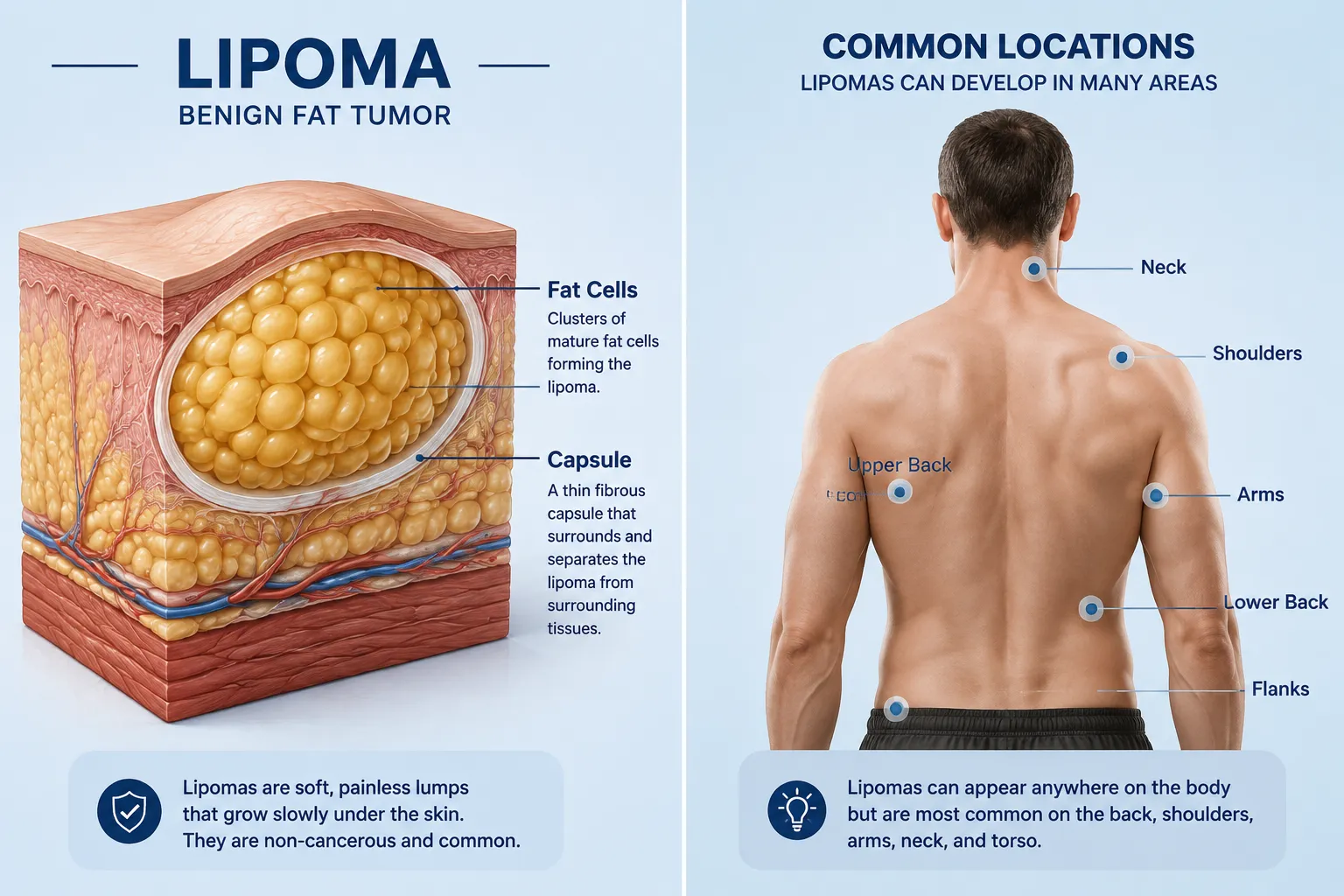
A lipoma is a benign tumor made up of mature fat cells enclosed in a thin fibrous capsule, sitting between the skin and the underlying muscle. The back is one of the most common locations for lipomas to develop, particularly across the upper and mid-back, shoulders, and the lower lumbar region.
Why the back? The back has a large surface area with abundant subcutaneous fat and relatively loose connective tissue, which gives fat cells room to cluster and expand. Lipomas can form anywhere on the body where fat is present, but the back, shoulders, neck, and upper arms account for a significant proportion of cases seen in clinical practice.
The exact cause of lipoma formation is not fully understood. Contributing factors include:
A special subtype worth knowing about is the episacral lipoma, which forms near the sacroiliac joint at the lower back and can mimic mechanical back pain. These are often misdiagnosed and may respond well to targeted removal.
Most single lipomas on the back are entirely harmless. They feel soft, moveable, and doughy under the fingers. They grow slowly, often over years, and rarely exceed 5 cm in diameter, though larger ones do occur.
For a broader explanation of how lipomas develop and what they mean for long-term health, the lipoma disease explained resource provides useful background.
A lipoma and a sebaceous or epidermoid cyst can look similar on the surface, but they have distinct characteristics that a trained clinician can usually distinguish on physical examination alone.
FeatureLipomaCystTextureSoft, doughy, compressibleFirm to rubbery, may feel tenseMobilityMoves freely under the skinOften tethered to the skin surfaceSkin changesNo skin changes above itMay have a central punctum (small dark pore)ContentsFat cellsKeratin or sebaceous materialTendernessUsually painlessCan become tender or infectedDepthSubcutaneous (below skin)Within the skin or just beneath it
Decision rule: If the lump has a visible pore or punctum on the overlying skin, it is almost certainly a cyst, not a lipoma. If it moves freely in all directions and feels uniformly soft with no skin attachment, a lipoma is more likely.
Imaging (ultrasound or MRI) can confirm the diagnosis when the clinical picture is unclear, particularly for deep or large lesions on the back. For more information on distinguishing these two conditions, see the guide on cyst removal in Stouffville and Markham, which covers examination techniques applicable to back lesions as well.
Not every lipoma requires removal. A small, painless lipoma that is not growing and causes no functional issues can safely be monitored. Removal becomes appropriate in several specific situations.
Get a lipoma removed if:
Seek urgent evaluation if the lump:
These features can indicate a liposarcoma, a rare but serious malignant tumor that can mimic a lipoma. The article on lipoma or cancer: when to seek medical advice for lumps under the skin outlines the red flags in detail.
For lipoma removal on the back, both dermatologists and general surgeons are qualified providers, but the right choice depends on the size, depth, and complexity of the lipoma.
Dermatologist: Well-suited for small to medium superficial lipomas (under 3 to 4 cm) that sit clearly within the subcutaneous fat layer. Many dermatologists perform excisions in an office or clinic setting under local anesthetic.
General surgeon or plastic surgeon: Preferable for large lipomas (over 5 cm), deep lipomas that may be near muscle fascia or neurovascular structures, or cases where the diagnosis is uncertain. Plastic surgeons are also the better choice when cosmetic outcome and scar minimization are a priority.
Minor surgery centers: Dedicated minor surgery centers, such as The Minor Surgery Center, offer a practical middle ground. These clinics specialize in soft-tissue excisions and can handle most back lipomas efficiently, with shorter wait times than hospital-based surgery and a clinical environment purpose-built for procedures of this type. For patients in the Greater Toronto Area, the best lipoma removal clinic in Mississauga and lipoma removal in Oakville are examples of dedicated minor surgery center locations that manage back lipomas routinely.
Choose based on these criteria:
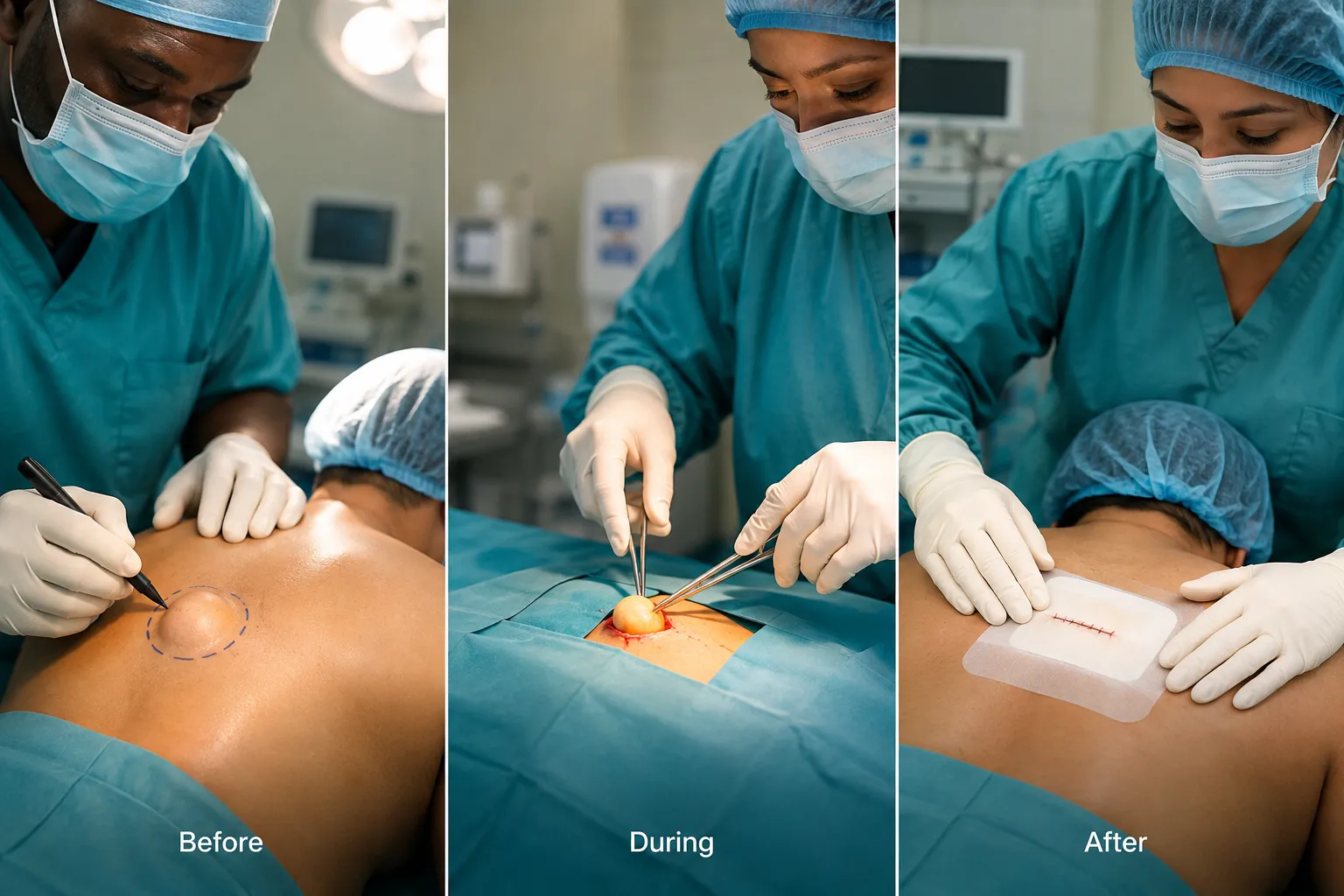
Surgical excision is the definitive treatment for lipoma removal on the back. The procedure is well-established, low-risk, and performed as an outpatient procedure under local anesthetic in a minor surgery center or clinic setting.
Step-by-step overview of the excision procedure:
The procedure is performed under local anesthetic, so patients are awake throughout. Most people describe feeling pressure or movement but no sharp pain. For those wondering about transport after the procedure, the guide on whether you can drive home after lipoma removal covers post-procedure considerations in detail.
Most lipoma removal procedures on the back take between 20 and 60 minutes from the first incision to the final dressing. The total clinic visit, including preparation, anesthetic, and post-procedure instructions, typically runs 45 to 90 minutes.
Several factors affect procedure duration:
For a detailed breakdown of procedure timing by lipoma size and type, the article on how long lipoma removal surgery takes provides specific estimates.
Recovery after lipoma removal on the back is generally straightforward, but the back's anatomy makes it slightly more demanding than removal from the arm or leg. Tension across the wound from movement, posture, and clothing can affect healing.
Typical recovery timeline:
Scarring after back lipoma removal:
The back is a moderate-risk area for scarring. Skin tension from posture and movement can cause scars to widen slightly if wound care is not followed carefully. However, with proper technique and aftercare, most scars become thin, pale, and inconspicuous over time.
Factors that improve scar outcome:
Factors that worsen scarring:
Patients with a personal or family history of keloid scarring should discuss this with their surgeon before the procedure, as the back (particularly the upper back and shoulders) is a higher-risk site for keloid formation.
During the procedure, local anesthetic effectively eliminates sharp pain. Patients typically feel pressure, movement, and mild tugging, but not cutting or sharp sensation. The injection of local anesthetic itself is the most uncomfortable part for most people, described as a brief sting or burning.
Post-operative pain:
Back lipoma removal produces mild to moderate soreness rather than severe pain. The back muscles surrounding the excision site can feel stiff and tender for several days, particularly with bending or reaching movements. Over-the-counter analgesics such as acetaminophen or ibuprofen are usually sufficient for pain management in the first few days.
Pain that warrants a call to the clinic:
Deeper lipomas near muscle or fascia may produce more post-operative discomfort than superficial ones. The surgeon will advise on expected pain levels based on the specific anatomy of the lipoma removed.
Non-surgical options exist but have significant limitations compared to excision. None of them remove the lipoma entirely or provide a tissue sample for pathology.
Steroid injection (intralesional corticosteroid):
Injecting a corticosteroid (typically triamcinolone) directly into a lipoma can cause it to shrink by 30 to 75 percent in some cases. It does not eliminate the lipoma completely. This approach is best suited for small lipomas (under 3 cm) where surgery is not preferred. Multiple injections may be needed, and results are inconsistent.
Injection lipolysis (phosphatidylcholine/deoxycholate):
This technique uses chemical injections to dissolve fat cells. Evidence for its use in lipomas is limited and it is not widely adopted as a standard treatment. Results are variable, and there is no tissue sample for pathology.
Liposuction-assisted removal:
A small cannula is inserted through a tiny incision to suction out the lipoma contents. This leaves a smaller scar than open excision but has a higher recurrence rate because the capsule is not removed. It is sometimes used for very large or multiple lipomas where cosmetic outcome is the primary concern.
What does not work:
Bottom line: For a back lipoma that is symptomatic, large, or diagnostically uncertain, surgical excision at a qualified minor surgery center remains the most reliable and definitive option.
Attempting to remove a lipoma at home is not safe and should not be done. The back is a particularly dangerous location for self-treatment due to limited visibility, proximity to the spine, and the risk of damaging deeper structures.
Why home removal is dangerous:
There is no safe or effective home removal method for a back lipoma. The appropriate step is consultation with a qualified clinician at a minor surgery center or physician's office.
The cost of lipoma removal on the back in Canada varies depending on the size of the lipoma, the provider, and the geographic location. In 2026, patients at private clinics and minor surgery centers in Ontario can expect to pay in the range of $400 to $1,500 or more for a single lipoma excision, with larger or more complex lipomas at the higher end of that range.
Factors that affect cost:
For a detailed breakdown of current pricing in the Toronto area, the lipoma removal cost in Toronto 2026 price guide provides up-to-date figures.
In Ontario, OHIP generally does not cover lipoma removal when the indication is cosmetic. However, coverage may be available when the lipoma causes documented pain, functional impairment, or when there is clinical concern about malignancy.
Coverage scenarios:
For a thorough explanation of what determines coverage eligibility in Ontario, the article on whether lipoma removal is covered by OHIP or insurance is an essential read before booking a procedure.
Practical tip: If a back lipoma is causing genuine pain or functional limitation, ensure this is documented in the medical record before seeking referral or coverage approval.
After complete surgical excision, the recurrence rate for a single lipoma is low. When the entire lipoma, including its capsule, is removed cleanly, the chance of it returning at the same site is estimated to be under 5 percent in most clinical literature.
When recurrence is more likely:
New lipomas vs. recurrence: It is important to distinguish between a true recurrence at the same site and the development of a new lipoma elsewhere on the back. Patients with a tendency to form lipomas may develop new ones over time, which is not the same as the removed lipoma returning.
For a broader discussion of whether removed soft-tissue lesions grow back, the article on whether a mole, cyst, or lipoma will grow back covers the topic across lesion types.
Lipoma removal on the back is a low-risk procedure, but all surgical interventions carry some potential for complications. Understanding these risks helps patients make informed decisions.
Common, minor complications:
Less common complications:
Rare but serious risks:
Patients should discuss their individual risk profile with the surgeon at the pre-procedure consultation, particularly if they have diabetes, take blood thinners, or have a history of poor wound healing.
The typical outcome of back lipoma removal is a flat, smooth skin surface where the lump once was, with a linear scar that fades significantly over 6 to 12 months.
What to realistically expect:
Factors that produce the best before-and-after results:
For patients with multiple lipomas or those seeking removal in specific Ontario locations, lipoma removal in Woodbridge and Vaughan and other minor surgery center locations offer consultations to review expected outcomes for individual cases.
Q: Can a lipoma on the back go away on its own without treatment?
A: Lipomas very rarely resolve spontaneously. Most remain stable or grow slowly over time. Watchful waiting is appropriate for small, painless lipomas, but they should not be expected to disappear without treatment.
Q: Is lipoma removal on the back painful?
A: The procedure itself is not painful because local anesthetic is used. The injection of anesthetic produces a brief sting. Post-operatively, back lipoma removal causes mild to moderate soreness for 3 to 7 days, manageable with over-the-counter pain relievers.
Q: How big does a back lipoma need to be before it should be removed?
A: Size alone is not the only criterion. A 3 cm lipoma causing significant pain warrants removal. A 6 cm lipoma that is entirely asymptomatic may be monitored. Clinical guidelines generally recommend evaluation for removal when a lipoma exceeds 5 cm, is growing, or causes symptoms.
Q: Will I need general anesthesia for back lipoma removal?
A: For the vast majority of back lipomas, local anesthetic is sufficient. General anesthesia is reserved for very large, deep, or complex cases, or when multiple lipomas are being removed in a single session. Most minor surgery center procedures use local anesthetic only.
Q: How do I know if my back lump is a lipoma and not something more serious?
A: A soft, mobile, painless lump that has been present for months or years and is growing very slowly is most likely a lipoma. A lump that is hard, fixed, rapidly growing, or associated with systemic symptoms should be evaluated urgently by a physician. Ultrasound can confirm the diagnosis in most cases.
Q: Can I exercise after back lipoma removal?
A: Light walking is usually fine within a few days. Activities that strain the back muscles, including weight training, yoga, swimming, and contact sports, should be avoided for at least 4 to 6 weeks to allow proper internal healing and reduce the risk of wound complications.
Q: How many stitches will I need after back lipoma removal?
A: This depends on the size of the lipoma. A small lipoma may require 3 to 5 sutures; a large one may need 10 or more. Back wounds typically also require internal (deep) sutures to close the space left by the removed tissue and reduce seroma risk.
Q: Is it safe to have multiple back lipomas removed at the same time?
A: Yes, in many cases multiple lipomas can be removed in a single session. The surgeon will assess the total operative time, the patient's tolerance, and the locations of the lipomas to determine whether a single session is appropriate.
Q: How do I find a qualified clinic for lipoma removal on the back near me?
A: Look for a clinic or minor surgery center staffed by physicians experienced in soft-tissue excision, with clear pre-operative consultation processes and pathology submission protocols. The best lipoma clinics in Toronto guide compares multiple providers across the Greater Toronto Area.
Q: What happens to the lipoma after it is removed?
A: The excised tissue is sent to a pathology laboratory for analysis. This confirms the benign diagnosis and rules out any unexpected findings. Results are typically available within 1 to 2 weeks and reviewed with the patient.
Q: Can a lipoma on the back cause back pain?
A: Most superficial lipomas do not cause back pain. However, lipomas in specific locations, such as the lower lumbar region or near the sacroiliac joint (episacral lipomas), can compress nerves or bursal tissue and produce localized or referred pain. Removal of the lipoma in these cases often resolves the pain.
Q: What is long-term care like after lipoma surgery on the back?
A: After the wound heals, most patients require no ongoing treatment. Scar care with silicone products for 3 to 6 months is recommended. Annual skin checks are advisable for patients who have had multiple lipomas. The guide on long-term care after lipoma surgery provides a detailed post-operative plan.
Lipoma removal on the back is a safe, effective, and well-tolerated procedure when performed by a qualified clinician in an appropriate setting. The key decisions, choosing the right provider, understanding the recovery process, and knowing when insurance coverage may apply, are all manageable with the right information.
Actionable next steps:
A well-chosen minor surgery center, experienced in soft-tissue excision, can remove most back lipomas efficiently with minimal downtime and a high likelihood of a clean, lasting result.