
Last updated: April 28, 2026
Quick Answer: Most patients who undergo lipoma removal under local anesthesia — with no sedation — can drive themselves home the same day, provided the lipoma was small, superficial, and located away from areas that affect movement (such as the neck, shoulder, groin, or lower limbs). If sedation or general anesthesia was used, driving is prohibited for at least 24 hours. Lipoma location, anesthesia type, pain medication, and procedure size are the four factors that determine whether driving home is safe.
The answer to "lipoma removal: can I drive home after?" depends almost entirely on four clinical variables — not on the procedure itself.
Those four variables are:
Each of these can independently affect your ability to safely operate a vehicle. Understanding how they interact gives a clear picture of what to expect on procedure day.
Local anesthesia numbs only the immediate area around the lipoma. It does not impair cognition, reaction time, or motor coordination. Patients who receive only local anesthesia are generally cleared to drive once they feel comfortable doing so [2][5].
General anesthesia and intravenous sedation are a different matter entirely. These agents cause systemic drowsiness, impaired judgment, and slowed reflexes that can persist for 12–24 hours after the procedure ends. Driving under these conditions is unsafe and, in most jurisdictions, illegal [2].
Clinical rule: If your procedure used only local anesthetic — no sedation, no general anesthesia — and you feel well, driving home the same day is typically safe for small lipomas in non-restrictive locations.
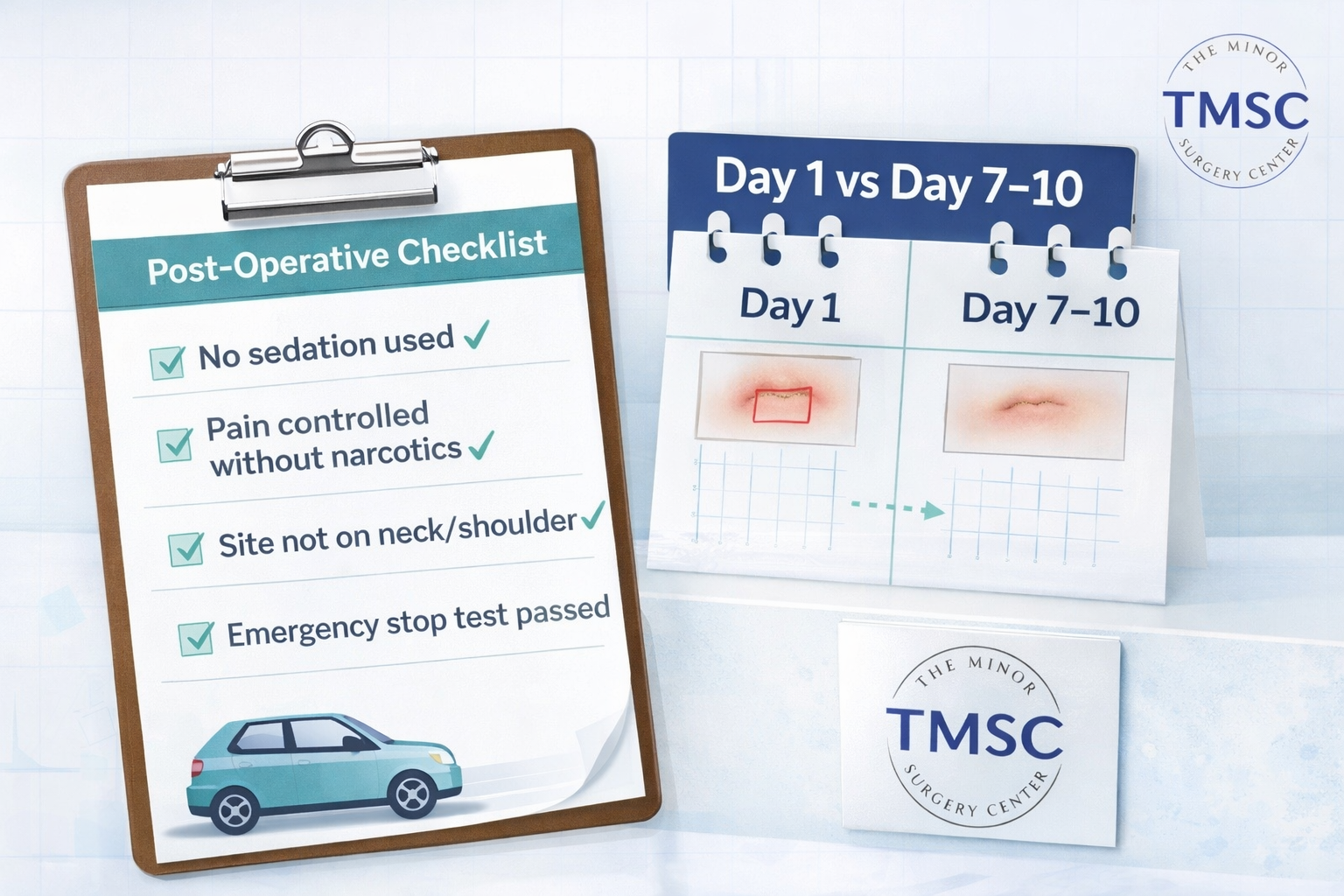
Consultant Surgeon Mr. James Kirkby-Bott notes that for small lipomas located away from the groin, lower limbs, and neck or shoulder region, patients can usually drive the next day — provided they can perform an emergency stop safely. For larger lipomas in those anatomical areas, a waiting period of 7–10 days is recommended [1].
Here is a practical breakdown:
Lipoma LocationTypical Driving Wait TimeBack, upper arm, trunk (small)Same day or next day (local anesthesia)Neck or shoulder7–10 days (movement restriction)Groin or upper thigh7–10 days (affects leg pedal control)Lower limb7–10 days (affects braking ability)Face or scalpNext day (if no sedation used)
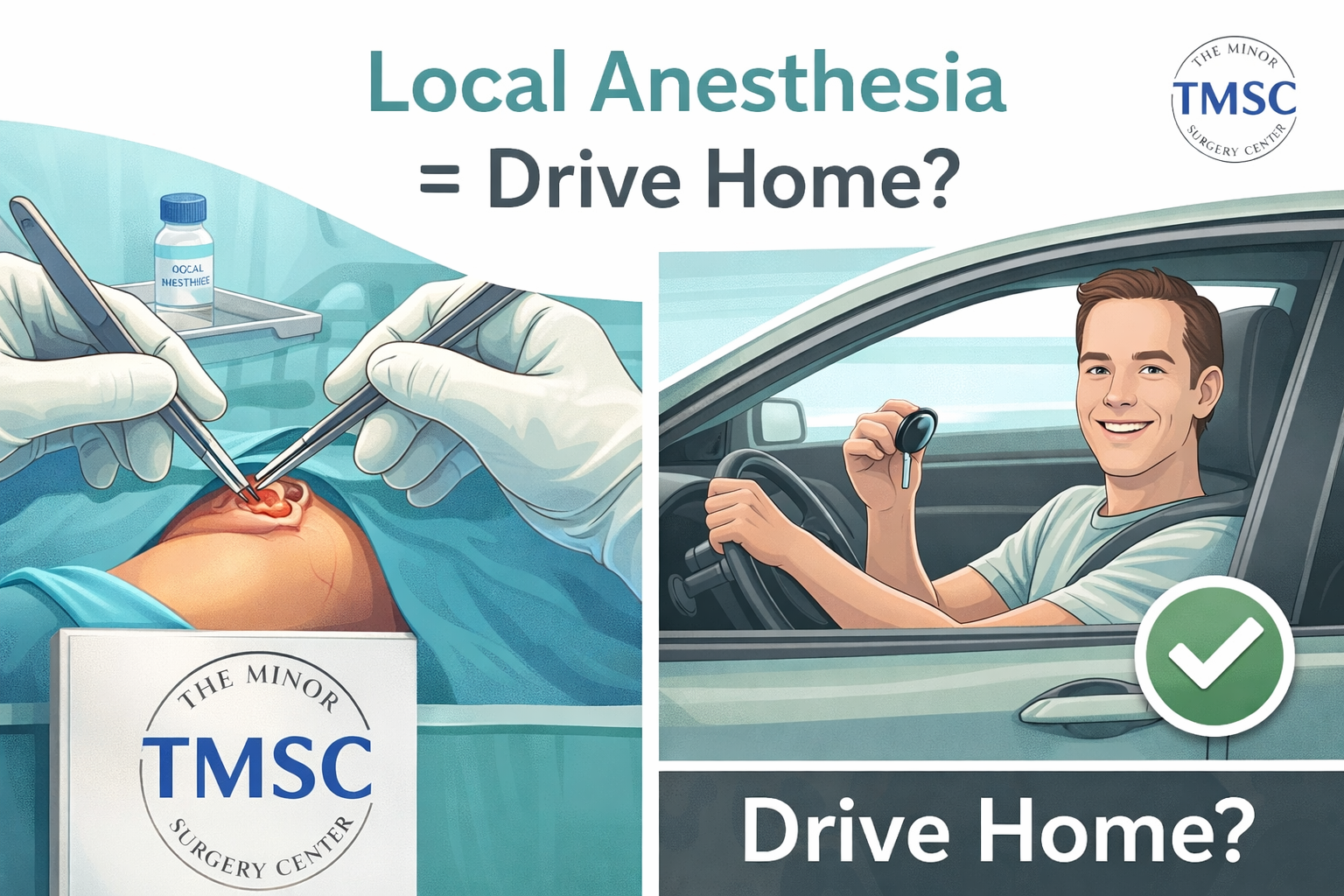
Yes, in most cases. Patients who have a small lipoma removed under local anesthesia in a clinic or outpatient setting are typically able to drive home the same day [4][5].
Baylor College of Medicine guidelines confirm that patients go home immediately after clinic-based lipoma removal performed under local anesthesia. No recovery room observation period is required in these cases, which implies that driving is feasible as long as no sedation was administered and the patient feels physically capable [4].
Before getting behind the wheel, run through this self-check:
If all six boxes are checked, driving home is generally considered safe. If even one is not, arrange alternative transportation.
Common mistake: Patients sometimes assume that because the procedure was "minor," they can automatically drive. The procedure being minor does not override the effects of sedation or the physical limitations caused by a lipoma in a joint-adjacent location.
Driving is not recommended — and in some cases not permitted — in the following situations:
Absolute restrictions (do not drive):
Situational restrictions (consult your surgeon):
Apollo Spectra surgeons note that patients are generally not fit to drive alone for 7–10 days post-operatively when the procedure involves observation needs and significant discomfort — particularly for larger lipomas [source: Apollo Spectra, March 2026].
If in doubt, arrange a ride. The cost of a taxi or rideshare is significantly less than the consequences of a road accident caused by impaired reaction time or sudden pain.
Most patients recover quickly from lipoma removal, especially when the procedure is performed under local anesthesia in a clinic setting. Understanding the recovery timeline helps set realistic expectations.
Immediately after the procedure:
Hours 4–24 post-procedure:
Days 2–7:
For those curious about what the healing process looks like visually, the before and after lipoma removal gallery at The Minor Surgery Center provides a helpful reference.
It is also worth noting that potential complications from lipoma removal — though rare — such as hematoma or wound dehiscence, can extend recovery and delay driving clearance. Your surgeon will flag any concerns before discharge.
Different lipoma removal techniques carry different recovery profiles, and this directly affects when driving becomes safe again.
This is the most common method. A surgeon makes an incision, removes the lipoma intact, and closes the wound with sutures. Recovery is straightforward for small lipomas, and driving the same day or next day is typical when local anesthesia is used [1][5].
For larger lipomas requiring deeper dissection, recovery may take longer and driving may be restricted for 7–10 days [1].
Survey data indicates that 67.8% of dermatologists use minimal incision extraction for lipomas around 1 cm in diameter. This technique uses a smaller incision and causes less tissue disruption, generally resulting in a quicker return to normal activities — including driving — compared to traditional excision.
This technique uses laser energy to liquefy fat cells before removal, reducing incision size and tissue trauma. New research in 2026 continues to explore this approach as a way to shorten recovery times [9]. Patients interested in this option can review 1444 nm Nd:YAG laser lipoma removal for a detailed clinical overview.
RFA is a minimally invasive option currently in ongoing trials. It uses heat energy to destroy lipoma tissue without a large incision, potentially reducing scarring and recovery time. Driving restrictions following RFA are expected to be shorter than those for traditional excision, though this technique is not yet standard practice.
Injectable therapies such as CBL-514 are in clinical trials and may eventually offer a non-surgical alternative for multiple lipomas. If approved, these would likely eliminate most driving restrictions since no incision or anesthesia is required. However, these are not yet available as standard treatment [9].
For patients who have considered avoiding professional care altogether, it is critical to understand the real dangers of DIY lipoma removal at home — a practice that carries serious infection and injury risks.
Planning ahead eliminates most of the uncertainty around driving after lipoma removal. Here is what to do before, during, and after the appointment.
Before the procedure:
On procedure day:
After the procedure:
Patients across the Greater Toronto Area — including those visiting clinics in Mississauga, Oakville, and Whitby — should factor travel distance into their post-procedure planning, particularly if the drive home involves highway speeds or significant head movement.
A brief pre-procedure conversation with your surgeon can prevent confusion on the day of removal. These are the most important questions to ask:
Board-certified surgeons who specialize in lipoma removal — such as those at The Minor Surgery Center, which has performed over 10,000 lipoma procedures — will give direct, case-specific answers to these questions during the consultation.
For patients who want to understand the broader scope of what to expect, reviewing the full lipoma removal FAQ is a useful starting point.
Q: Can I drive myself to a lipoma removal appointment?
A: Yes. Driving to the appointment is fine in most cases. The concern is driving home, which depends on whether sedation is used and where the lipoma is located.
Q: How long after lipoma removal under local anesthesia can I drive?
A: Most patients can drive within a few hours of the procedure, once they confirm they can move comfortably and are not taking narcotic pain medication [1][5].
Q: What if my lipoma was on my back — can I drive home?
A: A lipoma on the back, removed under local anesthesia, typically does not restrict head movement or pedal control. Driving the same day is generally acceptable if you feel comfortable [1].
Q: Can I drive after lipoma removal if I took ibuprofen?
A: Yes. Ibuprofen (600 mg every 6 hours) does not impair driving and is a recommended post-operative pain management option [3].
Q: What if I had a large lipoma removed — does that change the driving timeline?
A: Yes. Larger lipomas, particularly those near the neck, shoulder, groin, or lower limbs, may require 7–10 days before driving is safe due to discomfort and restricted movement [1].
Q: Is it safe to drive after lipoma removal if I feel fine?
A: Feeling fine is a good sign, but it must be combined with objective checks: no sedation used, no narcotic pain meds taken, full range of motion in the relevant body area, and ability to brake firmly without pain.
Q: Do I need someone to drive me home after lipoma removal?
A: Not always. For small lipomas removed under local anesthesia, self-driving is typically fine. However, it is always wise to have a backup plan, especially if the procedure is more involved than expected [4][10].
Q: Will my surgeon tell me if I cannot drive?
A: Yes. Any reputable surgeon will provide explicit post-operative instructions that include driving restrictions. If yours does not, ask directly before leaving the clinic [1][3].
Q: Does the type of lipoma (e.g., facial lipoma vs. arm lipoma) change driving guidelines?
A: Location affects movement restriction more than lipoma type. A facial lipoma removed under local anesthesia typically allows next-day driving, while a shoulder lipoma may restrict head rotation for several days.
Q: Are there lipoma removal methods that allow faster driving resumption?
A: Minimally invasive techniques such as minimal incision extraction and laser-assisted removal generally result in less tissue disruption, which may allow earlier driving compared to traditional open excision [9].
The answer to "lipoma removal: can I drive home after?" is not a blanket yes or no — it is a clinical decision based on anesthesia type, lipoma location, procedure size, and post-operative pain management.
The practical summary:
Actionable next steps:
For patients in the Greater Toronto Area seeking expert lipoma removal from board-certified surgeons, The Minor Surgery Center offers expedited care across multiple locations including Mississauga, Oakville, and Whitby. A direct conversation with your surgeon before the procedure is the single most reliable way to know exactly when you can safely get back on the road.
[1] Post Lipoma Surgery What To Expect - https://jameskirkbybott.com/post-lipoma-surgery-what-to-expect/
[2] Lipoma Removal - https://www.hbmc.org/wp-content/uploads/2019/05/Lipoma-Removal.pdf
[3] Post Op Instructions Skin Lesion Or Lipoma Removal - https://www.drsambartholomew.com/post-op-instructions-skin-lesion-or-lipoma-removal/
[4] Lipoma Surgery - https://cdn.bcm.edu/sites/default/files/lipoma-surgery.pdf
[5] Lipoma Excision - https://www.bvderm.com/service/lipoma-excision/
[6] What To Expect After A Lipoma Surgery - https://www.medfin.in/blog/general-surgeries/what-to-expect-after-a-lipoma-surgery/
[8] Lipoma Removal Surgery What To Expect Before During And After - http://karetrip.com/blogs/lipoma-removal-surgery-what-to-expect-before-during-and-after
[9] New Research Of Lipoma 2026 - https://www.theminorsurgerycenter.com/blog/new-research-of-lipoma-2026
[10] What To Expect Before During And After A Lipoma Or Cyst Removal - https://www.mohssurgerymd.com/blog/what-to-expect-before-during-and-after-a-lipoma-or-cyst-removal