
Last updated: September 15, 2026
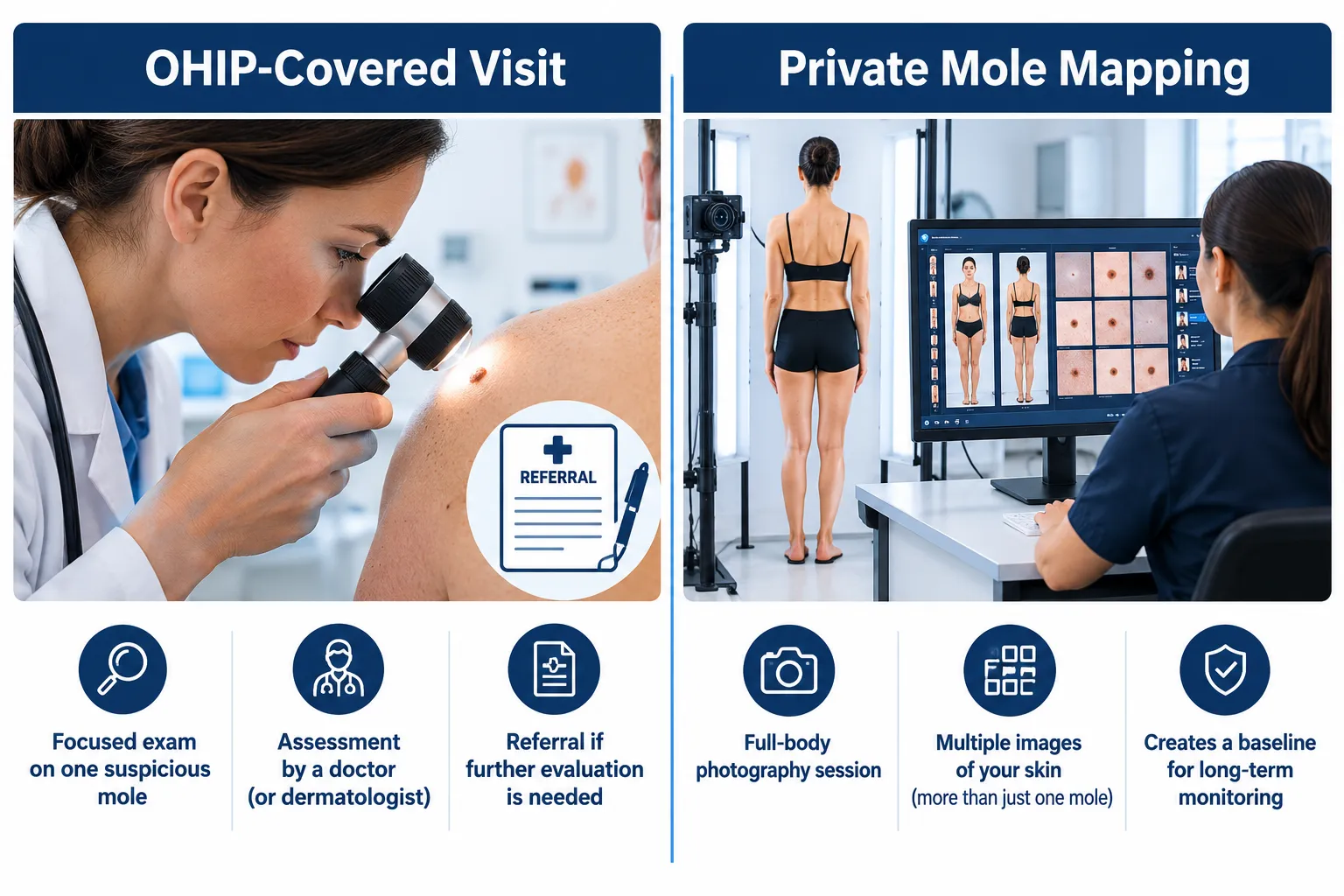
Is mole mapping covered by OHIP? In almost all cases, no. Routine or preventive mole mapping, including full-body photography and digital mole tracking, is a private, patient-paid service in Ontario, typically costing between $150 and $800 per session depending on the clinic and technology used.[1][2][7][14] OHIP only steps in when a physician identifies a specific, medically concerning lesion that needs assessment, biopsy, or removal. In that case, the visit, biopsy, and any necessary treatment are billed to OHIP as insured medical care.[2][7][8][9]
Mole mapping is a diagnostic imaging technique that photographs and catalogs every mole and skin lesion on a person's body to create a baseline record for tracking changes over time. It typically combines total-body photography with dermoscopy (magnified imaging of individual lesions) so that a clinician can compare images at future visits and spot new or changing spots early.[1][2]
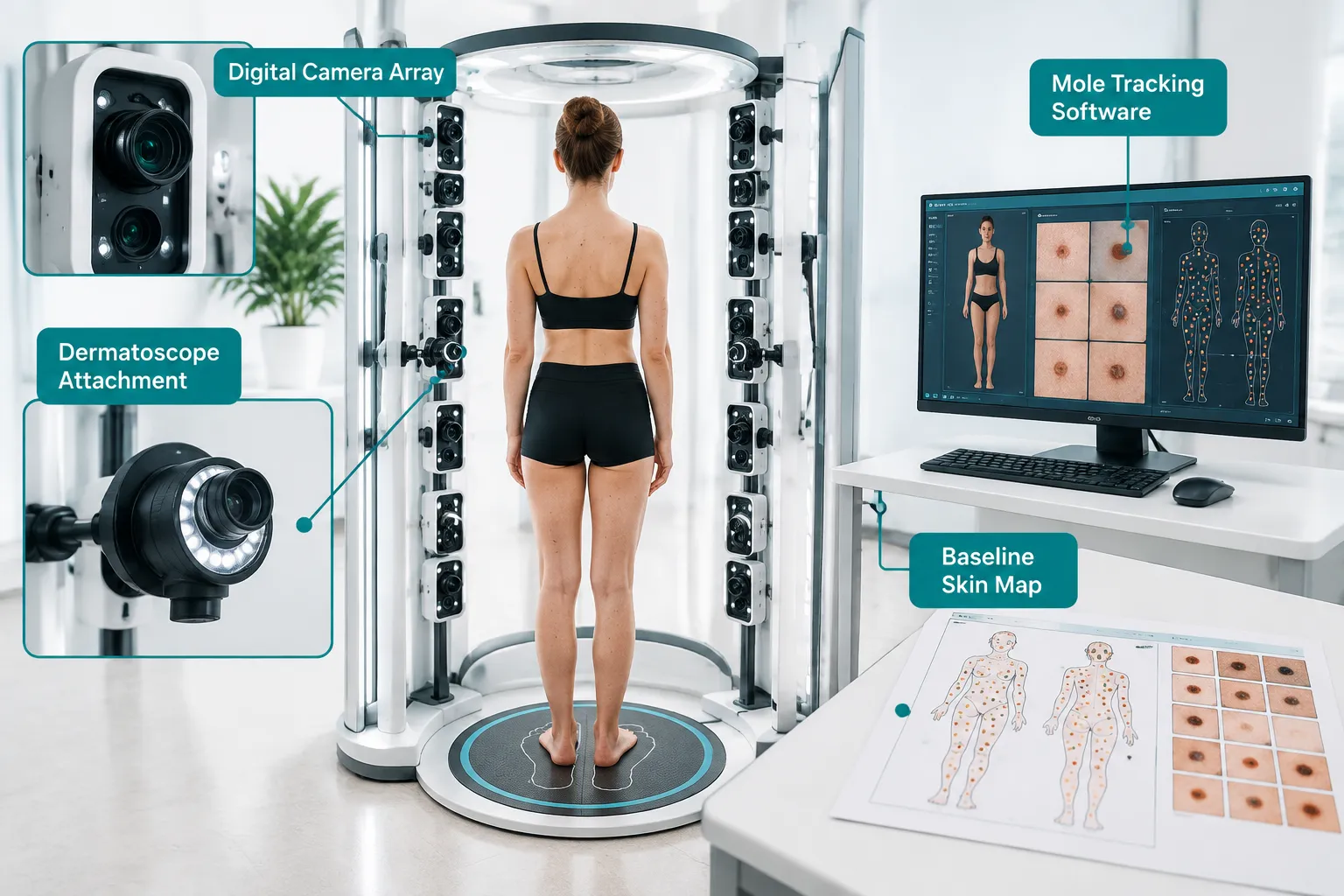
Here is how a typical session works:
The point of mole mapping is early detection, not treatment. If a lesion looks concerning during the process, the clinic refers the patient for further medical assessment, which is where OHIP coverage can come into play.[2][7]
No. OHIP does not cover mole mapping, total-body photography, or digital mole tracking when done as a preventive or screening service. This applies across Ontario clinics and is not specific to any one provider, it reflects how the province defines insured versus non-insured services.[1][2][4][7][13][15]
OHIP funds services that are "medically necessary," meaning a physician has identified a specific health concern requiring assessment or treatment. Preventive screening, checking healthy-looking skin just in case, tracking moles over time for peace of mind, or building a baseline record before a change ever appears, does not meet that bar under current Ministry of Health rules.[8][9][15]
This is true even for patients who are objectively high-risk:
Common mistake: assuming that because a service is medical or performed by a physician, it must be billable to OHIP. Coverage depends on medical necessity for a specific concern, not on who performs the service or how sophisticated the equipment is.
Decision rule: if you are booking an appointment specifically to create or update a mole map "just to be safe," expect to pay privately. If your doctor has already noticed a lesion that worries them and refers you for assessment, that visit is typically OHIP-insured.
For a deeper look at how this plays out at the clinic level in Toronto specifically, see the related breakdown on whether a mole check in Toronto is covered by OHIP.
Without insurance, mole mapping in Ontario generally costs between $150 and $800 per session, depending on the technology, the clinic, and whether it is a single-visit scan or an ongoing tracking program. Toronto-area full-body mole mapping tends to sit toward the higher end of that range, often $350 to $800 plus HST.[1][2][7][14][15]
Here is a general breakdown of what drives the price:
Service typeTypical price range (CAD)What's includedBasic mole check / single-lesion review$75,$200Visual and dermatoscopic exam of one or a few molesStandard full-body mole mapping$150,$400Full-body photography plus dermoscopy of flagged lesionsAdvanced digital mole mapping (e.g., FotoFinder-style systems)$350,$800High-resolution imaging, AI-assisted lesion tracking, detailed digital archiveFollow-up mole mapping sessionOften discounted vs. initial visitComparison against baseline images
Some clinics quote a flat standard fee, several Toronto providers list around $350 as of 2025 to 2026 pricing.[1][2] Costs can vary based on:
Quick example: a patient with 30 moles booking a standard full-body scan at a suburban Ontario clinic might pay around $250. The same service at a downtown Toronto clinic using advanced digital imaging could run closer to $500 to $650.
For a broader cost comparison across mole-related procedures, the mole removal cost guide for 2026 is a useful companion resource, since mapping and removal are often discussed together but priced very differently.
Mole mapping and dermoscopy are related but not the same thing. Dermoscopy is the tool, a handheld magnifying device that lets a clinician examine a single mole's structure in detail. Mole mapping is the process, using photography (often combined with dermoscopy) to catalog and track every lesion on the body over time.[2]
FeatureDermoscopyMole mappingScopeOne lesion at a timeEntire body, all lesionsPurposeImmediate close-up assessmentLong-term tracking and comparisonTypical settingAny doctor's visit, OHIP-covered when medically necessaryUsually a dedicated appointment, private-payEquipmentSimple handheld dermatoscopeCamera systems, sometimes AI-assisted softwareOHIP statusCovered as part of an insured assessment of a specific lesionNot covered when used for preventive screening
A family doctor might use dermoscopy for thirty seconds during a routine check to look closer at one mole. Mole mapping, by contrast, is a dedicated appointment, often 30 to 60 minutes, designed to photograph and log everything.
Edge case: some clinics use dermoscopy during a mole mapping session to zoom in on lesions that look atypical on the wide-angle photos. In that scenario, the dermoscopic look is still part of the private mole mapping package unless it leads to a referral for a specific medical concern.
Mole mapping is most useful for people who have many moles, atypical mole patterns, or a personal or family history of melanoma, and who want a structured way to track changes over months and years. It is a screening tool for people concerned about long-term risk, not an emergency diagnostic step for an active concern.[5][13][15]
Good candidates for mole mapping typically include:
Decision rule: choose mole mapping if your goal is early detection and long-term tracking across many moles. Choose a direct doctor's visit instead if you already have one specific mole that is changing, bleeding, itching, or growing, that scenario calls for prompt medical assessment, not a scheduled mapping session.
If a specific lesion is already worrying you, a faster path is a suspicious mole assessment in Toronto, which focuses on evaluating that one lesion rather than cataloging the whole body.
Family doctors can perform basic mole checks, but most do not offer full mole mapping with photography and digital tracking, that service is usually provided by dermatology clinics, skin cancer clinics, or dedicated mole-mapping providers. A referral is not required to book private mole mapping, though it is required if you want an OHIP-covered dermatologist assessment of a specific lesion.[7][8][9]
Here is how the pathways differ:
Common mistake: assuming a family doctor visit that includes "checking a few moles" is the same as mole mapping. A five-minute look during an annual physical is not a substitute for a full-body photographic baseline, and it will not catch subtle changes the way a documented image comparison can.
Many Ontario patients skip the family doctor step entirely for preventive screening and go straight to a specialized clinic. For options across the Greater Toronto Area, see the roundup of best mole mapping clinics in Toronto or search more broadly using a mole mapping near me resource to compare local providers.
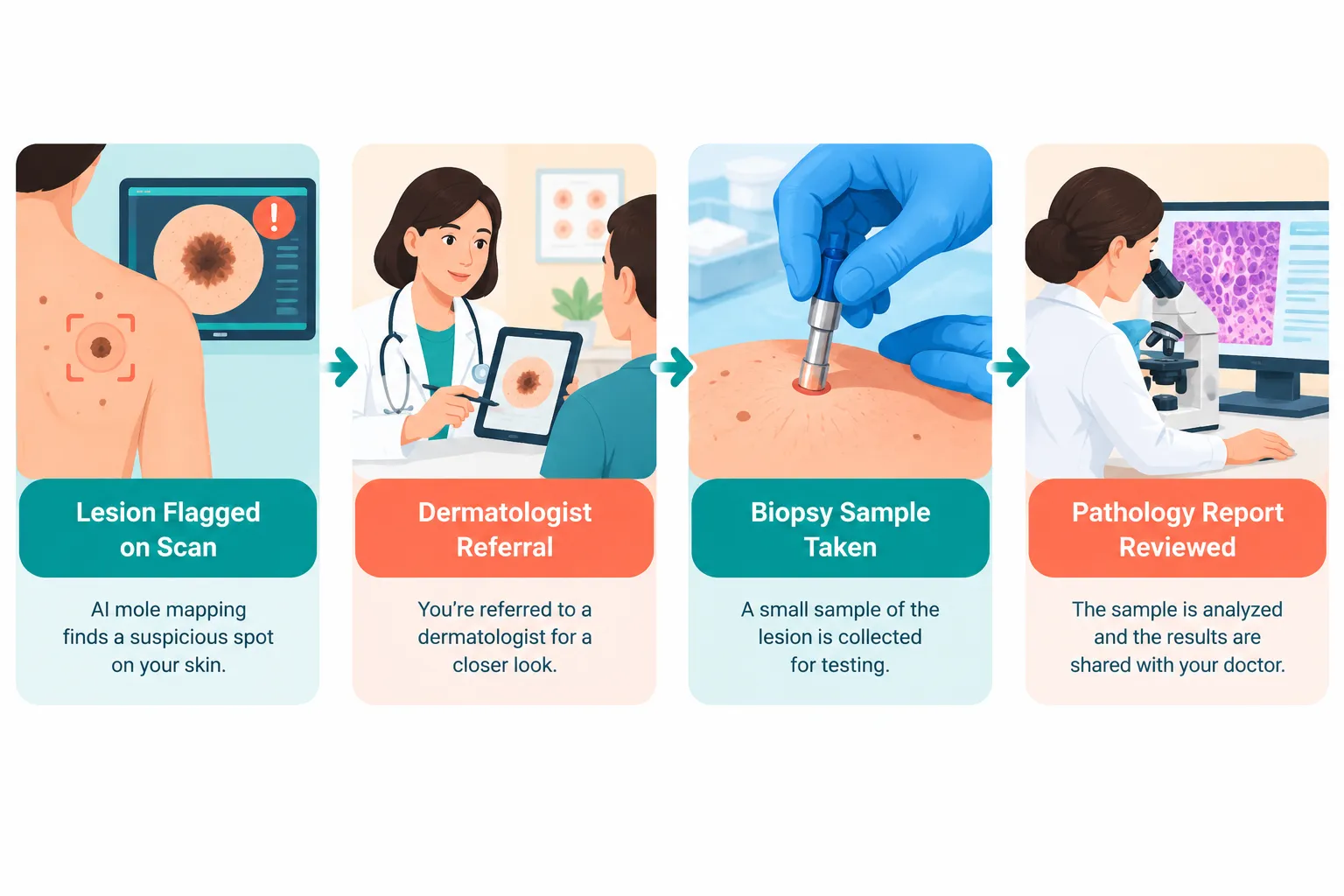
If mole mapping identifies a lesion that looks atypical, the clinic will typically flag it for further medical evaluation, which can include a closer dermoscopic look, a referral to a dermatologist, or a biopsy. At this point, the pathway shifts from private preventive screening to medically necessary care, and OHIP coverage generally applies to the assessment, biopsy, and any required treatment.[2][7][9]
The typical sequence looks like this:
Quick example: a patient books private mole mapping for $350 with no specific complaint. During the session, the technician flags one mole on the back with irregular pigmentation. The physician examines it, decides a biopsy is warranted, and that biopsy, along with the pathology testing, is billed to OHIP because it is now medically necessary, not preventive.
Patients wanting to understand what a biopsy involves before it happens can review the mole biopsy process in Toronto, including how results are typically communicated.
Mole mapping may be partially or fully covered by extended health benefits or Health Spending Accounts, depending on the plan, even though it is not covered by OHIP. Several Ontario clinics report that many extended plans reimburse roughly 50 to 80 percent of the cost, though exact coverage varies significantly by employer and insurer.[6][10][11]
Steps to check your coverage before booking:
Edge case: some employer plans cover "diagnostic imaging" broadly enough to include mole mapping, while others explicitly exclude "preventive" or "elective" screening. Reading the plan booklet's exclusions section, not just the covered-services list, avoids surprises.
Common mistake: assuming that because a service is delivered in a medical clinic by a licensed professional, insurance will automatically cover it. Insurance coverage depends on plan wording, not on the setting.
Most clinics recommend repeating mole mapping every six to twelve months for higher-risk patients, and annually for those with a moderate number of moles or mild risk factors. The right interval depends on personal risk level, not a fixed rule, and a clinician can help set the right schedule based on mole count and history.[2][13]
General guidance by risk level:
Decision rule: choose a 6-month interval if a mole has been flagged before as atypical but not requiring removal, this shorter window lets the clinician catch progression early. Choose an annual interval for general peace-of-mind tracking without a specific prior concern.
Between formal sessions, some patients use self-monitoring apps to track changes at home, though the reliability of these tools varies. For a closer look at that option, see the review of whether 3D mole mapping apps are reliable.
Mole mapping improves early detection but is not foolproof, it can miss melanoma, particularly if imaging quality is poor, follow-up intervals are too long, or a fast-growing lesion appears and changes significantly between sessions. It is a monitoring tool, not a guarantee, and should be paired with prompt medical attention for any new or rapidly changing mole regardless of the mapping schedule.
Factors that reduce mole mapping's effectiveness:
Common mistake: treating a clean mole mapping report as a reason to ignore a new symptom that appears afterward. If a mole starts bleeding, itching persistently, or changing rapidly before your next scheduled session, that warrants an earlier medical visit rather than waiting for the next mapping appointment.
"Mole mapping is a surveillance tool, not a substitute for prompt evaluation of a mole that is actively changing between visits."
For patients unsure whether a specific spot looks concerning enough to act on now, a direct comparison resource on flat mole versus raised mole skin cancer risk can help clarify which features matter most.
Mole mapping makes the most sense for people with many moles, atypical mole patterns, or melanoma risk factors who want structured long-term tracking. It is generally unnecessary for people with very few moles and no personal or family history of skin cancer, who may be adequately served by periodic self-checks and a doctor's visual exam.
Good candidates:
Who may not need it:
Decision rule: choose mole mapping if tracking dozens of moles by memory or photos on your phone feels unreliable. Skip it if you have very few moles and no elevated risk profile, and instead rely on an annual skin check with your doctor.
For a comprehensive overview of who benefits most and how the technology works in practice, the interactive mole mapping guide walks through the process step by step.
There is no OHIP referral pathway for routine mole mapping itself, because it is not an insured service, but there is a referral pathway for OHIP-covered assessment of a specific suspicious mole, which starts with your family doctor or a walk-in clinic physician. Understanding this distinction prevents wasted time trying to get a private preventive service billed through the public system.[7][8][9]
Steps to get OHIP-covered care for a specific concerning lesion:
What this does not cover: using this pathway to get a full-body mole mapping session paid for by OHIP. Even with a referral, if the underlying reason for the visit is general preventive screening rather than a specific lesion of concern, the mapping component itself remains private-pay.
Quick example: a patient tells their family doctor, "I want my whole body mapped because I'm worried about melanoma in general." Without a specific lesion flagged, this is treated as preventive screening and is not OHIP-billable. Compare that to a patient who says, "This mole on my shoulder has doubled in size in three months", that specific complaint supports an OHIP-covered assessment and possible referral.
Patients who want to skip the family doctor step entirely for a focused concern can also consider clinics offering mole checks without a referral in Toronto, which provide faster access to assessment, though the visit itself may still be private-pay unless billed appropriately by the clinic's physician.
Quick reference: what's covered and what isn't
Is mole mapping covered by OHIP in Ontario?
No. Mole mapping is classified as a preventive or screening service, and OHIP only funds medically necessary care. It remains a private-pay service across Ontario clinics, regardless of a patient's risk level.[1][2][8]
Does OHIP cover a dermatologist visit for a suspicious mole?
Yes, if a physician refers you because a specific lesion looks concerning, that dermatology assessment is typically OHIP-insured, along with any resulting biopsy.[7][9]
How much does mole mapping cost in Ontario without insurance?
Expect to pay roughly $150 to $400 for a standard session, and up to $800 for advanced digital imaging at some Toronto clinics.[1][2][14]
Can my family doctor do mole mapping instead of a specialist?
Family doctors can visually check moles, but most do not offer full photographic mole mapping. That service is usually provided by dedicated skin clinics or dermatology practices, and no referral is required to book it privately.[7][9]
Will my extended health benefits pay for mole mapping?
Possibly. Many extended health plans and Health Spending Accounts reimburse part or all of the cost, often in the 50 to 80 percent range, but this varies by plan, so confirming directly with your insurer is essential.[6][10][11]
What happens if a mole mapping session finds something abnormal?
The clinic typically refers you for further clinical evaluation, which may include a biopsy. That follow-up assessment and any medically necessary treatment are generally OHIP-covered, even though the original mapping session was private.[2][7]
How often should mole mapping be repeated?
Every 6 months for higher-risk patients and annually for moderate-risk patients is a common guideline, though your clinician may recommend a different interval based on your history.[2][13]
Is there any plan to make OHIP cover mole mapping in the future?
As of 2026, there is no indication of a planned OHIP policy change to fund routine mole mapping or total-body photography. Coverage is expected to remain limited to medically necessary assessment and treatment unless the Ministry of Health introduces a dedicated screening program.[1][2][7][8][13][14][15]
Is mole mapping the same as a skin cancer screening appointment?
Not exactly. Screening appointments assess visible lesions and may include dermoscopy, while mole mapping specifically creates a photographic baseline for long-term tracking. Neither is typically OHIP-covered on its own, but treatment triggered by findings during either can be.[3][12][14]
Can mole mapping miss melanoma?
Yes. It is a surveillance tool, not a guarantee. Fast-growing melanomas, poor image quality, or long gaps between sessions can all reduce its effectiveness, so new symptoms between visits should still prompt a prompt medical check.
Mole mapping sits outside OHIP's insured services list because it is preventive, not diagnostic for a specific concern. The moment a physician identifies an actual suspicious lesion, though, the pathway shifts, and OHIP typically covers the assessment, biopsy, and any medically necessary treatment that follows.[2][7][9] Understanding this line helps set realistic expectations before booking: budget for a private session if the goal is baseline tracking, but expect standard OHIP-covered care once a real concern is identified.
Practical next steps:
For those ready to compare local options, the guide to Toronto's best mole check clinics with rapid access offers a practical starting point for booking an assessment without unnecessary delay.
[1] Is Mole Check In Toronto Covered By Ohip - https://www.theminorsurgerycenter.com/blog/is-mole-check-in-toronto-covered-by-ohip
[2] Mole Mapping Total Body Photography - https://www.dermadex.ca/blog/mole-mapping-total-body-photography
[3] Skin Cancer Screening - https://morristonmedical.ca/skin-cancer-screening.html
[4] molepatrol.ca - https://molepatrol.ca/faq
[5] Canada Life Coverage For Mole Mapping By A - https://www.reddit.com/r/CanadaPublicServants/comments/1lipbn0/canada_life_coverage_for_mole_mapping_by_a/
[6] Book Online - https://www.dermscan.ca/book-online
[7] Mole Mapping - https://www.baycharlesmedical.com/mole-mapping
[8] Ohip - https://drbaathskinclinic.ca/ohip
[9] Mole Mapping - https://www.thornhillderm.com/mole-mapping
[10] Howitworks - https://www.dermscan.ca/howitworks