
Last updated: September 23, 2026
A cyst on the chest is usually a benign, slow-growing lump that forms under the skin from a blocked hair follicle or oil gland. Most are epidermoid (commonly called "sebaceous") cysts that stay harmless for years, but some become inflamed, infected, or large enough to bother you. Cancer is rare, though any cyst that grows fast, feels hard and fixed, or bleeds needs a medical exam. Treatment ranges from simply watching it to complete surgical removal, which is the only option that stops it from coming back.
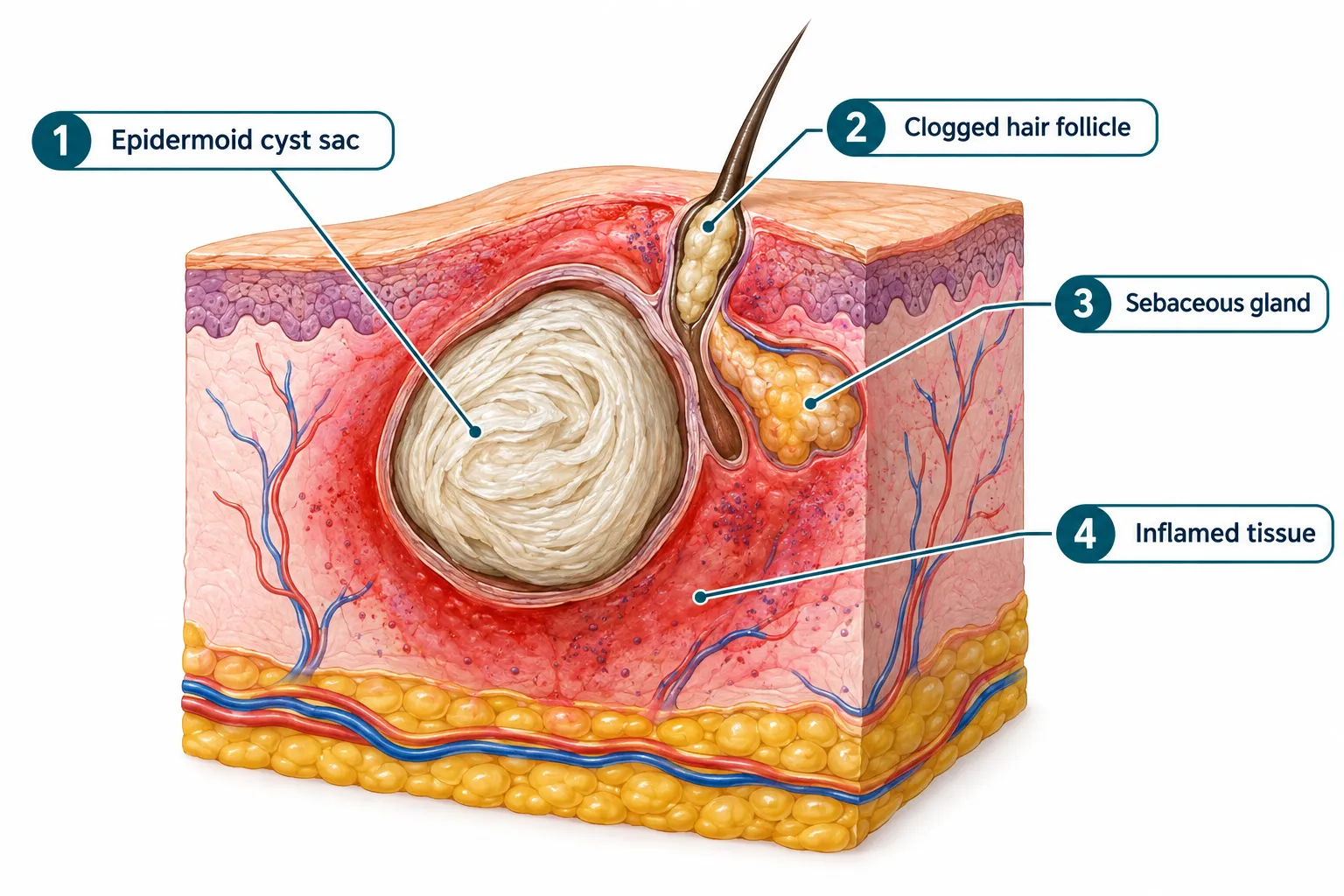
A cyst on the chest is a closed sac under the skin, most commonly an epidermoid cyst that forms when a hair follicle or oil gland gets blocked and dead skin cells build up inside a pocket [2][7]. The chest, upper back, and shoulders are common sites because these areas have a high density of oil glands.
Doctors sometimes call these growths "sebaceous cysts," though that term is technically outdated, true sebaceous cysts (from the oil gland itself) are far less common than epidermoid cysts, which form from the skin's outer layer [6]. Either way, the lump feels and behaves the same way from a patient's point of view: a firm, round bump that grows slowly over months or years.
Other, less common types of chest lumps that get mistaken for a simple skin cyst include:
Most chest cysts form when a hair follicle or pore becomes blocked, trapping dead skin cells (keratin) in a pocket that slowly fills and expands [2][7]. The chest is a high-risk area because it has many oil glands and is exposed to friction from clothing, straps, and sweat.
Common contributing factors include:
Edge case: a lump near the breastbone or sternum that has been present since birth is more likely a congenital dermoid cyst than a typical acquired epidermoid cyst, and it deserves imaging before any removal is planned.
A cyst on the chest typically feels like a small, smooth, round lump that moves slightly under the skin when pressed, and it is usually painless unless it becomes inflamed or infected. Size can range from a pea to a golf ball, and many have a tiny central pore (punctum) that occasionally leaks a thick, foul-smelling substance.
Here is how symptoms typically progress:
StageWhat it feels likeWhat it looks likeEarly, uninflamedFirm, smooth, painless, mobile under skinSkin-colored bump, sometimes with a tiny central dotGrowingSlightly larger, still usually painlessMore noticeable dome shapeInflamedTender, warm to touch, may throbRed, swollen skin around the lumpInfected/rupturedSharp pain, pressure, sometimes feverRedness spreading, pus discharge, foul odor
A cyst that suddenly turns red, hot, and painful has likely become inflamed or infected, this is different from a cyst that has always been painless and slow-growing.
Decision rule: if the lump has been the same size and completely painless for months, it is very unlikely to be an emergency. If pain, redness, or fever appear suddenly, it needs prompt medical attention rather than home care.
Most cysts on the chest are benign and pose no health risk, but a small number of chest wall lumps turn out to be something more serious, so any cyst with unusual features should be evaluated by a doctor. Simple epidermoid cysts virtually never turn cancerous [7][10].
Features that raise concern for something other than a routine benign cyst include:
Common mistake: assuming any lump on the chest is "just a cyst" without a physical exam. A firm, non-mobile mass that a person assumes is a skin cyst can sometimes be a lipoma, a lymph node, or in rare cases a soft tissue tumor, comparisons worth understanding in cyst vs lymph node.
For deeper, less common chest cysts, such as chest wall lymphangiomatous cysts, current practice favors complete excision with long-term follow-up rather than partial removal, because incomplete treatment raises the chance the cyst returns or continues to grow [3][4].
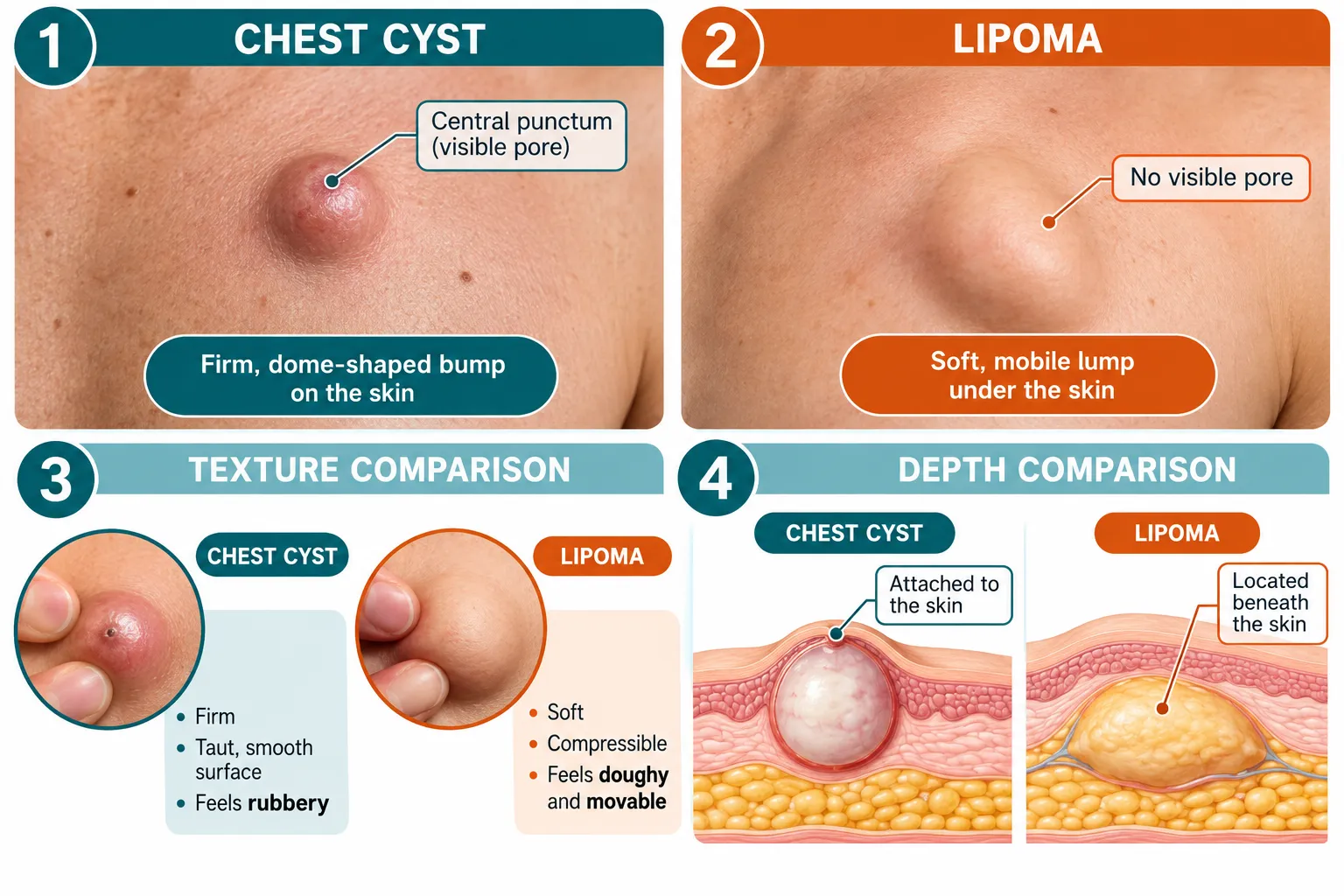
A chest cyst is typically firmer, attached to the skin above it, and may have a visible central pore, while a lipoma is a soft, doughy, freely movable lump that sits deeper in the fatty tissue and is not attached to the skin surface. Both are usually benign, but they are different types of growths with different removal techniques.
FeatureChest CystLipomaTextureFirm, rubberySoft, doughyDepthJust under skin, often attached to itDeeper, in fat layer, skin slides over itCentral poreSometimes presentNever presentGrowth speedSlow, steadySlow, steadyMobilitySlightly mobile, tethered to skinVery mobile, moves freely under skinInfection riskCan become inflamed/infectedRarely gets infected
Choose this rule of thumb: if the lump has a tiny dark dot on the surface and the skin above it seems "stuck" to the bump, it is more likely a cyst. If the skin glides smoothly over a soft, squishy lump with no surface marking, it behaves more like a lipoma.
Not every bump on the chest is a cyst, some are boils, swollen lymph nodes, ingrown hairs, or acne nodules, and telling them apart matters because treatment differs for each. A true cyst is a closed sac with a defined wall (capsule), while many other "bumps" are inflammation without that internal capsule.
Quick differentiators:
Edge case: a "bump" that appears and disappears within days, especially with menstrual cycle timing in breast tissue, is more consistent with a hormonal breast cyst than a skin cyst.
A chest cyst generally needs removal when it becomes painful, infected, keeps growing, interferes with clothing or movement, or bothers a person cosmetically. Small, stable, symptom-free cysts can often just be watched [10].
Signs that point toward removal rather than watching:
For multiple small cysts on the chest and trunk (steatocystoma multiplex), current dermatology guidance leans toward watchful observation rather than removing every single one, since they are numerous, generally harmless, and surgery on each would leave many scars [9]. Individual problem cysts within that pattern can still be removed selectively.
Decision rule: choose removal if the cyst has been infected before, is growing, or sits somewhere it keeps getting irritated. Choose watching if it is small, stable, and has never caused a problem.
Popping a chest cyst at home is not recommended because squeezing only empties the contents while leaving the cyst wall (capsule) behind, which almost always causes the cyst to refill and significantly raises the risk of infection and scarring [2]. Unlike a pimple, a cyst has a structural sac that needs to be removed, not just drained.
Risks of DIY popping include:
Common mistake: treating a chest cyst like a typical pimple. A pimple has no defined capsule, so drainage alone often works. A cyst's wall keeps producing keratin debris, so drainage without removing that wall is a temporary fix at best, a distinction covered further in cyst vs pimple vs boil.
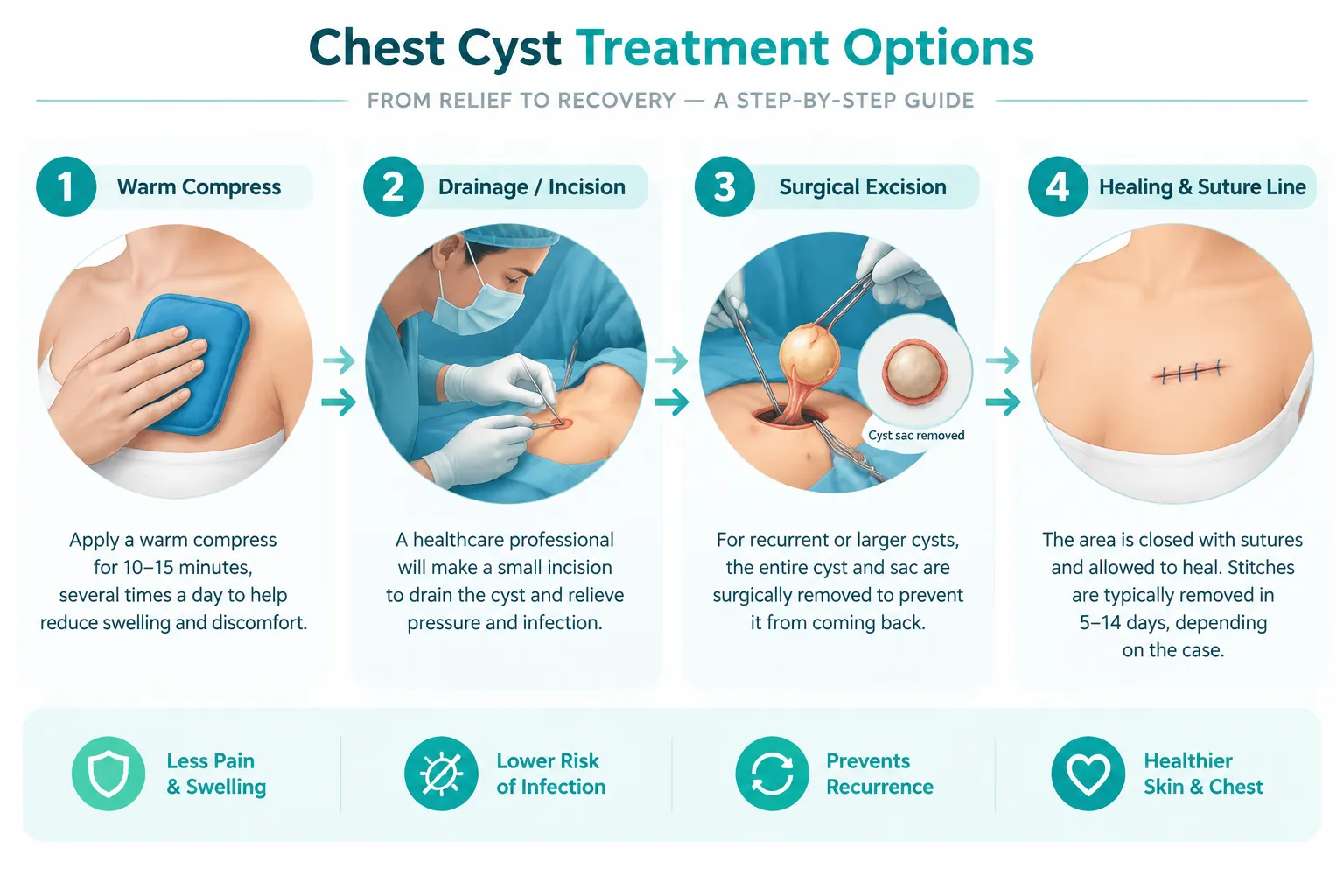
If a cyst is already inflamed or looks close to rupturing on its own, a warm compress applied several times a day can help reduce pressure and discomfort while waiting for a medical appointment, but it will not replace proper drainage or removal.
The best treatment for a chest cyst depends on whether it is inflamed, infected, or simply stable, but complete surgical excision with the cyst sac intact is the only approach that reliably prevents it from coming back [7][10]. Inflamed or infected cysts are usually calmed down first, then removed later once the swelling has settled [2][6].
Typical treatment pathway:
Pros and cons at a glance:
For symptomatic cysts located deeper in the chest cavity, such as bronchogenic or mediastinal cysts, treatment usually involves minimally invasive surgical resection rather than simple drainage, since these are structurally different from skin-level cysts and carry different risks if left untreated [3][4].
Anyone considering removal can review what the actual procedure involves in cyst removal surgery step by step, and what results typically look like afterward in cyst removal results: what to actually expect.
The cost of removing a chest cyst depends on the cyst's size, whether it is inflamed or infected, the clinic performing the procedure, and regional pricing, so there is no single fixed number that applies everywhere. In Ontario, for example, costs and coverage details vary by clinic and by whether the removal is considered medically necessary or elective.
Factors that influence price:
For a detailed regional cost breakdown, see cyst removal cost in Ontario. Readers outside that region should ask their chosen clinic for a direct quote, since national and regional healthcare coverage rules affect out-of-pocket costs significantly.
An untreated chest cyst rarely goes away on its own and typically stays the same size or slowly grows over months to years unless it is drained or surgically removed. Occasionally a small cyst can rupture and drain naturally, temporarily shrinking, but the sac usually remains and refills over time [2].
Realistic timelines:
Quick example: a pea-sized, uninflamed chest cyst that has been stable for two years is unlikely to disappear on its own next month, it is more likely to remain unchanged until either treated or left long-term.
A chest cyst can come back if any part of the sac wall is left behind during removal, which is why complete excision technique matters more than the removal method used. When the entire capsule is removed cleanly, recurrence in that exact location is uncommon [7][10].
Situations where recurrence is more likely:
Edge case: someone with several chest cysts who has one removed may still develop new, separate cysts elsewhere on the chest later, this is a new cyst forming, not the old one returning.
A person should see a doctor about a chest cyst if it grows quickly, becomes painful or red, drains pus, keeps coming back after popping, or simply has never been medically evaluated before. Routine follow-up is also worth scheduling for any cyst that is affecting daily comfort or confidence.
See a doctor promptly if any of these apply:
Locations offering evaluation and removal for chest and trunk cysts include clinics such as Downtown Toronto mole and cyst removal, Mississauga mole, cyst and skin tag removal, and Vaughan cyst removal services, among other regional options for those seeking an in-person assessment.
Light exercise is usually fine with a stable, uninflamed chest cyst, but activities that cause direct friction, pressure, or repeated rubbing over the cyst, such as tight straps, chest presses, or contact sports, can irritate it and should be modified or avoided until it is treated. If the cyst is inflamed, infected, or recently drained or excised, exercise should be paused until a doctor confirms it is safe to resume.
Practical guidance:
Common mistake: ignoring a backpack strap or sports bra band that repeatedly rubs directly over the cyst. Repeated friction is a common reason a previously calm cyst suddenly becomes inflamed.
Is a cyst on the chest the same as a sebaceous cyst?
Most cysts referred to as "sebaceous cysts" on the chest are actually epidermoid cysts forming from the skin's outer layer, not the oil gland itself, though both terms are used interchangeably in casual conversation [6][7].
Can stress cause a cyst on the chest?
Stress does not directly cause skin cysts. Chest cysts form from blocked follicles or pores, though stress-related sweating and skin changes can occasionally contribute to clogged pores.
Does insurance or public healthcare cover chest cyst removal?
Coverage depends on the region and whether removal is classified as medically necessary versus cosmetic; policies and coverage rules vary, so it's best to confirm directly with the clinic or provider beforehand.
Can a chest cyst turn into cancer if left alone?
Simple epidermoid cysts almost never become cancerous [7][10]. However, any lump that grows rapidly, feels fixed and hard, or has irregular borders should be examined to rule out other conditions.
What is inside a chest cyst?
Most chest cysts contain a soft, cheese-like material made of keratin (dead skin cells), which can have a distinct odor if the cyst ruptures or is drained [2].
Should a cyst on the chest be drained or fully removed?
Drainage relieves pressure quickly but usually leaves the cyst wall behind, leading to recurrence. Full surgical excision of the sac is the only approach that reliably prevents the cyst from coming back [7][10].
Can chest cysts run in families?
Yes, in some cases. Steatocystoma multiplex, which causes multiple small cysts on the chest and trunk, is an inherited condition [9]. Single, isolated epidermoid cysts are usually not hereditary.
Is it normal for a chest cyst to smell bad?
A foul smell usually comes from the keratin material inside the cyst, especially if it has ruptured or is draining. This is common with epidermoid cysts and not necessarily a sign of a dangerous infection, though ongoing odor with redness and pain should be checked by a doctor.
A cyst on the chest is, in the vast majority of cases, a benign and slow-growing lump that does not require urgent action. Watching a small, stable, painless cyst is a reasonable choice, but inflammation, infection, rapid growth, or repeated irritation from clothing are all clear signals it's time for a medical evaluation. Popping it at home rarely solves the problem long-term, since the sac wall stays behind and the cyst tends to return. For a permanent fix, complete surgical excision remains the standard, most reliable option.
Anyone dealing with a chest cyst that keeps recurring, growing, or causing discomfort should book an evaluation with a qualified provider rather than continuing to monitor it indefinitely. Early assessment makes removal simpler, reduces the chance of infection, and rules out the rare cases that need a closer look.
[1] Gscarr 2025 0077 - https://gsconlinepress.com/journals/gscarr/sites/default/files/GSCARR-2025-0077.pdf
[2] Epidermoid Cyst - https://www.pcds.org.uk/clinical-guidance/epidermoid-cyst
[3] academic.oup - https://academic.oup.com/jscr/article/2025/10/rjaf815/8285944
[4] academic.oup - https://academic.oup.com/jscr/article/2025/7/rjaf514/8198749
[5] 2025 Tr Bestpracticesguidelines Chest Wall - https://www.facs.org/media/qdgliayt/2025_tr_bestpracticesguidelines_chest-wall.pdf
[6] Epidermal Infundibular Cysts - https://www.dermatologyadvisor.com/home/decision-support-in-medicine/dermatology/epidermal-infundibular-cysts/
[7] Epidermoid Cyst - https://dermnetnz.org/topics/epidermoid-cyst
[8] Pmc10493618 - https://pmc.ncbi.nlm.nih.gov/articles/PMC10493618/
[9] Steatocystomas Update Clinical Manifestations Diagnosis And Management - https://www.mdedge.com/cutis/article/272926/mixed-topics/steatocystomas-update-clinical-manifestations-diagnosis-and-management
[10] Drc 20352706 - https://www.mayoclinic.org/diseases-conditions/epidermoid-cysts/diagnosis-treatment/drc-20352706