
Last updated: August 18, 2026
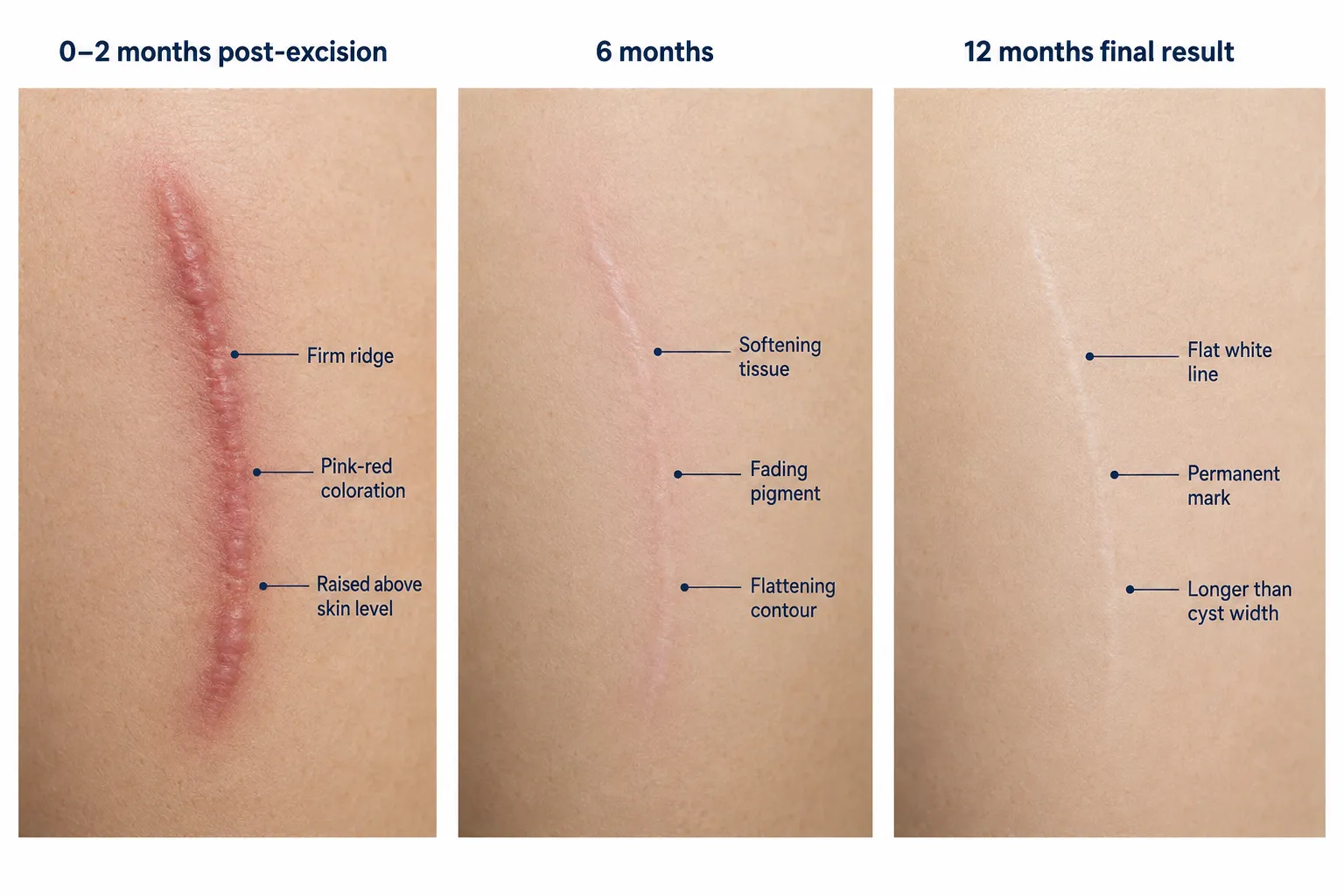
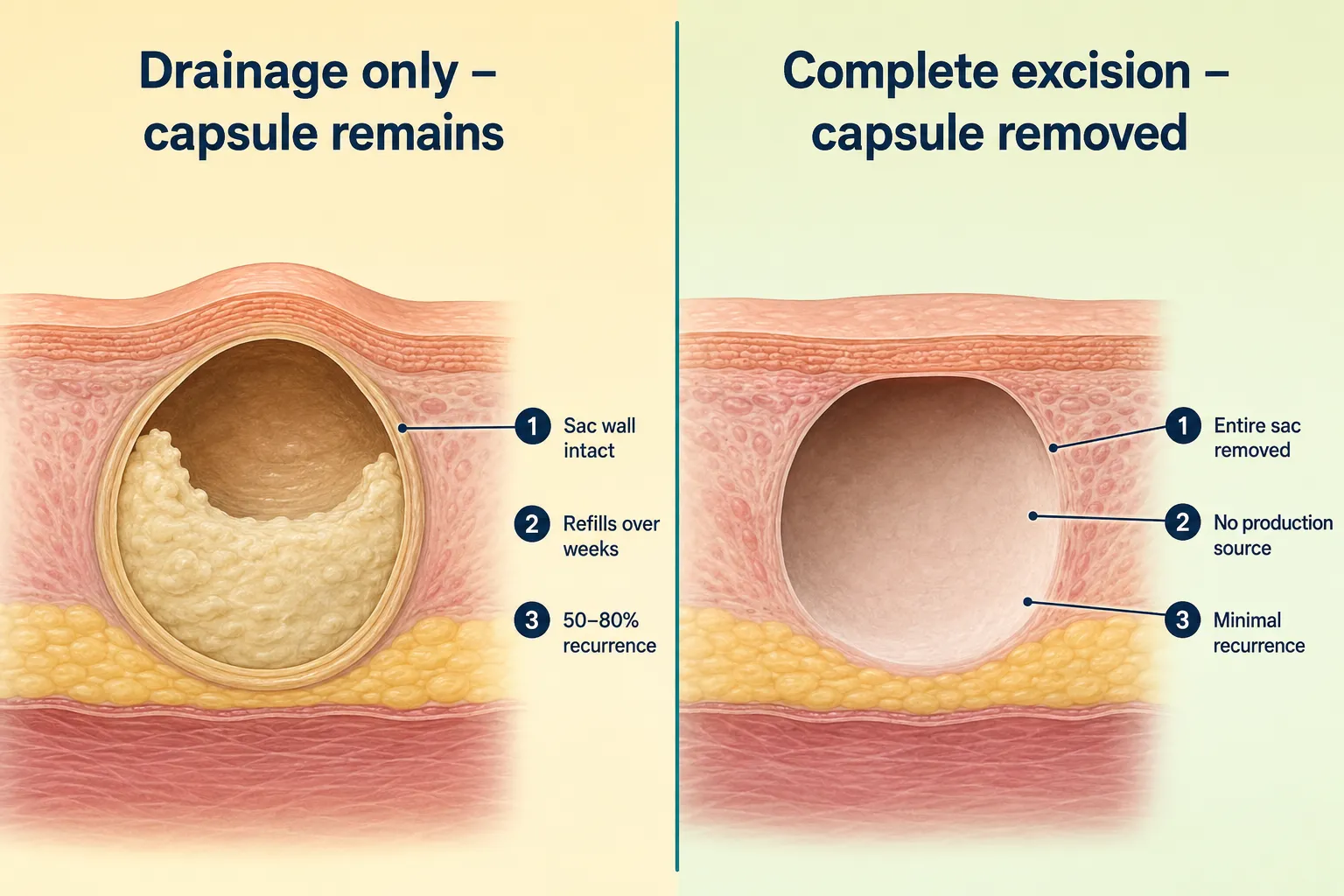
A cyst that is fully excised, capsule and all, should not come back. The trade-off is a permanent scar that is longer than the cyst was wide. Most cyst removal results look red, firm and slightly raised for the first two months, then soften and fade over 6 to 12 months. Cysts that were only drained, not excised, refill because the sac wall is still there.
"Results" means three separate things, and patients often blend them together. A realistic picture of cyst removal results starts with separating them.
This is the reverse of mole removal, where the cosmetic result usually leads the conversation. With cysts, the priority is getting the sac out in one piece. A beautiful scar over a cyst that refills in three months is not a good result.
A cyst removal has succeeded when the lump is gone for good. The scar is the price of that, not the measure of it.
Results vary by cyst type because the structures differ. The three most common skin and soft-tissue lumps behave in distinct ways.
A soft, squishy, mobile lump under the skin with no central pore is often a lipoma, a benign fat growth. Lipomas have a capsule-like margin rather than a keratin-filled sac, they are usually removed in one piece, and they rarely refill the way a drained cyst does. Getting the diagnosis right before surgery changes the plan and the expected result.
Because drainage empties the cyst but leaves the sac. The lining keeps producing material, so the cyst refills, sometimes within weeks.
Incision and drainage at a walk-in clinic or emergency department is a pressure-relief procedure. It is the right call when a cyst is acutely infected and painful. It is not definitive treatment. One evidence summary reports that incision and curettage without capsule removal can approach 100% recurrence within one to four months, while complete excision with an intact cyst wall has achieved 0% recurrence in case series followed for 9 to 60 months [8].
A 2026 systematic review comparing excision with incision and drainage found the lowest recurrence in techniques that remove the entire cyst wall, in the range of 0.66% to 8.3%. Minimal-incision and laser-assisted approaches gave good cosmetic results with similar complication rates [4]. In other words, the access method can change the scar. It does not change the rule about the capsule. That principle is covered further in the explanation of why the whole cyst sac has to come out.
ApproachWhat is removedRecurrence patternIncision and drainageContents only, sac left behindHigh; roughly 50-80% reported [2]Incomplete excisionContents plus part of the sacIntermediateComplete excisionWhole capsule, intactLow; roughly 0.5-3.3% reported [2]Minimal excisionWhole capsule via small openingLow, similar to elliptical excision [4]
An actively infected cyst is often drained first and excised later. That is a deliberate sequence, not a delay tactic.
When a cyst is inflamed, the tissue is swollen, friable and bleeding-prone. The boundary between capsule and normal tissue disappears. Two things follow: the chance of leaving capsule behind goes up, and the scar tends to heal wider and more irregular. Letting the inflammation settle first gives a cleaner dissection and a better scar.
Decision rule: if the lump is hot, red, spreading, draining pus or exquisitely tender, the immediate goal is to control infection. Definitive excision is planned once the area is quiet. If the lump is firm, stable and not painful, it can usually be excised at the first appointment.
[EMBED: HEALING TIMELINE ELEMENT]
Visible healing takes about two weeks. The final appearance of the scar takes 6 to 12 months, and it will change a lot in between.
Site matters for timing. Scalp and facial excisions tend to settle faster and flatter. Back, shoulder and chest excisions sit under constant tension and can take the full year, often ending up wider and thicker.
Site, size, prior inflammation and your own healing biology drive most of the difference. Some factors are controllable; several are not.
Largely fixed factors
Controllable factors
To close the skin flat after removing a round sac, the surgeon usually cuts an ellipse. A circular hole closed directly puckers at both ends. So a cyst 1 cm across typically leaves a line noticeably longer than 1 cm. That is normal surgical planning, not overcutting. Closure in layers, releasing tension from the deeper tissue and lining the incision up with natural skin tension lines all genuinely change how the final line looks. There is more on this in the discussion of whether cyst removal leaves a scar.
The main risks are recurrence, a poor scar, bleeding, infection, pigment change and altered sensation near the site. Most are manageable, and several respond well to treatment if raised early.
ProblemWhat it looks likeCommon optionsRecurrenceLump returns at the same spotRe-excision of remaining capsuleWidened scarLine stretches, especially on the backScar massage, silicone, possible revisionHypertrophic scarRaised, red, stays within the scar lineSilicone sheeting, steroid injectionKeloidRaised scar that spreads beyond the lineSteroid injection, pressure, specialist careTethered or depressed scarDip or dimple that pulls when you moveMassage, time, sometimes revisionPigment changeDarker or lighter than nearby skinSun protection, timeInfectionSee signs belowAssessment, sometimes antibiotics
Contact the clinic if you notice increasing pain after day three, spreading redness, warmth, swelling that worsens rather than settles, pus or foul-smelling discharge, wound edges pulling apart, a fever or feeling generally unwell. Early assessment is far better than waiting.
Do not wait for a scheduled visit if something concerns you. Call (647) 614-1611 or get in touch with the clinic at any point during healing, including months later if a lump seems to be returning.
Before and after galleries are useful only if they are honest. Judge the gallery, not just the pictures.
[BEFORE AND AFTER GALLERY]
Common mistake: choosing a clinic on gallery photos alone. Ask instead how the capsule is removed, what closure is planned, and what happens if the cyst returns.
Leaving a small, painless, stable cyst alone is a reasonable choice. Removal makes more sense once the cyst causes symptoms, keeps getting infected or is growing.
Reasons to remove
Reasons to wait
A practical point on timing: removing a quiet cyst is usually simpler than removing one that has been drained twice. The tissue is cleaner and the scar is often narrower.
No, a cyst cannot be removed at home. Squeezing it may empty some contents, but the capsule stays and the cyst refills. Home attempts also risk infection, deeper inflammation and a worse permanent scar.
Sterile technique, adequate anaesthetic, proper dissection of the capsule and layered closure cannot be replicated with a needle and a mirror. Popping a cyst frequently causes rupture under the skin, which triggers a firm inflammatory lump that is harder to remove later.
On the "is it worth it" question that comes up constantly in online forums such as Reddit: people who are happy with their outcome tend to be those who had the cyst excised rather than drained, and who expected a permanent line rather than no mark. People who are disappointed usually either had drainage and a recurrence, or expected the scar to vanish. Set the expectation correctly and the trade is straightforward. A permanent thin line replaces a lump that keeps coming back.
Cost depends on the cyst, the site, its size and whether the removal is considered medically necessary. Coverage is not the same for every patient or every lump.
Whether the procedure is publicly funded or paid privately depends on medical necessity in your specific case. Rather than guess, review the Minor Surgery Center pricing information and confirm the details at consultation, where the cyst can actually be examined. No referral is needed for most procedures.
Will cyst removal leave a scar?
Yes. Any excision leaves a permanent mark. The goal is a fine, flat line placed along natural skin tension lines, but no technique produces a scar-free result.
Will the cyst come back after removal?
If the entire capsule is removed intact, recurrence is uncommon. Reported recurrence after complete excision sits in the low single digits, compared with much higher rates when the sac is left behind [2][4].
Can I just have it drained instead?
Drainage relieves pressure and is appropriate for an acute infection, but it is not definitive treatment. Drainage without capsule removal has high reported recurrence, sometimes approaching 100% within a few months [8].
Does cyst removal hurt?
The area is numbed with local anaesthetic, so the procedure itself is not painful, though the freezing injection stings briefly. Afterwards, most people describe an ache or tightness for a few days.
How long until the scar fades?
Expect pinkness and firmness to peak around weeks 3 to 8, then improve steadily. The settled appearance is usually clear between 6 and 12 months.
What if my cyst is infected right now?
Infection is usually treated first. Excising through inflamed tissue makes complete capsule removal harder and tends to produce a worse scar, so definitive removal is often planned once things settle.
Can I pop or squeeze a cyst myself?
No. Squeezing does not remove the sac, and it can rupture the cyst under the skin, cause infection and leave a larger permanent mark.
Is the cyst sent for pathology?
Removed tissue is commonly sent for examination to confirm the diagnosis. Most skin cysts are benign, and the report confirms what was removed.
If a cyst has been drained once and came back, that is not bad luck. It is the predictable result of leaving the sac in place. Complete excision of the capsule is what changes the outcome, and the honest trade is a permanent scar that looks worse before it looks better.
Next steps
To arrange an assessment at a North York/Toronto, Oakville, Vaughan, Mississauga or York Mills location, contact The Minor Surgery Center or call (647) 614-1611. The clinics are staffed by board-certified plastic surgeons and other surgical specialists, and no referral is needed for most procedures.
[1] Why Can Epidermoid Cysts Recur After Surgical Removal - https://www.droracle.ai/articles/616239/why-can-epidermoid-cysts-recur-after-surgical-removal
[2] Epidermoid Sebaceous Cyst Removal Recurrence Cost When To Worry - https://aestheticmedguide.com/blog/epidermoid-sebaceous-cyst-removal-recurrence-cost-when-to-worry
[4] Comparative outcomes of excision techniques for epidermoid cysts - https://pmc.ncbi.nlm.nih.gov/articles/PMC12945473/
[8] What Is The Recurrence Rate Of Epidermal Inclusion Cysts - https://www.droracle.ai/articles/726905/what-is-the-recurrence-rate-of-epidermal-inclusion-cysts