
Carpal tunnel syndrome and Raynaud's disease can both cause hand symptoms, but they're fundamentally different conditions. Carpal tunnel is a nerve compression problem that produces numbness, tingling, and weakness in the thumb, index, middle, and half of the ring finger — often worse at night. Raynaud's is a blood vessel problem that causes fingers to turn white, then blue, then red in response to cold or stress. If your fingers change color, think Raynaud's. If they go numb or tingle without color change, think carpal tunnel.
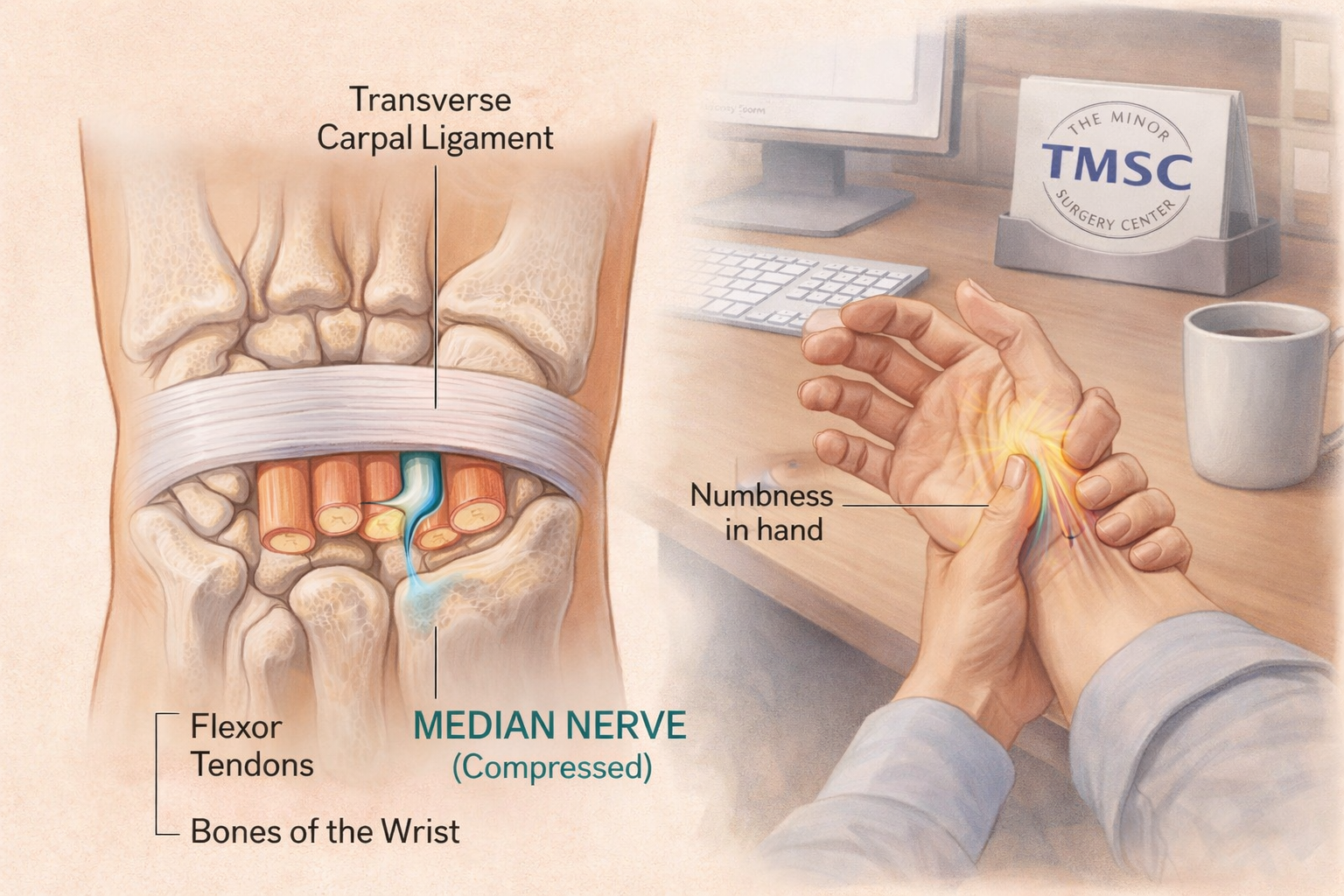
Carpal tunnel syndrome is a compression neuropathy of the median nerve as it passes through a narrow tunnel in the wrist. The transverse carpal ligament forms the roof of that tunnel. When pressure rises inside — from swelling, repetitive strain, pregnancy, thyroid disease, or diabetes — the nerve gets squeezed. [9]
Hallmark symptoms:
The little finger is spared because it's supplied by the ulnar nerve, not the median. That single detail is one of the most reliable ways to separate CTS from other hand conditions.
CTS carries a significant economic cost. U.S. direct medical costs exceed $2 billion annually, and affected workers miss a median of 27 days of work. For a deeper anatomical overview, see our guide on carpal tunnel and the ulnar nerve.
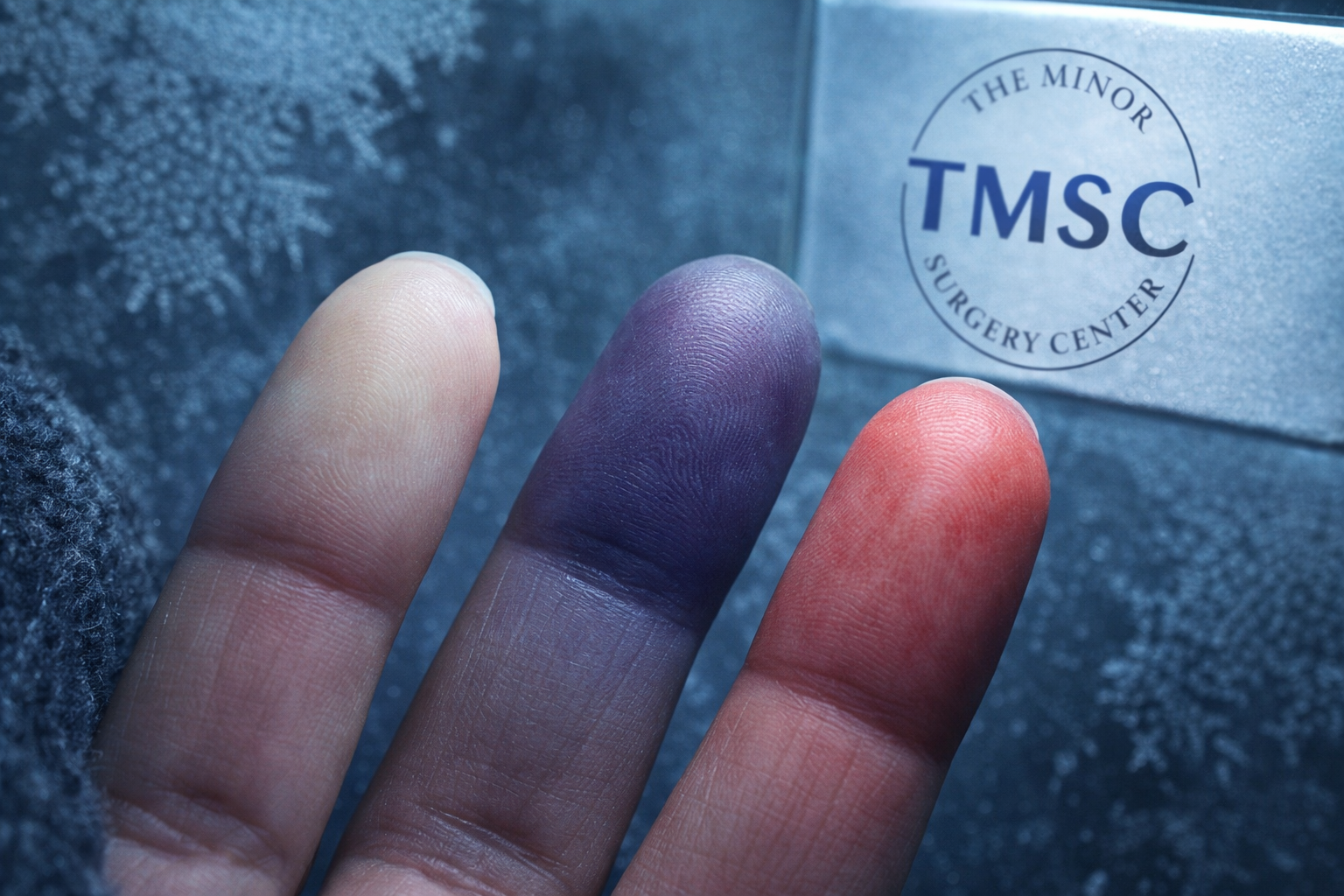
Raynaud's phenomenon is an exaggerated narrowing (vasospasm) of the small arteries that supply the fingers, toes, and occasionally the nose or ears. Cold exposure or emotional stress triggers an attack. Blood flow drops sharply, the affected digit turns white (pallor), then blue (cyanosis) as oxygen is depleted, then red (rubor) when blood rushes back as the spasm releases. [3]
Raynaud's comes in two forms:
Attacks last minutes to hours. Between attacks, the hands typically look and feel normal. That intermittent pattern is a key clue.
Here is the fastest way to separate the two conditions based on what patients actually notice.
FeatureCarpal Tunnel SyndromeRaynaud's DiseasePrimary problemNerve compression (median nerve)Blood vessel spasmClassic symptomNumbness, tingling, burningColor change: white → blue → redFingers involvedThumb, index, middle, half of ringAny or all fingers; often symmetricLittle finger affected?No (ulnar nerve)Yes, oftenTriggerRepetitive wrist use, sleep positionCold exposure, emotional stressWorse at night?Very commonUncommonBetween episodesSymptoms linger or recur with useHands look normalKey testNerve conduction study, Tinel's, Phalen'sNailfold capillaroscopy, cold challengeTreatmentSplints, therapy, injection, surgeryWarmth, vasodilators, lifestyle
"Color change is the Raynaud's signature. Numbness in the first three and a half fingers is the carpal tunnel signature. They rarely look the same if you watch closely."
Diagnosis is clinical first, then confirmed with nerve testing. A surgeon or hand specialist will:
If you're unsure whether your symptoms fit the pattern, our article on carpal tunnel syndrome misdiagnosis walks through conditions commonly confused with CTS.
Common mistake: Assuming any hand numbness is carpal tunnel. Numbness that involves the little finger, wraps around the elbow, or involves the whole arm points toward ulnar neuropathy or cervical radiculopathy instead. See our comparison of carpal tunnel vs. cervical radiculopathy.
Raynaud's is diagnosed mainly by history and physical exam. The patient describes cold-triggered color changes, and the clinician confirms no underlying disease is present (or searches for one if secondary Raynaud's is suspected). [6]
Key tools include:
A rheumatologist is typically the best specialist for evaluation, especially when secondary Raynaud's is suspected. Primary Raynaud's often needs no treatment beyond lifestyle adjustment.
Yes. The two conditions are unrelated in cause but can occur together, particularly in people with:
When both are present, symptoms can overlap and confuse the picture. A patient might report morning stiffness, cold-triggered color changes, and night-time numbness. Each symptom still points to its own mechanism — the job is to treat both separately.
Edge case: Vibration exposure. Workers who use jackhammers, grinders, or chainsaws can develop hand-arm vibration syndrome, which combines features of both nerve injury and vasospasm. This is a specific occupational diagnosis that requires workplace assessment.
Carpal tunnel feels like:
Raynaud's feels like:
One is a nerve signal problem. The other is a plumbing problem. The words patients use usually give the diagnosis away before any testing.
Treatment follows a stepped approach based on severity. Our detailed breakdown of mild vs. moderate vs. severe carpal tunnel covers this in depth.
Conservative first-line options (per the 2026 APTA Clinical Practice Guidelines):
Surgical options when conservative care fails or severity is high:
Premera Blue Cross, effective June 5, 2026, classifies ultrasound-guided percutaneous intracarpal tunnel balloon dilation release as investigational — patients should confirm coverage before pursuing newer techniques.
For recovery expectations, see our guide to what to expect after carpal tunnel surgery. For a surgeon consultation, visit our Toronto carpal tunnel specialists page.
Raynaud's treatment focuses on preventing attacks and protecting tissue. [10]
Lifestyle and self-care:
Medications (for moderate to severe cases):
Surgical sympathectomy is a last resort for severe, ulcer-prone secondary Raynaud's.
Book an urgent assessment if you experience any of the following.
Red flags for carpal tunnel:
Red flags for Raynaud's:
Ontario patients can reach a board-certified surgeon quickly through our referral page or our Mississauga carpal tunnel clinic.
Does carpal tunnel cause color changes in the fingers?
No. CTS is a nerve problem and does not cause the dramatic white-blue-red color sequence seen in Raynaud's. Some patients report mild skin color differences from posture or swelling, but that's not true vasospasm.
Does Raynaud's cause numbness?
Yes, but only during an attack. Numbness is brief and resolves as the fingers warm up. Persistent numbness between attacks suggests another diagnosis.
Which fingers does carpal tunnel affect?
The thumb, index, middle finger, and the thumb-side half of the ring finger. The little finger is spared.
Which fingers does Raynaud's affect?
Any or all fingers, often symmetrically in both hands. Toes, ears, and the nose can also be involved.
Is Raynaud's more common in women?
Yes. Primary Raynaud's is roughly 4–5 times more common in women, typically starting between ages 15 and 30.
Can pregnancy cause carpal tunnel?
Yes. Fluid retention in pregnancy raises pressure inside the carpal tunnel. See our guide to carpal tunnel in pregnancy.
Can cold weather make carpal tunnel worse?
Cold can stiffen tendons and amplify nerve symptoms, but it's not the primary trigger like it is with Raynaud's.
Do I need surgery for Raynaud's?
Very rarely. Most patients manage well with warmth, lifestyle changes, and medication. Sympathectomy is reserved for severe, ulcer-prone cases.
Is carpal tunnel surgery a permanent fix?
For most patients, yes. Long-term relief rates exceed 85–90%, especially when surgery is performed before severe nerve damage occurs.
Can stress cause either condition?
Stress is a direct trigger for Raynaud's attacks. It doesn't cause CTS, though it can worsen the perception of symptoms.
What specialist should I see?
A hand surgeon or orthopedic surgeon for carpal tunnel. A rheumatologist for Raynaud's, especially if secondary disease is suspected.
Can the two conditions be confused with arthritis or tendonitis?
Yes — and frequently. Review our comparison of carpal tunnel vs. tendonitis vs. arthritis for the clearest breakdown.
Carpal tunnel syndrome and Raynaud's disease share real estate — the hands — but little else. Carpal tunnel is a mechanical nerve compression that produces numbness, tingling, and night-time pain in a predictable finger pattern. Raynaud's is a vascular spasm that produces visible color changes triggered by cold or stress. The fastest path to the right diagnosis is paying attention to what the fingers actually do: numb and tingly points to nerves; white, blue, and red points to blood vessels.
Next steps:
If you're in the Greater Toronto Area and suspect carpal tunnel, our board-certified surgeons offer expedited consultations at The Minor Surgery Center, with no wait times for qualifying patients.
[1] Carpal Tunnel Syndrome Clinical Evidence - https://pmc.ncbi.nlm.nih.gov/articles/PMC2418160/
[2] Occupational Medicine Journal - https://academic.oup.com/occmed/article-abstract/72/3/170/6513858
[3] Raynaud's Phenomenon - Johns Hopkins Medicine - https://www.hopkinsmedicine.org/health/conditions-and-diseases/raynauds-phenomenon
[4] Raynaud's Syndrome and Carpal Tunnel - https://www.carpaltunnelrelief.net/raynauds-syndrome/
[5] PubMed Clinical Review - https://pubmed.ncbi.nlm.nih.gov/35064670/
[6] Raynaud's Phenomenon Diagnosis and Treatment - American Family Physician - https://www.aafp.org/pubs/afp/issues/2016/1215/p993.html
[7] Raynaud's Syndrome - UCSF Limb Preservation - https://limbpreservation.ucsf.edu/condition/raynauds-syndrome
[8] Raynaud's Syndrome: What It Is and How It's Treated - https://www.boneandjointclinicbr.com/blog/raynauds-syndrome-what-it-is-and-how-its-treated
[9] Carpal Tunnel Syndrome - Johns Hopkins Medicine - https://www.hopkinsmedicine.org/health/conditions-and-diseases/carpal-tunnel-syndrome
[10] Raynaud's Phenomenon - American College of Rheumatology - https://rheumatology.org/patients/raynauds-phenomenon
Last updated: April 28, 2026